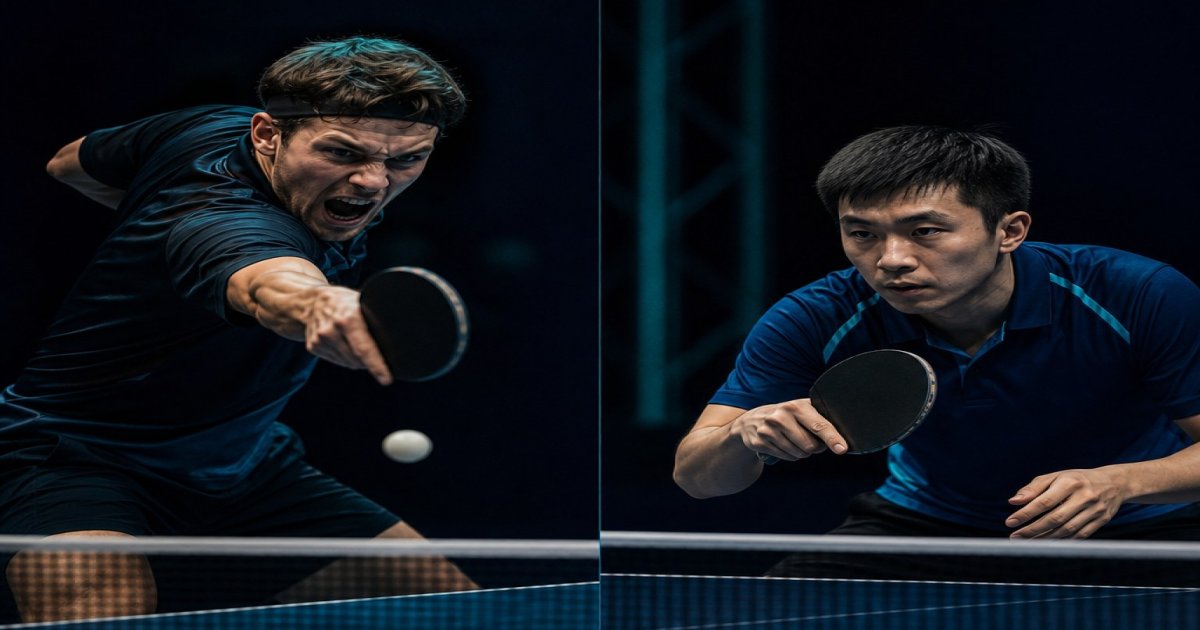
Two players in the same Arima club, both nationally ranked, both trained by the same coach for over a decade, developed such completely opposite games that newer members sometimes assumed they’d learned the sport in different countries. Offensive vs defensive style runs that deep.
One attacked every ball within reach. The other seemed to attack nothing at all, and somehow kept winning anyway. Neither approach was ever wrong. They were simply answering the same question with different, equally valid answers.
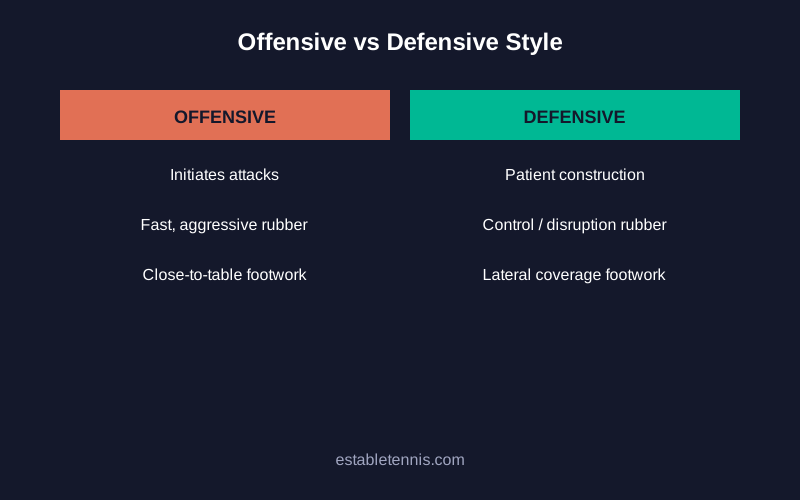
Offensive style prioritizes initiating attacks through loops and aggressive placement, aiming to finish points quickly.
Defensive style prioritizes patient point construction, absorbing pace, and forcing opponent errors through consistency and placement rather than raw power. Neither style is objectively superior; the right choice depends on natural temperament and physical strengths.
This choice shapes nearly every other decision a developing player makes, from equipment to practice priorities, and yet it’s rarely discussed as deliberately as it deserves.
What actually determines whether a player leans offensive or defensive?
Natural temperament matters more than most players expect: a player who feels comfortable initiating risk and committing to aggressive shots tends toward offensive play, while a player who finds satisfaction in patience, placement, and forcing errors tends toward defensive play.
Physical attributes like reach, speed, and reaction time also play a role, but temperament is often the stronger predictor of which style a player eventually settles into.
How does equipment differ between offensive and defensive setups?
Offensive players typically favor faster, more aggressive rubber and blades, covered in our guides on choosing rubber and carbon blades, that reward committed, powerful strokes.
Defensive players often favor more control-oriented rubber, sometimes incorporating pimples-out or long pips, covered in our guide on long pips table tennis, which supports disruption and placement over raw power.
Does footwork differ meaningfully between the two styles?
Yes. Offensive players often position closer to the table, using explosive, forward-committed footwork to close distance and attack quickly.
Defensive players frequently play further back, using lateral coverage and controlled recovery footwork, covered in our guide on how to improve table tennis footwork, since their game depends more on retrieving and redirecting shots than initiating aggressive attacks.
How does serve strategy differ between offensive and defensive players?
Offensive players often use serves designed to set up an immediate aggressive follow-up, covered in our guide on how to serve in table tennis, prioritizing serves that create attacking opportunities on the very next shot.
Defensive players often favor serves that deny easy attacking angles to their opponent, prioritizing control and placement over setting up their own immediate attack.
Can a player genuinely switch styles partway through their development?
Yes, though it requires deliberate, patient retraining rather than a quick adjustment.
A player who’s built years of habits around one style will find the transition genuinely uncomfortable at first, since the underlying footwork, shot selection, and even equipment all need to shift in coordination rather than piecemeal.
Most players who do switch styles do so gradually, over months, rather than all at once.
Is one style easier to learn as a genuine beginner?
Offensive fundamentals are often taught first, covered across our technique guides, since the basic mechanics of a forehand and backhand naturally lean toward attacking shot patterns.
Defensive specialization, particularly involving pimples or long pips rubber, tends to develop later, once a player already has some foundational understanding of spin and shot construction to actually disrupt.
How does mental composure differ between the two styles under pressure?
Offensive players often need to manage the psychological weight of committing to risk repeatedly, since an aggressive style inherently accepts more unforced errors in exchange for more winners.
Defensive players often need to manage the patience and discipline to avoid forcing a premature attack out of frustration, since their game depends on waiting for the right opportunity rather than manufacturing one prematurely.
Does one style have a competitive advantage over the other at higher levels?
Neither dominates definitively: both offensive and defensive specialists succeed at the highest competitive levels, though offensive, loop-based play has become more prevalent overall as the modern game has evolved.
A well-executed defensive game remains a genuine, formidable threat against even elite offensive players, precisely because it’s become rarer and less familiar as fewer players commit to mastering it.
How does spin generation priority differ between offensive and defensive players?
Offensive players prioritize generating their own heavy topspin, covered in our guide on how to generate more topspin, treating spin as their primary offensive weapon.
Defensive players often prioritize neutralizing or disrupting an opponent’s spin rather than generating their own, using equipment and technique specifically built around that disruptive function instead.
What’s a common misconception about defensive players and their actual skill level?
That defensive play represents a lesser or easier path compared to “real” attacking table tennis, when in reality defensive mastery demands exceptional touch, precise racket control, and the tactical patience to construct points over many shots rather than finish them quickly.
Skilled defensive players are frequently underestimated by attacking opponents who dismiss the style as passive, right up until they lose to it.
How does a coach typically identify which style suits a developing player?
By observing natural tendencies over months of play rather than deciding early based on a single session: a player who consistently prefers extending rallies, absorbing pace, and finding satisfaction in forcing errors shows early signals toward defensive play, while a player who instinctively commits to aggressive, risk-taking shots shows signals toward offensive play.
This diagnostic process takes patience and genuinely benefits from letting a player’s own instincts reveal themselves rather than forcing a style prematurely.
Does physical build or body type meaningfully predict which style suits a player better?
Some correlation exists but it’s far from deterministic: taller players with longer reach sometimes gravitate toward defensive coverage advantages, while quicker, more compact players sometimes favor the explosive movement offensive play rewards.
These are loose tendencies rather than hard rules, and plenty of successful players across both styles don’t fit the stereotypical physical profile associated with their chosen approach.
How do offensive and defensive players typically train differently?
Offensive players often emphasize multiball drilling focused on loop consistency and power development, covered in our guide on multiball training.
Defensive players often emphasize footwork endurance, placement precision, and extended rally consistency drills, since their game depends more on sustained tactical patience than on any single explosive shot.
What happens when an offensive player faces a skilled defensive player for the first time?
Often genuine frustration, since an offensive player’s usual sources of confidence (clean, decisive winners) become considerably harder to produce against an opponent who specifically absorbs and redirects pace rather than engaging in the kind of exchange the offensive player is comfortable with.
This frustration can compound mentally across a match, turning a competitive contest lopsided through accumulated tilt rather than a genuine skill gap.
How does the modern competitive game’s evolution affect the offensive-defensive balance?
Offensive, loop-based play has grown increasingly dominant at the highest levels over recent decades, as equipment technology and training methods have made aggressive topspin generation more accessible and more powerful than in earlier eras of the sport.
This shift means pure defensive specialists are rarer at elite levels than they once were, though the style remains fully viable and, in some ways, more disruptive precisely because fewer modern attacking players have regular exposure to it.
Do doubles formats favor one style over the other?
Offensive play often translates more naturally into doubles, where the compressed pace and alternating shot requirement reward quick, decisive attacking shots over extended defensive rallies that are harder to sustain when partners must alternate contact.
This doesn’t make defensive doubles play impossible, but it does mean defensive specialists sometimes need to adapt their approach more significantly when transitioning from singles to doubles competition.
How does a hybrid or all-round style fit into this offensive-defensive framework?
Many players, particularly at intermediate levels, develop a genuinely hybrid approach: comfortable initiating attacks when a clear opportunity arises, but equally comfortable settling into patient, defensive rallies when the situation calls for it.
This all-round style isn’t a failure to commit to one extreme; it’s a legitimate third category that some players find suits their temperament better than either pure offensive or pure defensive specialization.
What’s the relationship between style choice and long-term player development?
Style choice tends to solidify gradually over a player’s first one to two years of serious development, rather than being fixed from the very first session.
Early exposure to a wide variety of shot types and tactical approaches, before committing heavily to one style, generally produces a more complete, adaptable player than premature specialization, even if that player eventually does settle firmly into one dominant style.
How does a player’s chosen style affect their approach to equipment maintenance and care?
Defensive players relying on pimples or long pips rubber often need more careful equipment maintenance, covered in our guides on protecting table tennis rubber and how long table tennis rubber lasts, since these specialized rubber types tend to be more delicate and their disruptive effect depends heavily on maintaining precise surface condition.
Offensive players’ faster, higher-grip rubber also requires diligent care, but the specific maintenance priorities and failure modes differ somewhat between the two equipment categories.
Does mental training differ between offensive and defensive specialists?
The underlying principles of composure and focus apply to both styles, but the specific psychological challenges differ: offensive players often need to manage the anxiety of repeated risk-taking and the frustration of missed aggressive attempts, while defensive players often need to manage the discipline required to avoid impatience, resisting the urge to force a premature attack out of frustration with a prolonged, patient rally.
How should a parent or coach introduce style considerations to a young, developing player?
Gradually and without forcing a premature decision, letting a young player experience a broad range of shot types and tactical situations before any specialization begins.
Pushing a young player toward a specific style too early, based on a coach’s personal preference rather than the player’s own emerging tendencies, often produces a less naturally comfortable, less ultimately successful long-term fit than patient observation would have revealed.
According to the ITTF equipment regulations, both offensive and defensive equipment configurations, including specialized pimples and long pips rubber, are equally legal under the same approval standards, meaning the sport’s own rules have never favored one style over the other despite how differently the two approaches look on the table.
The two players in Arima never once compared notes on which approach was more correct, because by the time either of them had reached a nationally competitive level, the question itself had stopped making any sense to ask.
Their coach had simply let each of them become who they already were, one patient season at a time.
Forcing a style onto a player who hasn’t yet revealed their own natural tendencies is one of the more common, more avoidable mistakes in youth coaching: an eager coach with a personal preference for aggressive play can quietly push a naturally patient, defensive-minded kid into a mismatched game that never quite fits, simply because nobody paused long enough to watch what actually came naturally first.
Patience in diagnosis pays off considerably more than urgency ever does here.
A season or two of broad exposure costs nothing and reveals everything a coach actually needs to know before any serious specialization decision gets made.
Style, in the end, is less a choice a player makes and more a truth about themselves that patient practice eventually reveals. Rush that revelation, and you risk building an entire game on top of a mismatch that takes years to unwind later.
Let it emerge naturally, and the resulting style tends to feel less like a decision and more like simply how that particular player was always going to play.
Watch what a player does when nobody’s coaching the choice out of them, and you’ll usually already know which style is theirs.
Trust that instinct over any coach’s personal preference, including your own if you’re the one doing the coaching.
Ten years of shared coaching produced two completely opposite champions, side by side, and not one lesson between them was wasted on either player.
That’s the whole argument for patience over urgency, laid out in one club’s two rating certificates.
Simple as that.
Neither style wins the argument. Both keep winning matches, which is the only scoreboard that ever actually mattered.
Find your own, whichever side of the table it puts you on, and stop apologizing for it.
End of story.
Both approaches deserve the same respect, from coaches and opponents alike, once the results are sitting right there on the scoreboard.
Give both a fair look before deciding which one is actually yours.
Worth the season it takes to find out.
Definitely worth it.
Every single time.
No exceptions to this one.
Now go find out for yourself which side of the table actually feels like home.
Simple as that, truly.
Go find out today.
Really, go find out today.
Both are waiting.
Pick one.
Quick Recap: Offensive vs Defensive Style in Table Tennis
Offensive and defensive styles answer the same fundamental question about how to win points through completely different, equally legitimate means: one through initiated risk, the other through patient construction and disruption.
Those two players in Arima, trained by the same coach for over a decade, never once needed to resolve which approach was correct. Both kept winning, precisely because neither one was wrong.
Frequently Asked Questions
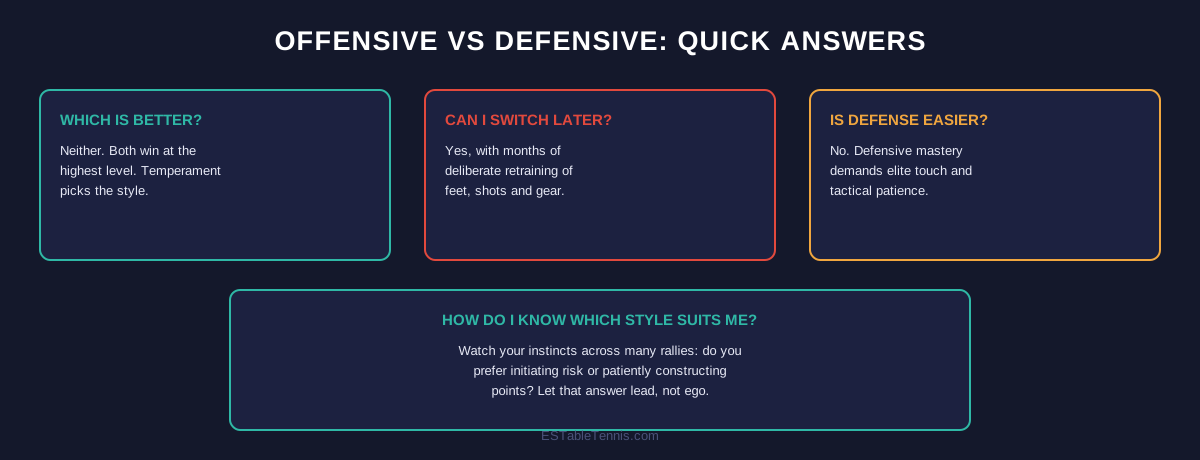
Is offensive or defensive style better in table tennis?
Can a player switch from offensive to defensive style later in their development?
Does equipment differ between offensive and defensive setups?
Is defensive play actually easier than offensive play?
How do I know which style suits me better?
Newer members at that club eventually stopped trying to figure out which of the two was actually better.
They just picked whichever one felt more like themselves, and got considerably better, considerably faster, once they stopped fighting their own natural instincts.
Not sure whether your natural game leans offensive or defensive? PingPath gives you a fitted equipment and style recommendation in under three minutes.
Leave a Reply