A father in Diego Martin bought his son a carbon-fiber blade for his ninth birthday because the salesman said it was what the professionals used. Two months later the boy quit the sport, quietly, without much drama, telling his father he just wasn’t very good at it. Nobody at the counter asked the one question that mattered: is carbon blade good for beginners? For a nine-year-old still learning contact, the answer was no. He was, in fact, quite good: he just couldn’t keep a single rally under three shots alive, because a blade built for players who never miss had turned his every mistimed swing into a ball off the far wall.
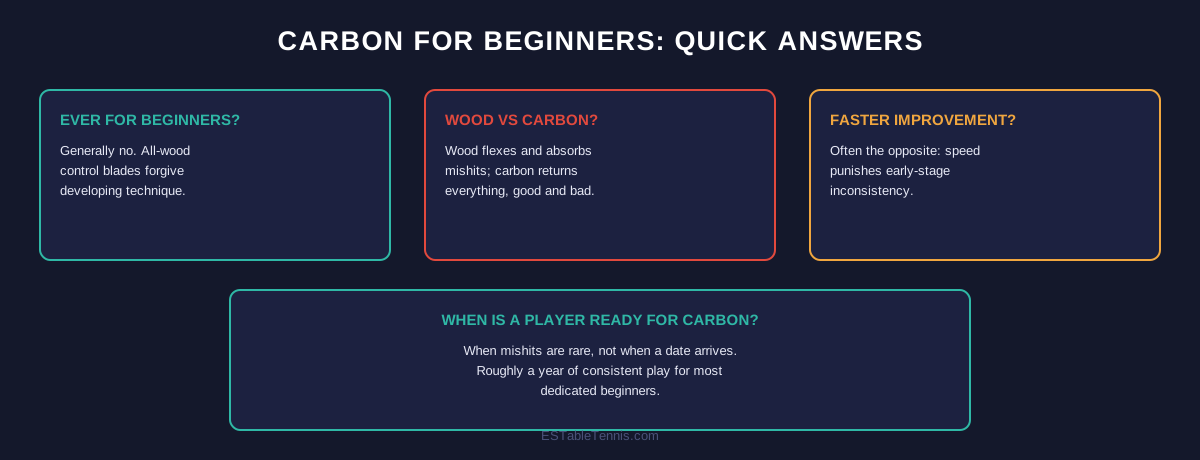
No, not usually. Carbon-fiber blades add stiffness and speed that amplify small technical errors before a beginner has developed the timing to control them. A pure wooden blade with moderate speed gives more forgiveness and feedback while fundamentals are still being built.
Carbon blades are marketed as an upgrade, and in the hands of the right player they are exactly that. In the hands of a beginner, they’re usually a shortcut to frustration wearing the disguise of progress.
Think of stiffness as a volume knob for whatever’s already true about your swing. Turn it up before the swing itself is reliable, and you’re not amplifying skill, you’re amplifying noise, and noise, turned up loud enough for long enough, is exactly what convinces a talented kid he isn’t any good.
What does carbon fiber actually do to a blade?
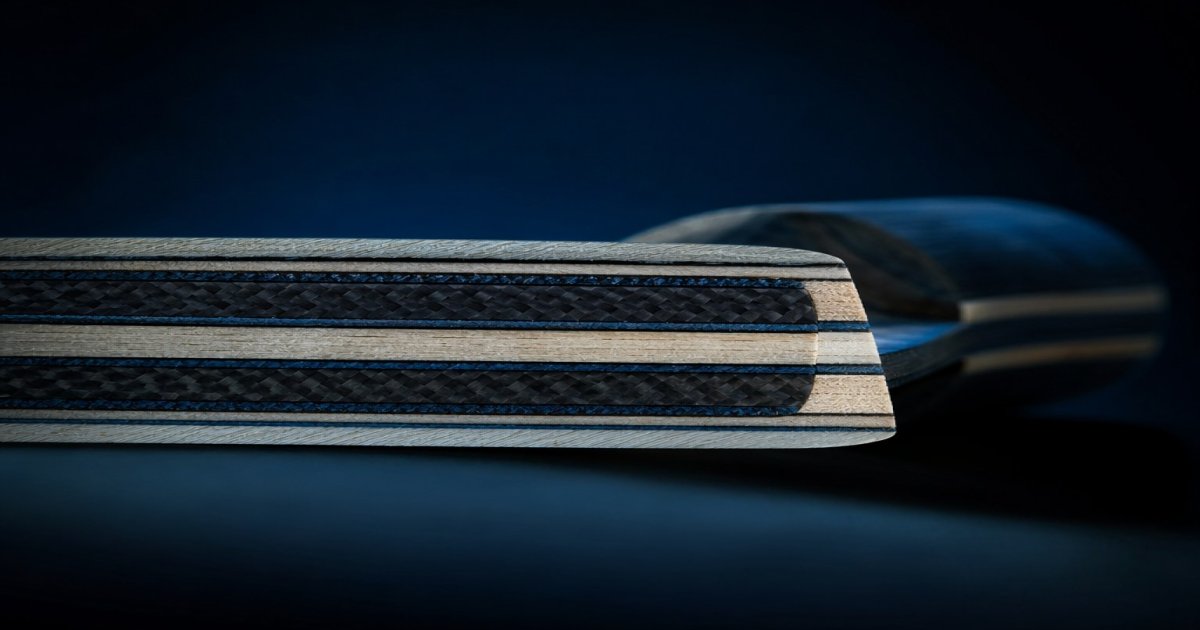
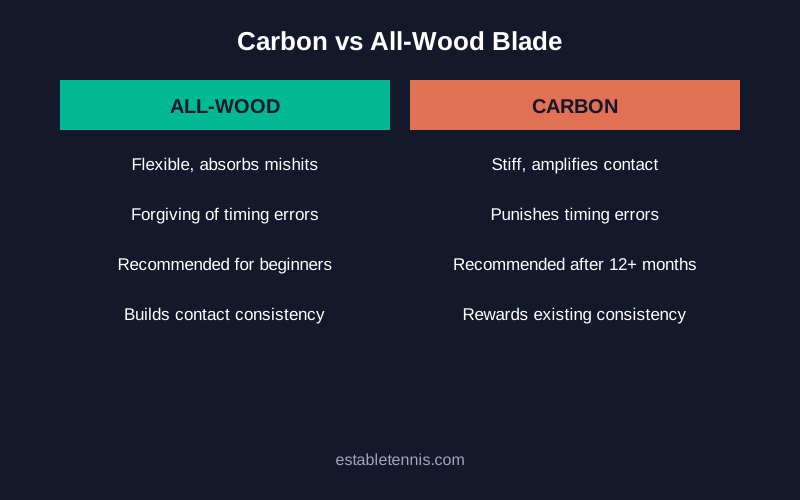
Carbon-fiber layers are woven into the blade’s wood construction to increase stiffness and reduce the amount of energy absorbed on contact. A stiffer blade returns more of your swing energy directly into the ball, producing more speed and a firmer, more “solid” feel on contact.
It also shrinks the sweet spot’s forgiveness: mishits and off-center contacts, which a flexible all-wood blade would partially absorb, get transmitted almost fully into an erratic ball flight on a carbon blade.
Every store shelf in the country sells this speed for a price, and almost none of them sell the twelve months of consistent contact a player actually needs before that speed becomes an asset rather than a liability.
Why does that extra speed hurt beginners specifically?
Because the skill a beginner is actually building isn’t power: it’s timing and contact consistency. A carbon blade takes every small timing error and magnifies it into a bigger placement error.
The same mistimed swing that would land safely on the table off a control-oriented all-wood blade sails long or wide off a carbon blade, and the player experiences that as a technique failure rather than an equipment mismatch, which is precisely the mental trap covered in our piece on premade vs custom rackets.
An all-wood blade doesn’t ask a beginner to already be good. It just asks them to keep showing up, which, it turns out, is the entire game at that stage anyway.
What blade construction should beginners actually use?
An all-wood blade, typically five to seven plies, rated “control” or “all-round” rather than “offensive” or “speed.” All-wood blades flex slightly on contact, absorbing a portion of mishit energy and giving a longer, more forgiving feel that rewards a developing, consistent stroke over raw power.
This is the same logic that applies to rubber choice. See our guide on choosing rubber for beginners for the matching principle on the sponge side of the equation.
Every one of them started exactly where you’re starting, mishitting balls off a blade that was, at the time, entirely appropriate for where they actually were.
Do professional players actually use carbon blades?
Many do, particularly at the highest levels of offensive, looping-style play, where the extra speed and stiffness reward a player who has already mastered contact consistency and needs the equipment to keep pace with their technique rather than compensate for its absence.
But “what professionals use” is a poor guide for equipment selection at any skill level below advanced: professional gear is built to amplify a strength that beginners haven’t developed yet.
A store shelf rarely explains this distinction clearly, since a full offensive carbon blade and a gentle all-round-plus model often sit side by side with equally impressive-sounding names attached to entirely different levels of forgiveness.
Are all carbon blades equally aggressive?
No. Carbon content and placement vary significantly between models: some blades use a thin carbon layer purely to add stability without dramatically increasing speed, functioning closer to a fast all-wood blade than a true offensive carbon build.
If a player is set on trying a carbon blade earlier than typically recommended, a low-carbon-content “all-round plus” model is a far gentler entry point than a full offensive carbon blade built for looping specialists.
When does it make sense to move to a carbon blade?
Once contact timing is consistent enough that mishits are the exception rather than a regular occurrence, and the player’s technique is generating power the current all-wood blade can no longer keep up with. That’s usually a matter of a year or more of regular play for a dedicated beginner, not a matter of what looks impressive on a store shelf during the first month.
What’s the actual cost of moving to carbon too early?
Beyond the immediate frustration of inconsistent shots, the deeper cost is developing compensating habits: a shortened, tentative swing built to avoid overhitting a blade that punishes commitment. Those compensations get baked in as muscle memory and are considerably harder to unlearn later than they would have been to simply avoid in the first place by starting on the right equipment.
How do you know if your current blade is holding you back or if it’s genuinely a technique issue?
The honest test: if your mishits and inconsistent shots feel wildly unpredictable (sometimes landing safely, sometimes flying well past the table on what felt like an identical swing), that unpredictability is often the equipment amplifying small variances rather than your technique itself being erratic. A more forgiving blade should make your actual skill level visible, not hide it behind noise.
What’s the actual construction difference between a carbon blade and an all-wood blade?
An all-wood blade is built entirely from layered wood plies, typically five to seven, glued and pressed to create a specific flex and weight profile. A carbon blade replaces one or more of the inner wood layers with a carbon-fiber composite layer, which is dramatically stiffer than wood and barely compresses under impact.
The outer hitting surfaces are almost always still wood in both constructions: the carbon sits in the core, changing how the whole blade flexes and returns energy rather than changing what the ball actually contacts.
Does carbon placement in the blade matter?
Yes, significantly. Carbon layered close to the core, sandwiched deep within the wood plies, produces a more moderate stiffness increase than carbon placed closer to the outer hitting surface, which transmits stiffness far more directly into every shot. Some “hybrid” blades use a small amount of carbon specifically to add stability without a dramatic speed increase, which is a meaningfully gentler introduction to carbon technology than a full offensive carbon blade built for looping specialists at the top level of the sport.
How does blade weight interact with the carbon-beginner question?
Carbon blades tend to run lighter for their stiffness than a comparable all-wood blade, which can initially feel like an advantage: faster racket-head speed for the same swing effort. But that lighter, stiffer combination is exactly what removes the natural braking effect a heavier, more flexible all-wood blade provides on a mistimed swing.
A beginner’s inconsistent swing speed benefits from a blade that absorbs and dampens minor timing errors, not one that efficiently transmits every ounce of inconsistency straight into the ball’s flight path.
What does “forgiveness” actually mean in blade selection?
Forgiveness describes how much a blade compensates for imperfect technique: off-center contact, slightly mistimed swings, inconsistent racket angle. A forgiving blade absorbs some of that imperfection into its own flex, producing a shot that lands closer to where the player intended even when the technique wasn’t perfect.
An unforgiving blade transmits the imperfection directly, producing a wider spread of outcomes from what feels like a similar swing. Beginners, whose technique is inherently inconsistent by definition of still learning, benefit enormously from maximizing forgiveness while that inconsistency gets ironed out through practice.
How does the choice interact with rubber selection?
Blade and rubber compound each other’s speed characteristics rather than operating independently: a control-rated all-wood blade paired with a fast, hard rubber can end up playing faster overall than expected, and a carbon blade paired with soft, control-oriented rubber can end up more forgiving than a carbon blade alone would suggest.
For a true beginner, the safest approach pairs a control all-wood blade with a control-to-medium rubber (see our guide on choosing rubber for beginners), so neither half of the setup is independently pushing toward speed and stiffness at the same time.
What’s the psychological cost specifically tied to carbon’s unforgiving nature?
Beyond the technical mismatch, there’s a distinct mental pattern that carbon blades tend to accelerate in beginners: a growing hesitation on full-effort swings, born from repeated experience watching committed strokes fly off the end of the table.
That hesitation becomes its own bad habit: a shortened, tentative swing that persists even after a player eventually moves to more appropriate equipment, because the nervous system learned caution as a survival response to a blade that punished commitment. Unlearning a defensive, hesitant swing pattern takes considerably longer than simply starting with equipment that never demanded it in the first place.
How should an intermediate player evaluate whether they’re actually ready for carbon?
Beyond raw contact consistency, look specifically at whether your current all-wood blade’s speed ceiling is limiting shots where your technique is already sound, not occasional shots, but a consistent pattern across a full session. If your loops and drives regularly feel like they’re being absorbed or slowed by the blade rather than amplified by it, and your mishits remain rare even under match pressure, that’s a genuine signal the current equipment has become the limiting factor rather than your own consistency.
Do coaches generally agree on delaying carbon blades for beginners?
Overwhelmingly, yes, and it’s one of the more consistent pieces of advice across different coaching philosophies otherwise divided on plenty of other technique questions.
The reasoning converges from multiple directions: sports science perspectives on skill acquisition emphasize consistent, controllable feedback loops during early learning, while purely practical club-level coaching experience simply shows, repeatedly, that beginners on forgiving equipment progress faster and stay engaged with the sport longer than beginners fighting equipment built for a skill level they haven’t reached yet.
What’s a reasonable timeline for a dedicated beginner to consider their first carbon blade?
Most players training two to three times weekly see genuine readiness signals (consistent contact, developing spin generation, a swing that’s stopped shrinking defensively) somewhere between twelve and eighteen months in.
Players training more intensively, four or more sessions a week with structured coaching, sometimes reach that point closer to eight to ten months. There’s no universal number, and chasing a specific timeline rather than watching for the actual feedback signals defeats the purpose of waiting in the first place.
Are there carbon blades specifically marketed toward intermediate transition, rather than full offensive play?
Yes, and this category is worth knowing about once you’re genuinely approaching the upgrade window. “ALC” (arylate carbon) and similarly softer carbon-composite blades occupy a middle ground between pure all-wood control blades and aggressive full-carbon offensive blades, offering a noticeable but more moderate stiffness increase.
These transition-oriented blades are a sensible next step for a player who has outgrown their beginner all-wood blade but isn’t yet ready for the most extreme offensive carbon options built for advanced looping specialists.
What happens if a beginner insists on a carbon blade despite the advice against it?
The outcome isn’t catastrophic: plenty of players do learn on carbon blades and eventually adjust, particularly younger players with more physical adaptability and fewer ingrained habits to unlearn. But the typical path involves a longer, more frustrating early period, more compensating technical habits that need correcting later, and a higher rate of players getting discouraged and quitting before they reach the consistency the equipment demands.
It’s not a guaranteed failure; it’s a harder, less efficient path to the same destination most beginners could reach faster on more forgiving gear.
What that store salesman was really selling wasn’t a blade at all: it was a piece of borrowed identity, a way for a nine-year-old to feel connected to players he’d only ever watched on a screen. That impulse isn’t wrong or silly; it’s simply misapplied at the equipment level.
The connection to the sport a young player is actually chasing gets built through consistent contact, small wins, and rallies that don’t die after two shots, not through owning the same blade material as someone who trained for two decades to make it work.
None of that patience makes for an exciting birthday present. It makes for a nine-year-old who’s still playing at nineteen, which is the only outcome that actually mattered in that story to begin with.
Patience wins, every time, over any material a blade could ever be made from.
Somewhere in a drawer in Diego Martin, that unused blade is still waiting for a swing consistent enough to actually deserve it.
Quick Recap: Is Carbon Blade Good For Beginners
Whether a carbon blade is good for beginners right comes down to matching the equipment to where you actually are, not where marketing copy wants you to be. Revisit this whenever your game changes enough that the current setup starts feeling wrong.
Frequently Asked Questions
According to the ITTF equipment regulations, all racket coverings must meet specific approval standards before use in sanctioned competition.
Should a complete beginner ever use a carbon blade?
What’s the difference between all-wood and carbon blades?
Do carbon blades make you a better player faster?
Is it worth buying a cheap carbon blade to try it out?
How long should a beginner wait before considering a carbon blade?
The boy in Diego Martin never went back to the sport. His father, years later, still keeps the carbon blade in a drawer, a nine-year-old’s abandoned birthday present that never got the chance to be the wrong tool for a much better beginner racket sitting one aisle over in the same store.
Not sure whether your current blade is helping or fighting your game? PingPath matches your playing style to the right blade and rubber setup in under three minutes.
Leave a Reply