Choosing table tennis rubber for beginners the right way avoids months of misdiagnosed technique problems.
Marcus stood in the equipment aisle of a sporting goods store in San Fernando for eleven minutes, holding two identical-looking black rubber sheets, before he did the thing every beginner eventually does. He put both back and bought whatever was cheapest.
That decision cost him four months. Not because the cheap rubber was bad (it wasn’t, particularly), but because it was wrong for how he actually played, and he spent those four months blaming his forehand for a problem that lived entirely in the sponge.
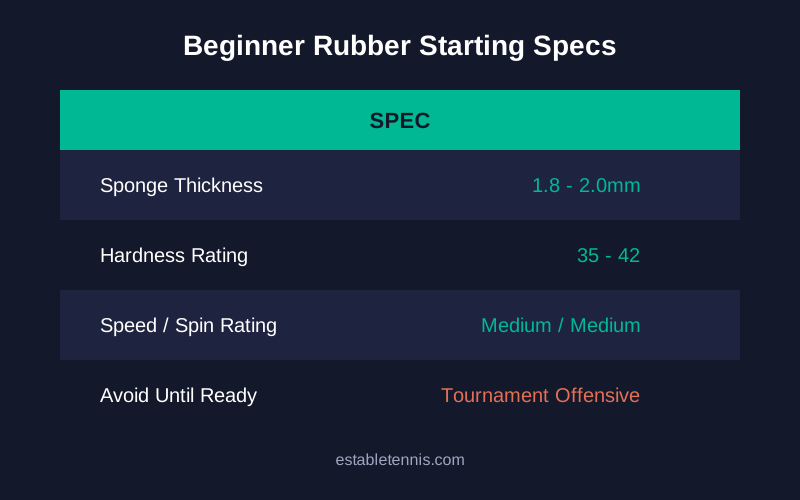
Choose a medium-speed, medium-spin inverted rubber with a sponge thickness around 1.8–2.0mm. This gives you enough grip to learn spin without so much speed that the ball flies off the blade before you’ve built control. Avoid the fastest tournament-grade sheets until your strokes are consistent.
Rubber selection feels like a technical decision. It is actually a psychological one wearing a technical disguise. The wrong rubber doesn’t just play badly: it trains you to distrust your own shots, and that distrust follows you into matches long after the rubber itself has been replaced.
This confusion is compounded by the sheer volume of rubber marketed at every level simultaneously, in the same store aisle, with speed and spin numbers printed prominently on every box and almost no context for what those numbers mean relative to your own game. A number on a box tells you nothing about whether that rubber will teach your hand good habits or bad ones. That only becomes clear once you understand what the number is actually describing.
What does table tennis rubber actually do?
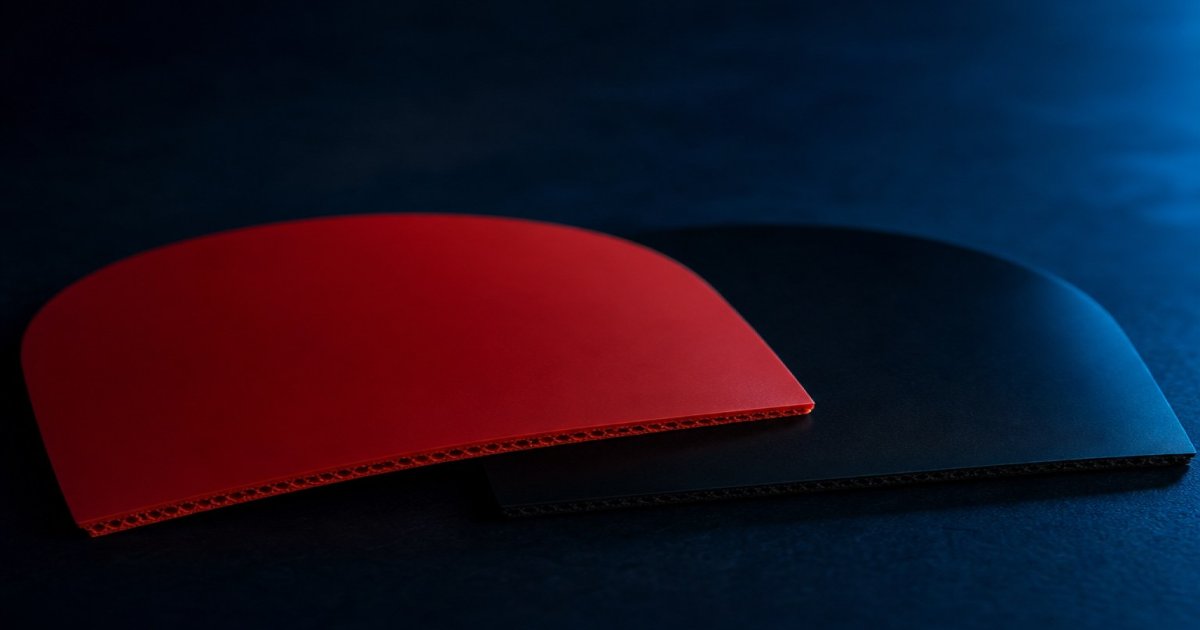
Table tennis rubber is the layer bonded to the blade that makes contact with the ball. It has two parts: the topsheet (the surface you see, usually with small pimples facing either out or in) and the sponge underneath, which compresses on contact and returns energy to the ball. Together they determine how much spin you can generate, how much speed the ball carries off your racket, and how forgiving small technical errors are.
What’s the difference between speed, spin, and control ratings?
Every rubber is rated on three loose scales: speed (how fast the ball leaves the racket), spin (how much rotation you can impart), and control (how forgiving the rubber is of imperfect technique). These three trade off against each other. High-speed rubbers reward committed, accelerating strokes and punish hesitation. High-control rubbers slow the ball down and give you more time to correct mid-stroke, at the cost of raw power. Beginners almost always benefit from prioritizing control over speed, because the skill you’re missing at this stage is timing, not power.
Why do beginners keep buying rubber that’s too fast?
Because fast rubber looks impressive in a store display and feels exciting for the first ten minutes on the table. It is marketed by the same logic that sells a first-time driver a car with too much horsepower: the capability exists, but the person behind it hasn’t developed the judgment to use it safely yet. A fast rubber amplifies every mistake. A slightly late swing becomes a ball into the net. A slightly early swing becomes a ball off the end. The beginner concludes their technique is bad, when the actual problem is that the equipment removed the margin for error that technique needs to develop in the first place.
What sponge thickness should a beginner use?
Sponge thickness typically ranges from 1.5mm to 2.2mm (or “max,” which varies by brand but usually lands around 2.1–2.3mm). Thicker sponge generates more speed and power from the same swing. For a beginner, 1.8mm to 2.0mm is the sweet spot: enough sponge to feel responsive, not so much that every shot threatens to sail long. Players who start on max-thickness sponge often develop a shortened, tentative swing to compensate for the extra power, which becomes a habit that’s difficult to unlearn once their technique catches up.
Should a beginner use the same rubber on both sides?
Not necessarily. Many beginner-friendly setups pair a grippier rubber on the forehand, where most players learn to attack first, with a more control-oriented or even a short-pips rubber on the backhand, where blocking and defensive shots are more common early on. The premade rackets marketed for beginners often already do this asymmetric pairing for you, which is one reason a premade setup is worth starting with. See our guide on premade vs custom table tennis rackets for the full reasoning on when to move away from a matched factory pair.
How does hardness affect rubber choice?
Sponge hardness (usually rated in degrees, roughly 30–50 for most consumer rubbers) determines how much the ball compresses into the sponge before rebounding. Softer sponge is more forgiving and easier to control at slower swing speeds: the ball sits on the rubber slightly longer, giving you more time to feel the contact and impart spin without needing significant arm speed. Harder sponge needs a faster, more committed stroke to compress properly, which rewards players with developed technique and punishes players still building it. Beginners should default to soft-to-medium hardness, in the 35–42 range, until their swing speed and consistency justify going firmer.
Store staff, well-meaning as they usually are, often default to whatever they personally play with or whatever the shop has the most stock of, neither of which has any bearing on your situation. Trust a specific, forgiving spec range over any single recommendation from a person who has never watched you swing a racket.
What rubber brands and models are actually good starting points?
Look for rubbers explicitly marketed as “control” or “all-round” rather than “offensive” or “tournament.” A rubber like DHS Hurricane 3 Neo is a reasonable entry point for a player leaning into spin-heavy play, offering tacky grip without extreme speed. For a flatter, more forgiving hit, something in the control-oriented range from Yasaka or Butterfly’s beginner lines will serve better than their flagship tournament sheets. The exact model matters less than staying out of the “tournament offensive” category until you’ve logged real hours.
How does playing style change what rubber you should pick?
An attacking player who wants to loop from both wings needs a rubber with enough inherent grip to make spin generation forgiving: something in the tacky, medium-speed range. A blocker or all-round counter-driver benefits more from a flatter, more control-oriented sheet that rewards precise placement over raw spin.
Most beginners don’t know which of these they are yet, and that’s fine: the point isn’t to lock in a permanent identity in your first month, it’s to avoid a rubber so extreme in either direction that it actively prevents you from finding out. A moderate, forgiving rubber lets your natural tendencies surface through play, rather than the equipment forcing a style onto you before you’ve had a chance to discover your own.
What role does the blade play alongside rubber choice?
Rubber and blade aren’t independent decisions: a fast blade paired with fast rubber compounds the speed problem beginners run into, while a control blade paired with fast rubber can partially offset an overly aggressive rubber choice, and vice versa.
If you’re building a setup rather than buying premade, treat the two together: a control or all-round blade with medium rubber is the standard forgiving beginner combination, and swapping either half toward speed should happen gradually, one variable at a time, so you can actually feel what changed. For more on when a from-scratch build makes sense versus staying with a factory pairing, see our guide on premade vs custom rackets.
How much should budget factor into a beginner rubber decision?
Less than most new players assume. Entry-level rubbers from reputable brands, priced well below their tournament-grade siblings, are specifically engineered around the control and forgiveness beginners need: spending more doesn’t buy a better beginner experience, it usually buys more speed and less forgiveness, which is the opposite of what’s useful at this stage.
The money is better spent later, once you actually know what your game needs, than upfront on a rubber whose main selling point is a speed rating you’re not ready to use.
What mistakes do beginners repeat most often when choosing rubber?
Beyond simply buying too fast a rubber, the two other recurring mistakes are chasing whatever a favorite professional player uses, and treating the first rubber purchase as a permanent decision rather than a starting point. Professional-grade rubber is tuned for players with years of committed swing mechanics behind them. Wearing that gear as a beginner is like borrowing a race car to learn to drive.
And the first rubber doesn’t need to be the right rubber forever; it needs to be forgiving enough to let your technique develop without the equipment actively working against you, with the expectation that you’ll reassess in a few months once you actually know more about your own game.
When should you upgrade from your beginner rubber?
The honest signal isn’t time: it’s feedback. If you’re consistently generating your own spin on loops rather than relying on the rubber’s inherent grip to do the work, and the current rubber’s ceiling feels like it’s limiting your placement rather than covering for your inconsistency, that’s the upgrade trigger.
For most players training two to three times a week, this lands somewhere between four and eight months in, not the two weeks a hyped-up store display might suggest.
How does the ITTF equipment approval list factor into a beginner purchase?
Every legal rubber for sanctioned competitive play appears on the ITTF’s approved equipment list, which certifies a rubber meets the sport’s regulations on thickness, composition, and performance limits.
For a beginner, this list matters less as a shopping filter (nearly every rubber sold by a reputable table tennis retailer is already ITTF-approved) and more as a reassurance that the sport’s governing rules aren’t secretly capping what you can achieve with a well-chosen entry-level sheet. The gap between a beginner rubber and a professional rubber is about fit to your current skill, not about one being handicapped by regulation while the other isn’t.
What does a realistic first month with new rubber actually look like?
Expect an adjustment period, even with a well-matched beginner rubber. The first few sessions often feel slightly worse than whatever you were playing on before, simply because your hand hasn’t yet calibrated to the new grip, bounce, and feedback. This is normal and temporary: give a new rubber at least two to three full sessions before judging whether it’s actually a good fit, rather than reverting to old gear at the first sign of unfamiliarity.
Players who swap equipment constantly in the first few months, chasing a feeling of instant comfort, often never give any single setup enough time to reveal whether it was actually working.
How do you know when your rubber choice was right, versus when it’s the technique that needs work?
The clearest signal is consistency of the failure. If a shot fails in the same specific way (always sailing long on the same stroke, always landing in the same spot on the net), that’s usually a technique pattern to correct through practice.
If a shot fails unpredictably, sometimes landing safely and sometimes flying wildly off what feels like an identical swing, that inconsistency is often the equipment amplifying small natural variance in your motion rather than the motion itself being fundamentally broken. Learning to tell these two apart is one of the more useful diagnostic skills a developing player can build, and it saves months of misdirected effort chasing a technique fix for what was actually a rubber mismatch.
Should beginners buy loose rubber and mount it themselves, or start with a premade racket?
Starting with a premade racket (blade and rubber already factory-assembled and matched) removes an entire layer of decisions a true beginner isn’t equipped to make well yet, and manufacturers who build these sets have already done the work of pairing sensible speed, spin, and control ratings for a new player.
Once you’ve logged real hours and developed a sense of what you’re missing, buying loose rubber and mounting it yourself (or having a shop do it) becomes worthwhile, because by then you actually have specific feedback to act on rather than a guess based on marketing copy. There’s no shame in staying on a premade setup for six months or longer: the racket isn’t the bottleneck at that stage; your hours on the table are.
The broader lesson buried in all of this: rubber selection is not a one-time technical decision to research exhaustively and then forget. It’s an ongoing conversation between your developing skill and the equipment underneath it, and the right answer at month one is rarely the right answer at month eight. Treat your first rubber as a reasonable, forgiving starting point rather than a permanent identity, and revisit the decision once you actually have enough hours on the table to know what you’re missing.
A dozen small, consistent hours on forgiving gear will teach you more about your own game than a single expensive purchase ever could.
Quick Recap: Table Tennis Rubber For Beginners
Getting table tennis rubber for beginners right comes down to matching the equipment to where you actually are, not where marketing copy wants you to be. Revisit this whenever your game changes enough that the current setup starts feeling wrong.
Frequently Asked Questions
According to the ITTF equipment regulations, all racket coverings must meet specific approval standards before use in sanctioned competition.
What’s the best table tennis rubber for a complete beginner?
Is thicker sponge always better?
How often should beginners replace their rubber?
Can beginners use the same rubber on forehand and backhand?
Does rubber color (red vs black) affect performance?
Marcus eventually swapped his cheap store-brand rubber for a control-oriented sheet with a sponge two-tenths of a millimeter thinner than what he’d been playing on. Nothing else changed: same blade, same technique, same four months of frustration behind him. Within three weeks, his forehand, the shot he’d spent a season convinced he’d never learn, started landing where he aimed it. The equipment had been quietly working against him the entire time, and he had never once suspected it.
Not sure which rubber actually fits your game instead of guessing in a store aisle? PingPath matches your playing style to a specific rubber recommendation in under three minutes.
Leave a Reply