
How do you serve in table tennis?
A serve is the only shot in table tennis a player controls completely, uncontested by an opponent’s return.
That total control is exactly why it rewards more deliberate practice, relative to its difficulty, than almost any other shot in the sport.
Toss the ball at least 16cm straight up from an open palm, then strike it so it bounces once on your side of the table before crossing the net and bouncing once on your opponent’s side.
Effective serves combine spin, placement, and disguise: the toss and swing should look similar regardless of what spin is actually being applied.
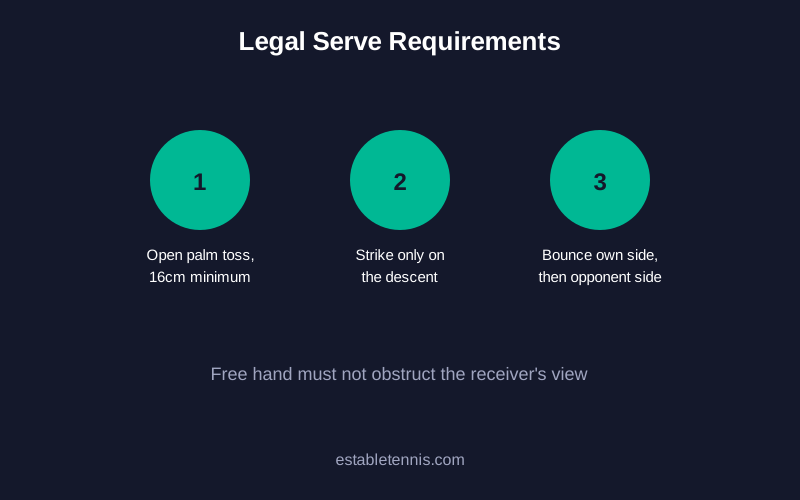
What are the legal requirements for a serve?
What’s the difference between a short and long serve?
A short serve bounces twice on the opponent’s side if left untouched, landing close to the net and denying the opponent a strong attacking angle. A long serve travels deep, close to the opponent’s baseline, and is typically used to set up an aggressive follow-up shot when paired with heavy spin. Beginners tend to overuse long serves since they’re easier to control, but short serves are often more tactically valuable at every level above complete beginner.How does spin actually get imparted on a serve?
The racket’s contact angle and the direction of the brushing motion across the ball determine spin type: a downward, brushing swing produces backspin, an upward brushing motion produces topspin, and a sideways brushing motion produces sidespin. Most effective serves combine two of these axes, such as backspin with sidespin, which is considerably harder for an opponent to read than a single, pure spin type. The mechanics of spin generation itself are covered in our companion guide on how to spin in table tennis.What makes a serve genuinely deceptive rather than just spinny?
Disguise, not raw spin, separates a good serve from a great one. A server who telegraphs exactly which spin is coming through an obvious, distinct swing motion for each serve type gives the opponent free information, regardless of how much spin is actually on the ball. The best servers make heavy topspin, heavy backspin, and no-spin “knuckle” serves all look nearly identical in the backswing, with the actual differentiation happening only in the final fraction of a second of racket-to-ball contact.How important is serve placement compared to spin?
Placement is arguably underrated relative to how much attention spin generation gets in most coaching conversations. A serve to the opponent’s playing elbow (the awkward zone where it’s unclear whether to use forehand or backhand) can be more effective than a heavily spun serve to an obvious, comfortable location. Combining spin, placement, and disguise together is what separates a serve that wins free points from one that merely starts a rally evenly.What’s a good first serve variation for a beginner to learn?
A short backspin serve to the middle of the table, low over the net, is a strong foundational serve: it denies an easy attacking angle, forces the receiver to lift the ball (risking a weak return), and doesn’t require advanced disguise to be effective at a beginner level. Mastering this one serve thoroughly, rather than trying to learn five different serves poorly, builds the underlying racket control that every other serve variation eventually builds on.How should a player practice serves effectively?
Dedicated serve practice, separate from full rally practice, is where most competitive improvement in this specific skill actually happens: serving repeatedly into a target zone, without a returning opponent, lets a player isolate and refine spin generation, placement, and disguise without the pressure of an ongoing point. Many players badly under-invest in this kind of isolated serve practice compared to how much of a match’s outcome the serve actually decides.Does serve strategy change between casual and competitive play?
Significantly. Casual players often serve to start the rally with minimal strategic intent, while competitive players treat every serve as a deliberate tactical decision, often varying spin and placement specifically based on what’s worked or failed against a particular opponent earlier in the same match. Serve strategy at a competitive level is closer to a chess opening than a formality: setting up an advantage several shots ahead rather than simply beginning the point.What’s the mental discipline required to serve well under pressure?
A server has total control over the shot, which paradoxically makes it one of the more mentally fragile moments in a close match: there’s no opponent to blame for a poor toss or a mistimed swing, and the total responsibility can create genuine performance anxiety at key moments. Players who practice serves under simulated pressure, not just in relaxed repetition, build the composure to execute their best serve at 10-10 in a deciding game, not just in an empty practice hall.How does equipment affect serve quality?
Rubber grip plays an outsized role in serve spin generation specifically, since serves rely heavily on brushing contact to impart rotation: a rubber with poor grip limits how much spin a server can generate regardless of technique, which is one of the reasons beginner-appropriate rubber, covered in our guide on choosing rubber for beginners, still needs enough tack to let a developing player feel real spin feedback on their serves.What’s the difference between a forehand and backhand serve?
Forehand serves, struck from the dominant side of the body, generally allow more natural power and a wider range of spin variations, and are the more common serve style at every level of the sport. Backhand serves, struck across the body from the non-dominant side, offer a different, sometimes more disguised toss angle and are a favored variation among players looking to add unpredictability to their serve rotation, though they typically take longer to develop comparable spin and control.How do you read and adjust to an opponent’s serve return patterns?
Effective competitive servers pay close attention to how an opponent handles each specific serve variation across a match, adjusting their serve selection based on what’s produced weak returns versus strong ones. A server who notices an opponent consistently struggling against short backspin to the forehand side will naturally lean into that serve more heavily as the match progresses, treating serve selection as a live, adaptive tactical decision rather than a fixed pre-match plan.What’s a common technical flaw in beginner serves?
Rushing the toss and swing together into one hurried motion, rather than treating the toss as a distinct, controlled action followed by a deliberate strike. This rushed pattern produces inconsistent height and placement on the toss itself, which cascades into inconsistent contact and spin on the actual serve. Slowing down the toss specifically, even exaggerating its height and control during practice, often fixes serve consistency problems that feel like they’re located in the swing but are actually rooted in the toss.How many serve variations does a competitive player actually need?
Fewer than most players assume. Three to four well-disguised, well-controlled serve variations, executed with genuine mastery, consistently outperform eight or nine mediocre variations that all look slightly different but none of which the server can execute reliably under pressure. Depth of mastery on a small serve repertoire beats breadth of mediocre variety, especially at the intermediate level where consistency still matters more than novelty.How does the receiver’s positioning affect what serve to choose?
A receiver standing deep, further back from the table, is generally more vulnerable to short serves that land close to the net, since covering that distance quickly enough to attack the ball is physically difficult. A receiver crowding the table is often more vulnerable to long, fast serves that rush their reaction time before they can properly set up. Reading an opponent’s default receiving position before the first serve of a match gives a server useful information to exploit from the very first point.What’s the role of the free hand and arm during a serve?
Beyond the legal requirement that it not obstruct the receiver’s view, the free hand and arm play a real role in balance and rhythm during the toss and strike. Many players develop a consistent, almost ritualistic free-hand motion that helps time the toss and swing together reliably, not unlike a basketball player’s consistent pre-shot routine at the free-throw line, where the ritual itself supports consistency rather than being purely decorative.How do serve rules differ between casual and officiated matches?
Casual games often overlook subtle serve infractions (insufficient toss height, obstruction from the free arm) that an umpire in officiated competition would flag immediately. A player who only ever plays casually and never has their serve checked against strict standards can develop habits that suddenly become illegal, and costly, the first time they enter sanctioned competition. Learning the strict version of serve rules early avoids this unpleasant surprise.Why do some players struggle to add spin variation even after years of playing?
Often because their fundamental toss and contact timing were never built with variation in mind: a player who’s only ever practiced one serve motion for years has ingrained a single, narrow pattern that resists the small technical adjustments new spin variations require. This is why coaches often recommend introducing at least basic serve variation early in a player’s development, even if execution is initially inconsistent, rather than waiting until one serve motion is deeply ingrained and then trying to diversify from that rigid starting point.Does serve return practice matter as much as serve practice itself?
Genuinely, yes, and it’s the natural complement covered in our companion guide on how to return serve. A player who has mastered disguised, spin-varied serves but never practiced reading and returning similar serves from an opponent has only built half of the serve-and-return equation that decides so many points in this sport.How does confidence in a specific serve affect its actual execution?
Considerably more than most players realize. A serve a player genuinely trusts, built through repeated successful practice, gets executed with full commitment and natural rhythm. A serve a player is uncertain about (whether from insufficient practice or a bad recent experience with an opponent reading it easily) tends to get executed tentatively, which paradoxically makes it easier to read and return, since hesitation itself often telegraphs the coming spin more clearly than a confident, committed swing would. According to ITTF equipment regulations, serve rules including toss height and obstruction were tightened specifically over the decades to reduce hidden, unreadable serves, a direct response to the sport’s own history of servers exploiting ambiguous rules to hide contact entirely. None of this history is trivia for its own sake. Every rule governing the modern serve exists because some server, somewhere, found an edge the rulebook hadn’t yet closed, and the current version of the serve you’re learning to master today is the result of a century of exactly that back-and-forth between innovation and regulation. A serve you’ve drilled a thousand times in an empty hall behaves completely differently the first time real match pressure arrives, which is exactly why the players who separate themselves aren’t the ones with the most exotic serve, but the ones who’ve actually tested their best serve under something resembling real stakes before it ever mattered. Most club players never get around to this kind of deliberate serve practice at all, treating the serve as a formality that merely starts the point rather than a shot worth the same dedicated attention as a forehand loop. That gap in attention is precisely where a patient, focused player finds an edge that costs nothing but time. A server’s toss, struck a thousand different ways by a thousand different players, still has to obey the same sixteen centimeters and the same open palm every single time: the rule is rigid so that everything built on top of it, the spin, the disguise, the placement, can be as creative as a player’s imagination allows. Nobody claps for a good toss. The scoreboard does, eventually. That’s the entire trade a serve offers: unglamorous hours in, decisive points out. Most players never make the trade. You can, though, starting with the very next practice session. Pick one variation. Drill it until you trust it completely. Then add the next. Simple as that. Nothing complicated about the plan. Just the discipline to run it. That’s the whole game. Ten minutes a session is enough to start. Start today.Quick Recap: How to Serve in Table Tennis
Learning how to serve in table tennis rewards patient, isolated practice more than almost any other shot in the sport, precisely because it’s the one moment a player controls entirely without interference. Master a small handful of disguised, well-placed variations before chasing a large, flashy repertoire, and the free points will follow.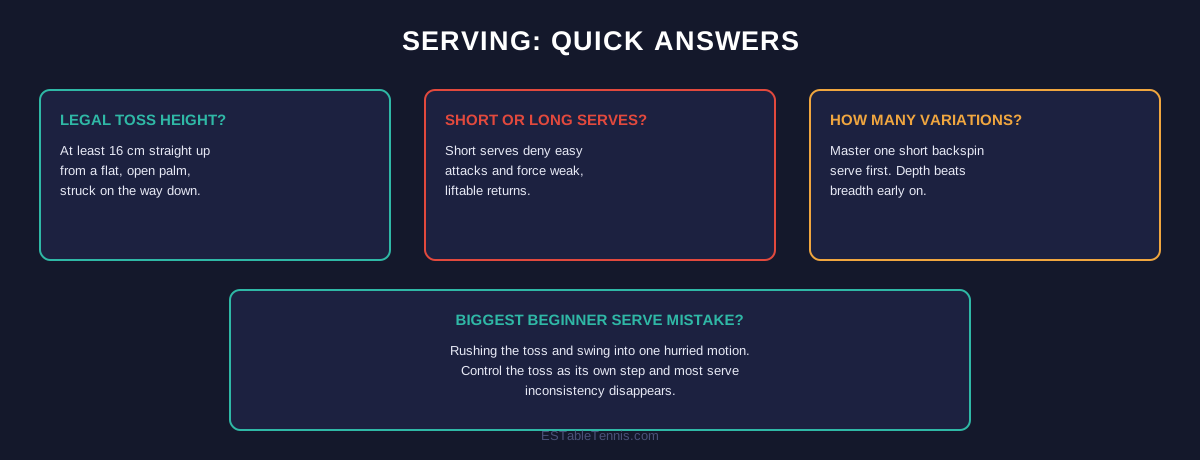
Frequently Asked Questions
What’s the legal minimum toss height for a table tennis serve?
At least 16 centimeters straight up from an open, flat palm, struck only as the ball descends, not on the way up.
Why do short serves matter more than beginners expect?
Short serves deny an easy attacking angle and force the receiver to lift the ball, creating weak return opportunities that long serves rarely produce as reliably.
How many serve variations should a beginner learn first?
One well-mastered serve, typically a short backspin serve to the middle, before adding variations. Depth beats breadth at the beginner stage.
Does rubber choice affect serve spin?
Yes. Rubber grip significantly affects how much spin a player can generate on serves specifically, since serves rely heavily on brushing contact.
What’s the biggest mistake beginners make when serving?
Rushing the toss and swing together into one hurried motion. Slowing down and controlling the toss separately fixes most beginner serve inconsistency.
Leave a Reply