
Ma Long’s coaches have described watching him practice spin generation in isolation, for hours, with no ball crossing the net at all: just racket angle, contact point, and follow-through, repeated until the movement pattern was permanent. That is how to spin in table tennis at the highest level: treated as its own skill rather than a byproduct.
Most club players have never once practiced spin as its own standalone skill. They practice shots, and spin arrives as a byproduct, inconsistent and half-understood, which is exactly backwards from how the players who actually control it built that control in the first place.
Spin comes from brushing contact rather than flat contact: the racket surface grazes across the ball’s surface at an angle, gripping and rotating it, rather than striking it head-on.
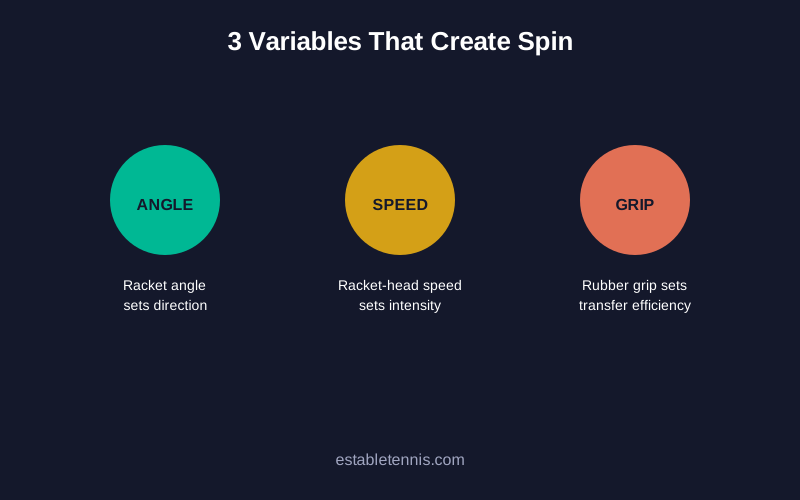
Racket angle, swing direction, and racket-head speed all combine to determine spin type and intensity, and rubber grip determines how efficiently that brushing motion actually transfers into rotation.
Spin is the single most misunderstood mechanical element in the sport, treated by most players as a mysterious talent rather than the direct, learnable product of specific, repeatable technical choices.
What’s the actual physical mechanism that creates spin?
Friction between the rubber’s surface and the ball, generated by a brushing rather than flat contact, imparts rotational force onto the ball as it leaves the racket.
The more the racket surface moves tangentially across the ball relative to how much it moves directly through it, the more spin (and proportionally less raw speed) the shot carries.
A perfectly flat, head-on strike produces minimal spin and maximum direct speed; a heavily brushing, glancing contact produces maximum spin and comparatively less raw pace.
How does racket angle determine spin type?
A closed racket angle (tilted down and forward) combined with a low-to-high swing path produces topspin.
An open racket angle (tilted up and back) combined with a high-to-low swing path produces backspin.
A racket angle tilted to one side, combined with a swing path moving laterally, produces sidespin. Most effective shots combine two of these axes rather than producing pure, single-direction spin.
Why does swing speed matter as much as racket angle?
Racket angle determines spin direction, but racket-head speed at the moment of contact determines spin intensity.
The same correctly angled brushing motion produces dramatically more spin when executed with a fast, accelerating racket-head speed than a slow, tentative one.
This is why simply understanding the correct angle isn’t enough: a player also needs the racket-head acceleration to actually generate meaningful rotation from that angle.
How does rubber grip affect how efficiently spin transfers?
Higher-grip, tackier rubber transfers more of a given brushing motion’s energy into actual ball rotation, while lower-grip rubber lets the ball slide across the surface more, wasting some of that same motion as slippage rather than spin.
This is why beginner-appropriate rubber, covered in our guide on choosing rubber for beginners, still needs enough tack to give a developing player honest feedback about whether their technique is actually generating spin correctly.
What’s the difference between generating topspin and generating backspin, mechanically?
Topspin generation typically involves a lower starting racket position, brushing upward and forward through contact, often paired with forward weight transfer for additional power.
Backspin generation involves a higher starting position, brushing downward and slightly forward, typically with a more controlled, less powerful swing since backspin shots are often more about disruption and placement than raw pace.
The specific mechanics of topspin generation are covered in more depth in our guide on how to generate more topspin.
Why do beginners struggle to generate consistent spin?
Because they instinctively favor flat, direct contact, which feels more intuitive and controllable than the deliberately glancing, brushing contact spin actually requires.
This instinct isn’t wrong exactly (flat contact is genuinely easier to control at first), but it caps spin generation at a low ceiling that a player has to consciously override through deliberate practice, rather than something that improves naturally just through more general playing time.
How can a player practice spin generation as an isolated skill?
Shadow swings without a ball, focused purely on racket path and angle, combined with slow-motion practice against a wall or with a coach feeding controlled, predictable balls specifically for spin practice rather than match-realistic rallies.
This isolated approach, mirroring Ma Long’s hours of ball-less repetition, builds the movement pattern without the added complexity of also managing an opponent’s varying spin and pace simultaneously.
Does spin generation ability transfer automatically between different shots?
Not entirely. The underlying brushing-contact principle transfers conceptually, but the specific racket angle, swing path, and timing differ enough between a forehand loop, a backhand drive, and a serve that each requires its own dedicated practice to genuinely master, rather than assuming general spin understanding automatically produces spin competency across every shot in a player’s arsenal.
How does opponent’s spin reading connect back to your own spin generation?
Understanding spin mechanics from the generation side directly improves a player’s ability to read incoming spin from an opponent, since recognizing the racket angle and swing path that produces a specific spin type works in both directions: generating it yourself, and recognizing it when someone else produces it.
This connection is covered from the reading side in our companion guide on how to read spin in table tennis, and the two skills reinforce each other far more than most players realize when they treat them as separate topics.
What’s the relationship between spin and shot risk?
Heavier spin generally increases a shot’s margin for error over the net and table, since spin affects trajectory in ways that can compensate for imperfect raw aim: a heavily topspin-loaded ball dips down faster, letting a player hit with more pace while still landing on the table.
This is part of why advanced players rely so heavily on spin rather than pure flat power: it’s not just about making the shot harder to return, it’s about making the shot itself more reliable to execute in the first place.
How does sponge hardness and thickness affect spin generation?
Softer, thicker sponge generally provides more dwell time (the fraction of a second the ball stays in contact with the rubber), which gives more opportunity to impart spin through the brushing motion, covered in our guide on table tennis rubber hardness explained.
Harder sponge reduces this dwell time, requiring faster racket-head speed to generate comparable spin, which is why beginner-appropriate equipment specifically favors the softer, more forgiving end of the spectrum while spin generation technique is still developing.
Why does sidespin get less attention than topspin and backspin in most coaching?
Because pure sidespin is relatively rare in isolation: most effective serves and shots combine sidespin with either topspin or backspin, making it a modifying element rather than a standalone spin type most players deliberately practice on its own.
This doesn’t make it less important; combined-axis spin, particularly on serves, is considerably harder for opponents to read than any single-axis spin, which is exactly why advanced serve development spends real time on it despite the more limited standalone coaching attention it receives.
How much does spin generation ability actually separate skill levels in this sport?
Enormously, more than almost any other single mechanical factor. Two players with similar raw athleticism and footwork will differ dramatically in competitive outcome if one has genuinely mastered spin generation and reading while the other relies mostly on flat, direct hitting.
This is why coaches consistently emphasize spin fundamentals even with intermediate and advanced players, rather than treating it as a beginner topic that gets fully resolved and then ignored.
What’s a realistic timeline for developing genuine spin control?
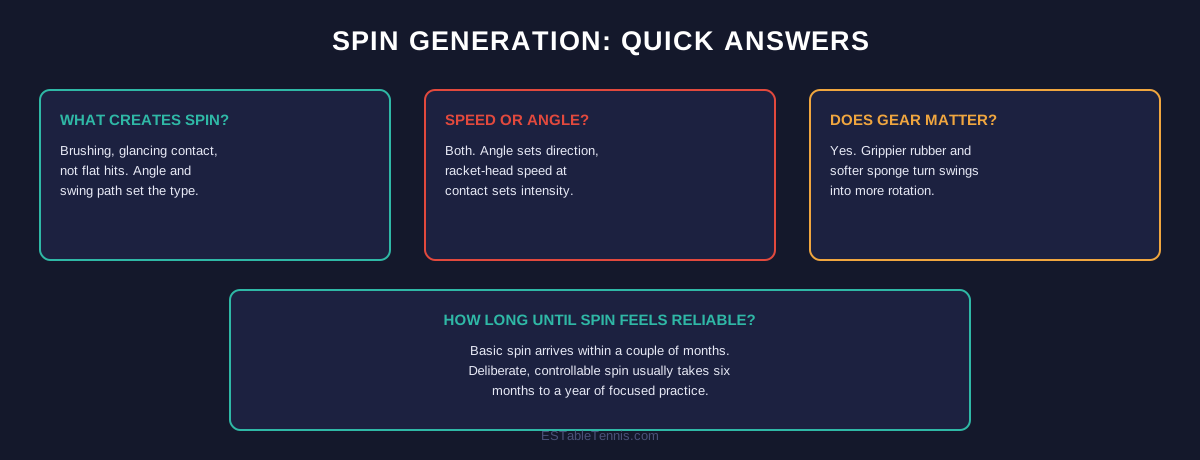
Basic, inconsistent spin generation usually emerges within the first couple of months of regular practice, almost as an accidental byproduct of general stroke development.
Genuinely deliberate, controllable spin (the kind a player can vary and combine on command rather than producing inconsistently) typically takes six months to a year of focused, isolated practice specifically targeting the brushing-contact mechanics covered throughout this guide.
How does spin interact with the ball’s bounce off the table before it even reaches an opponent’s racket?
Spin affects the ball’s bounce off the table itself, not just its flight through the air: heavy topspin kicks forward and low off the bounce, heavy backspin drags or dies, and this pre-contact behavior is exactly what a receiving player has to read and adjust for before their racket ever touches the ball.
Understanding this two-stage effect (flight path, then bounce behavior) is part of why spin reading takes considerably longer to master than spin generation, since it requires processing information from two distinct phases of the ball’s trajectory almost simultaneously.
What’s the connection between spin generation and confidence under match pressure?
A player who has only ever generated reliable spin in relaxed, isolated practice often finds that spin generation breaks down specifically under match pressure, since anxiety tends to shorten and rush the exact brushing motion spin depends on.
This is the same mental-equipment crossover running through this entire site: the technical skill and the psychological state supporting it aren’t separate, and practicing spin generation exclusively in low-pressure settings leaves a real gap that only shows up when it matters most.
Does spin generation differ meaningfully between offensive and defensive playing styles?
Yes. Offensive players prioritize maximum spin generation on attacking shots, often sacrificing some consistency for higher ceiling potential on loops and aggressive topspin drives.
Defensive players often prioritize more controlled, moderate spin that supports consistent blocking and placement over raw rotational intensity, since their tactical approach depends more on reliability and disruption than on overwhelming an opponent with pure spin power.
How does a player know if their spin generation technique is actually correct, versus just producing an acceptable result by accident?
The clearest diagnostic is consistency across repeated attempts: correct technique produces similar spin intensity and type shot after shot, while accidental or partially correct technique produces wildly inconsistent results even when a single attempt happens to work well.
A player who can’t reliably reproduce a specific spin type on demand, even in relaxed practice, likely has a technique gap rather than genuine mastery, regardless of how good any individual successful shot might have felt.
What role does the wrist play specifically in fine-tuning spin at the last moment?
The wrist provides the final, most adjustable point of contact control, letting a player make small, last-instant adjustments to racket angle and brushing direction that the larger arm and body motion can’t as precisely fine-tune.
This is part of why advanced spin variation, particularly on serves, relies so heavily on wrist snap: it’s the body’s most precise, most adjustable tool for the exact moment spin is actually imparted onto the ball.
Should a beginner try to learn all spin types simultaneously, or focus on one first?
One at a time, thoroughly, rather than simultaneously. Topspin is generally the most useful foundational spin type to master first, since it underlies the majority of offensive shots a developing player will build their game around.
Backspin and sidespin, while important, are more commonly layered on top of a solid topspin foundation rather than developed as an equal priority from day one.
How does watching slow-motion footage of professional spin generation help a developing player?
Slow-motion analysis reveals the precise racket angle, contact point, and swing path that full-speed match footage hides entirely, making it one of the more underused learning tools available to a self-motivated player without constant access to a coach.
Studying a professional’s topspin loop frame by frame, specifically focused on the exact moment of ball contact, teaches details about angle and timing that are simply invisible at normal playback speed.
According to ITTF equipment regulations, rubber surface texture and thickness are tightly regulated specifically because spin generation is so central to competitive balance in this sport: an unregulated rubber surface could otherwise produce spin levels the rules were never designed to accommodate.
None of the mechanics covered here require natural talent to access. They require exactly what Ma Long’s hours of ball-less repetition represented: a willingness to isolate an unglamorous skill and drill it long after it stops feeling productive, right up until the moment it quietly becomes automatic.
Most club players will never spend an hour practicing spin without a ball, and that’s exactly the gap a patient, deliberate player can quietly close over a single dedicated season, while everyone else keeps hoping the skill arrives on its own through general match repetition.
Angle, speed, grip. That’s the entire recipe, repeated until it stops requiring conscious thought at all.
No ball needed for the first hundred repetitions. Just the motion, done correctly, again and again.
Most talent stories, on close inspection, turn out to be patience stories wearing a more exciting name.
This one is no different.
Pick one spin type. Drill it alone, without a ball, until your arm knows it better than your mind does.
Simple as that.
Then, and only then, add the ball back in.
Ma Long never needed one to get started.
Neither do you.
Start tonight.
Even fifteen minutes counts.
Nobody is watching. That’s exactly why it works.
End of story.
Get to work.
Worth every minute.
Truly.
Go.
Now.
Really.
Truly, really, now.
Quick Recap: How to Spin in Table Tennis
Learning how to spin in table tennis comes down to three controllable variables (racket angle, swing path, and racket-head speed), combined with rubber grip that determines how efficiently that motion actually transfers into rotation.
Isolated, deliberate practice, the kind that skips the ball entirely at first, builds this skill far faster than hoping it emerges naturally from general match play.
Frequently Asked Questions
What actually creates spin on a table tennis ball?
Does racket speed matter more than racket angle for spin?
Why can’t I generate spin as well as more experienced players?
Does equipment affect how much spin I can generate?
How long does it take to develop reliable spin control?
Ma Long’s hours without a ball crossing the net never made it into any highlight reel either.
What eventually did make the highlight reel was built entirely in those unwitnessed, ball-less repetitions, a lesson available to any player patient enough to actually apply it.
Want to know if your current rubber setup is actually helping or limiting your spin generation? PingPath gives you a fitted recommendation in under three minutes.
Leave a Reply