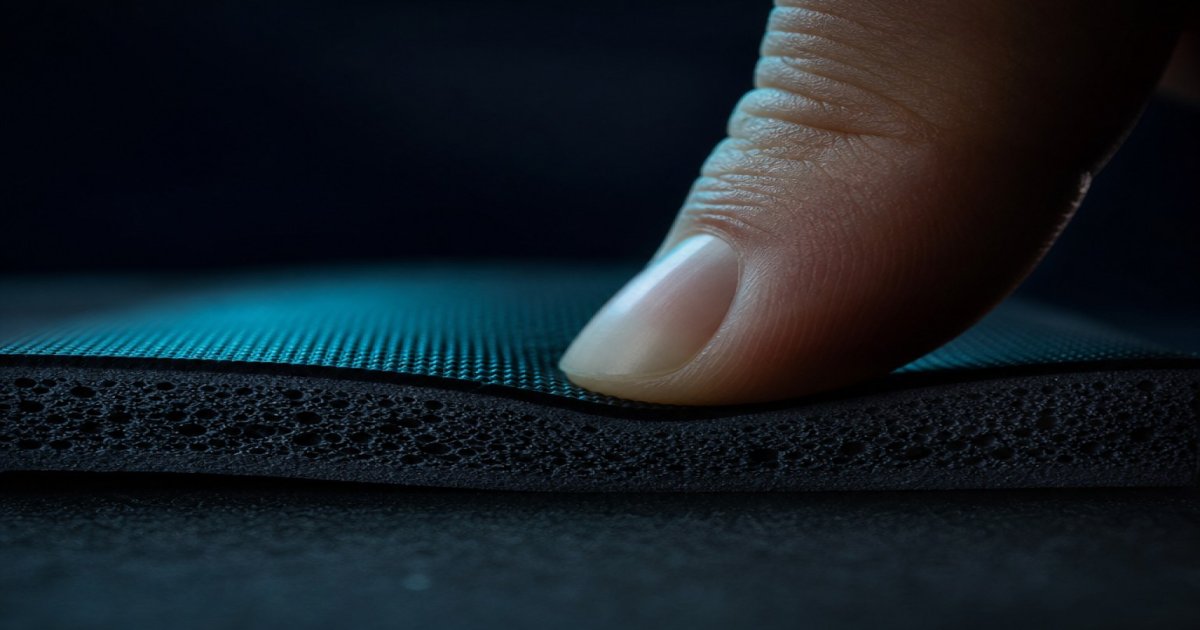
A coach in Chaguanas used to keep two rubbers taped to the underside of the club table, unlabeled, and make new players press a thumbnail into each one before they were allowed to ask about buying gear. One gave easily, springing back slow. The other barely yielded at all. Most players couldn’t tell you which number belonged to which sheet, but they could always tell you which one felt right under their own hand, which is closer to the actual answer than any spec sheet.
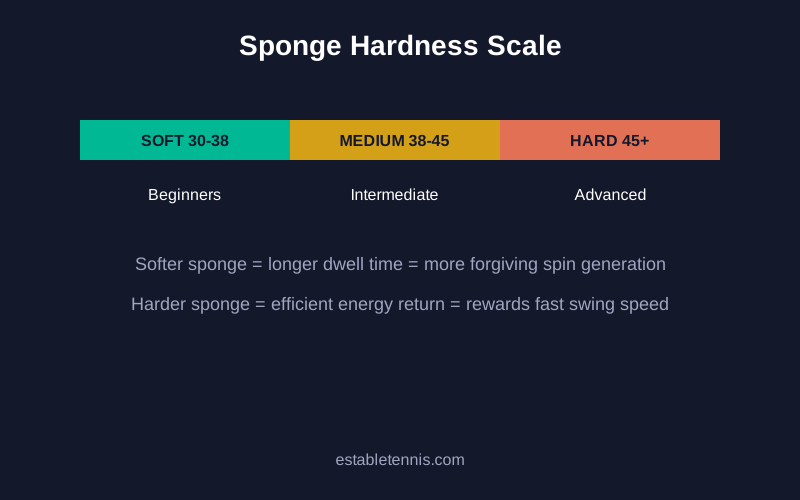
Rubber hardness measures how much the sponge compresses under pressure, rated roughly 30–50+ degrees. Softer sponge (30–40) compresses easily and returns energy slowly, giving more control and dwell time. Harder sponge (45+) compresses less and returns energy fast, rewarding a committed swing with more speed but punishing a hesitant one.
The number on the sponge label tells you almost nothing on its own. Hardness only means something in relation to how fast and how hard you actually swing, which is why the same rubber can feel like a rocket launcher to one player and a wet towel to another.
Two rubbers with the exact same headline speed rating can play completely differently once you factor hardness in, which is why relying on speed alone as a shopping filter leaves out half the story.
How is rubber hardness actually measured?
Manufacturers rate sponge hardness on a durometer scale, though there’s no single industry standard: a 40 from one brand can feel different from a 40 from another. Treat the number as a rough guide within a brand’s own lineup rather than a universal measurement you can compare across manufacturers without testing.
Treat the durometer number the way you’d treat a shoe size from a brand you’ve never worn before: a useful starting estimate, not a guarantee, and worth confirming against how it actually feels the first time you step onto the table with it.
What actually happens when a harder sponge compresses?
A harder sponge resists compression, meaning the ball spends less time in contact with the rubber before rebounding. Less contact time means less opportunity to “catch” the ball and impart spin through friction, so hard sponge rewards players who generate spin primarily through fast racket-head speed rather than through prolonged contact.
It also means energy transfer is more efficient at high swing speeds: the sponge doesn’t absorb your effort, it returns nearly all of it.
A rubber that feels lively and connected in a pro’s hands can feel dead and unresponsive in a beginner’s, purely because the swing speed generating that liveliness isn’t there yet. The sponge itself hasn’t changed, only who’s swinging it has.
What happens with softer sponge?
Softer sponge compresses more deeply and rebounds more slowly, which extends the dwell time, the fraction of a second the ball sits on the rubber. That extra dwell time is where beginners and control players actually build their spin, because it gives the racket surface more time to grip and rotate the ball even at moderate swing speeds.
The tradeoff is that soft sponge caps how much raw speed you can generate, since a portion of your swing energy gets absorbed into the compression rather than returned to the ball.
Does hardness matter more than sponge thickness?
They’re related but distinct variables. Thickness controls how much total sponge is available to compress; hardness controls how easily that sponge compresses. A thick, soft sponge and a thin, hard sponge can produce surprisingly similar top-end speed through different mechanisms, but they’ll feel completely different in your hand, and they respond to technique errors differently. For a full breakdown of thickness on its own, see our piece on table tennis rubber thickness explained.
Consider hardness the quiet variable that decides whether every other spec on the box actually delivers what it promises. A perfectly chosen thickness and topsheet paired with the wrong hardness for your swing will still feel wrong, and no amount of technique adjustment fixes a mismatch that lives entirely in the sponge’s compression rate.
What hardness should a beginner use?
Beginners should stay in the 35–42 range. This gives enough dwell time to learn spin generation through technique rather than raw racket speed, while still offering enough responsiveness to feel like a real table tennis rubber rather than a pillow. Anything above 45 asks for a swing speed and consistency most players haven’t built yet, and the punishing feedback loop (mistimed shots flying off the end) tends to create the exact hesitation that ruins a developing stroke, a topic covered in depth in our guide on choosing rubber for beginners.
When does a harder sponge start to make sense?
Once your swing is consistent enough that you’re generating spin through racket-head acceleration rather than relying on the rubber’s dwell time to do the work for you, a harder sponge stops being a liability and starts being an upgrade. The signal isn’t a calendar date: it’s whether your current soft-sponge setup feels like it’s capping your power on shots where your technique is already sound.
None of this needs to be memorized before your next purchase: it only needs to be understood well enough to ask the right question at the counter, or read the right line on a product page, instead of defaulting to whatever number sounds the most impressive.
Does climate or humidity affect how hardness plays?
Yes, more than most players expect. Sponge is temperature-sensitive: it firms up in cold conditions and softens in heat and humidity. A rubber that plays like a 40 in an air-conditioned Trinidad gymnasium can play noticeably softer in an unconditioned hall during the wet season. Players who compete across venues with different climates sometimes keep two nearly identical setups at different hardness ratings specifically to account for this.
Once your swing settles into that consistency, the rubber stops feeling dead and starts feeling like it’s finally working with you rather than against you, the single clearest sign a hardness change was overdue.
Can hardness be adjusted after purchase?
Not meaningfully. Sponge hardness is baked into the manufacturing process and doesn’t change with glue, booster products, or use, though heavy, prolonged use will eventually degrade the sponge’s responsiveness regardless of its original rating, which is a separate maintenance question covered in our guide on how long table tennis rubber lasts.
How do speed glue and boosters interact with hardness?
Before speed glues were banned by the ITTF, players used solvent-based glues to temporarily swell the sponge and artificially soften its effective hardness, boosting speed and spin beyond the rubber’s factory rating. Modern tuning products (boosters) that remain legal in some contexts work on a similar principle: chemically altering sponge behavior temporarily.
For a beginner, none of this matters yet. It’s worth knowing the terminology exists so a store recommendation involving a “booster” doesn’t sound like mandatory maintenance; it’s an advanced-player tuning tool, not something a new player needs to think about.
Why do some rubbers list two hardness numbers?
Some manufacturers rate hardness using their own internal scale alongside a converted “ITTF-style” or industry-comparable number, because there’s no single global standard (as mentioned above).
When you see two numbers on the same product listing, treat the manufacturer’s own internal scale as the more reliable point of comparison against other rubbers from that same brand, and be skeptical of cross-brand comparisons based on the converted number alone. The safest approach is always to test in person or trust reviews from players with a similar swing speed and skill level to your own, rather than comparing raw numbers across brands.
Does the hardness number tell you anything about durability?
Not directly. Hardness describes responsiveness, not longevity: a soft sponge and a hard sponge can have similar lifespans under identical play conditions, and durability is driven far more by topsheet wear, storage, and maintenance than by the underlying hardness rating. Don’t let hardness factor into a durability judgment; that’s a separate question covered in our guide on how long table tennis rubber lasts.
How does a beginner actually test hardness before buying?
Where possible, press a thumbnail firmly into the sponge edge of a demo rubber at a shop or club: a soft sponge yields noticeably and springs back slowly; a hard sponge barely gives. This crude test won’t replace an actual hitting session, but it’s a far better gut check than reading a number on a box, and it’s exactly the informal method experienced coaches still use to sort players toward a starting rubber before any formal spec discussion happens.
What’s the relationship between hardness and the sound of a good hit?
Harder sponges tend to produce a sharper, more percussive contact sound, since less energy is absorbed into the compression itself. Softer sponges produce a duller, more muted sound, with more of the contact energy spent compressing the sponge rather than immediately rebounding.
Some experienced players use this sound as a real-time feedback cue during a match, gauging contact quality by ear as much as by feel, a skill that develops naturally over time and isn’t something a beginner needs to consciously train, but worth knowing exists as your ear calibrates to your own equipment.
How does hardness interact with different blade speeds?
A hard sponge on a fast, stiff blade compounds speed in a way that can overwhelm a developing player’s control, while the same hard sponge on a slower, control-oriented blade can be tempered into something more playable.
This is the same pairing logic covered in our carbon blade guide (see is a carbon blade good for beginners) and it reinforces why hardness should never be evaluated in isolation from the rest of the setup. A single variable pushed too far in the aggressive direction, even if every other part of the setup is beginner-appropriate, can undo the forgiveness the rest of the build was designed to provide.
What’s a realistic hardness progression as a player improves?
Most developing players who stick with the sport move gradually from the 35–42 beginner range toward 42–48 as their swing speed and consistency build, typically over twelve to eighteen months of regular play, before some competitive players eventually push into the upper end of the scale as their technique fully matures.
This isn’t a fixed timeline: it’s a response to actual feedback from your own game, and jumping ahead of that curve because a harder sponge “seems more serious” tends to recreate the exact same control problems a beginner rubber was designed to avoid in the first place.
Why do so many players never think about hardness at all?
Because thickness and overall speed rating dominate the marketing conversation, while hardness sits quietly in the product specs as a number most buyers skim past.
This is a mistake: for two rubbers with identical thickness and speed rating, hardness is often the variable that determines whether the rubber actually feels playable in your hand, and ignoring it is how players end up with equipment that looks correct on paper but plays wrong on the table. Reading past the headline speed number to the hardness rating underneath it is a small habit that saves a lot of trial and error.
How does hardness affect a beginner’s confidence, not just their shots?
This is the part of the equation that rarely gets discussed openly, but it’s the one that actually determines whether a beginner sticks with the sport. A too-hard sponge produces unpredictable results from a still-developing swing, and that unpredictability reads to the player as personal failure rather than a mismatch with the equipment.
Confidence in table tennis is built through a tight feedback loop (swing, see result, adjust, repeat) and a sponge too hard to give reliable feedback at a beginner’s current swing speed breaks that loop before it can even form. This is the same mental-equipment crossover that runs through every piece of gear advice on this site: the equipment doesn’t just affect the shot; it affects whether the player trusts their own hands the next time they step up to the table.
Should a beginner ever ask a shop to explain hardness before buying?
Yes, and it’s one of the more useful questions to ask, because it forces a conversation about your actual swing speed and playing frequency rather than a generic recommendation pulled from whatever’s in stock.
A good shop or coach will ask how often you play, whether you’re leaning toward attacking or defensive shots, and answer with a specific hardness range rather than a single model name. If they can’t or won’t do that, treat the recommendation with some skepticism and default to the 35–42 range covered above until you’ve had a chance to test in person.
What’s the single biggest hardness mistake to avoid as a beginner?
Buying based on what a rubber is “rated for” rather than what you can actually control. Manufacturer marketing copy routinely describes harder, faster rubbers as suited for “intermediate” players, and plenty of true beginners read that label as an invitation rather than a warning.
The rating on the box describes a swing speed and consistency level, not a self-assessment of ambition, and starting a rank below where the marketing points you almost always produces faster, more confident progress than starting where the box suggests.
That’s the whole game, really: matching the sponge’s give to the hand swinging it.
Quick Recap: Table Tennis Rubber Hardness
Getting table tennis rubber hardness right comes down to matching the equipment to where you actually are, not where marketing copy wants you to be. Revisit this whenever your game changes enough that the current setup starts feeling wrong.
Frequently Asked Questions
According to the ITTF equipment regulations, all racket coverings must meet specific approval standards before use in sanctioned competition.
What hardness rating is best for beginners?
Is a harder sponge always faster?
Does hardness affect spin or just speed?
Why do professional players use harder sponge?
Should I match hardness on my forehand and backhand?
The coach in Chaguanas never explained the durometer scale to anyone. He just watched which rubber a player’s thumb sank into without hesitation, and started them there. Years later, most of those players couldn’t tell you the hardness number on their current setup either, only that it finally stopped fighting them back.
Want a specific hardness and thickness recommendation matched to your actual swing, not a guess from a store shelf? PingPath gives you a fitted setup in under three minutes.
Leave a Reply