I once watched a player lose a match he should have won by five points. He was stronger, faster, and had been training for two years longer than his opponent. But his rubber was wrong, and he knew it, and somewhere around the third game that knowledge became a weight he couldn’t put down.
His table tennis rubber thickness was 2.1mm. His coach had told him to try it. The coach meant well. But this player’s game was built on close-to-the-table blocking and fast counter-hitting, and 2.1mm gave him a dwell time he couldn’t feel his way around. Every shot that should have been crisp came back a fraction late. Not wrong, exactly. Just off. Just enough. By the fifth game, he was second-guessing every contact point, and second-guessing in table tennis is the beginning of the end.
I tell that story because rubber thickness is one of those technical choices that sound like they belong in a physics textbook but actually live in the nervous system of every competitive player. Get it right, and you stop thinking about your equipment. Get it wrong, and your equipment becomes the only thing you think about, usually at 9-9 in the fifth when thinking is the last thing that helps you.
What Is Table Tennis Rubber Thickness?
Rubber thickness means the combined measurement of the topsheet plus the sponge underneath it, and the sponge is the variable that actually changes between rubbers, typically ranging from 1.5mm to 2.2mm in practical competitive play. When people say “rubber thickness” in table tennis, they almost always mean the total thickness of the rubber sheet: the topsheet (the pimpled outer layer you actually hit the ball with) plus the sponge layer underneath it. The topsheet itself is roughly consistent across rubbers, ranging from 1.5mm to 2mm. The variable is the sponge.
ITTF rules cap total rubber thickness at 4mm, but in practical competitive play, you’ll rarely see anyone playing at 4mm. The realistic range is between 1.5mm and 2.2mm for most players, with some specialist configurations going slightly outside that band.
When a manufacturer lists a rubber as “MAX,” that means the sponge is cut to the maximum thickness the topsheet allows, which typically means a total thickness of 2.2mm to 2.5mm depending on the specific rubber model. When you see “1.8mm” or “2.0mm,” that’s the combined measurement of sponge and topsheet together.
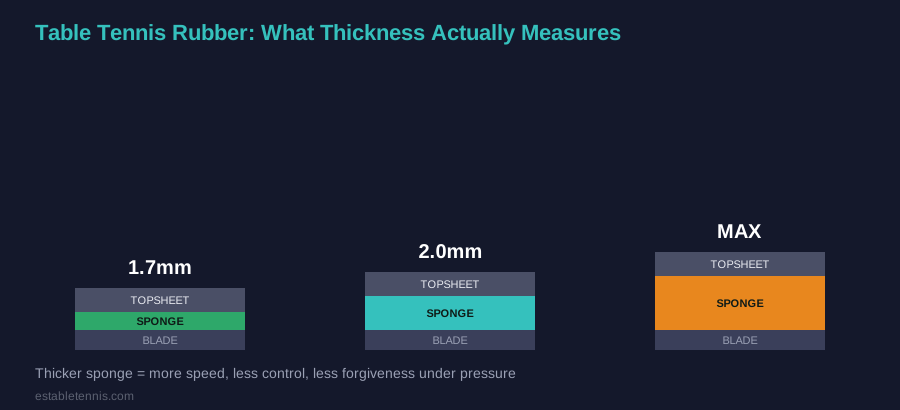
The thickness measurement matters because sponge thickness is the primary variable that controls three things your game depends on: speed, spin potential, and how much control you feel in your fingers on every single contact. Those three variables are not independent. Change one and the others shift with it.
What’s the Speed-Control Trade-Off in Rubber Thickness?
A thicker sponge stores and returns more energy, producing more speed, at the direct cost of forgiving less of your timing errors. A thicker sponge stores more energy. When the ball contacts the rubber, the sponge compresses and releases, and more sponge means more compression, more energy storage, and more energy returned to the ball. The result is more speed. It’s a simple physical relationship that every equipment guide will tell you.
What most equipment guides won’t tell you is what that extra speed costs you in terms of mental load.
A thicker sponge is less forgiving of timing errors. When you’re using 2.0mm or MAX thickness, the ball leaves the racket faster, which means your margin for contact timing is narrower. A contact point that’s a fraction early or late produces a more dramatically different result than the same contact point error would on 1.5mm or 1.8mm sponge. The rubber doesn’t forgive the mistake the same way.
For technically consistent players, this tighter feedback loop is a feature. Your good shots are faster, your game is more dangerous, and the rubber rewards precision. For players who are still building consistency, or for players whose technique degrades under pressure (which is most competitive players, including good ones), thicker sponge turns small technical mistakes into big tactical problems.
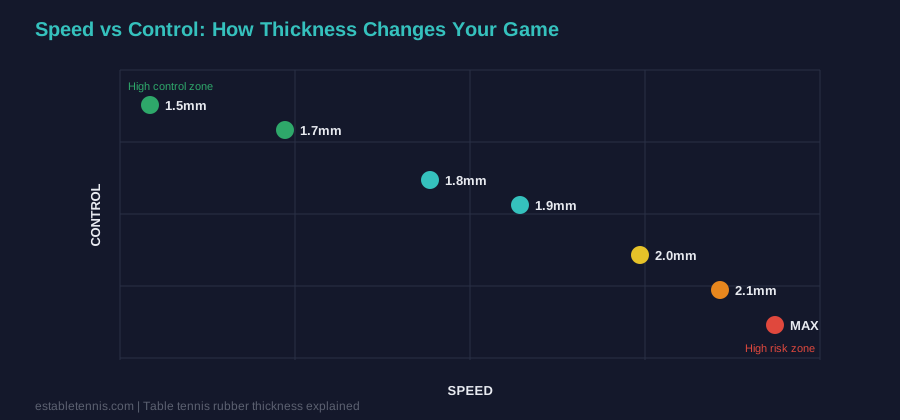
This is why every coach who has ever watched a junior player reach for the thickest rubber in the shop has had the same quiet conversation with themselves: the player thinks they’re upgrading their offense. What they’re actually doing is reducing their margin for error at the exact moment in their development when they can’t afford to reduce their margin for error.
What Do the Common Rubber Thickness Levels Actually Do?
Here’s what the practical thickness spectrum looks like in competitive play:
1.5mm to 1.7mm: Control and Consistency
This is the beginner-to-intermediate range, and calling it that doesn’t mean it’s only for beginners. Several world-class defensive players have used thin sponge throughout their careers precisely because the control characteristics align with a game built on placement and consistency rather than speed.
At 1.5mm to 1.7mm, the ball spends more time on the rubber on each contact. Dwell time increases. You feel the ball more through your hand, which gives you more information about what the ball is doing and more ability to adjust your response. The trade-off is ceiling speed. You cannot generate the same raw pace as a thicker setup, and against players who attack from close to the table, that speed ceiling eventually becomes a real problem.
Where this thickness genuinely excels is in training. Younger players who are building technique learn to use their strokes correctly on thinner rubber because the margin for error is larger. The rubber compensates less for poor mechanics. If you want to know what your backhand loop actually looks like without the rubber covering for you, go thin for a month. You’ll find out fast.
The 1.8mm to 1.9mm Middle Ground
This is the thickness range I come back to most often when talking to developing competitive players who ask for a practical recommendation. It’s not a compromise between two bad options. It’s a range where control and speed coexist at a level most players can actually use.
At 1.8mm to 1.9mm, you have enough sponge to generate serious topspin and meaningful attacking speed. You also have enough control to block consistently and keep the ball on the table under pressure. The forgiveness on timing errors is meaningfully better than MAX without feeling like you’ve given up your offense.
For players who compete regularly and whose technique is largely built but still developing under pressure, 1.8mm to 1.9mm is the range where table tennis rubber thickness explained correctly starts to make practical sense. You’re not trading control for speed yet. You’re building a game you can sustain when it matters.
2.0mm to 2.1mm: Attacking Development
This is where the speed starts to noticeably dominate the equation. At 2.0mm and 2.1mm, players with clean technique can generate substantial pace and spin. Topspin attacks off the bounce carry more punch. Service return aggression is easier to commit to because the rubber does more of the work.
The mental question at this thickness is whether your technique holds up when you’re fatigued or under emotional pressure. Plenty of players use 2.0mm or 2.1mm comfortably in training, where the conditions are familiar, and the stakes are low. The same players discover at 9-8 in the fifth game of a tournament match that the rubber is faster than their decision-making in that moment. The rubber hasn’t changed. Their timing has.
If you’re considering a move to this range, the test I’d suggest is simple: play three training sessions using only counter-hitting and blocking, no loops, at your normal pressure. If your consistency holds at 2.0mm or 2.1mm in those sessions, your technique can handle it. If you’re popping balls off the end of the table regularly, you’re not ready for the thickness, no matter what your attacking game looks like.
MAX (approximately 2.2mm to 2.5mm): Maximum Attack
MAX thickness rubber is built for one thing: maximum energy return at contact. Every aspect of the rubber’s behavior is pushed toward speed and spin generation at the expense of control and feel. Players who use MAX rubber successfully are players whose technique is reliable enough that they don’t need the rubber to compensate for anything. They’re asking the rubber to amplify what’s already working, not to cover for what isn’t.
The players who struggle most with MAX rubber are not beginners. They’re intermediate players who have good training-room technique but whose mechanics break down in competitive conditions. They pick up MAX because it makes their loops feel devastating in casual play, and they’re right about that. The loops are devastating. The problem shows up in serve return, in blocking, in every shot where they need control rather than power, and in every moment in a match where their nerves have tightened their swing, and the rubber is giving them back more than they’re putting in.

How Does Rubber Thickness Interact With Your Playing Style?
The thickness question doesn’t exist in isolation from how you actually play. Two players can use the same thickness with completely different results because their game styles demand different things from the rubber.
Close-to-the-Table Players
If your game is built around fast exchanges close to the table, quick blocking, and counter-hitting with short backswings, you need control above speed. Thicker rubber at close range is unforgiving of the split-second timing differences between a good block and a ball off the end of the table. Most close-to-the-table players I’ve worked with perform better and feel more confident at 1.8mm to 2.0mm than they do trying to match the 2.1mm or MAX setups their looping opponents use.
Looping Players Who Attack from Mid-Distance
If you initiate with topspin attacks from mid-distance and use your forehand as your primary weapon, thicker sponge plays to your strengths. The energy return on a full forehand loop with 2.0mm or MAX can be genuinely intimidating. The question is what happens when that loop doesn’t land, and you’re forced into a defensive exchange. If your blocking game is solid, thicker rubber on the forehand side pairs well with a slightly thinner rubber (1.8mm or 1.9mm) on the backhand for control on the receiving side.
Defensive Players and Choppers
Defensive players sometimes use very thin sponge (1.5mm or under) or even long-pimple rubbers without sponge on one side specifically to disrupt the attacker’s timing. This is a specialist configuration that goes beyond standard thickness choices, but the principle is the same: the rubber serves the game style. Defensive players prioritising control at the expense of speed is not a compromise. It’s a tactical decision that works when the player understands exactly what they’re trading.
How Does Rubber Thickness Affect Your Mental Game Under Pressure?
Thicker sponge amplifies the mechanical changes that pressure creates in your swing. A small timing error that costs you a marginal miss on thin rubber costs you a shot off the table entirely on MAX. Understanding table tennis rubber thickness explained in full context means seeing how it connects to your mental game. I’ve written elsewhere on this site about why players perform worse in matches than in practice, and rubber thickness is one of the underrated contributors to that gap. Here’s the mechanism.
In practice, you adapt to your rubber unconsciously over hundreds of repetitions. Your nervous system builds a model of what this specific rubber does on each type of contact, and your timing adjusts automatically. That model is built under low-pressure conditions. It’s reliable when nothing’s at stake.
Under competitive pressure, two things happen simultaneously. Your muscle tension increases, which changes your swing mechanics in subtle ways. And your conscious attention to the ball increases, which actually disrupts the automatic processing that makes your technique reliable. Both of these effects interact badly with thicker sponge.
Thicker sponge amplifies the mechanical changes that come with tension. If your swing gets slightly tighter under pressure, a 1.8mm rubber will produce a shot that’s marginally off target. The same mechanical change on MAX rubber produces a shot that’s clearly off target or off the table entirely. The rubber is not causing the pressure. But it is making the pressure more expensive.
This is also why players who keep losing the critical points in close games should consider whether their rubber is the right thickness for their technique under pressure, not just for their technique in a relaxed training environment. The consistency of your equipment choices directly affects how much mental load you’re carrying at 9-9 in the deciding game. Equipment you can predict is equipment that frees your mind to focus on the match rather than on second-guessing your own racket.
How Ball Type Interacts with Rubber Thickness
The table tennis rubber thickness explained discussion has changed since the celluloid era. The transition from celluloid to plastic ABS balls has changed what thickness choices make sense for competitive players. Plastic balls are harder than celluloid balls; they produce less spin on contact, and they require more from the rubber to generate equivalent topspin. This is not a minor adjustment. It’s a systematic shift in how equipment combinations work together.
The practical consequence is that the thickness choices that worked well with celluloid balls are not automatically optimal with plastic ABS balls. Players who were playing well at 1.8mm with celluloid have sometimes found that moving to 2.0mm with the plastic ball restores the feeling and spin generation they lost. Players who were already at MAX with celluloid have sometimes found that MAX with plastic feels deadening because the harder ball isn’t compressing the sponge the same way.
There’s no universal rule for this adjustment. It depends on your rubber model, your playing style, and what your technique produces on contact. But if you made a thickness choice more than three years ago and haven’t revisited it since the ball transition, it’s worth a systematic re-evaluation. The game has changed around your equipment.
How Do You Actually Choose the Right Rubber Thickness?
Most advice on rubber thickness falls into two categories: the technical explanation (thicker equals faster) and the category-based prescription (beginners use thin, advanced players use MAX). Both are true, and both are incomplete. Here’s a more useful framework.
Step 1: Identify Your Weakest Point Under Pressure
The question is not “what’s the thickest rubber I can control in training?” The question is “what’s the thickest rubber I can control when I’m serving at 8-10 in the final game of a match I care about winning?” Those are different questions, and they have different answers for most competitive players.
If your weakest point under pressure is consistency on the backhand, thinner rubber on the backhand side (1.8mm or even 1.7mm) gives you more margin at the moments when your technique is most compressed. If your weakest point is serving aggression (you tend to float the serve when you’re nervous), thicker rubber won’t fix that and may make it worse by making your tentative serves even slower relative to what your opponent expects.
Step 2: Test Your Technique, Not Your Equipment
Before changing rubber thickness, spend three sessions playing purely technically: focused drilling, consistent stroke production, no games. Notice where your consistency naturally lives at your current thickness. The strokes that are reliable in drilling are the strokes whose technique is solid enough to handle thickness changes. The strokes that break down in drilling are the strokes you need to leave room for, not ones to challenge with less forgiving equipment.
Step 3: Make One Change at a Time
Changing rubber brand, topsheet type, and thickness simultaneously is how players end up confused about what changed and why. Isolate the thickness variable. Keep the same rubber model and change only the thickness. Give it at least six weeks of competitive play before concluding. The adaptation period is real, and the first two weeks of any new thickness feel wrong because your nervous system is recalibrating its model of what this rubber does.
Step 4: Use Tools Built for This Decision
If you want a systematic approach to equipment selection that takes your playing style, the ball type you’re using, and your current technical level into account, the PingPath rubber recommendation tool works through exactly these variables and produces a personalised recommendation rather than a generic chart. It’s free and takes about two minutes.
What Mistakes Do Players Make With Rubber Thickness?
I’ve watched enough competitive players make the same equipment errors that I can predict them now before they happen. The most common ones on thickness specifically:
Copying the thickness of a player they admire without understanding that player’s technique or game style. The Chinese national team players who use MAX have spent ten years building the technique to use MAX. Their choice tells you nothing about what’s right for your game right now.
Upgrading to thicker rubber after a good performance, when the good performance was actually the result of technique and mental focus, not equipment. The rubber didn’t win the match. You won the match. The rubber is not the variable you should be changing after a win.
Staying with a thick rubber that isn’t working because they’ve told people it’s their setup and changing feels like admitting weakness. Equipment choices are not identity statements. A player who drops from 2.1mm to 1.9mm because 1.9mm makes them more consistent is not a weaker player. They’re a more honest one.
Treating both sides of the bat as a single thickness decision. Forehand and backhand rubber serve different functions in most playing styles. They don’t need to match. Many competitive players use different thicknesses on forehand and backhand specifically because their forehand game and backhand game make different demands of the equipment.
How Does Thickness Work Differently for Pimple-Out and Anti-Spin Rubber?
Pimple-out and anti-spin rubbers follow different rules entirely. Short pimples with thin sponge produce direct, low-spin contact, while long pimples without sponge remove the energy-storage function altogether. Everything above applies to inverted (smooth-faced) rubbers, which is what the majority of competitive players use. Pimple-out rubbers and anti-spin rubbers follow different rules. Short pimples with thin sponge (0.5mm to 1.0mm) produce a very direct, fast, low-spin contact that bears almost no resemblance to what inverted rubber does at the same thickness. Long pimples without sponge (OX) remove the energy storage function of the sponge entirely and are specifically designed to return the opponent’s spin in a disorienting way.
If you’re considering specialist rubber configurations, the thickness question becomes secondary to the fundamental question of what type of rubber you’re using and how it aligns with your game style. That’s a separate conversation worth having carefully, ideally with a coach who has watched you play rather than a forum thread written by someone who has never seen you at the table.
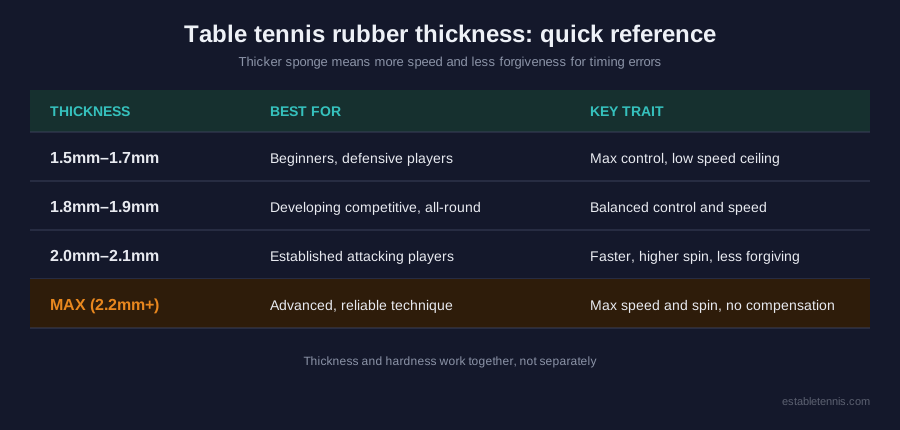
What Is a Quick Reference for Table Tennis Rubber Thickness?
What’s the Only Question That Actually Matters for Rubber Thickness?
The only real answer is that no thickness makes you better than your technique already allows. The right thickness just gets equipment out of the way so it stops costing you matches. Every player who has ever asked me about rubber thickness is really asking one question underneath the technical one. They want to know if there’s a piece of equipment that will make them better than they currently are. The honest answer is that there isn’t. Rubber thickness can stop being a problem. It cannot start being an advantage beyond what your technique earns.
The player I mentioned at the start of this piece eventually switched to 1.9mm. He didn’t lose any more matches because of his rubber after that. He still lost matches, because table tennis is a competition and losing is part of it. But he stopped losing matches while thinking about his rubber. That’s all equipment can do for you. It can get out of the way. The rest is yours.
If you want to take the mental side of your game as seriously as your equipment choices, the free ebook on how to stay calm under pressure and win more matches covers the psychological side of this same problem from a different angle. It’s free, and it might be the more important conversation.
Frequently Asked Questions
What table tennis rubber thickness should I use?
Most competitive players do best between 1.8mm and 2.0mm, thick enough for real spin and pace, thin enough to still forgive timing errors under pressure.
Does thicker rubber always mean a better player?
No. Thicker rubber only helps if your technique is already reliable enough not to need the rubber to compensate. Otherwise it just amplifies your mistakes.
Should my forehand and backhand rubber be the same thickness?
Not necessarily. Many players use thicker rubber on the forehand for attacking power and thinner rubber on the backhand for control, since the two sides serve different functions.
Why did my rubber thickness feel different after switching to plastic balls?
Plastic ABS balls are harder and produce less spin on contact than celluloid, so thickness choices that worked well with celluloid are not automatically optimal anymore and may need re-evaluating.
How long should I test a new rubber thickness before deciding if it works?
At least six weeks of competitive play. The first two weeks typically feel wrong simply because your nervous system is still recalibrating to the new rubber.
Leave a Reply