There’s a question I’ve heard from almost every competitive table tennis player I’ve coached, always after a loss that made no sense on paper. Why do I play worse in matches than in practice? The answer, in almost every case, was the same. It had nothing to do with effort or talent.
I had a player, a compact left-hander from Couva who trained six evenings a week without fail. His backhand topspin against multiball was one of the cleanest strokes I’d seen at the club level. He could maintain it for forty-five minutes straight in practice, the ball landing with that hollow, satisfying click in the same spot on the table, over and over. In official matches, he fell apart by the third game.
Not spectacularly. It was subtle, the kind of unraveling that looks like bad luck from the outside. The stroke was technically still there. His feet arrived a half-step late. His swing came a fraction slow. The decisions that felt obvious in practice became uncertain. He asked me after every loss the same question.
The answer is not what most coaches will tell you.
Why Do I Play Worse in Matches Than in Practice? It’s Not a Willpower Problem
The first thing worth saying: the practice-to-match gap is one of the most well-documented performance problems in competitive sport. It has nothing to do with how much you want to win or how hard you try when it counts.
Research from sports psychology, going back decades, shows that the mechanisms producing excellent practice performance and the mechanisms producing excellent match performance are related but not identical. Wanting it more doesn’t bridge the gap. Training harder at the same drills doesn’t either. The gap exists for structural reasons, and fixing it requires understanding what those reasons are.
There are seven of them. All seven were true of my player from Couva. They’re probably true of you.
Why Is Your Nervous System Playing a Different Game in Matches?
When you step into a match, your nervous system gets a signal it doesn’t receive in practice: the signal that something important is at stake.
That signal triggers the sympathetic branch of your autonomic nervous system, the fight-or-flight response. Cortisol and adrenaline flood your bloodstream. Your heart rate rises, your peripheral vision narrows, your muscles tighten. All of this is designed to help you survive a threat. None of it is designed to help you execute a well-timed backhand topspin.
In practice, none of this happens. The stakes are low. Your body stays relaxed. The strokes flow because, physiologically, they’re flowing in conditions they were never trained to handle under stress.
This is why the first rule of bridging the gap is a physiology rule, not a technique rule. You have to train in conditions that activate the stress response, at least partially, so your body learns to execute fine motor skills while it’s running hot. Drills that feel safe and risk-free will never prepare you for a body running on cortisol.
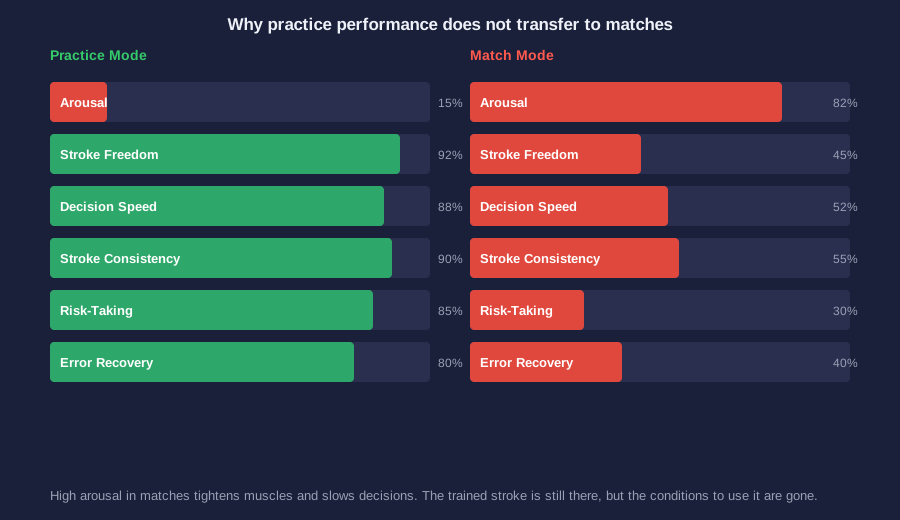
The arousal-performance relationship, described by researchers as the Yerkes-Dodson law, shows that moderate arousal improves performance, but high arousal destroys it for tasks requiring precise motor control. Table tennis at the competitive level sits firmly in the precise motor control category. Your practice sessions, which produce near-zero arousal, are preparing you for a game that doesn’t exist.

How Does the Audience Effect Change How You Move?
An audience heightens your arousal, which helps well-learned skills but hurts ones you’re still consolidating, and you often can’t tell which category you’re in until you’re already mid-match. There’s a specific phenomenon in psychology called social facilitation, and it applies directly to the match-practice gap.
When other people are watching, your body generates heightened arousal. This improves performance of well-learned, simple tasks. It degrades performance of complex, technically demanding, or recently-learned tasks. A player who has been doing backhand topspin for twelve years often performs better with an audience. A player who learned it two years ago and is still consolidating the movement pattern often performs worse.
The problem is you can’t always know which category you’re in until you’re already in the match. You felt confident in practice. You assumed that confidence would hold. Then someone sits down to watch, the score becomes visible to others, and the entire physiological picture shifts.
Training in isolation doesn’t fix this. You need observers. You need conditions where someone can see you miss. That discomfort is the adaptation, not the obstacle.
Why Are You Playing Not to Lose Instead of Playing to Win?
You play worse because somewhere around a tight score, your goal quietly shifts from playing your best table tennis to not making the mistake that costs the game, and that defensive shift is what causes the very errors it’s trying to avoid. This one sits underneath every other reason, and it’s the hardest to see clearly because it feels like trying hard.
In practice, you play freely. You try things. You swing through the ball. You go for the lines. If you miss, you reset.
In a match, somewhere around 6-6 in the third game, a different instruction takes over. The goal shifts from “play my best table tennis” to “don’t make a mistake that costs this game.” The swing shortens. Decision-making becomes defensive. The player who was attacking in practice is now pushing, fishing, hoping the other person makes an error.
Research in sports psychology shows consistently that avoidance motivation is associated with increased anxiety, reduced performance, and higher rates of what athletes describe as choking.
The cruel irony is that playing not to lose is almost always what causes the loss. The restricted swing produces weak shots. The defensive posture surrenders the initiative. The opponent, playing freely, wins points they should not have won.
Every player I’ve coached who came to me with the question “why do I play worse in matches than in practice” had this problem running underneath the others. Fix it, and the gap closes substantially. Ignore it, and nothing else will.
If you want to understand what the full mental picture of match anxiety looks like, and how to interrupt it, the guide on overcoming performance anxiety in table tennis covers the practical tools in detail.
Why Don’t Your Practice Habits Prepare You for Match Conditions?
Most practice is not match-specific. That’s not a criticism. It’s just accurate.
Multiball drills build stroke consistency, but multiball is nothing like a match. Your partner feeds from the same position, the same speed, the same spin, over and over. Your brain learns to predict, and that prediction engine runs smoothly. In a match, nothing comes the same way twice. The prediction engine fails. The stroke that felt automatic breaks down because the input it was calibrated for is no longer the input it’s receiving.
One-to-one drilling is better, but most drilling doesn’t replicate match pressure. You stop to correct. You run patterns from the same starting position. You don’t serve for real, because serving for real slows things down. You don’t keep score, because keeping score creates tension.
The consequence is a player who has trained a version of table tennis that doesn’t exist outside the training hall.
Match simulation practice, where points are played to completion with real serves, where the score is kept and there are genuine consequences to losing a game, is the training format most directly transferable to match performance. I’ve seen players cut their practice-match gap in half by spending forty percent of their training time in match simulation rather than drilling.
The honest question every player should ask: how much of my practice actually resembles a real match? If the answer is “very little,” you’ve found a significant part of your problem.
How Does Equipment Uncertainty Create a Mental Trapdoor?
This is the reason most coaches don’t talk about. It’s also the core insight this site exists to share.
Equipment inconsistency is one of the most reliable ways to collapse a trained player’s match performance, and most players never connect the dots between their paddle and their psychology.
Here’s how it happens. You train for weeks with a rubber that’s broken in, that feels a certain way off the bat, that you’ve calibrated to without realising you’re calibrating to it. Then you play a match on a day when the rubber has become a little less tacky, or you’ve recently switched sheets, or you’re using a loaner setup. The stroke feels different. Not dramatically. Just slightly off.
That small discrepancy between expected feedback and actual feedback starts a feedback loop of doubt. You hit a ball and it feels wrong. You check the paddle. You try to compensate. The compensation changes your swing path. The swing path change produces a different result. Now you’re problem-solving in the middle of a match, which is exactly where your attention should not be.
Your equipment choices affect your mental state in ways that are invisible until you’re already in the match and it’s too late. A paddle that doesn’t give you confidence, because you don’t fully understand it yet or because you’ve been told it’s advanced but haven’t found its sweet spot, is a psychological liability dressed as a performance upgrade.
The player who understands their equipment, who has played enough with the same setup to stop thinking about it entirely, plays with a mental freedom that equipment uncertainty takes away completely.
How Is the Score Rewriting Your Technique?
There’s a pattern I’ve noticed coaching juniors across multiple seasons. Technique that looks clean in practice becomes uncertain in a match in direct proportion to how much the score matters.
When you’re down 7-9 in the fifth game, the score is doing something to your technique that has nothing to do with technique. Your grip tightens. Your shoulder rises. Your backswing shortens. You contact the ball earlier because your swing is arriving late, because your timing is disrupted by a body that’s bracing for impact it doesn’t want to take.
None of this is conscious. You don’t decide to grip harder. Your nervous system decides, because it’s trying to protect you from a threat that isn’t actually a threat, but that your brain has filed under the same category as genuine danger.
Researchers call this paralysis by analysis. Studies on attentional control in sport show that directing conscious attention to an automated motor skill degrades that skill, because the conscious mind runs too slowly and introduces errors the trained motor system would not have made on its own.
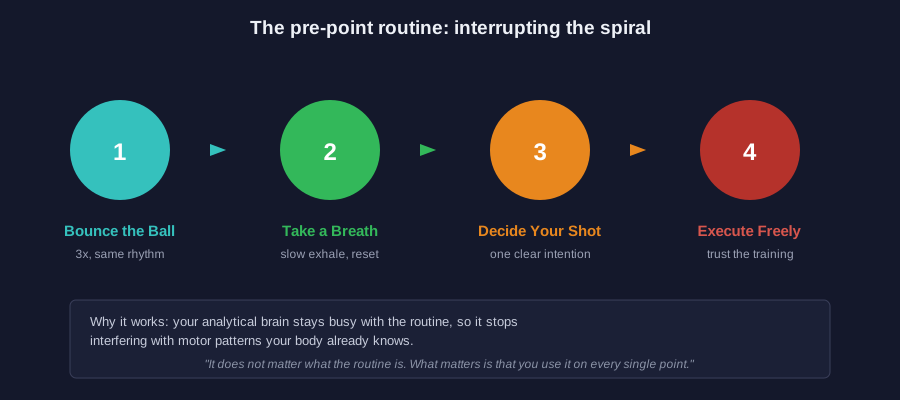
The remedy is a pre-point routine that gives your conscious mind something specific and harmless to do, so it stops interfering with your stroke. Bounce the ball three times. Take one breath. Adjust your grip deliberately before the toss. These rituals aren’t superstition. They’re neurological interference prevention, keeping your analytical brain occupied while your motor system does its job.
Why Haven’t You Trained the Match State Itself?
This is the final reason, and in some ways the most important.
Practice develops skills. Matches require the use of those skills under conditions that practice doesn’t replicate. If you never deliberately train the match state, you arrive in every match as an untrained athlete in the one area that actually decides close games, regardless of how many hours you’ve put into stroke technique.
Training the match state means practising the specific mental skills that match play demands: recovering from errors without ruminating on them, redirecting focus when a bad call or a lucky edge distracts you, managing your emotional state when the score is tight, maintaining confidence when two or three things go wrong in a row.
These are trainable skills. They are not personality traits. The player who stays calm in tight fifth games isn’t naturally calmer than you. They’ve practised staying calm. They have specific tools they use, specific routines they return to, specific ways of thinking about errors that keep one bad shot from becoming a bad game.
The guide on how to perform under pressure in table tennis is the practical starting point for most players. The deeper work, building a complete mental performance system, is what the MentalEdge course covers directly.
How to Start Closing the Gap Today
Knowing the seven reasons is useful. Having a starting plan is more useful. Here are four things you can change in your next training session that will close the gap faster than anything else.
Introduce stakes into every session. This doesn’t mean every practice has to feel like a championship. It means at least one third of your training time should involve keeping score, serving for real, and playing points to completion. Even a practice partner keeping a simple tally changes the psychological conditions of a session.
Settle your equipment. If you’ve changed rubber in the last four weeks and you’re playing a match this month, you’re practising under one set of conditions and competing under a different one. Pick a setup you understand. Play with it until you stop thinking about it. Changing equipment to improve often makes performance worse, not because the equipment is worse, but because uncertainty itself is the problem.
Build a pre-point routine and use it on every single point. The specific routine matters less than the consistency. Three bounces and a breath. Two taps of the paddle and one deep exhale. A pre-point routine interrupts the nervous system’s spiral and gives your motor system a clear signal that it’s time to execute, not analyse.
Practise your error recovery. Most training involves trying to hit good shots. Almost no training involves practising the recovery from bad ones. After every error in practice, give yourself exactly one second to acknowledge it, then deliberately redirect your attention to the next point. This builds the same recovery reflex you’ll need when the score is 8-10 in the fifth.
The practice-match gap doesn’t close overnight. It closes faster than most players expect when they start training the right things.
What Answer Did the Left-Hander From Couva Eventually Find?
He got there, eventually. Not quickly, and not by training harder.
It took one honest conversation about his equipment, which revealed he’d been playing with a rubber that had aged past its best and that he’d been quietly doubting for months. Then it took six months of deliberately uncomfortable practice: full match simulation, stakes on every game, a score that mattered, other people watching.
He didn’t become a different player. He became the same player, available under match conditions. That is what closing the practice-match gap actually looks like. You don’t find new skills in a match. You find access to the skills you already have.
The question of why you play worse in matches than in practice has seven structural answers. None of them require more talent. All of them require more deliberate preparation.
Your practice should look more like a match. Your nervous system needs activation before match day, not for the first time on match day. Your equipment needs to be settled, trusted, and calibrated to your actual game. Your mental skills need the same training time as your physical ones.
Start there. The gap starts to close.
The MentalEdge course covers the exact mental tools that close the practice-match gap, including pre-point routines, error recovery techniques, and focus training for fifth-game pressure. Start for free: download the ebook “Staying Calm Under Pressure” for the foundation principles. You can also explore the full MentalEdge course to build a complete match mental game.
Frequently Asked Questions
Why do I play worse in matches than in practice?
The gap is structural, not a willpower problem: your nervous system, an audience, a real score, and untrained match habits all activate mechanisms that low-stakes practice never triggers.
How do I fix the gap between my practice and match performance?
Introduce real stakes into practice, settle your equipment instead of second-guessing it, build a consistent pre-point routine, and deliberately practice recovering from errors, not just hitting good shots.
Why does my technique fall apart when I get nervous?
Conscious attention to an already-automated motor skill degrades it, since the analytical mind runs slower and introduces errors your trained motor system would not make on its own. A pre-point routine keeps that analytical mind occupied elsewhere.
Why doesn’t my practice performance transfer to matches?
Most practice, especially multiball drilling, trains a predictable version of the game that doesn’t exist in a real match. Match simulation, with real serves and a kept score, is what actually transfers.
Can my equipment really affect my mental performance?
Yes. A rubber or setup you don’t fully trust creates a feedback loop of doubt mid-match: a shot feels slightly off, you try to compensate, and the compensation itself becomes the new problem.
Leave a Reply