
Performance anxiety in table tennis does not announce itself. There was a player I coached in Trinidad, a young man from San Fernando, who could beat anyone in the room during practice. I mean anyone. He had a loop that bent like it had a personal grudge against the table, a backhand flick so clean it looked rehearsed, and footwork that made experienced players look like they were standing on concrete. In practice, he was, by any honest measure, one of the two or three best players I had ever worked with.
He lost in the first round of his first real tournament to a man he had beaten three times in the preceding week.
He did not lose because his technique fell apart. His technique was fine. He lost because his hands started shaking when the score reached 8-6 in the third, and his brain, which had always been his greatest asset, decided at exactly the wrong moment to remind him of every mistake he had ever made. He stood there, two points from the match, and he was somewhere else entirely.
That is performance anxiety. And if you have played competitive table tennis for more than a season, you have been that player.
Overcoming performance anxiety in table tennis is not about being fearless. The players who tell you they feel nothing before a big match are either lying, or they have confused numbness with control. The goal is not to make the anxiety disappear. The goal is to make it work for you instead of against you.
Here are seven techniques that actually do that.
What Is Your Body Actually Doing When You Feel Anxious?
When you walk out to a table in a tournament and your heart rate climbs and your palms get damp, your body is not malfunctioning. It is doing exactly what it was designed to do.
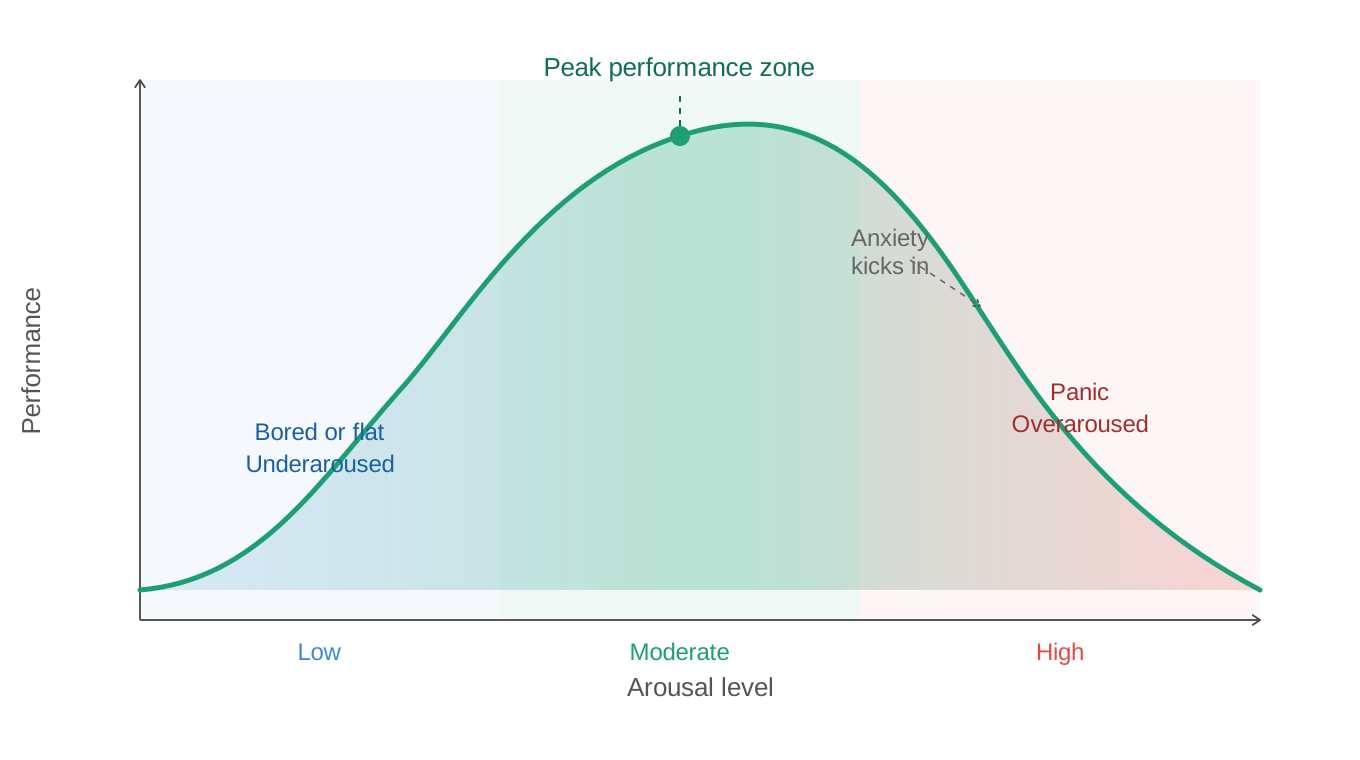
The physiological response behind performance anxiety in table tennis is not what most people think. The physical reaction you experience before a high-stakes match is identical to the response that helped your ancestors run from things with large teeth. Your body does not know the difference between a tiger and a match point. It releases adrenaline, tightens your muscles, sharpens your senses, and puts every available resource on standby. This is called arousal, and in the right amount, it makes you faster, more focused, and more capable than your baseline resting state.
The problem is not the arousal. The problem is the story you tell yourself about it.
Research on performance anxiety in table tennis and other precision sports consistently shows that athletes who interpret their pre-competition physical symptoms as excitement perform significantly better than those who interpret the same symptoms as fear. The physical experience is identical. The interpretation is everything.
So the first technique is this: when you feel your heart rate go up before a match, do not tell yourself you are nervous. Tell yourself you are ready. Your body is loading the systems you need. That is not a threat. That is preparation.
This sounds like a small thing. It is not. The story you tell yourself in the thirty seconds before a match shapes everything that follows.
How Do You Build a Pre-Match Routine and Defend It Ruthlessly?
In 2003, at the World Table Tennis Championships in Paris, I watched Werner Schlager prepare for a match from about thirty meters away in a corridor that smelled of rubber cement and floor wax. He did the same sequence of movements, the same stretches, the same shadow footwork pattern, for almost exactly eleven minutes. When it was over, he looked like a man who had just completed a transaction. There was no visible anxiety. There was no visible excitement. There was just a person who had done a familiar thing and was now ready to do the next familiar thing.
I did not understand what I was watching at the time.
A pre-match routine is not superstition, and it is not theater. It is a neurological anchor. When you repeat the same sequence of actions before competition, your nervous system begins to associate that sequence with a specific mental state: the state you were in the last time you did it. Over time, the routine becomes a trigger. You do the routine, and your brain shifts into competition mode, not panic mode, not distraction mode, competition mode.
The keyword is ruthlessly. Most players have a loose idea of what they do before a match. That is not the same thing. Your routine needs to be specific enough that you could describe it to someone in detail, and consistent enough that you do it the same way whether you are playing a club match on a Tuesday night or the national championships.
It should include: a physical warm-up sequence, a moment of deliberate breathing, and some form of mental cue, whether that is a phrase you say to yourself, a specific image you hold in your mind, or a physical gesture. The content matters less than the consistency.
Start building yours now. Not before your next important match. Now, in practice, so that by the time the stakes are real, the routine already feels like home.
What Is the Two-Second Rule for Controlling What You Can Control?
Overcoming performance anxiety in table tennis requires understanding something that sounds obvious but takes years to actually believe: the only moment you can influence is the one you are currently in.
The player from San Fernando was not losing to his opponent. He was losing to a version of himself that existed about forty-five seconds in the future, in a scenario that had not happened yet. He was playing out the loss in his head before it occurred, and his body was responding to that imagined future as if it were real.
This is where the two-second rule becomes useful.
The two-second rule is simple: after any point, whether you won it or lost it, you have two seconds to react however you want. Two seconds to feel the frustration, the elation, the regret. After two seconds, you reset. You pick up your position, you do your between-point routine (a breath, a bounce of the ball, a specific phrase), and you return your attention to the next two seconds: the serve you are about to play.
The core challenge of overcoming performance anxiety in table tennis is not suppressing emotion. Suppressing emotion is exhausting, and it does not work. This is about giving emotion a container with walls. Two seconds is enough to acknowledge what happened. It is not enough to spiral.
Top competitive players do not have shorter emotional reactions than you. They have more practiced containers.
How Do You Practice Under Pressure on Purpose?
Here is a thing that is true and that most players resist: overcoming performance anxiety in table tennis requires that you train under pressure, not around it.
If your practice sessions feel comfortable, they are not preparing you for competition. Comfort in practice and composure in competition are not connected. They are almost opposites.
The anxiety you feel in a tournament comes, at least in part, from novelty. Your nervous system encounters conditions it does not have a template for, and it defaults to threat response. The solution is to make pressure a familiar condition rather than a novel one.
There are several ways to do this deliberately. Play every practice game as if it has stakes. Keep score. Make the loser do something unpleasant, whether that is picking up balls, running a lap, or buying drinks. The specific consequence matters less than the fact that something is on the line.
Use pressure serves in training. Set yourself a rule: if you miss this serve, you lose the drill. The serve does not change. The stakes do. Notice how your body responds, and practice staying in your routine regardless.
Play practice matches in front of people. Even two or three spectators changes the feel of a match in ways that pure score-tracking does not. You are training yourself to perform while being observed, which is exactly what a tournament demands.
The more familiar pressure becomes, the less your body treats it as a threat. You still feel it. But it stops being surprising.
How Do You Use Breathing as a Real Tool, Not a Platitude?
Every article about performance anxiety tells you to breathe. Most of them are not specific enough to be useful, which is why most players read the advice, nod, and then do nothing with it.
Here is the specific version.
Your nervous system has two modes: fight-or-flight (high arousal, fast heart rate) and calm recovery (slow heart rate, relaxed muscles). You cannot consciously control your heart rate. You can, however, directly influence which mode your nervous system is in through your breathing, because breathing is the one automatic body process you can also control on purpose.
The technique is called box breathing, and it works like this: inhale for four counts, hold for four counts, exhale for four counts, hold for four counts. One cycle. Repeat three to four times before a match or between points when you feel the spiral starting.
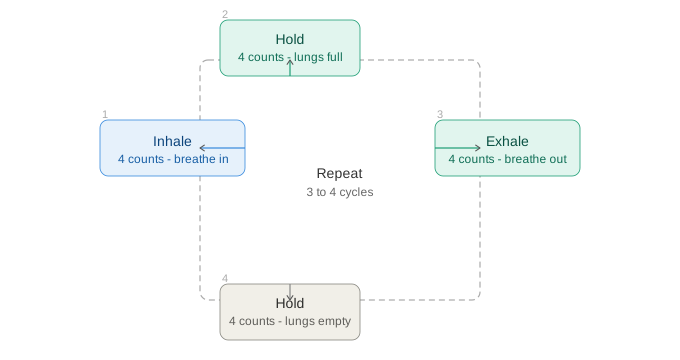
The extended exhale in particular activates the calm side of your nervous system. When you breathe out longer than you breathe in, you are sending a direct signal to your body that the threat has passed. Your heart rate drops. Your muscles stop bracing. The part of your brain responsible for decision-making and fine motor control comes back online.
This is not a metaphor. This is what the body does.
Do this in practice until it is automatic. When you need it in a match, you will not have to think about it.
How Do You Reframe What the Match Actually Means?
Performance anxiety in table tennis is, at its core, a meaning problem.
You are anxious because you have decided that the outcome of this match is a verdict on something important: your skill, your worth, your standing among the people watching. The match has become a referendum on you as a person, and the stakes are, as a result, impossible to manage.
The player who beat the young man from San Fernando did not win because he was better. He won because he had decided, consciously or not, that the match was just a match. He was not on trial. He was playing table tennis.
This reframe is harder than it sounds, and it takes time to mean it rather than just say it. But the practice is this: before each match, write down what you want to learn from it. Not what you want to win. What you want to learn. One specific thing. Maybe you want to test your serve-receive under pressure. Maybe you want to see if your new between-point routine holds when you go down early.
When the match becomes an experiment rather than a verdict, the weight shifts. You are no longer defending yourself. You are gathering information. The outcome still matters, but it is no longer the only thing that matters.
This is not resignation. This is the mental structure of players who compete well consistently, because they have separated their self-worth from the scoreline without losing their drive.
How Do You Deal With the Equipment Variable Nobody Talks About?
There is a cause of performance anxiety in table tennis that almost nobody talks about: players often compete with equipment they do not fully trust.
This matters more than most coaches acknowledge. When you are not confident in your rubber, when you know your blade is slightly off, when your setup is borrowed or unfamiliar, you introduce a variable that sits in the back of your mind during every point. You play with half your attention on the game and half your attention watching your gear, asking whether the shot that just missed was you or your equipment.
That monitoring drains the mental space you need for competition. It also gives you a convenient explanation for failure, which means it never fully goes away, even when the equipment is fine.
The solution is deliberate and boring: spend enough time with your current setup in practice that the question of whether it works is settled before you walk into a tournament. Not almost settled. Settled.
If you are not sure whether your current rubber is helping or hurting your game, that uncertainty is itself a form of anxiety, and it starts at the equipment level, long before the match begins. The mental game and the equipment game are not separate problems. The MentalEdge Course covers exactly this connection.
What’s the Real Truth About Anxiety and Performance?
The player from San Fernando eventually won a national title. It took him four years after that first-round loss, and he did not do it by learning to feel nothing. He did it by building systems: a routine, a breathing practice, a way of thinking about matches that removed the referendum.
The last time I watched him play, he was 9-10 in the fifth against a player who had beaten him twice that year. He bounced the ball three times, exactly as he always did, took one breath, and served. He won the point. He won the match.
He was not fearless. He was practiced.
Overcoming performance anxiety in table tennis does not happen the night before a tournament. It happens in the weeks of deliberate practice that make pressure feel familiar, the routines that anchor your nervous system, the reframes that change what a match means to you.
The anxiety will still show up. It always does. The question is whether you have built the machinery to work with it. Overcoming performance anxiety in table tennis is possible. The players who have done it are not special. They are just more practiced.
What Overcoming Performance Anxiety in Table Tennis Actually Looks Like Day to Day
The seven techniques above for overcoming performance anxiety in table tennis are not a one-time fix. They are a daily practice, and the way you build them into your regular training matters as much as understanding them.
Most players read something like this about overcoming performance anxiety in table tennis, find it interesting, and then do nothing different on Tuesday night at the club. That is not a character flaw. It is a planning failure. The techniques above only work if you schedule them into the way you already train, not as extras you add when you remember, but as structures that replace what you were already doing.
Here is what that looks like in practice.
In the first week, pick one technique: the pre-match routine. Write it down. Three to five steps, specific and repeatable. Do it before every single practice session, not just before matches. You are building a habit, and habits need repetitions, not just good intentions.
In the second week, add the two-second rule. After every point in practice, pause for two seconds, reset deliberately, and return. It will feel slow at first. It will feel artificial. That is what building a new habit feels like. The awkwardness is not a sign that it is not working.
In the third week, add box breathing into the warm-up portion of your routine. Four counts in, four hold, four out, four hold. Three cycles. Every session, before you pick up a paddle.
By week four, you will have three of the seven techniques running automatically, before you have even walked into a tournament. The remaining techniques follow the same logic: one at a time, scheduled into practice, repeated until they require no thought.
Overcoming performance anxiety in table tennis is not a mental insight problem. It is a training architecture problem. The players who manage anxiety well have built it into the structure of how they practice, not just into the way they think about competing.
If you want a structured approach to building that machinery, start with the free ebook: How to Remain Calm When It’s Crunch Time.
Frequently Asked Questions
Why do my hands shake before a competitive table tennis match?
Your body is releasing adrenaline exactly as it’s designed to under perceived stakes. It’s arousal, not malfunction, and the physical sensations of anxiety and excitement are nearly identical.
How do I stop overthinking during a table tennis match?
Build a pre-match and between-point routine specific enough to describe in detail, then run it the same way every time, so your nervous system uses it as a trigger into competition mode rather than analysis mode.
What is the two-second rule for handling emotions during a match?
Give yourself two seconds after any point to feel whatever you feel, then deliberately reset and return your attention to the next serve. The goal is a container for emotion, not suppression of it.
Can breathing techniques really calm you down during a match?
Yes. An extended exhale activates your parasympathetic nervous system directly, signaling to your body that the threat has passed and returning fine motor control and decision-making.
Can equipment uncertainty cause performance anxiety?
Yes. Not fully trusting your rubber or blade adds a background variable your attention keeps monitoring mid-match, draining the mental space competition actually needs.
Leave a Reply