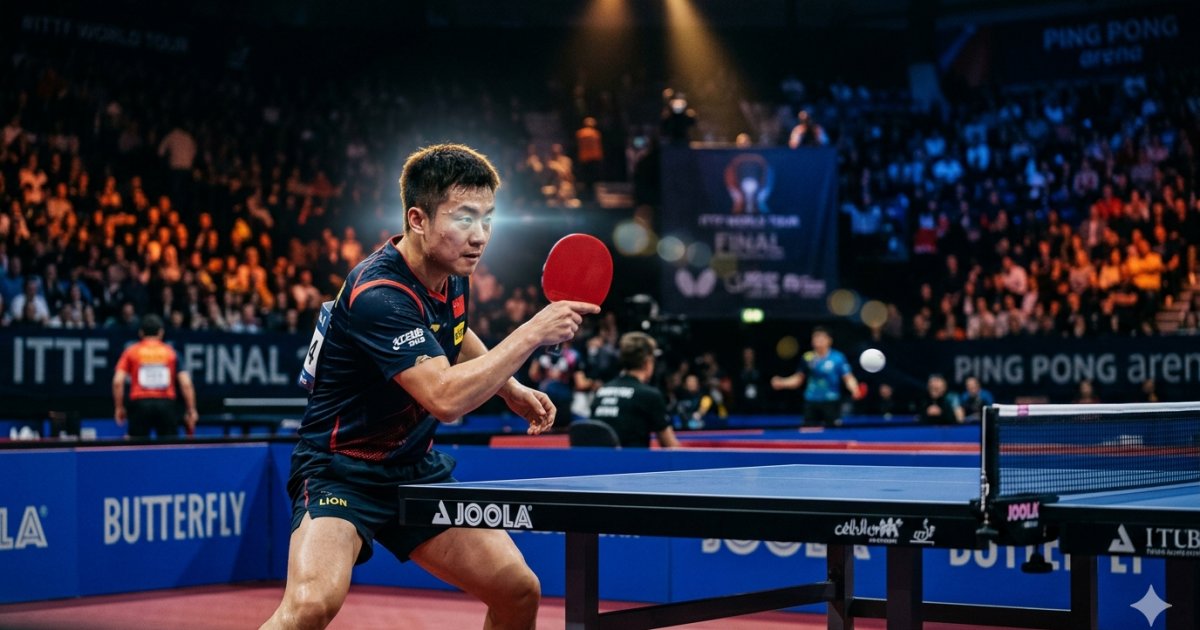
In a study on elite athletes, over 80% said the mental side of competition was as important as physical skill, if not more. Eighty percent. And yet most table tennis players spend almost none of their training time on their minds. I know because I was one of those players. Learning how to perform under pressure in table tennis isn’t optional if you want your training to actually show up on match day.
I remember being 10-7 up in the fifth set of a match I should’ve won in my sleep. My opponent was slower than me, less technical, and had about as much spin variety as a wet sock. But my hands started shaking, my backhand loop went wide three times in a row, and I ended up losing 12-10. I wanted to flip the table, and not in a cool way. I walked off feeling like a fraud.
That match changed how I thought about this sport. It made me realize that table tennis isn’t just a physical game. It’s a mental chess match played at a hundred miles an hour, and if your head isn’t right, none of your training matters. In this guide, I’m going to walk you through everything I’ve learned about how to perform under pressure as a table tennis player, from breathing tricks to building real mental toughness.
Why Do Table Tennis Players Struggle to Perform Under Pressure?
Let’s start with the uncomfortable truth: most of us fall apart under pressure, and it’s not because we’re weak. It’s because nobody ever taught us what pressure actually does to your brain and body, and nobody gave us the tools to deal with it. I didn’t figure this out until way later in my table tennis journey than I’d like to admit.
When you’re under pressure, your brain activates the fight-or-flight response. Cortisol and adrenaline flood your system. Your heart rate spikes, your muscles tighten, and your fine motor skills, the exact things you need for precise table tennis strokes, start to degrade. So that delicate wrist action on your topspin loop? Gone. The soft touch on your drop shot? History. Your body is literally preparing to fight a bear, not play ping pong.
Table tennis is uniquely brutal in this regard, compared to other sports. Points last between two and fifteen seconds. There’s almost no recovery time between points. Every rally is a tiny pressure cooker on its own, and then the next one starts almost immediately. There’s nowhere to hide. In football, you can run away from the ball for thirty seconds and collect yourself. In table tennis, you’re always on.
I’ve seen technically brilliant players, guys with the most buttery forehands you’ve ever witnessed, crumble at 9-9 in the fifth because they had zero mental training. I’ve also seen players with clunky, unorthodox technique beat them just because they stayed cool. It used to drive me absolutely insane to watch. Now I get it. The mental game is often the deciding factor.
Some of the most common signs that pressure is getting to you include rushing your serves, playing it safe when you should be attacking, tensing up your shoulders and grip, and going into your head between points. Sound familiar? It did to me, too. If you recognize yourself in any of this, don’t worry, the rest of this article is basically a roadmap out of that headspace. And if you want a more structured, step-by-step approach, I’ll talk more later about a course called Mental Strength Mastery that’s designed specifically for table tennis players who want to fix this stuff properly.
The first step to solving a problem is knowing you have one. And honestly? Accepting that the mental side of your game needs work is one of the bravest things a competitive player can do.
Why Does the Mental Game Matter More Than You Think?
Here’s something that took me embarrassingly long to understand. You can have the best forehand loop in your club. You can read spin like a wizard. You can train five days a week with a multiball machine, a robot, and a coach who played at the national level. And still, STILL, get beaten by someone technically inferior to you, simply because they have their head screwed on better in competition. I’ve been on both sides of that equation, and being on the losing side is a special kind of frustrating.
The mind-body connection in table tennis is real, and it goes deeper than most players think. Your mental state directly affects your muscle memory. When you’re relaxed and confident, the strokes you’ve drilled thousands of times come out naturally, almost automatically. But the moment anxiety creeps in, that automatic system gets overridden. You start consciously thinking about your backhand technique in the middle of a rally. And the moment you start thinking about mechanics under pressure, you’re cooked. That’s called “paralysis by analysis,” and it’s one of the most common ways pressure kills performance in this sport.
I used to think mental training was just motivational stuff. Like, you know, watching a pump-up video before a match and telling yourself you’re amazing. That has its place. But real mental training is more specific than that. It’s about building systems, breathing protocols, focus anchors, reset routines, and self-talk patterns that kick in automatically when the heat rises. It’s about doing the reps in your brain, just like you do the reps on the table.
What separates your average club player from someone who competes at the regional or national level often isn’t technique; it’s composure. The top players have bad days, make unforced errors, and get rattled. The difference is that they have a mental toolkit to pull themselves back to neutral fast. They don’t dwell on the last point. They reset, refocus, and execute. That’s not a natural talent. That’s a trained skill.
And this is exactly why I think the Mental Strength Mastery course I spoke about earlier is worth paying attention to. It’s built around the specific mental demands of table tennis, not generic sports psychology advice that could apply to any sport, and it gives you a real framework for training your mind the same way you train your strokes. I wish something like that existed when I was grinding through the junior ranks, making every mental mistake in the book. If you’re serious about levelling up your performance under pressure, that’s the kind of structured approach that actually moves the needle.
Neglecting the mental game isn’t just a missed opportunity. It actively costs you matches. Every time you train your technique without also training your mindset, you’re building a sports car with no steering wheel. It looks great, but it’ll go off the road the moment the terrain gets difficult.
What Breathing Techniques Help You Stay Calm During High-Pressure Points?
Alright, let’s get practical. One of the fastest, most underrated tools for performing under pressure as a table tennis player is something you do every second of every day without thinking about it: breathing. “Just breathe” sounds like the lamest advice in the world. But when I actually started applying intentional breathing in my matches, it genuinely changed stuff.
The problem is that when you’re stressed, your breathing automatically becomes shallow and rapid. Short, fast breaths signal to your nervous system that you’re in danger, which keeps the fight-or-flight response cranked up. It’s a vicious cycle. But the relationship goes both ways. Slowing and deepening your breath can actually signal your nervous system to calm down. It’s like a manual override for your stress response. Scientists call it activating the parasympathetic nervous system. I call it “the reset button.”
One technique that works brilliantly between points is box breathing. You breathe in for four counts, hold for four counts, breathe out for four counts, hold for four counts, and repeat. It sounds simple because it is. But it takes conscious practice before it becomes automatic under pressure. I used to practice it while watching TV just to get the rhythm into my body. Weird habit, maybe, but it paid off.
The other thing I do, and I picked this up almost by accident, is to exhale deliberately when I hit my main attacking shot. A short, sharp breath out on contact. It relaxes the muscles in that fraction of a second, reduces grip tension, and actually helps with timing. A lot of top players do this without even realizing it. Watch a professional table tennis match and listen for the little sounds they make on big shots. A lot of that is deliberate breath control.
Between points, you have, depending on the referee, about fifteen to twenty seconds before the next serve. Most players spend that time either replaying the last point in their heads or staring blankly at the table. Both of those are wasted opportunities. Use that time to breathe. Walk slowly to the back of your end. Take one full, deep breath in through your nose, and a long exhale through your mouth. Then refocus. That small routine, done consistently, can keep your arousal level in the optimal zone for performance.
I went into a tournament once, having practiced box breathing religiously for three weeks beforehand. I got to a deciding game in every match I played that day, and I won all of them. Was it entirely down to the breathing? No, probably not. But it kept me present and calm in the moments that mattered most, and that’s not a small thing.
Practice your breathing off the table as much as on it. Make it a reflex. Because in a tight match, you won’t have space to think about doing it, it needs to happen automatically.
How to Build Mental Toughness for Table Tennis
Mental toughness. Everyone talks about it. Very few people actually train it. And for a long time, I thought it was one of those things you either had or you didn’t, like you were born mentally tough or you weren’t. Spoiler: That is absolute nonsense. Mental toughness is a skill. You build it. You practice it. And it’s available to literally anyone willing to put in the work.
So what does mental toughness actually mean in the context of table tennis? It’s not about being emotionless, or pretending you don’t care, or having some kind of robotic calm that nothing can crack. Real mental toughness means being able to stay committed to your game plan when things go wrong. It means being able to tolerate discomfort, physical, emotional, and competitive, and still execute. It means bouncing back from a bad run of points without letting it spiral into a full collapse.
One of the best ways to build mental toughness is to deliberately seek out discomfort in training. Not just physically tough training, but mentally challenging situations. Play matches where you start every game at 0-5 down. Compete against people who are significantly better than you, regularly. Put pressure bets on your training matches, not money necessarily, but something that makes the outcome matter. Do drills where you have to reach a target score before your training partner does, with consequences for failure. These kinds of scenarios build your capacity to perform under pressure because they expose you to pressure repeatedly in a controlled environment.
Visualization is another massive tool that I slept on for way too long. I used to think it was a bit woo-woo, if I’m honest. But there’s serious sports science behind it. When you vividly visualize performing a skill, your brain activates many of the same neural pathways as when you physically perform it. So mentally rehearsing playing at 10-10 in the fifth, feeling the nerves, seeing the ball, executing your shots, actually prepares your nervous system for when that situation becomes real. I now spend ten minutes before every match doing this, and it’s become one of the most valuable parts of my preparation.
Self-talk is the other piece that people underestimate. The voice in your head during a match either helps you or hurts you; there’s no neutral position. Negative self-talk (“I always blow it at this score,” “my backhand is terrible today,” “why am I even here”) is genuinely destructive to performance. It’s not just unhelpful, it actively degrades the quality of your strokes by increasing tension and doubt. Learning to catch negative self-talk and replace it with something cue-based and constructive (“stay low,” “watch the ball,” “play your game”) is a learnable skill that makes a measurable difference.
Daily habits matter too. Sleep, nutrition, and managing overall stress levels in your life all affect your mental toughness reservoir. You can’t be chronically stressed, sleep-deprived, and caffeine-dependent, then wonder why you fall apart at 9-9 in the fifth. Your mental resilience is directly connected to your overall well-being. I learned this the hard way during a period when work was relentless, and I was playing my worst table tennis in years, and the two were absolutely connected.
How Do You Stay in the Zone Under Pressure?
“The zone.” Every player has been there at least once. That feeling where the game slows down, every decision feels obvious, your shots come out crisp and clean without you even trying, and you feel like you literally cannot miss. It’s the greatest feeling in table tennis, and honestly, in most of life. The frustrating thing is it feels like it just happens to you, like you can’t control when you enter it or stay in it. But that’s not entirely true.
The zone, what sports psychologists call a “flow state,” is a specific mental condition where you’re fully absorbed in the present moment, your arousal level is optimal, and you’re not overthinking or second-guessing. It’s actually possible to create conditions that make entering the zone more likely, and just as importantly, to build routines that help you stay there or return to it after getting knocked out of it by a bad point.
Concentration in table tennis is about controlling attention. And attention in this sport has to be very specifically focused. The research on elite sports performance suggests that the best performers focus on process cues, things within their control, rather than outcome cues like the score. When you’re thinking, “I need to win this point to get to game point,” you’re focused on the outcome. When you’re thinking “watch the ball, stay low, load the hip,” you’re focused on process. Process focus keeps you in the zone. Outcome focus usually kicks you out of it.
Pre-point routines are one of the most powerful tools for maintaining concentration. A pre-point routine is a brief, consistent sequence of actions and thoughts you do before every point, whether you’re serving or receiving. It might look like: bounce the ball twice, take a breath, pick your serve variation, visualize the opening ball, and get into your ready position. The key is that it’s consistent and it ends with a clear focus anchor, a word, an image, a physical sensation that tells your brain, “we’re in competition mode.” Over time, this routine becomes a trigger for focus. Your brain learns to shift into the right gear when you go through it.
Resetting after bad points is equally critical. We all lose points. The players who perform best under pressure are not the ones who never get rattled; they’re the ones who reset fastest. A good reset routine might be as simple as turning your back to the table, taking one deep breath, giving yourself one instructional cue (“next ball, attack the backhand”), and walking back to the table. The whole thing takes five seconds. But those five seconds are the difference between carrying a bad point into the next one or leaving it behind.
I had a coach once who told me, “The last point is gone, it doesn’t exist anymore. All that exists is the next serve.” That sounds simple. But training yourself to actually believe and live by that under match pressure takes real practice. It’s not natural. Your brain wants to replay mistakes, analyze what went wrong, and feel the embarrassment. You have to interrupt that loop deliberately. Every. Single. Time.
How Do You Manage Nerves Before and During a Match?
Let me tell you about the first big tournament I played. I barely slept the night before. I ate half a banana for breakfast because everything else made me feel sick. My hands were literally trembling when I warmed up, and I played the first two games of my first match like someone who’d never held a paddle before. Lost both games easily, clawed back the next two, and scraped through on willpower alone. I had all the technical preparation in the world, and my nerves nearly tanked the whole thing.
Here’s something that genuinely helped me reframe nerves: not all nerves are bad. In fact, a certain amount of physiological arousal is actually performance-enhancing. Your heart rate is going up, a bit of adrenaline is in your system, and heightened alertness; these are the same physical responses as excitement. The difference between “I’m scared” and “I’m excited” is often just the story you’re telling yourself about the sensations. Some sports psychologists call this “reappraisal,” and research shows that telling yourself “I’m excited, not nervous” before competition actually improves performance compared to trying to calm down. I started doing this, and it genuinely helped. Instead of fighting the feeling, I started treating it as fuel.
That said, there’s a level of anxiety that goes beyond useful and starts to hurt you. If your hands won’t stop shaking, your mind is blanking on your game plan, and you’re second-guessing every decision, that’s anxiety in the red zone, and you need tools to bring it down. Pre-match rituals are huge here. A consistent warm-up routine in terms of both duration and content gives your brain a familiar, calming signal. It’s like telling your nervous system, “We’ve done this before, we know what to do.”
Music can be a powerful pre-match tool too. I have a playlist that I’ve used before matches for years. Certain songs in it trigger a specific confident, focused mental state almost automatically; now it’s basically classical conditioning at this point. I walk into the playing hall with my headphones in, and my brain shifts into competition mode whether I want it to or not.
Mid-match nerves are a different beast. They often spike at specific moments when you’ve just made a mistake on an important point, when you’re close to winning and don’t want to blow it, or when you’re coming from behind and can sense a comeback. When nerves spike mid-match, the most important thing is to slow down. Not your play, your transitions. Walk slower between points. Take your time with your serves. Use the maximum amount of time the rules allow between points. Rushing is almost always a response to nerves, and it almost always makes things worse.
Managing nerves also means managing your inner voice in those moments. Telling yourself “stop being nervous” doesn’t work; it’s like telling someone not to think about a pink elephant. Instead, give your brain a job. Focus on something specific and controllable: your serve placement, your ready position, and watching the seam of the ball. A brain that has a task is a brain that isn’t generating anxiety.
How to Perform Under Pressure With Practice
This is the section that I think gets overlooked the most, and it’s something I messed up badly for years. I used to train hard, genuinely hard, and then show up to competitions and play well below my training level. And I couldn’t figure out why for the longest time. The answer, eventually, was obvious: I never practiced performing under pressure. I just practiced. Two very different things.
The training environment for most club players is completely pressure-free. You’re playing with people you know, in a familiar place, with no score that really matters, and no consequences for missing. Your nervous system is relaxed. And you get really, really good at playing table tennis when you’re relaxed. The problem is that competition is nothing like that. Competition has stakes, strangers, unfamiliar environments, tight scores, and consequences. And if your nervous system has never been trained to perform under those conditions, it has no idea what to do when they arrive.
The solution is to deliberately introduce pressure into your training. One of my favorite ways to do this is “pressure serve practice.” Instead of just serving into an empty half of the table for reps, I’ll tell my training partner: I need to land ten specific serves in a row to a precise target. If I miss one, I start the count again. That’s pressure. That’s the stakes. That tightens up the throat a little, and that’s exactly what you need to practice performing through.
Another great method is competitive drills with consequences. You and your training partner play a multiball drill where whoever loses the session has to pack away the equipment, buy dinner, or do twenty press-ups. Silly consequences, maybe. But the moment something is on the line, the pressure changes. I’ve seen players completely transform under drill conditions the moment a small forfeit is involved. Their technique tightens, their focus sharpens, and some of them absolutely crumble, which tells them exactly what they need to work on.
Playing up is one of the most underused and most effective things you can do. Regularly competing against players significantly better than you forces you to perform under conditions where almost every point feels like a pressure point. You’ll lose, often. But you’ll learn to stay composed under fire faster than almost any other method. I used to hate playing against our club’s top players because I felt embarrassed by the scorelines. Now I seek those sessions out specifically because of how much they sharpen my mental game.
Use competitions themselves as mental training opportunities. Not every tournament is a final. Go to lower-stakes events with the explicit goal of experimenting with your mental strategies, your breathing routine, your pre-point routine, and your reset habits. Treat the whole tournament as a mental skills lab. This removes the “win at all costs” pressure and lets you actually practice the mental game in real conditions. Some of my biggest mental breakthroughs happened at tournaments where I went in with zero expectations and just focused on executing my mental tools consistently.
How Can the MentalEdge Course Unlock Your Full Potential?
Okay, let’s talk about this directly for a minute, because I think it’s genuinely important. Everything we’ve covered in this article, breathing techniques, mental toughness habits, focus routines, pressure training, nerve management, is real, proven, and powerful. But here’s the truth: reading about it is only the beginning. Knowing the theory and actually having it wired into your game under competitive pressure are two completely different things. And bridging that gap usually requires structured, progressive, guided training.
That’s exactly what the Mental Strength Mastery course is built to do. It’s not a generic mindset course with some rebranded table tennis graphics slapped on it. It’s built specifically for the mental demands of competitive table tennis, the fast-twitch decision-making, the point-by-point pressure, the unique psychological challenges of a one-on-one sport where you can’t hide behind teammates and every mistake is completely visible.
Think about what it would mean for your game if you had a structured system that walked you through exactly how to build a pre-match mental routine, how to develop focus anchors that actually work under fire, how to train your self-talk to become a performance enhancer instead of a performance killer, and how to create the mental reset habits that keep you in every match, even when the wheels start to come off. That’s not a dream, that’s a trainable, learnable skillset. And having a course that guides you through it methodically is miles better than piecing it together from YouTube videos and random blog posts (no offense to those, including this one!).
One of the things I love about having a dedicated mental training program is accountability. When you have a structured course with modules and exercises, you actually do the mental training instead of just thinking “I should probably work on my mindset” and then going back to hitting forehands for an hour. The mental game needs the same disciplined, consistent practice that your strokes get. A course gives you that structure.
If you’re the kind of player who trains hard physically but still underperforms in competition, the answer is almost certainly in the mental game. And if you’ve read this far into this article, you already know that. The next step is doing something about it. Head over to MentalEdge Course and check out what the Mental Strength Mastery course offers. Investing in your mental game now is one of the smartest moves you can make for your competitive future. It’s the training most of your opponents are completely ignoring, which means it’s your biggest potential advantage.
What’s the Bottom Line on Performing Under Pressure?
So there you have it. We’ve covered a lot of ground, and I hope by now it’s crystal clear that learning how to perform under pressure as a table tennis player isn’t about hoping you’re in a good headspace on match day. It’s about building deliberately, consistently, over time, a mental game that’s just as trained and reliable as your forehand loop or your short backhand push.
The key things to take away? Understand why pressure messes with your performance physiologically, so you stop blaming yourself and start fixing the root cause. Train your breathing until it’s an automatic reset tool. Build mental toughness habits into your daily routine: visualization, self-talk, deliberate discomfort. Create focus and reset routines that keep you in the present moment, point after point. Manage your nerves by reframing them as fuel, and slow down when the heat rises. And most importantly, practice performing under pressure in training, not just technique in a pressure-free bubble.
The mental game is the great equalizer in table tennis. It’s where average players become dangerous and good players become great. You don’t need to be the most technically gifted person in the room. You need to be the most mentally prepared.
Now get out there, do the work, and go win some close fifth games.
Have your own tips for performing under pressure at the table? Drop them in the comments. I’d love to hear what’s worked for you! For a practical framework to take into your next match, the free ESTableTennis ebook on staying calm under pressure is the right place to start.
Frequently Asked Questions
How can I perform better under pressure in table tennis?
Train your breathing until it becomes an automatic reset tool, build a consistent pre-point routine, reframe nervous arousal as excitement rather than fear, and deliberately practice under manufactured pressure instead of only relaxed drilling.
Why do I fall apart in tight games even when I train hard?
Most training happens in low-pressure conditions with no real stakes, so your nervous system never learns to execute under the fight-or-flight response that a genuinely tight score triggers.
Does breathing really help with pressure in table tennis?
Yes. Slow, deliberate breathing activates your parasympathetic nervous system, directly counteracting the fight-or-flight response that shallow, rapid breathing under stress keeps switched on.
Is mental toughness something you are born with?
No. Mental toughness is a trainable skill built through deliberately practicing under discomfort, visualization, and directed self-talk, not a fixed trait some players have and others do not.
How do I practice performing under pressure before a real match?
Add real stakes to training: pressure serve drills with a miss-and-restart rule, small consequences for losing a practice game, and regularly playing opponents better than you.
Leave a Reply