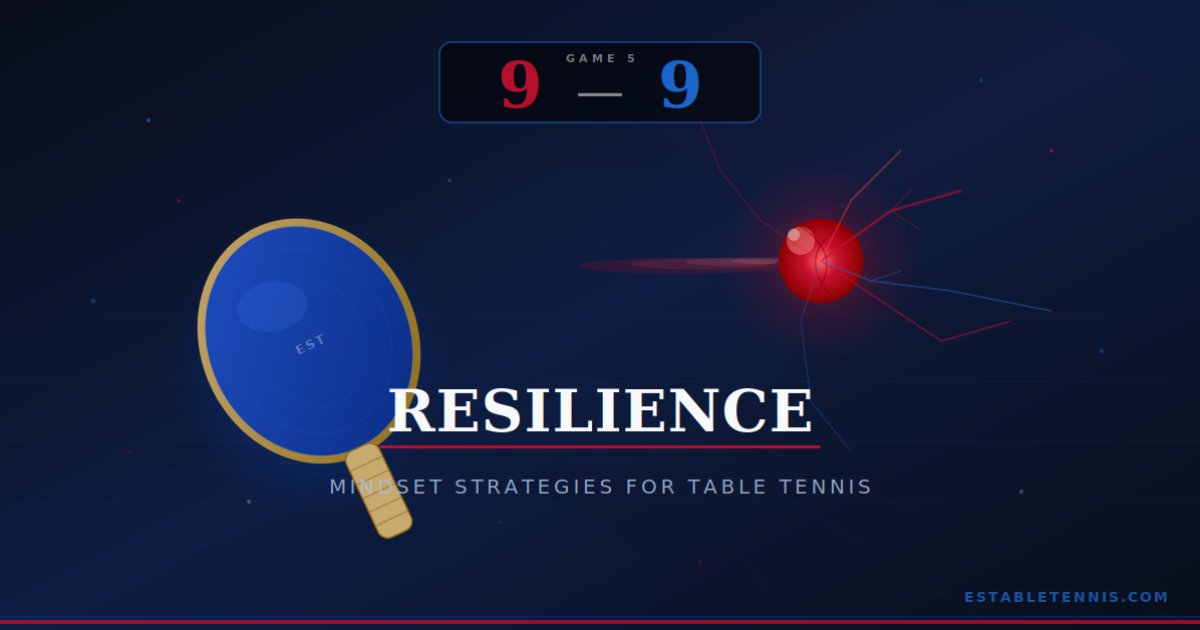
Here’s a stat that might surprise you: research in sports psychology consistently shows that mental factors account for up to 90% of performance at the competitive level once athletes reach a similar physical skill threshold. And yet most table tennis players spend maybe 2% of their training time on the mental side of the game. I know I did for years, and it cost me more matches than any technical weakness ever did.
Table tennis is brutal on the mind. The points are fast, the momentum swings are violent, and there is nowhere to hide. You can’t run down the clock, you can’t call a timeout to regroup, and you definitely can’t blame the team. It is just you, the ball, and whatever story your brain decides to tell you at 9-9 in the fifth set. That story, more than your forehand or your footwork, is what determines the outcome.
This article is about changing that story. Specifically, it is about building the kind of resilience that lets you absorb a bad run of points, shake off a humiliating loss, and come back to the table mentally stronger than before. We are going to go deep on mindset strategies that actually work, not the vague “just believe in yourself” advice that fills motivational posters.
What Does Resilience in Table Tennis Actually Mean?
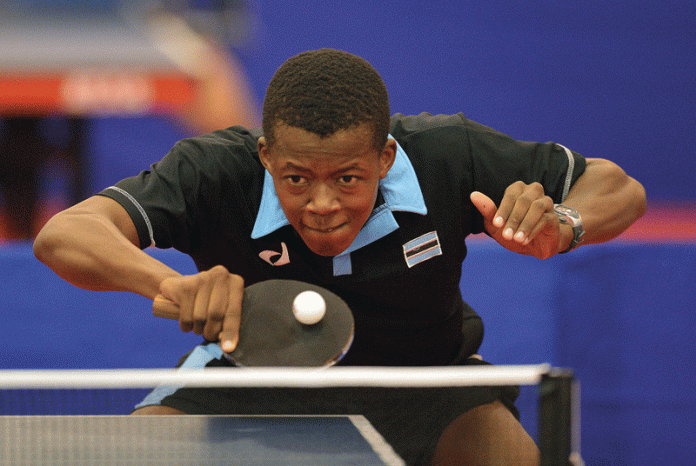
I used to think resilience was just another word for toughness. Like, you grit your teeth, you don’t cry when you lose, and you show up the next day. That’s not resilience. That’s just stubbornness with a sports uniform on. Real resilience in table tennis is something much more specific, and once I understood the difference, everything about my mental game started to shift.
Resilience is your capacity to absorb a disruption and return to functional performance. That’s it. It is not about never feeling rattled. It is about how quickly and how completely you recover after you do get rattled. Every player gets rattled. The 2,700-rated player gets rattled. The difference is the recovery time and the quality of the comeback.
Table tennis demands resilience more than almost any other racket sport, and I’ll tell you why. The scoring system means one bad run can flip a whole set in under two minutes. In tennis, a bad game costs you a game. In table tennis, a bad two minutes can cost you the match. The ball moves at speeds that leave almost no processing time, so your mental state bleeds directly into your execution with almost zero buffer. There’s no slow drift between mental error and physical error. It’s instant.
A lot of players also confuse resilience with having no emotions. I’ve heard coaches tell kids to “switch off” after a mistake, as if you can just unplug your feelings like a toaster. That’s not how the brain works, and honestly, chasing emotional numbness is a trap. The goal is not to feel nothing. The goal is to feel the frustration, acknowledge it, and then get it out of the way fast enough that it doesn’t eat your next three points.
One more thing worth naming here: resilience is not a personality trait you either have or don’t. It is a skill. It is trainable. That is probably the most important thing in this entire article, so let me say it again. Resilience is a skill you can train, just like your backhand loop. If you believe it’s something you’re born with, you’ll never bother developing it. But if you treat it like a technique to be drilled, everything changes.
Why Do Most Players Crack Under Pressure, and How Do You Stop It?
Most players crack because a missed shot triggers a mental spiral: the brain flags it as a pattern, muscles tighten, and the technical errors that follow are symptoms of an anxiety response, not a swing problem. I remember a league match a few years back where I was leading 10-6 in the final set. I was already mentally celebrating. And then, somehow, I lost 10-12. Four points in a row went sideways, I started tightening up, the errors multiplied, and by the time I figured out what was happening, it was over. Sound familiar? That collapse did not happen because my technique fell apart. It happened because my brain started running a very unhelpful program.
The mental spiral is real, and it works like this. You miss one ball you should have put away. Instead of moving on, your brain flags it as a problem. Then you miss another, and now your brain is treating it as a pattern. By the third mistake, you are no longer playing table tennis. You are managing anxiety. Your muscles tighten, your swing shortens, and your decision-making slows to a crawl. The technical errors are just symptoms. The disease is mental.
A huge part of what drives this spiral is ego involvement. When we confuse our identity with our score, every missed point feels like a personal attack on our self-worth. That sounds dramatic, but it’s true for most competitive players, whether they admit it or not. I’ve done it hundreds of times. The shift that helps is moving from ego goals (winning, looking good) to process goals (executing my serve, staying balanced, reading the spin). When the process is your focus, a missed point is just information. When your ego is the focus, a missed point is a crisis.
Self-talk is the engine of the spiral. Most players have no idea what their inner voice is saying during a match because it happens so fast it feels automatic. But if you slow it down and really listen, you will probably find some variation of “typical,” “you always do this,” or “you’re blowing it again.” Those are not neutral observations. That is your brain actively writing a story of failure, and your nervous system is reading every word. Changing that inner voice is not soft. It is one of the highest-leverage things you can do for your game.
Pattern interruption is the practical fix. When you feel the spiral starting, you need a deliberate action to break the pattern before it accelerates. That might be a physical cue like bouncing on your heels, taking one slow breath, or adjusting your grip for a second. The specific action matters less than the fact that it is consistent and deliberate. You are essentially telling your brain: we are pausing the current program and loading a new one. Do it every single time, especially when you don’t feel like it, and over time it becomes automatic.
How Do You Build a Pre-Match Mindset Routine That Actually Works?
Build a pre-match routine around breathing, a focus anchor, and process goals set before the match, since the mental warm-up matters as much as the physical one. 
For most of my early competitive career, my pre-match routine was: show up, hit a few balls, and hope for the best. I was not unusual in that. Most club players treat mental preparation like something you do if you happen to have extra time, which of course you never do. But the pre-match window is actually when you set the tone for your entire mental performance, and ignoring it is like showing up to a race with cold muscles.
The mental warm-up should start before you ever pick up your paddle. I’m talking about the drive to the venue, the time in the changing room, the moments while you’re watching other matches. Your brain is already orienting itself. The question is whether you are directing that orientation or just letting random anxiety fill the space. Even five minutes of intentional mental prep makes a measurable difference.
Breathing is the most underused tool in the game. Breathing advice sounds like something off a yoga Instagram account. Here’s what’s actually happening: slow, controlled breathing activates your parasympathetic nervous system, which physically counteracts the cortisol response. You cannot be in full fight-or-flight mode and breathe slowly at the same time. It’s physiologically incompatible. A simple box breath (four counts in, four counts hold, four counts out) done five to ten times is enough to bring your arousal level down to a workable range before a big match.
Focus anchors are another tool I picked up through trial and error. A focus anchor is a specific phrase or mental image you return to when your attention drifts. Mine used to be “ball and feet,” meaning I would redirect my attention to tracking the ball and moving my feet. Simple, concrete, and functional. When my brain started wandering into scoreboard territory, “ball and feet” brought me back to process. Pick something relevant to your game and short enough to fire off in one breath.
Setting process goals before the match is where it all comes together. Instead of going in thinking “I need to win this,” you go in thinking “I’m going to attack the wide backhand, stay low, and reset after every error.” That is a process goal. You can execute it regardless of the score. You can evaluate it without checking the scoreboard. And honestly, when you nail your process goals, winning tends to follow anyway because you are playing better table tennis.
How to Reset Between Points Like a Champion
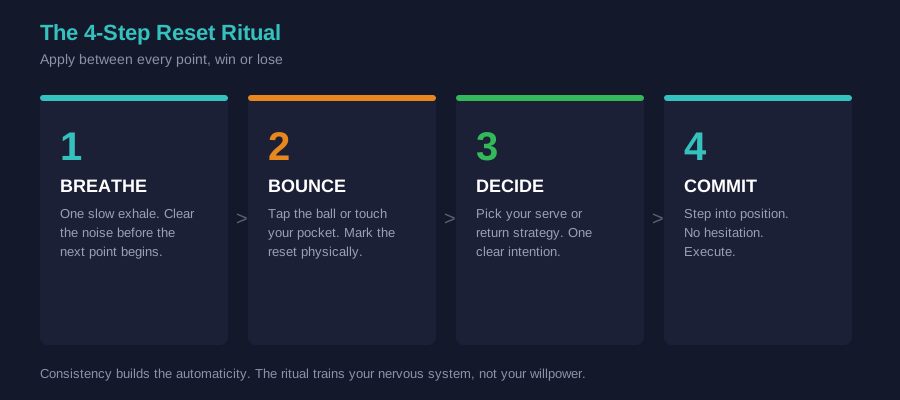
Between every single point in a table tennis match, there is a window. It’s short, maybe ten to fifteen seconds if you’re collecting the ball deliberately, and most players waste it completely. They are either replaying the last point in their head or worrying about the next one. Elite players use that window differently, and it is one of the most concrete and coachable aspects of mental resilience in the sport.
The physical ritual is the starting point. Watch any elite table tennis player, and you’ll notice they do something consistent between points: a spin of the paddle, a bounce on the toes, a wipe of the hand on the shirt, a look at the paddle edge. These are not nervous habits. They are deliberate psychological anchors that signal “the last point is over and the next point is fresh.” The physical action creates a mental boundary. Without that boundary, points bleed together, and emotions accumulate until the pressure is unbearable.
Letting go of the last point is maybe the single hardest mental skill in the sport. I’ve lost matches I should have won simply because I couldn’t stop replaying a serve error from four points ago. The brain wants to analyze, problem-solve, and prevent future mistakes, which is a great feature in most contexts. At the table between points, it is a disaster. The antidote is not to tell yourself “don’t think about it,” because that doesn’t work. The antidote is to redirect. Pick your next tactical intention before the next serve, and your brain has something useful to do instead of obsessing over the mistake.
The bounce-back technique is specifically for strings of errors, that nightmare run where you miss three in a row and start to feel like you’ve forgotten how to play. The technique is simple: after a bad run, deliberately slow everything down. Take an extra second to collect the ball. Take one breath. Pick the most basic, reliable shot in your game and use it on the next point. Win the point, no matter how basic. Small wins interrupt losing momentum, and your brain responds to them even when your rational mind knows you’re “just” keeping the ball on the table.
Here’s something nobody told me until way too late: the between-point routine has to be practiced. Not thought about, practiced. You need to do it in training until it is as automatic as your footwork. A lot of players have a between-point routine in theory that completely evaporates under match pressure because they never trained it under stress. Build it in low-stakes training. Then build it in practice matches. Then it will be there when it matters.
How Do You Turn Losses Into Resilience-Building Fuel?
Turn a loss into fuel with a three-question review, what worked, what didn’t, what you’ll change, then release the emotional weight once you’ve extracted one specific, actionable takeaway. I spent years hating losses. Like, genuinely dreading them, avoiding thinking about them, changing the subject when people brought them up. And in doing that, I wasted probably the most valuable training resource available to a competitive player. A loss is a live-fire exercise in every mental and technical weakness you have. That is uncomfortable. It is also incredibly useful if you know how to process it.
The post-match review is your first tool. Not a full coaching debrief every time, but a structured few minutes of honest reflection. I use three questions: What worked? What didn’t? What’s one thing I’ll do differently? That’s it. The goal is not to produce a comprehensive scouting report on yourself. The goal is to extract one useful thing and let the rest go. Writing it down matters because it shifts the experience from something that happened to you into something you are actively learning from.
Reframing a bad result is crucial, but there’s a right way and a wrong way to do it. The wrong way is toxic positivity: “it’s fine, I learned so much, every loss is a gift!” That is not honest, and your competitive instincts will reject it. The right way is honest reframing: “I got outplayed in the third set because I had no answer for his heavy topspin. That’s a specific problem I can address.” You are not pretending the loss was secretly great. You are extracting a specific, actionable takeaway while releasing the emotional weight of the result.
One thing I’ve noticed over the years is that players who develop strong resilience tend to have a healthy relationship with losing, not a comfortable one. They don’t like losing. They sometimes feel genuinely terrible after a loss. But they don’t let the loss define them or contaminate their self-image as a player. That separation between “I lost that match” and “I am a loser” is subtle but absolutely fundamental. You need to be able to feel the disappointment fully and then put it down when the analysis is done.
The players who never develop resilience are usually the ones who either avoid losses entirely by playing down in competition, or who drown in them and carry the emotional weight for days. Both responses protect the ego at the expense of growth. The middle path is to sit with the discomfort long enough to learn from it, and then move on with intention. That is not natural for most people. It requires practice. But it is the foundation of every resilient competitor I have ever known.
What Role Does Practice Play in Hardwiring Mental Resilience?
Practice hardwires resilience only when it includes pressure drills with real costs for failure, since thinking about resilience doesn’t build it the way manufactured stress does. Here’s something I had to learn the hard way: you cannot think your way to resilience. You can read every sports psychology book ever written, understand every concept perfectly, and still completely fall apart at 9-9 in the fifth. Mental resilience, just like physical technique, has to be trained in conditions that resemble the ones where you need it. Thinking about it is not training it.
Pressure drills are the best practical tool for this. A pressure drill is any training exercise that introduces a cost for failure similar to what you experience in matches. Points scoring with real consequences (loser does push-ups, winner picks the next drill), training games where you start at a deficit, serve and receive competitions where the score is tracked and announced. These are not just fun variations. They are simulation environments for your nervous system. Every time you manage your arousal level in a pressure drill and execute anyway, you are literally building neural pathways for resilience.
Training with players who challenge you mentally is something that took me embarrassingly long to prioritize. I used to seek out training partners I could beat comfortably because it felt good. What I actually needed were players who made me uncomfortable, players who competed hard even in training, who mixed in trash talk or played unusual styles or pushed me to my edge technically. Those players taught me more about my mental game than any drill, because they triggered the real emotional responses I needed to learn to manage.
Deliberate practice, in the table tennis context, means not just hitting lots of balls but designing your practice to address specific weaknesses under conditions of stress. If you know you crack when you’re returning a heavy backspin serve at 9-9, then you need to practice heavy backspin receives in high-pressure situations, repeatedly, until the situation stops triggering a stress response. That is the slow, unglamorous work of hardwiring mental resilience. There are no shortcuts, and anyone who tells you otherwise is selling something.
Confidence is the product of this process, not the prerequisite. A lot of players wait to feel confident before they compete hard or take on tough training partners. It works the other way around. You build confidence by accumulating evidence of successful execution under pressure. Every time you handle a tough training drill well, you are depositing into your confidence account. By the time you reach a high-stakes match, that account either has funds in it, or it doesn’t, and no amount of positive thinking will substitute for the deposits.
What Self-Talk Scripts Rebuild Confidence Mid-Match?
Effective mid-match self-talk is evidence-based and short: one honest sentence that redirects your attention to the very next action, not a generic affirmation. If you could record and play back your internal monologue during a tough match, I guarantee most players would be horrified. Not because they’re weak or negative people, but because the competitive brain under stress defaults to a very specific kind of unhelpful narration. “Here we go again.” “You always tighten up here.” “You’re going to blow this.” That stuff runs on autopilot, and unless you’ve trained an alternative, it runs unchallenged.
The first step is just awareness. Start paying attention to what your inner voice actually says during practice matches. Don’t judge it yet, just notice. You will probably find that it falls into a few recurring patterns: catastrophizing, self-blame, comparison to past failures. Once you identify the patterns, you can start to build counter-scripts that feel authentic rather than forced.
Cue words are the simplest and most effective self-talk tool I’ve found. A cue word is a single word or short phrase that you associate with a specific mental or physical state you want to access. “Loose” might remind you to relax your grip. “Ready” might trigger your pre-point focus stance. “Next” might be your between-point reset cue. The key is to practice the cue in training until the association is strong, and then it becomes a shortcut to the state you need in a match.
Affirmations have gotten a bad reputation in sports because most of them are garbage. “I am a champion!” shouted into the mirror means nothing if there is no evidence behind it. The kind of self-talk that works mid-match is evidence-based. “I’ve handled this pressure before.” “I know how to return this serve.” “I’ve come back from worse.” These are not delusions. They are accurate statements that redirect your attention to your actual capabilities and history. That’s a very different thing from generic positive thinking.
The mid-match script I recommend to players I work with goes something like this. After a bad point: “That’s done. What do I want to do next?” After a good point: “That’s the game I want to play.” Before a pressure point: “I’ve been here before. Breathe. Pick my target.” It’s not poetry. It does not need to be. It needs to be honest, brief, and redirect attention to the immediate next action. Anything longer than one sentence is too long to use between points.
One thing worth noting is that self-talk has to match your personality. Some players are motivated by challenge: “Let’s see if I can come back from this.” Others need calm: “Stay easy, stay simple.” A script that works for one player might actually increase anxiety in another. Experiment in training, not in your biggest matches of the year, until you find language that genuinely shifts your state. When you find it, protect it and use it consistently.
How Do You Build Resilience After a Long Losing Streak?
Rebuild during a losing streak with micro-goals, executing one process cue consistently, rather than chasing your usual big results, since achievable wins interrupt negative momentum. Nobody talks about the losing streak. Everyone talks about the comeback, the turnaround, the triumphant return. Nobody really talks about being in the middle of a losing streak, which is where resilience is actually tested most severely. Not in the big match. In the third tournament in a row where you’ve lost in the early rounds, and you’re starting to wonder if something is fundamentally wrong with you.
The first thing to acknowledge is that losing streaks are normal. Every competitive player at every level goes through them. Your rating drops, your confidence dips, your training starts to feel hollow, and the results keep going the wrong way. The players who come out the other side stronger are not the ones who had some sudden revelation. They are the ones who managed to keep showing up with enough intention to keep learning, even when results weren’t there.
Rebuilding during a streak starts with micro-goals. When your big goals feel impossibly out of reach, the productive move is to shrink the target dramatically. Don’t aim to win the next tournament. Aim to execute your serve variation in your next three matches. Aim to use your reset cue consistently during the next training session. Aim to try one new tactical approach this week. These tiny targets give you something achievable to pursue, and achievement, even small achievement, interrupts the negative momentum.
The trap that a lot of players fall into during a losing streak is overcomplicating their game. They start changing everything at once, experimenting with new techniques, overhauling their tactics, seeking magical solutions. I’ve done this. It never helped. Usually, what a losing streak reveals is not a need for complexity but a need to return to fundamentals executed with better mental presence. Play simpler, not fancier. Focus harder, not differently.
Knowing when to take a break versus when to push through is genuinely difficult, and I don’t think there is a universal answer. If you are exhausted and resentful, a break is probably not weakness; it is sensible recovery. But if you are frustrated and scared, pushing through is usually the right call because avoiding the thing you fear only makes the fear bigger. The honest question to ask yourself is: am I tired, or am I scared? The answer points you in the right direction.
What’s the Bottom Line on Building Resilience in Table Tennis?
Resilience in table tennis is not a gift that some players get, and others don’t. It’s a set of skills, and skills can be developed, drilled, and refined over time. Everything we’ve covered in this article, from managing your self-talk to using your between-point window to processing a loss honestly, comes down to one core idea: your mental game is coachable. It responds to practice. It improves with attention.
If you take nothing else from this, take this: pick one strategy from this article and apply it intentionally in your next three training sessions. Not all of them. One. Maybe it’s the between-point breathing cue. Maybe it’s the post-match three-question review. Maybe it’s just starting to notice what your inner voice says when you’re under pressure. One thing, applied consistently, will do more for your resilience than understanding every concept here perfectly.
The mental side of table tennis is where your ceiling actually lives. Your technique will plateau. Your physical conditioning has limits. Your mental game? There’s no ceiling. The best players in the world are still working on it. That should be exciting, not intimidating, because it means no matter where you are right now, there is room to grow into a more resilient, more complete competitor.
If you’re serious about taking your mental game to the next level, get the Mentaledge Ebook for free here.
Now I want to hear from you. What’s your biggest mental challenge at the table? A losing streak, pressure points, post-loss spiraling? Drop it in the comments. Let’s talk about it, because the conversation around table tennis psychology is one we don’t have nearly enough.
Frequently Asked Questions
What is mental resilience in table tennis?
The capacity to absorb a disruption, a bad point, a bad game, a loss, and return to functional performance quickly, not the absence of frustration.
Why do I collapse mentally after a few bad points in a row?
A missed shot gets flagged by your brain as a pattern rather than an isolated event, triggering an anxiety response that tightens your muscles and shortens your swing before you consciously notice.
Is mental toughness something you’re born with or can you train it?
It’s trainable, the same way a stroke is trainable. Treating it as a fixed personality trait is exactly what stops most players from ever developing it.
How do I stop replaying my mistakes during a match?
Redirect instead of suppressing: pick your next tactical intention before the next serve, since telling yourself not to think about an error rarely works.
What should I do during a losing streak?
Shrink your goals to something immediately achievable, like executing one process cue consistently, rather than chasing the big results that feel out of reach.
For the full system behind these resilience strategies, the MentalEdge Course covers it end to end.
Leave a Reply