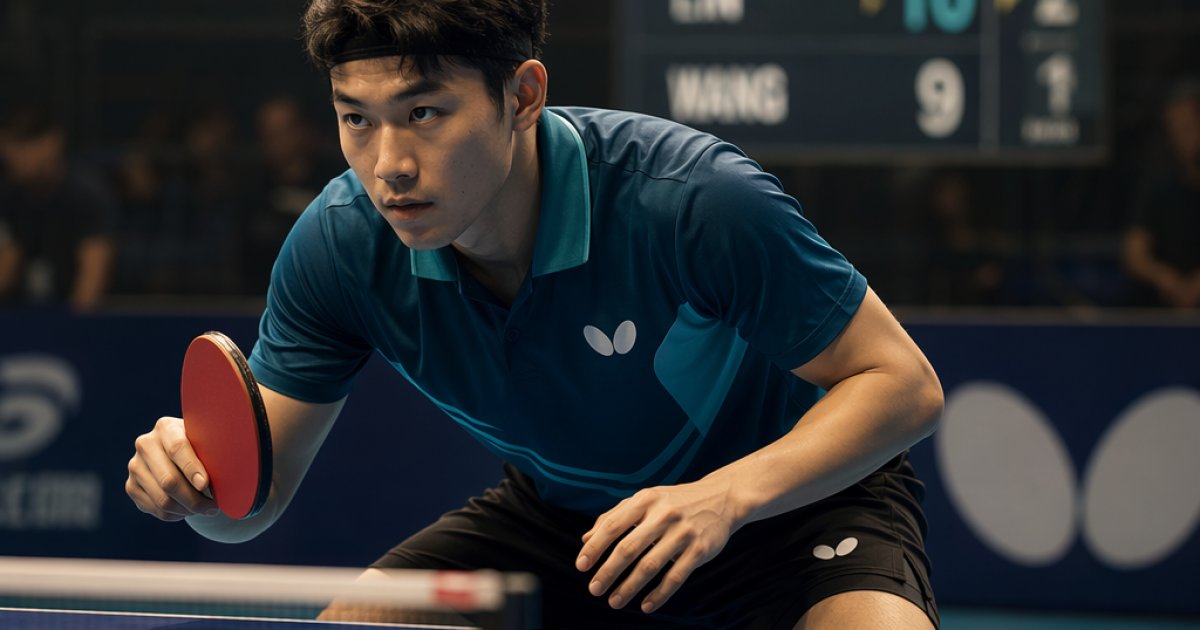
Alysha spent two years hitting a ball against the back wall of a carport in Diego Martin, alone, most evenings, until she could put a forehand into a taped square the size of a dinner plate nine times out of ten. Her technique, by the time a coach finally saw her, needed almost nothing fixed.
Her first real tournament match lasted eleven minutes. She lost 11-2, 11-3, and she did not miss because her forehand broke down. She missed because a stranger was watching, the score was real, and no amount of wall practice had prepared her for what that does to a person’s hands.
Everyone tells a story like this eventually, usually about themselves. The technical player who freezes. The talented junior who plays like a different, worse person once there’s a scoreboard and a stranger keeping it. What almost nobody tells you is why, or what to actually do about it, because “believe in yourself” is not an instruction. It is a wish.
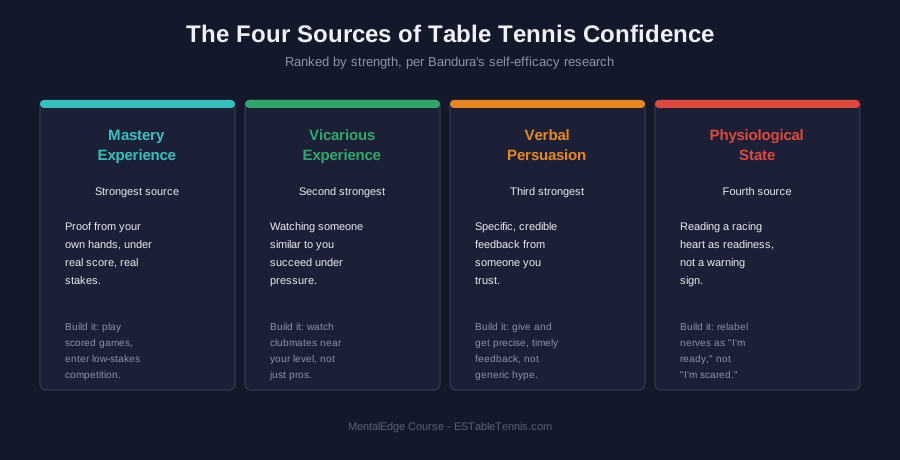
How to build confidence in table tennis: confidence is not a personality trait, it is a byproduct of four specific inputs, psychologist Albert Bandura’s sources of self-efficacy, applied on purpose. You build it through real evidence of your own success, by watching players like you succeed, through specific and credible feedback, and by learning to read a racing heart as readiness instead of danger. Skip any one of the four and the other three carry more weight than they can hold.
Why Does a Skilled Player Sometimes Have No Confidence at All?
Confidence and skill are not the same thing, which is the part Alysha’s story makes obvious and most coaching advice quietly ignores. Skill is what your hands can do. Confidence, more precisely what psychologists call self-efficacy, is your belief that you can do it right now, under these conditions, against this opponent, with this much riding on it. You can have one without the other in either direction.
A technically limited player who trusts completely what they can do will often beat a more gifted player convinced they’re about to fail.
Psychologist Albert Bandura spent much of his career studying exactly this gap, and his research on self-efficacy identified four things that actually build it, in a specific order of strength. None of them is “think positive.” All four are things you can deliberately go and do.
What Are the Four Real Sources of Table Tennis Confidence?
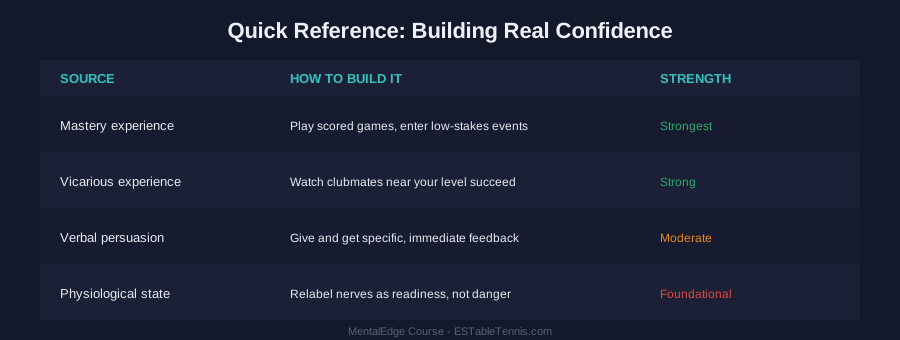
In order of how much they actually move the needle: mastery experience, which is proof from your own hands that you can do the thing under real conditions, not practice conditions. Vicarious experience, watching someone similar to you succeed at it. Verbal persuasion, specific and credible feedback from someone whose opinion you trust.
And physiological state, the ability to read your own racing heart as readiness rather than a warning sign. Wall practice gave Alysha a version of the first one. It gave her none of the other three, which is exactly why it collapsed the moment the room filled up with a stranger and a scoreboard.
What Do Most Players Get Wrong When Trying to Fix Their Confidence?
The first mistake is treating confidence as something you either wait for or fake, both of which skip the actual work. “Fake it till you make it” gets the mechanism backwards. Acting confident while your evidence base says otherwise is theater, and most opponents worth worrying about can tell the difference within a few points.
The second mistake is assuming nerves are proof you’re not ready, so players chase a calm they were never going to feel and never get, which just adds a second problem, anxiety about being anxious, on top of the first. The third mistake, probably the most common, is trying to build confidence entirely inside practice, which, as the mastery experience section explains, cannot fully substitute for a real scoreboard no matter how many hours go into it.
There is also a quieter mistake specific to parents and coaches: praising outcome instead of process. Telling a junior player “you won, great job” after a match teaches them that their worth is tied to the result, which is exactly the wrong lesson if the goal is a player who can walk into a match they might lose and still trust their own hands.
Praise the process instead: the shot selection, the footwork recovery, the decision to go for the serve they’d practiced, regardless of whether the point was won, and the confidence that builds attaches to something the player actually controls.
How Do You Build Real Mastery Experience Without a Coach or a Club?
Mastery experience has to come from conditions that resemble the thing you’re actually scared of, which a wall, a robot, or a cooperative training partner cannot fully provide, because none of them keep score against you. The fix is not more repetitions. It’s graded exposure to consequence: start keeping score in practice games against a partner, even when nothing is on the line.
Play to eleven and announce the score out loud after every point. Enter the lowest-stakes real competition available to you, a club ladder match, an internal round robin, a rating tournament nobody outside your club has heard of, before you enter the one that actually matters to you.
Each of these adds a small, specific piece of evidence: I have done this before and survived it. That evidence is what a scoreboard takes away from a player who has only ever practiced without one.
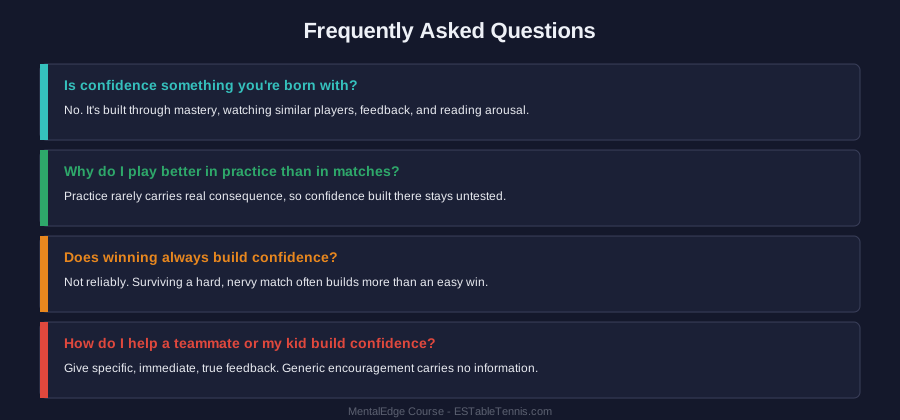
This is also why players who compete often, even in matches they lose, tend to look calmer over time than players who train constantly but rarely play anyone who counts the score. Losing a real match, it turns out, builds more actual confidence than winning a hundred practice points, because losing and surviving it is data your nervous system trusts in a way winning against no resistance never quite is.
Does Watching Better Players Actually Help Your Confidence?
It depends entirely on who you watch. Watching Ma Long does very little for most club players’ confidence, because the gap between his game and yours is too wide for your brain to file it as “someone like me.” Vicarious experience only transfers when the person succeeding is close enough to your own level, age, body type, or story that some part of you concludes, if they can do it, I probably can too.
This is why watching a clubmate you rate as roughly your equal win a tight, nervy match tends to do more for your own belief than any highlight reel of a professional, and it is worth deliberately seeking out. Watch the players in your own league.
Watch the ones who started later than you and caught up. Watch, specifically, the moments where they were clearly nervous and still executed, not just the moments where they looked effortless.
Why Doesn’t “You’ve Got This” Actually Make Anyone More Confident?
Because it isn’t information. Verbal persuasion only builds confidence when it’s specific and comes from someone whose judgment you actually trust, which rules out most of what passes for encouragement. “Believe in yourself” tells you nothing you didn’t already know you were supposed to feel.
“Your backhand block was clean today, and it was clean under pressure in the third game, not just in the warm-up” is a fact your brain can actually store and retrieve later, at 9-9 in the fifth. If you want this to work for a training partner, a student, or your own kid, the discipline is to be specific and immediate. Vague praise delivered a week later does almost nothing. A precise, true observation delivered right after it happened does considerably more, and it costs you nothing extra to say.
The same rule applies when the voice doing the persuading is your own. Self-talk between points works on the same mechanism: specific and credible beats vague and hollow, which is why “come on, you can do this” tends to do less for you mid-match than a specific, true reminder like “your serve to the wide forehand has worked twice already, run it again.”
Treat your own internal voice with the same standard you’d demand from a coach: precise, honest, and tied to something real you’ve actually done, not a generic pep talk aimed at a feeling instead of a fact.
Should You Try to Calm Your Nerves Before a Match?
No, and this is the source most players get backwards. The racing heart, the dry mouth, the slightly shaking hands before a match that matters are not signs that something has gone wrong. They are your body preparing to perform, and the research on emotional regulation- the same appraisal process that governs anger on the table governs nerves too- shows that how you label a physical sensation changes what it does to you.
Players who relabel the exact same racing heart as “I’m ready” rather than “I’m scared” perform measurably better than players fighting to suppress a feeling that was never actually a threat. You are not trying to arrive at the table calm. You are trying to arrive at the table with an accurate story about what your body is telling you.
What’s the Difference Between Real Confidence and Empty Bravado?
Real confidence is quiet and specific. It sounds like “I trust my backhand block against heavy topspin because I’ve hit it three hundred times under pressure and it holds up.” Bravado is loud and general. It sounds like “I’m going to crush this guy,” said before a ball has even been hit, usually by a player compensating for evidence they don’t actually have.
The tell is what happens after the first real setback. A player with genuine confidence loses an early point, shrugs, and plays the next one the same way, because their belief was never resting on a perfect start. A player running on bravado tends to unravel fast once the score stops cooperating, because the loud talk had nothing underneath it to fall back on.
This matters practically because it tells you what to actually watch for in yourself. If your pre-match self-talk is about the opponent, their ranking, their reputation, their last result against you, that’s usually bravado or its opposite, dread, dressed up as strategy. If it’s about your own game, the serve you’ve drilled, the pattern you know you can execute, that’s the real thing, and it tends to survive contact with an actual match far better.
Can Your Equipment Actually Undermine Your Confidence?
Yes, and this is the part most confidence advice skips entirely, because it treats the mind as if it operates independently of the hands holding the paddle. Mastery experience only counts as evidence if the result is repeatable, and a blade or rubber that doesn’t match your natural swing speed and style makes your own results inconsistent for reasons that have nothing to do with your nerve.
A player with a rubber too fast for their timing will block the ball off the end of the table some percentage of the time no matter how many times they’ve practiced it, and their nervous system correctly reads that inconsistency as unreliable evidence, which quietly erodes the exact mastery experience Bandura’s research says matters most.
This is worth checking honestly before assuming a confidence problem is purely psychological. If a shot you’ve drilled for months still feels like a coin flip in matches, ask whether the equipment is actually suited to how you play, not just what a highlight reel made you want to buy.
A player whose gear fits their timing and strength gets clean, repeatable feedback from practice, real mastery experience, while a player fighting their own equipment gets confusing, inconsistent feedback that no amount of positive self-talk will resolve. Getting properly fitted, rather than guessing, removes one whole category of false evidence against yourself.
How Long Does It Actually Take to Build Real Confidence?
Longer than one good match, and this is the part nobody wants to hear because it isn’t marketable. A single strong performance can feel like a turning point, and sometimes it is, but durable confidence is built the same way a callus is, through repeated exposure to the exact thing that used to hurt, not through one good day.
Expect the process to run for months, not weeks, with real setbacks in the middle of it that do not erase the progress underneath them. A player who has genuinely built mastery experience, watched the right models, received specific feedback, and learned to read their own nerves correctly does not stop feeling nervous. They just stop mistaking the feeling for evidence that they’re about to fail.
What Should You Actually Do This Week to Start Building This?
Pick one source and start there rather than trying to fix all four at once, which usually just produces a player who reads about confidence instead of building it. If mastery experience is the gap, book one scored practice match this week, out loud, full rules, and play it like it counts, even against a training partner you already know well.
If it’s vicarious experience, find one player at your club within a rating band of your own and watch their next match closely, specifically the point right after they make a mistake, since that reaction is the part worth studying. If verbal persuasion is missing, ask a coach or a training partner for one specific, honest observation about something you did well in your last session, not a compliment, an observation, and write it down somewhere you’ll actually see it again.
If physiological state is the issue, the next time your heart rate spikes before a match, say the word “ready” to yourself instead of noticing the racing feeling and assuming the worst, and see what changes.
None of these take more than a single session to attempt. What takes time is doing the one that applies to you consistently, week after week, until the evidence stacks up high enough that a bad first game stops feeling like proof you were never good enough to be there.
This building process is different from what to do in the middle of a match when a single bad shot or a bad call knocks your confidence loose in the moment, which is its own separate skill covered in how to stop choking in table tennis. It’s also worth reading alongside mental toughness in table tennis, since confidence is one input into toughness, not the whole of it.
Frequently Asked Questions
Alysha kept playing. It took the better part of two seasons, not two matches, but she got there, and the version of her that eventually won a match with a stranger keeping score did not feel calm walking up to the table. She felt exactly as nervous as the girl who lost 11-2, 11-3. She had just finally learned what that feeling was actually for.
If building that kind of durable confidence is the piece you’re missing, the MentalEdge Course walks through the full system: mastery, modeling, feedback, and arousal, step by step.
Leave a Reply