
There’s a sports hall in Chaguanas where I’ve watched the same match happen thirty different times, with thirty different players, in thirty different years. The score is 9–7 in the fifth. The player with the lead starts gripping the paddle a little tighter. Their feet get slower. And then, over the next four points, they lose something they can’t name and can’t get back.
They didn’t lose because they weren’t good enough. They lost because nobody told them what was happening inside their own head, or how to stop choking once it starts.
Choking isn’t a personality flaw or a talent gap. It’s a specific, predictable error in how your nervous system allocates attention under pressure. Once you understand the error, you can fix it. That’s what this post is for.
What Does Choking in Table Tennis Actually Mean?
Choking means performing worse than your established skill level in a high-pressure moment. Not worse than your best ever. Worse than your normal. You’re not suddenly unskilled. You’re executing your skill while your attention is pointed at the wrong thing.
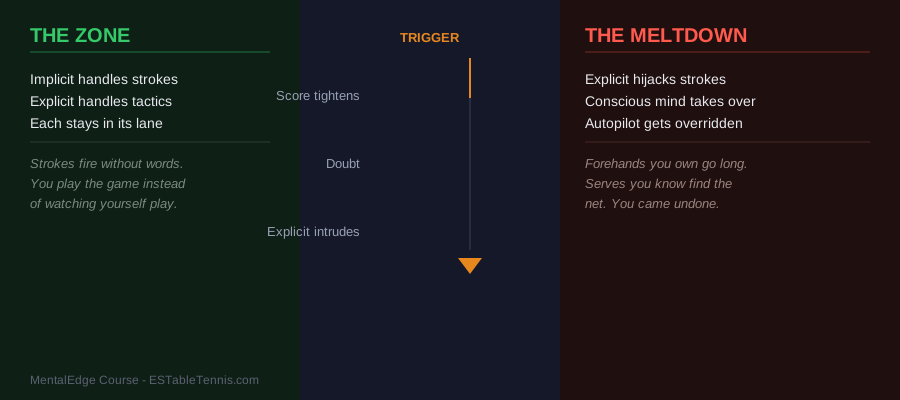
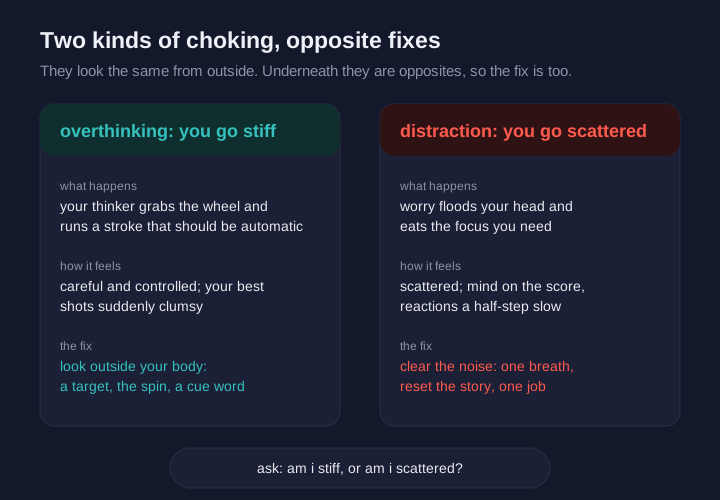
Sports psychologists have identified two separate mechanisms that cause this. They look the same from the outside but need opposite fixes inside.
Explicit monitoring is what happens when pressure makes you consciously attend to movements that normally run on autopilot. Your topspin loop doesn’t need you thinking about wrist angle. You trained it past that. But at 9–9 in the fifth, your brain drags it back under conscious control, and the movement falls apart. This is what players mean when they say they got “tight.” The body knows what to do. The conscious mind won’t let it.
Sian Beilock’s research at the University of Chicago confirmed this directly: high-level skills are hurt not by worrying itself, but by the attention and control that worry produces. You’re not failing. You’re over-supervising.
Distraction is the second path. Instead of monitoring your own technique, pressure fills your working memory with task-irrelevant thoughts. The score. What losing means. Who’s watching. These thoughts eat the processing capacity your brain needs for shot execution. It’s not weakness. It’s a dual-task problem, and your brain only has so much bandwidth.
Both mechanisms collapse your performance. They just get there by different roads. The fixes are also different, which is why understanding which one you’re dealing with matters before you try to address it.
Why Does Pressure Trigger Choking in the First Place?
Your nervous system reads high-stakes situations as threats. Not because it’s irrational, but because that’s what it evolved to do. When something matters, it raises the alert level. And a raised alert level shifts resources toward danger-detection and away from fine motor execution.
The Williams, Vickers, and Rodrigues study tested this directly using a modified table tennis task. When the task placed heavy demands on working memory and anxiety was elevated, players showed measurable changes in visual search and movement patterns. Accuracy dropped. The data matched what any competitive player already knows from experience: the more pressure, the harder simple shots feel.
What’s less obvious is that this response is trainable. Your nervous system isn’t fixed. It responds to experience. The more times it encounters high-pressure situations and survives them, the less it treats those situations as novel threats. That’s the entire basis of every technique below.
What Are the Five Techniques That Stop Choking?
These techniques come from sports psychology intervention research. They’re not motivational advice. They’re trained skills, and like every trained skill, they only work if you’ve built them in practice before you need them in a match.
Technique 1: The External Focus Cue Word
If explicit monitoring is your problem, the fix is to redirect attention outward, away from your body mechanics and toward the task itself.
A cue word does this. “Spin” focuses you on what the ball will do. “Contact” focuses you on the moment of impact. “Target” focuses you on where the ball is going. All of these are external. None of them invite your brain to supervise your wrist angle.
Gabriele Wulf’s research across dozens of studies confirmed that an external focus produces better and more durable performance than an internal one, especially for skilled athletes. The mechanism is exactly what you’d expect: external focus lets the trained movement run automatically while your conscious attention does something useful elsewhere.
Build a short personal menu. One cue for serving, one for receiving, one for rallies. Keep them short, one or two syllables. Drill them in training until saying the word and shifting focus become the same action. When pressure hits, and you feel yourself starting to over-supervise, the cue snaps your attention back out before the spiral starts.
Useful starting points: “Spin” or “Loose arm” for serving. “Read” or “Step” for receiving. “Play big” or “Target” for rallies.
Technique 2: The Between-Points Reset Routine
Momentum in table tennis is real, and it’s measurable. Den Hartigh and Gernigon’s study exposed players to scenarios where they came back from 1–7 to 7–7, or watched an opponent do the same. Even with the score identical at 7–7, the direction of the run changed how players felt, how they thought, and how they performed next.
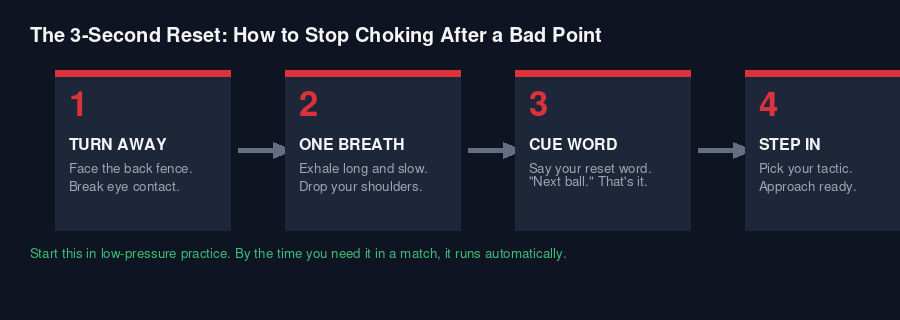
A between-points routine interrupts the run. It’s a 10 to 15 second sequence you do after every point, win or lose, that signals to your nervous system that the previous point is finished and the next one hasn’t started yet.
The sequence has four steps. First, turn your body away from the table. This breaks the visual loop of staring at where the last shot went wrong. Second, breathe. One breath with a longer exhale than inhale activates the parasympathetic response, the physiological brake. A 6-second inhale and a 7-second exhale work.
Third, decide what you’re doing on the next point. One tactical thought, forward-facing. Fourth, walk back with your chest open and your shoulders back. Body language feeds directly back into mental state.
Most players only want to do this after bad points. That’s a mistake. The routine works because it’s automatic, not selective. Do it after every point, good and bad, until it fires without thinking. That’s when it starts breaking momentum spirals instead of just acknowledging them.
Technique 3: Reappraisal
Anxiety and excitement are physiologically nearly identical. Both produce elevated heart rate, sharpened attention, and higher arousal. The difference is the label your brain puts on the sensation.
Anxiety reads the sensation as danger. Excitement reads it as opportunity. Alison Wood Brooks at Harvard showed that saying “I’m excited” out loud before a performance improved results across multiple tasks compared to trying to calm down. The mechanism makes sense: anxiety and excitement are both high-arousal states, so reframing one as the other is physiologically easy. Forcing yourself to calm down from a high-arousal state is fighting your own biology.
Before a match or before a critical point, say “I’m excited” out loud or internally. Not “I’m calm.” Not “I’ve got this.” Just “I’m excited.” Let your heart rate be high. It’s supposed to be. Call it what it actually is, which is readiness, not dread.
This shifts you from a threat appraisal to a challenge appraisal. Challenge states produce more efficient blood flow to the brain and muscles. Threat states produce vasoconstriction. Same arousal level, completely different physiological profile. The reappraisal is what makes the difference.
Technique 4: The Confidence Account
Choking is partly a mechanical problem and partly a confidence problem. Walk into a critical point already doubting yourself, and you’re more likely to trigger explicit monitoring. Your brain looks for evidence that you can handle the situation, and if it doesn’t find any, it over-corrects by supervising everything.
Confidence isn’t something you have or don’t have. Nate Zinsser, who ran the performance psychology program at West Point for years, describes it as a bank account. You make deposits by banking memories of effort, success, and progress. You make withdrawals by replaying failures. Most amateur players overdraft this account in the weeks before competition without realizing it.
Build the account deliberately. Every night, do a 60-second E.S.P. review. Write down one thing from the day that represents Effort, Success, or Progress. You hit your short serve well in practice? That’s Success. You pushed through a bad training session? That’s Effort. Your footwork improved on the forehand side? That’s Progress.
This is factual accounting, not positive thinking. You’re banking real evidence. When you step up for a critical point, you’re not walking in empty. Your brain has recent, specific proof that you can perform under pressure, because you’ve been collecting it.
Most players skip this because it feels small compared to the size of the problem choking presents. Sixty seconds a night does not feel like enough to counter years of collapsing at 9-9. But confidence built from specific, dated evidence compounds the same way physical training does. A month of consistent E.S.P. entries gives you thirty data points your brain can retrieve under pressure, each one a small, factual rebuttal to the doubt that shows up right before a big point. Players who skip this step are not lacking confidence because they are weaker competitors. They are lacking confidence because they have never deliberately built the evidence file their brain needs to draw on when it matters.
Technique 5: Pressure Inoculation
The fifth technique is the most direct. You stop choking in matches by choking in practice.
Your nervous system learns from experience. The more times it encounters high-pressure situations and comes through them, the less novel those situations feel. Novelty is what triggers the strongest threat response. Familiarity dampens it.
Add pressure to your training gradually. Play games where missing a point costs double. Play from 8–8 every session. Get filmed. Play against opponents who are better than you and commit fully to winning. The first time you choke in one of these situations, your nervous system treats it as a genuine threat. By the tenth time, it recognizes the pattern. It’s been here before. It knows it can handle it.
This is why experienced tournament players look calm in tight moments. Not because they feel less. Because they’ve felt it enough times that their nervous system stopped treating it as an emergency.
A specific version of this drill worth building into a weekly schedule: play a race to seven where every point past 5-5 costs the loser a rep of something unpleasant, and the winner gets to pick the next drill. The exact stakes matter less than the fact that something real is riding on the outcome. Run this once or twice a week for a month and most players report that a genuine tournament deuce starts to feel almost familiar, the same recognizable shape their body has already handled a dozen times in training. That familiarity is the entire mechanism. It is not confidence in the abstract. It is a nervous system that has stopped treating a specific situation as novel.
How Do These Techniques Work Together?
They work in layers, not in isolation.
Trying to install all five at once is how most players abandon the whole approach within a week. Pick the two that address your specific failure mode first, run them in every practice session for a month, and only add the rest once the first two are automatic. A player who reliably watches their swing tighten under pressure gets more from the cue word and pressure inoculation early. A player whose mind spirals after a bad point gets more mileage starting with the between-points reset and reappraisal. Sequence the work around your actual problem, not around the order the techniques happen to be listed in.
Before the match, build the confidence account and reappraise your nerves as excitement. Enter the hall with something in the bank and your arousal already reframed as readiness.
During the match, run the between-points routine after every point. Keep the arousal managed. Keep the forward focus intact. Don’t let a three-point run become a seven-point collapse because nothing reset.
During critical points specifically, fire the cue word. Pull attention external. Trust the stroke your body already knows.
Throughout your whole career, train under pressure. Make the high-stakes feeling familiar so it stops being a threat and starts being a signal.
What Does Choking Actually Reveal About Your Game?
Here’s the part people don’t say: choking means you’re good enough to be close. You don’t choke in matches where you’re overmatched. You choke when you’re 9–7 up. When winning is actually possible.
A player who never chokes either plays people they dominate or people who dominate them. The player who chokes is the one competing at their level, in matches that matter, where the outcome is genuinely in doubt.
This doesn’t make choking feel good. But it reframes what it means. You’re competitive. You’re playing matches that matter. The only gap is that your attention allocation isn’t matching your skill level. That’s fixable.
Frequently Asked Questions
Can you completely eliminate choking?
No. Pressure always creates some physiological response. But you can reduce it to a level where it stops sabotaging you. Elite players don’t choke less. They’ve trained their attention and arousal management to the point where pressure stops triggering the explicit-monitoring mechanism as easily.
How long does it take to stop choking?
If you start training these techniques in practice now, you should see measurable improvement in 3 to 4 weeks. Full integration where the skills fire automatically takes 8 to 12 weeks of consistent training. The sooner you start, the sooner you see results.
What if I choke even after training these techniques?
First: you probably haven’t trained them long enough or consistently enough. Mental skills take time. Second: some mechanisms are stronger than others for different people. If reappraisal and cue words aren’t cutting it, focus more on pressure inoculation and between-points routines. Third: if choking is accompanied by high anxiety that training doesn’t touch, talk to a sports psychologist (AASP-certified) who specializes in performance anxiety.
Do I need all five techniques or can I pick a few?
Start with the between-points routine and one cue word. These two are the highest-leverage tools and work for most people. Add reappraisal and E.S.P. banking next. Pressure inoculation is ongoing. The techniques work best together, but you can build them gradually.
What Should You Do Next?
Choking isn’t a character flaw. It’s an attention problem that training fixes. Now you know what you’re training for.
Start with your between-points routine. Build it into every practice game this week. Use the same sequence after every point. By next week, it should feel natural. Once it’s automatic, add your cue word. Once that’s firing automatically, add reappraisal and E.S.P. banking.
The goal isn’t perfection. It’s consistency. Consistent enough that when pressure arrives, your nervous system responds the way you trained it, not the way your amygdala wants it to respond.
This is how you stop choking. Not through willpower. Through practice.
Download the free mental training ebook for more on how to build the mental game that supports your skill.
Leave a Reply