Uncle Cecil kept a pirogue in Mayaro and went out past the third sandbar most mornings before the rest of the village had switched on their kettles, in a boat with a crack down the port side he never bothered fixing, because fixing it, he said, might make him careless. Rough water didn’t scare him, and it didn’t have to. He had exactly four things he did every time the swell got ugly: cut the engine to a crawl, turn the bow into the wave instead of running from it, count to four on the way up and four on the way down, and never once check how far the shore had gotten. There was no wisdom in it worth writing down. He just did the same four things every single time, calm water and rough water alike, and it worked so consistently that the younger fishermen who panicked and gunned the engine straight through a wave eventually stopped watching the horizon and started watching him instead.
Mental toughness in table tennis gets described a lot like something Uncle Cecil never had and never needed: bravery, grit, some private reserve of courage a player either has or doesn’t. It isn’t that. It’s closer to what he actually did out past the sandbar, a small, boring, repeatable set of responses that fire the same way regardless of how big the wave looks, built by a man who wasn’t fearless so much as already decided.
What Is Mental Toughness in Table Tennis?
Mental toughness is not bravado or grit. It is four trainable behaviors: control, commitment, challenge, and confidence. The word gets used so loosely in table tennis that it has come to mean almost nothing. A player who yells after a winner gets called mentally tough. A player who stares down an opponent gets called mentally tough. Neither has anything to do with it, and both are easier to fake in a highlight clip than to sustain across a fifth game that’s gone on forty minutes longer than anyone planned.
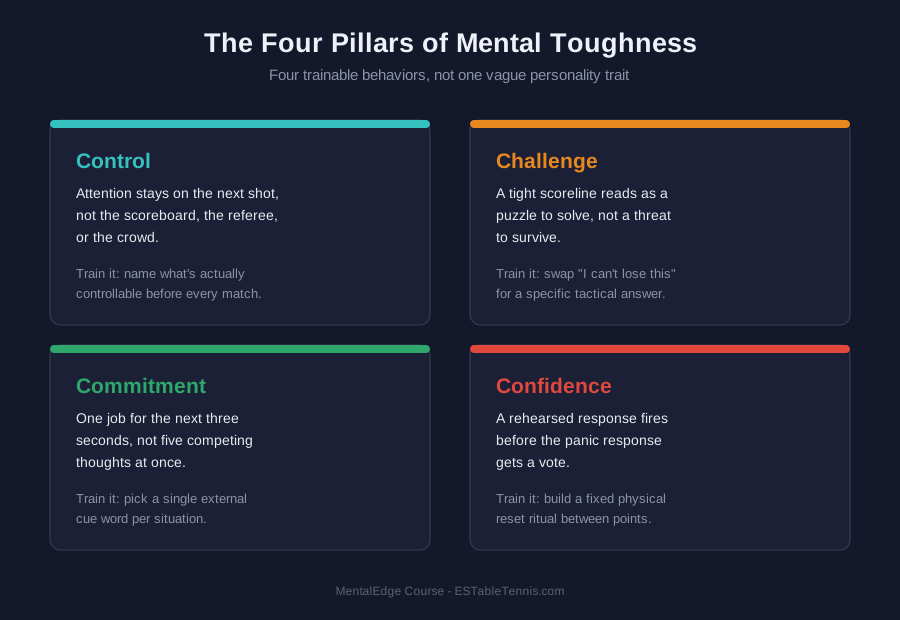
Sport psychologists have spent a long time trying to pin the idea down to something measurable rather than a vibe, and the version that has held up best under research breaks it into four separate ingredients rather than one vague trait: control, the sense that you can influence your own outcome instead of being at the mercy of it; commitment, the ability to keep carrying out a plan instead of abandoning it when it stops feeling good; challenge, treating a hard moment as something to solve rather than something to survive; and confidence, a working belief that you can execute the shot in front of you regardless of what the last one did (research measuring the four components of mental toughness). None of the four is a personality trait you’re stuck with. All four are behaviors, which means all four are trainable the same way a backhand loop is trainable, badly at first and then less badly, on purpose.
Real mental toughness, by that definition, looks almost nothing like the fighter stereotype. It looks like Uncle Cecil’s four steps. Small, repeatable, and running whether the water is calm or the swell is over the bow.
Why Isn’t Loud Confidence the Same as Mental Toughness?
Loud confidence isn’t mental toughness because it’s often a cover for a player who has no rehearsed response once things stop going his way. Every club has a player who looks like the toughest one in the building and isn’t. He hits the ball harder than anyone else in warmup, talks the loudest between points, and seems, on the surface, incapable of being rattled. Then the score gets to 9-9 in the fifth and something changes in his shoulders that everyone in the room can see except him, and the same shots that flew in during the first two games start landing two feet long.
What’s actually happening there is the same mechanism covered in match point pressure: a skill that should be running on autopilot gets pulled back under conscious control at the exact moment it needs to run free, and the shot gets rebuilt from scratch, badly, in real time. Volume and bravado were never evidence of mental toughness. They were often the opposite, a loud cover for a player who has no rehearsed response for the moment things stop going his way, because he never needed one before.
Mental toughness doesn’t announce itself. It’s the player who looks almost bored at 9-9, not because he doesn’t care, but because he already knows exactly what he’s about to do next, and has known it since long before this match started.
What Do Mentally Tough Table Tennis Players Actually Do?
Mentally tough players run four specific, trainable behaviors, not a personality trait. Strip away the stereotype and what’s left is a short list of specific, observable behaviors. Every one of them maps to one of the four ingredients above, and every one of them is something you can start practicing this week, not something you either have or don’t.
1. They control what’s actually theirs to control
A player low on this trait spends energy on the scoreboard, the referee’s call, the crowd, the lighting, the wobble in the second table nobody ever fixed. None of it is touchable. A player high on it narrows attention down to the next single shot, the only part of the next three seconds anyone has ever had real influence over.
This isn’t a mindset trick so much as a discipline, the same one covered in managing anxiety around a match: naming, out loud if needed, what’s actually controllable before a match starts, so there’s a pre-decided answer instead of a scramble when a bad call or a bad bounce shows up in the middle of a game.
2. They treat pressure as a puzzle instead of a threat
The same tight scoreline produces two completely different internal experiences depending on how a player frames it. One player experiences 9-9 as a threat, something happening to him that he has to survive. Another experiences the identical scoreline as a puzzle, a specific problem with a specific answer he’s about to go find.
That reframe isn’t wishful thinking. It’s a deliberate habit of language, swapping “I can’t lose this point” for “this point needs a deep serve to the wide backhand,” which keeps the mind pointed at a solution instead of an outcome. It’s the same shift underneath a good pre-point routine, which is really a way of making sure the puzzle-solving brain shows up instead of the threat-detecting one.
3. They keep one job per point, not five
Mental toughness collapses fast under a cluttered head. A player thinking about the score, the opponent’s reaction, last point’s mistake, and this point’s tactic all at once has, in practice, no room left to actually watch the ball.
The players who hold up under pressure tend to run something closer to the opposite: one clear job for the next three seconds, usually tied to a single external cue rather than a mental checklist. The mechanics of that narrowing are covered in more depth in table tennis focus techniques, but the short version is that mental toughness and clutter cannot occupy the same head at the same time, and something has to be cut.
4. They trust a rehearsed response before the panic response gets a vote
This is the one that most cleanly separates mental toughness from bravery. A brave player, in the popular sense, decides in the moment to push through fear. A tough player never has to decide anything in the moment, because the decision already got made weeks earlier in practice, the same way Uncle Cecil never debated whether to cut the engine once the swell got rough. He’d already decided that months before any particular wave showed up.
A fixed physical reset between points, the kind covered in building resilience in table tennis, works precisely because it removes the decision from the moment it’s hardest to make well. The ritual runs whether the last point was a disaster or a gift, which is the entire point of having one.
Why Doesn’t Talent Automatically Create Mental Toughness?
Talent doesn’t create mental toughness because practice against a robot carries no real consequence, while mental toughness is built specifically by manufacturing consequence. The hardest hitter in most junior clubs wins almost every practice game, sometimes by a wide margin, and loses in the first round of almost every tournament he enters, usually to someone he beat 11-2 the week before in a friendly. It’s a specific enough pattern that coaches stop being surprised by it after a few seasons. The stroke was never the problem. Practice never asked anything of his head, because practice, by design, has no real consequences attached to the score.
Physical talent and mental toughness are built by two completely different processes, and one does not create the other as a side effect. A blistering forehand gets built by thousands of reps against a robot that never talks back. Mental toughness gets built by deliberately practicing in conditions where losing actually costs something, which most players never bother to manufacture on their own, because it’s uncomfortable on purpose and nobody assigns it as homework.
How Do You Actually Train Mental Toughness?
You train mental toughness by manufacturing discomfort on a schedule: scored practice sets from behind, real costs for errors, and disguised serve-receive drills. Reading about the four pillars changes nothing on its own. What moves the needle is manufactured discomfort, applied on a schedule, the same way footwork drills or serve practice get scheduled rather than left to chance.
A useful starting set:
Play scored practice sets from a losing position on purpose, down 3-8 in an 11-point game, so the recovery skill gets reps before a real match ever demands it.
Add a real cost to practice points, a push-up per unforced error, a small forfeit for a lost game, anything that makes a miss sting slightly more than it otherwise would.
Run serve-receive drills against a partner told to disguise and vary aggressively, so the “read under uncertainty” muscle gets worked deliberately instead of accidentally.
Keep a short post-match log, three lines, on where the head actually went when the score got tight, since a pattern that goes unnamed tends to repeat.
Pressure training built this way, deliberately manufacturing consequence in practice, produces consistent gains in performance under pressure across novice and elite athletes alike (research on pressure training and mental toughness in athletes). The research on this kind of training backs up what most experienced coaches already suspected: structured psychological skills training produces measurable performance gains across a wide range of sports, not just a subjective sense of feeling calmer (meta-analysis on psychological interventions and athletic performance). It works the same way strength training works: nobody gets stronger by reading about deadlifts.
What Habit Quietly Destroys Mental Toughness?
Rumination, replaying the last point instead of playing the current one, quietly destroys all four pillars of mental toughness. There’s a single failure mode that shows up across every one of the four pillars, and it’s rarely talked about because it doesn’t look like weakness from the outside. It looks like caring. A player replays the missed smash from three points ago while the next rally is already starting, still half-arguing with a bad let call from the second game, still composing the thing they should have said to the umpire. None of it is happening on the current point, and the current point is the only one anyone has ever been able to influence.
Sport psychologists call this rumination, and it’s mechanically different from simply being nervous. Nerves are forward-looking, a reaction to what might happen. Rumination is backward-looking, a mind stuck replaying what already did, and it burns exactly the attention a tough response needs to fire on time. A player can have a rehearsed reset ritual, a solid cue word, and a genuinely controlled breathing pattern, and still lose the plot entirely if the point before is still running in the background like a browser tab nobody closed.
The fix isn’t complicated, but it has to be deliberate, because the mind doesn’t close that tab on its own. It’s the same physical reset covered earlier under commitment and confidence: turn away from the table, one slower breath, a single specific decision about the next point, then re-approach, every time, whether the last point was a disaster or a gift. The ritual isn’t there to make you feel better about what happened. It’s there to end the previous point on schedule, on purpose, so the next one gets a clean head instead of a crowded one.
Watch for it specifically after a bad call goes against you or after a point you should have won slips away on an edge or a net. Those are the two moments rumination shows up hardest, because they carry a legitimate grievance attached to them, and a legitimate grievance is exactly the kind of thought that convinces itself it deserves more time than the next point can afford to give it.
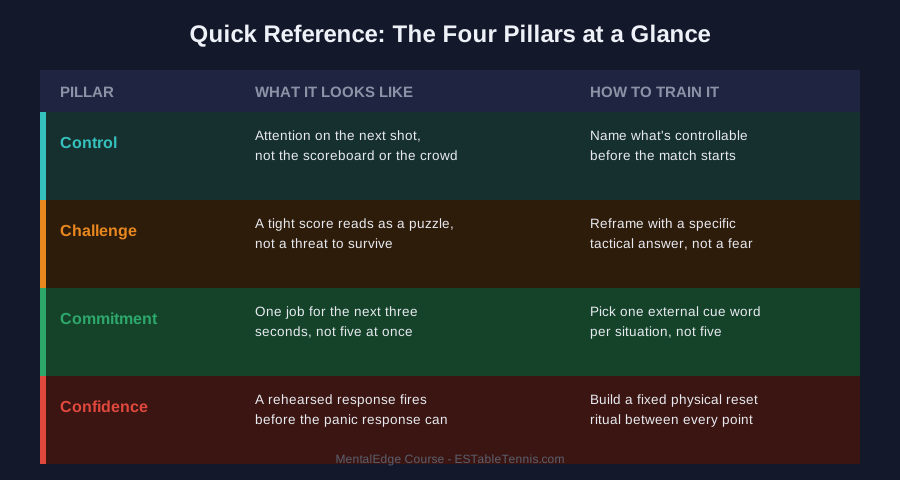
What Are the Four Pillars of Mental Toughness at a Glance?
Here’s a quick-reference recap of the four pillars covered above. If nothing else from this piece makes it into your next practice session, take this table with you. Each pillar is a specific behavior, not a personality type, and each one has a concrete way to start building it this week.
None of this requires new equipment or extra hours at the club. It requires the same thing your first backhand loop required: deliberate, slightly uncomfortable repetition, until the response stops needing your permission to show up.
Frequently Asked Questions
Is mental toughness something you’re born with, or can it actually be built?
It’s built. The four ingredients: control, commitment, challenge, and confidence- show up as behaviors that respond to deliberate practice the same way a stroke does. Some players start with a head start from temperament, but the gap closes fast once someone actually trains it instead of hoping for it.
How long does it take to see a real difference?
Weeks, not years, if the training is deliberate and happens under manufactured pressure rather than only in calm practice. A rehearsed reset ritual tends to show up first, usually within a handful of matches. Reframing pressure as a puzzle instead of a threat takes longer, because it’s fighting an older habit.
Do younger players need this, or is it only relevant for competitive adults?
Younger players benefit earlier than most parents expect. A simple breathing routine and a single cue word are workable for a ten-or eleven-year-old. The reframing piece tends to land better once a player has enough tournament experience to know what a real collapse actually feels like from the inside.
What’s the actual difference between mental toughness and just staying calm?
Staying calm is one visible symptom of it, not the whole thing. A player can look outwardly calm and still be making terrible decisions under the surface, thinking about the scoreboard instead of the next shot. Toughness is what’s happening underneath the calm exterior, the specific behaviors listed above, not the exterior itself.
Can better equipment or a technical fix substitute for mental toughness?
No, and treating it that way wastes money. A faster blade or a grippier rubber can remove some genuine excuses, but it can’t run a rehearsed reset ritual or reframe a tight scoreline for you. Equipment and mindset solve two different problems, and mixing them up is how players end up with an expensive racket and the same collapse at 9-9.
What’s the Real Takeaway From Uncle Cecil’s Four Rules?
Uncle Cecil never talked about courage, because as far as he was concerned there was nothing courageous about it. He had four things he did, and he did them every time, and the fact that they worked in rough water had nothing to do with how the rough water made him feel and everything to do with the fact that he’d already decided what he was doing about it long before he ever left the shore.
That’s the whole difference. Mental toughness in table tennis was never about feeling less afraid than the player across the table. It’s about having already decided, in a hundred boring practice reps nobody was watching, exactly what you’re going to do the moment the wave comes over the bow.
Build that decision one deliberate rep at a time with the MentalEdge Course, structured week by week instead of guessed at mid-match.
Leave a Reply