There’s a table tennis club in the south of England, a long low building near a rail yard, where a coach I once met used to run what he called “the anxiety experiment.” Every Thursday evening he would set up a match for a specific kind of player: technically solid, consistent in practice, completely reliable up to about 7-7 in the fifth. After that point, he said, something in them changed. The stroke didn’t change. The positioning didn’t change. But the player did. He’d watch the same person who had just driven three clean winners into the backhand corner suddenly become someone who bounced the ball seven times before each serve and still mishit the first one.
He wasn’t interested in what happened after 7-7. He was interested in what started building at 4-3. Because by the time a player is obviously anxious, he told me, the match is already half over in their head.
Anxiety in table tennis is not a feeling that arrives when the score gets tight. It’s a process that starts the moment you walk into the hall and begins cataloguing everything that could go wrong. The tight score is just where it finally shows up on the outside.
These table tennis anxiety tips aren’t about calming down after your hands are already shaking. They’re about recognizing the process early enough to interrupt it.
Why Does Table Tennis Anxiety Hit Differently Than Other Sports?
Table tennis gives you no recovery time between stressful moments, and the one-on-one format means there is no teammate to share the weight with. Most sports give you time to recover between moments of stress. A tennis player walks to the baseline. A golfer walks to the next hole. A basketball player jogs back on defense. Table tennis gives you nothing. The rallies are short, the transitions are immediate, and the score is visible and public the entire time.
A bad point in most sports becomes one data point in a stream. In table tennis, a bad point at 8-9 in the fifth is a referendum on your entire mental structure. You know it. Your opponent knows it. The two people watching from the far wall know it. And because you know everyone knows, the next serve happens inside a glass box of self-consciousness that you built yourself.
There’s also the specificity of the one-on-one format. You’re not in a team. You can’t look at a teammate and share the weight. It’s you, a small paddle, a 40mm ball, and a person across a table who is doing exactly what you’re trying not to do: staying calm enough to win.
Understanding why the sport is anxiety-prone isn’t pessimism. It’s context. You can’t manage a problem you’ve misidentified.
What Are the 3 Stages of Table Tennis Anxiety?
Anxiety builds in three stages: ambient loading before the match, cognitive narrowing as the score tightens, and execution failure once the nervous system tips into fight-or-flight. Most table tennis anxiety tips are written for Stage 3, which is the acute stage: heart rate spiked, breathing shallow, hands slightly trembling, automatic technique suddenly becoming manual. That’s the visible crisis, and it’s the one that gets all the attention.
But by Stage 3, you’re already working uphill. The anxiety has been compounding for two stages before it became visible.
Stage 1 is what I call ambient loading. It happens before the match and in the early games. You’re noticing your opponent’s warm-up. You’re thinking about what happened the last time you played them, or someone like them. You’re running scenarios instead of watching the ball. The physiological signs are minimal at this point. The mental signs, if you watch for them, are everywhere.
Stage 2 is cognitive narrowing. This is where your awareness pulls in. You stop noticing the whole table and start fixating on the backhand corner, or the score, or the memory of the last point you played badly. Your shot selection tightens. You stop playing your game and start playing not-to-lose. Technically, Stage 2 can look fine from the outside. Internally, it’s where the match is being decided.
Stage 3 is execution failure. The technique breaks down because the nervous system is in a partial fight-or-flight state. The American Psychological Association defines anxiety as a future-oriented state, meaning the body is reacting to a threat that hasn’t happened yet. In table tennis, that threat is usually “losing this match in front of these people,” and the body is treating it with the same chemical urgency as a physical danger.
The tips that follow are organized by stage. Use the ones that fit where you are.

The Yerkes-Dodson curve: a small amount of anxiety improves your performance. The problem is recognizing when you’ve crossed the line from useful to harmful.
What Are the Best Anxiety Tips for Stage 1, Before the Match Starts?
Tip 1: Use a Fixed Pre-Match Protocol That Has Nothing to Do With Your Opponent
The brain’s threat-detection system is opportunistic. Give it nothing specific to attach to and it will find something. Stage 1 anxiety feeds on open mental space, which is why players who arrive early, change slowly, and sit watching their opponent warm up are doing themselves a quiet harm they don’t realize.
A pre-match protocol is not a superstition. It’s a cognitive occupation strategy. You give your attention something specific and familiar to do so the threat-scanning can’t take over. It doesn’t matter much what the protocol contains. What matters is that it’s consistent, that it starts and ends at predictable points, and that it’s entirely focused on your own preparation rather than theirs.
Some players warm up in a specific order: footwork, forehand drives, backhand drives, loops, serves. Some arrive at the venue at a specific time. Some listen to a specific playlist on the walk in. The content is almost irrelevant. The predictability is the point. Your nervous system is already reading the environment for signals of threat; a familiar sequence tells it that this environment is known, and known environments are safer than unknown ones.
Tip 2: Decide Your Game Plan Before You See the Score
One of the cleanest sources of Stage 1 anxiety is strategic uncertainty. You walk into a match against a player you’ve beaten before, or lost to before, or never played before, and you genuinely don’t know what you’re going to do. The match starts and you’re improvising, which means you’re also monitoring yourself improvising, which doubles your cognitive load.
A decided game plan, even an imperfect one, removes a category of mental work from the match. It doesn’t need to be comprehensive. It needs to answer one question: what am I going to do in the first three points of this match? Everything after that can adjust based on what you see. But those first three points have a plan, and having a plan means your brain is executing rather than deciding. Execution under pressure is much easier than decision-making under pressure.
Tip 3: Reframe the Physical Symptoms Before They Frighten You
Adrenaline produces an almost identical physiological signature whether you’re anxious or excited. Faster heart rate, sharper senses, heightened muscle readiness: these are fight-or-flight signals, yes, but they’re also the exact physical state that improves short-burst athletic performance. Research published in the Journal of Experimental Psychology found that reappraising anxiety as excitement improved performance across singing, public speaking, and math tasks compared to attempting to calm down.
The practical application is simple and slightly counterintuitive. When you feel the pre-match nervousness building, don’t try to suppress it. Say (out loud if you’re alone, internally if you’re not): “I’m excited.” Not “I’m calm.” Not “I’m fine.” The physical state you’re in is closer to excitement than calm, so the reframe is physiologically honest, which means your brain accepts it more readily than a flat reassurance that nothing is happening.
This one tip alone, applied consistently, can change your relationship with pre-match nerves within a few weeks.
What Are the Best Anxiety Tips for Stage 2, When the Match Gets Close?
Tip 4: Anchor to Process Goals, Not Score Goals
Stage 2 anxiety is almost always triggered by an involuntary shift from process to outcome focus. You stop thinking about playing your game and start thinking about the score and what the score means. This shift is partly involuntary, driven by the competitive context, but you can train a counter-response that’s faster than the anxiety it’s countering.
Process goals are instructions about how you play, not what the result is. “Keep the ball low over the net on my serve” is a process goal. “Win this game” is an outcome goal. The difference matters because process goals keep your attention on something you can directly control, and anxiety thrives in the space between what you want and what you can control.
Before a match, write down two or three process goals. They should be specific and technical: your backhand placement, your serve variation pattern, your footwork positioning. When you notice Stage 2 narrowing starting (usually identifiable as the moment you become conscious of the score in a way that feels threatening rather than informational), you have a prepared place to redirect your attention.
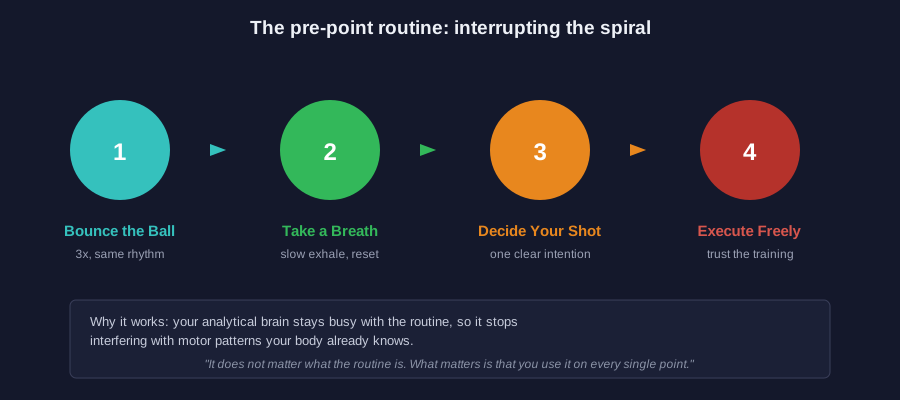
The pre-point routine creates a mental checkpoint between points, interrupting the anxiety spiral before it can compound.
Tip 5: Use the Between-Point Window as a Reset, Not a Review
There’s approximately 15 to 25 seconds between each point in a competitive table tennis match. What most anxious players do with that time is conduct an involuntary post-mortem on the last point while simultaneously catastrophizing about the next one. Both activities are useless. Neither can change what happened or guarantee what will happen. Both consume exactly the mental resources you need for the next point.
The between-point window is your most underused competitive tool. It’s a fixed, repeatable gap in which you can perform a standardized mental reset, and the entire art of managing Stage 2 anxiety comes down to what you do in that gap. This is the foundation of a pre-serve mental routine, and if you haven’t built one deliberately, you’re leaving your worst mental habits in charge of the most important 20 seconds of each point.
The reset has three components. First, a physical anchor: bouncing the ball, adjusting your grip, touching your paddle edge. Second, a single breath: slow exhale, not a dramatic inhalation. Third, one process cue from your pre-match game plan. That’s it. The whole thing takes four seconds. But it interrupts the anxiety loop and returns you to the present tense, which is the only tense where you can actually play table tennis.
Tip 6: Lower Your Shoulders Deliberately
Anxiety raises muscle tension across the upper body in a specific and consistent pattern. The shoulders come up toward the ears. The grip tightens. The jaw sets. None of this is intentional, and most players don’t notice it’s happening until they’re already in Stage 3.
But the relationship between the physical and the mental runs both ways. You can’t think your way out of a physical anxiety state as easily as you can move your way out of one. A deliberate, exaggerated shoulder drop, combined with loosening your grip so the paddle rests lightly, sends a direct signal to the nervous system that the threat has passed. It hasn’t, of course. But the body doesn’t fully distinguish between “the threat passed” and “the muscles are no longer braced for the threat.”
Do this during time-outs, between points, and any time you become aware that your upper body is locked. It costs you nothing. It resets a physiological pattern that, if left unchecked, will compound straight into Stage 3.
Tip 7: Treat the Score as Information, Not a Verdict
This is the cognitive core of Stage 2 management. Most players experience the score not as data about the state of the match but as a running judgment on their quality as a player. 4-7 down doesn’t mean “I need to win the next few points to get back in this.” It means “I am failing, and people can see it, and the score is proof.”
That interpretation is almost never examined. It arrives automatically and frames everything that follows. The player who believes the score is a verdict on them plays differently than the player who believes the score is a count of past points. One is looking backward at an accumulating judgment. The other is looking forward at a math problem with a known solution set.
4-7 is three points. In a game to eleven, three points is not a crisis. It’s an instruction: win the next three before they win the next four. That’s a sequence, not a tragedy. Table tennis scoring is non-linear in the sense that momentum shifts are possible at almost any point in a game, and experienced players know that a 7-4 lead is psychologically comfortable but not statistically safe. The player who scores the next two points changes the entire emotional geometry of the match.
What Are the Best Anxiety Tips for Stage 3, When You’re Already Anxious?
Tip 8: Use the Breathing Sequence That Specifically Counters Fight-or-Flight
By Stage 3, you need a direct physiological intervention. Thinking positively won’t work. Telling yourself to relax won’t work. What works is activating the parasympathetic nervous system through extended exhalation, which is the mechanism behind every breathing technique worth using in a competitive setting.
The practical version for in-match use: inhale for 4 counts, exhale for 6 counts. The longer exhale is what matters. It signals to the vagus nerve that the emergency is over. You’re not going to be able to do box breathing in the middle of a point, but you can run this 4-6 pattern between serves. Two cycles is often enough to take the edge off Stage 3 symptoms without being so conspicuous that you’re telegraphing distress to your opponent.
For a full breakdown of how breathing techniques work at the physiological level and which specific patterns are most effective for competitive play, the post on table tennis breathing techniques covers this in considerably more depth, including the research on why exhale length matters more than inhale length.
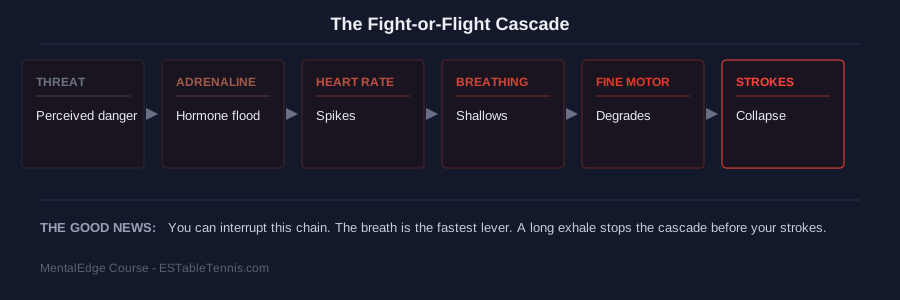
The fight-or-flight cascade starts before you notice it. By the time your hands are shaking, the physiological chain has been running for several minutes.
Tip 9: Accept the Current Point Is Gone and Play the Next One
Stage 3 anxiety almost always includes rumination: replaying the last point or two, examining the errors, feeling the embarrassment compound. This is the single most expensive mental activity available to you in a match, because it consumes processing capacity that has exactly one other use: playing the next point.
The mental model that helps most players with this is what some coaches call the “point horizon.” Once a point ends, it no longer exists in any useful sense. The score has changed. That’s the only residue. The actual events of the rally are gone and examining them during a match is not useful information processing; it’s involuntary punishment for something that can’t be undone.
You already know this, logically. The problem is that knowing it and doing it are separated by a significant gap in most competitive players. The gap closes through repetition, not through instruction. You practice the mental reset the same way you practice the backhand loop: imperfectly, repeatedly, getting slightly better each time, until one day it happens automatically under conditions that used to break it. This is part of what the gap between practice and match performance comes down to. The technique is the same in both settings. The mental discipline to forget the last point is not.
Tip 10: Take the Time You Are Allowed
Players managing Stage 3 anxiety often speed up. The discomfort of the state makes them want to escape it by accelerating through points, by serving quickly, by not giving themselves or their opponent any space. This is the opposite of what the nervous system needs and the opposite of what the rules allow.
ITTF regulations give you time between serves. You are allowed to towel off every six points in major competition. You are allowed to use time-outs. These are not stalling tactics. They are legal, available tools, and using them fully is a competitive decision, not a psychological admission.
Deliberately slowing your service routine by two seconds, taking a full breath before each toss, walking to the baseline without urgency: these are recoveries the rules permit. Most players don’t use them because rushing feels like momentum and slowing down feels like admission. The reverse is true. You’re not hiding your anxiety by slowing down. You’re managing it, which is the entire job.
How Does Equipment Affect Table Tennis Anxiety?
Equipment uncertainty is a hidden source of anxiety. Not fully trusting your paddle makes you play tentatively, which shows up physically as tightened shoulders and cautious footwork. Anxiety in table tennis doesn’t arrive in a vacuum. It arrives in the specific context of you, your equipment, your opponent, and the match conditions. And one of the most consistent sources of performance anxiety I’ve seen in players at club and regional level is equipment uncertainty.
A player who doesn’t fully trust their paddle doesn’t commit to shots the same way. They play tentatively, which in table tennis means they play slowly, which means their opponent gets more time, which means more shots go to their strength. The technical result of equipment uncertainty looks like anxiety in the body. The player tightens. They steer the ball instead of driving through it. Their footwork becomes cautious.
Equipment certainty is a form of mental load reduction. When you know what your paddle will do on a fast loop to the forehand, you can focus entirely on the physical execution of the shot. When you’re not sure, some part of your attention stays on the variable you can’t predict, which is attention that isn’t on the ball. This is one of the reasons the connection between equipment choices and mental performance is real and underexamined at most levels of the game.
What’s the Real Long-Term Fix for Table Tennis Anxiety?
The players who manage anxiety best aren’t the most mentally trained. They’ve decided in advance that losing a match isn’t a catastrophe. The coach in that club near the rail yard, the one who ran the anxiety experiments, told me something I’ve thought about quite a lot since. He said the players who managed their anxiety best weren’t the ones with the most mental training. They were the ones who had decided in advance that losing a table tennis match was not a catastrophe.
Not because they didn’t care. They cared. But there was a difference between caring about performance, which sharpens focus, and caring about outcome to the point where a loss felt like evidence of personal inadequacy, which produces exactly the Stage 1 loading that compounds into Stage 2 and Stage 3.
Anxiety in table tennis is almost always an argument your nervous system is having with the stakes you’ve assigned to the result. The tips above are ways to interrupt that argument in the moment. But the longer work, if you’re serious about it, is examining why losing this particular match to this particular person in this particular venue feels like the thing it feels like. Because once you’ve changed that, the anxiety doesn’t disappear. It just stops being in charge.
If you want a structured path through the mental side of the game, the MentalEdge course covers the full system, from understanding how fight-or-flight affects your technique to building the mental routines that hold up when the score is tight and the margin is thin.
Frequently Asked Questions
Why do I get so nervous playing table tennis matches?
Your nervous system reads competition signals like the scoreboard and a watching crowd as threats, which shrinks your working memory and pulls automatic skills back into conscious, effortful control.
How can I calm my nerves during a table tennis match?
Reframe the physical sensations as excitement rather than fear, run a fixed routine between every point, and use a longer exhale than inhale to activate your parasympathetic nervous system.
Why do I play worse when the score gets close?
As the score tightens, attention narrows onto the scoreboard and past mistakes instead of the next shot, a stage sports psychologists call cognitive narrowing.
Is it normal to feel anxious before a table tennis match?
Yes. A moderate amount of pre-match arousal actually improves performance. The goal isn’t to eliminate the feeling but to keep it in your effective range and interpret it as readiness rather than threat.
How do professional table tennis players stay calm under pressure?
They rely on rehearsed process goals and pre-point routines rather than willpower, so the response is automatic instead of something they have to decide on point by point.
Leave a Reply