“Get better this year” is not a goal. It is a wish wearing a goal’s clothes, and it will not survive contact with the first bad week of training.
There is a reason the January version of this always fails and the October version, written down, dated, checked weekly, tends to actually survive: the January version was never designed to be checked at all. It existed to feel good for about a week. A real goal is designed to be uncomfortable, checkable, and slightly annoying to keep up with, which is precisely the set of features a wish is missing.
Most players set goals like this every January and forget them by March, not because they lack discipline, but because the goal itself was never built to survive contact with an actual season.
Table tennis goal setting that actually works uses specific, difficult targets instead of vague ones, breaks them into a hierarchy (outcome, performance, process), and tracks the process goals weekly, since those are the only ones fully inside your control.
Why Do Most Table Tennis Goals Fail Before the Season Even Starts?
Most goals fail because they are vague and comfortable instead of specific and difficult, and vague, comfortable goals give your brain nothing concrete to actually aim at on a random Tuesday practice session in February.
Decades of research on goal setting, going back to Locke and Latham’s work, finds a consistent pattern: specific, difficult goals produce significantly better performance than vague ones, easy ones, or no goal at all. “Get better” fails this test twice over. It is not specific, and it is not measurable enough to know whether you are on track or drifting.
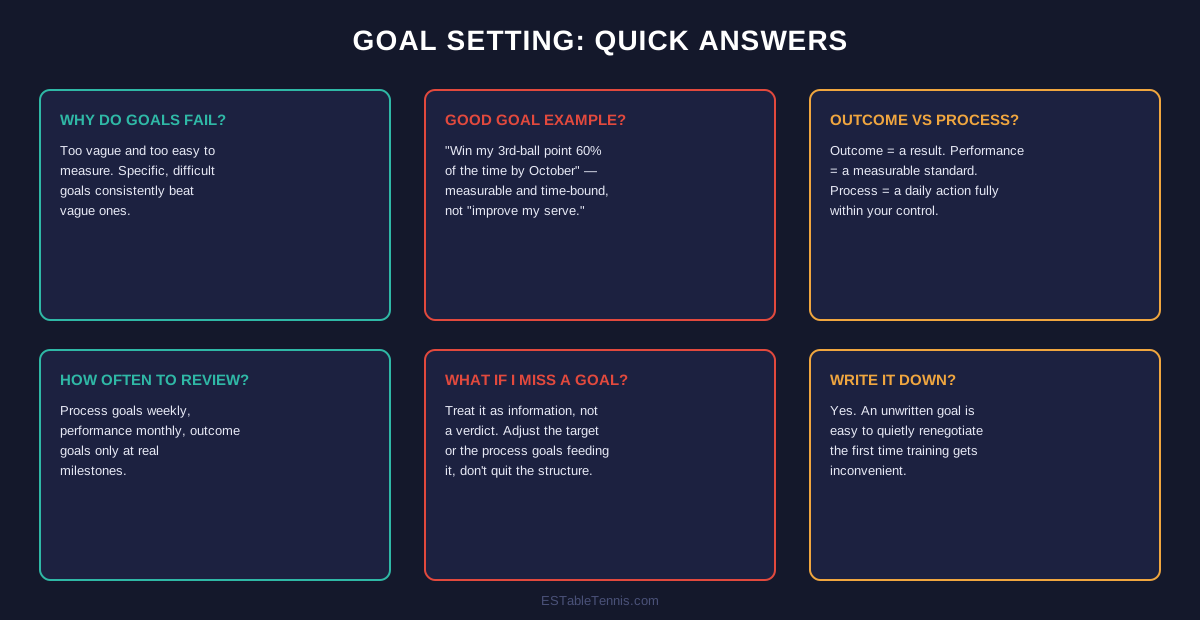
Compare that to “win my serve-and-third-ball point at least 60% of the time by the regional championships in October.” The second version tells you exactly what to track in practice this week. The first one tells you nothing until the season is already over and you are guessing whether it worked.
What Makes a Goal Actually Work?
A working goal is specific enough to measure and difficult enough to require real effort, since goals that are either vague or too easy produce almost no improvement in the research on this, regardless of how sincerely they were set.
“Difficult” does not mean unrealistic. A genuinely impossible goal produces the same disengagement as a goal that is too easy, since your brain stops investing effort in a target it does not believe is reachable. The useful zone sits at the edge of what stretches you without breaking your belief that it is achievable with real work.
How Specific Should a Difficult Goal Actually Be?
Specific enough that two different people looking at your results could agree on whether you hit it or not, with no room for you to talk yourself into a pass on a target you actually missed.
“Improve my consistency” fails this test because you get to decide afterward what counts as improved. “Fewer than eight unforced errors per match, averaged over my next ten matches” does not have that loophole. Either the number is eight or under, or it is not.
This is uncomfortable on purpose. A goal you cannot fail is not really a goal; it is a hope with better branding, and the discomfort of a real, checkable number is exactly what makes the difficult half of “specific and difficult” actually difficult.
This is also where a coach or training partner earns their keep. Left alone, most players quietly round their own results in a favorable direction without meaning to. A second set of eyes on your match stats keeps the number honest, which matters more than it sounds, since a goal you can secretly redefine after the fact was never really constraining your effort in the first place.
How Do You Build a Goal Hierarchy for Table Tennis?
Build a three-level hierarchy: one outcome goal (a result, like a ranking or a tournament placement), one or two performance goals (a measurable standard, like your third-ball win rate), and several process goals (specific actions inside every single practice session).
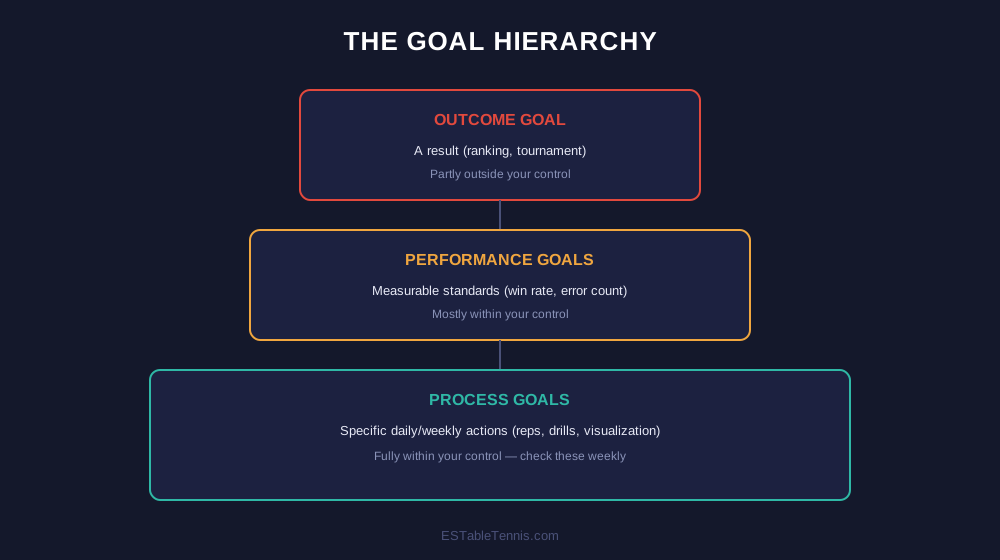
The outcome goal, reaching a certain ranking, winning a specific tournament, depends partly on your opponents, the draw, and factors outside your control. It is useful as a direction, but a bad day for it does not mean your training failed. The performance goal, your serve-and-third-ball win rate, your unforced error count per match, is closer to fully within your control and gives you something concrete to review after every match.
None of this needs to feel like homework. The players who actually stick with a structure like this for a full season tend to describe it less like discipline and more like relief, since a specific weekly checklist replaces the constant, low-grade anxiety of wondering in vague terms whether they are “doing enough” with a simple yes or no they can answer honestly every Sunday night.
The process goals are the ones you actually execute daily: 200 reps of a specific serve, ten minutes of visualization per the protocol in table tennis visualization techniques, a set number of pressure-point drills per week. These are entirely within your control regardless of how any single match goes, which is exactly why they should get most of your daily attention, not the outcome goal sitting months away.
A worked example makes this concrete. Outcome goal: reach the quarterfinals of your regional closed championship in October. A quarterfinal is a real target for one player and a stretch goal for another; the number that matters is whichever one sits right at the edge of what you currently believe you can do, not a number borrowed from someone else’s season.
Performance goals underneath it: win your third-ball point 60% of the time, keep unforced errors under eight per match. Process goals underneath those: 200 forehand loop reps three times a week, ten minutes of visualization before each session using the PETTLEP structure, one pressure-point drill per practice where missing costs something real.
Notice that only the bottom layer, the process goals, gets checked daily. The performance goals get reviewed after matches and monthly practice logs. The outcome goal gets checked exactly once, in October, because checking it in June tells you nothing you can act on yet.
How Do You Track Progress Without Getting Obsessed with Results?
Track your process goals weekly and your performance goals monthly, and check your outcome goal only at the actual milestones, since checking a months-away target every single day creates anxiety without giving you any new information to act on.
A simple weekly review works: did you complete the process goals you set for this week, yes or no? That is the entire check. Not “did I improve” in some vague global sense, which you cannot actually measure week to week, but whether the specific, controllable actions happened. Over a full season, those weekly yeses are what move the performance and outcome numbers, usually with a lag of several weeks before the effect becomes visible in your match results.
Should Beginners and Advanced Players Set Goals Differently?
Beginners should weight process goals even more heavily than advanced players, since early improvement comes mostly from raw repetition and consistent habits, while advanced players increasingly need performance goals that target specific, narrow weaknesses rather than general skill-building.
A beginner benefits enormously from a process goal as simple as “play three sessions a week for two months,” because at that stage almost any consistent repetition produces visible gains. Beginners chasing a purely outcome-based goal, a ranking, a trophy, without any process structure underneath it tend to burn out fastest of all, since the gap between where they start and where the outcome goal sits feels enormous with nothing concrete bridging the two.
An advanced player rarely improves from more generic hitting. Their process goals need to target the specific gap, the backhand transition, the second-ball attack after a short serve, that is actually capping their results, which usually requires a coach’s eye to identify accurately rather than a guess. Advanced players sometimes resist this because narrow, specific goals feel less impressive to say out loud than a broad ambition. Say the narrow one anyway. It is the one that actually moves.
What Do You Do When Training Toward a Goal Gets Boring?
Expect the boredom, and build in a scheduled variation rather than waiting for motivation to return on its own, since even a genuinely well-built goal hierarchy runs into flat, uninspired stretches partway through a season.
This is normal and does not mean the goal was wrong. Build in planned variety ahead of time: a different drill partner every few weeks, a friendly tournament with nothing riding on it, a session that is just play with no metric attached, so the plan has some flexibility built into it before the boredom hits rather than after you have already started skipping sessions. A missed rep tonight is not a missed season. It is one data point in fifty-two weeks of them.
What Should You Do When You Miss a Goal?
Treat a missed goal as information about the goal or the plan, not as a verdict on your ability, and adjust the specific number or timeline rather than abandoning the whole structure.
If your third-ball win rate is stuck at 45% against a 60% target three months in, that is data. Maybe the target was too aggressive for your current level. Maybe the process goals feeding it were wrong: more reps on a serve you already execute well instead of the one that is actually costing you points.
Neither miss means the plan failed. Both mean it is working exactly as intended: telling you something true you did not know in June. Either way, the fix is a specific adjustment, not a decision that goal setting does not work for you.
Should You Set Goals for a Whole Season or Just the Next Tournament?
Run both at once, on different timescales, since a season-long outcome goal without any near-term target leaves you with nothing concrete to aim at this week, and a tournament-only goal with no season structure leaves you rebuilding your plan from scratch every few weeks.
The season goal sets the direction: the outcome and performance targets covered above. Inside that, set a small, specific goal for your very next tournament, one tactical thing you are testing, one process metric you are checking, so every event on the calendar is also doing double duty as a data point for the bigger structure, rather than existing in isolation from it.
Does It Help to Write Your Goals Down, or Is Thinking About Them Enough?
Write them down. A goal that lives only in your head is far easier to quietly renegotiate the first time training gets inconvenient, and the whole value of a specific, measurable target depends on it staying fixed long enough to actually measure against.
This does not need to be elaborate. A single page, the three-level hierarchy, a date next to each target, kept somewhere you will actually see it, your training bag, your phone’s notes app, works better than a detailed system you built once and never opened again. The format matters far less than whether you actually look at it before your next training session.
Does Your Equipment Fit Into Your Goals?
Yes, directly, since a performance goal built around a shot your current equipment cannot reliably support sets you up to fail for reasons that have nothing to do with effort or training.
If your process goal is 200 loop reps a week but your rubber is genuinely unsuited to looping, you are grinding toward a performance goal your gear is quietly working against. Settle your equipment fit before you lock in a season of performance goals built on top of it, so the numbers you are chasing are realistic for the setup you are actually playing with.
What If Your Coach or Club Sets Different Goals Than You Do?
Reconcile them explicitly rather than quietly running two separate plans, since a player privately chasing one target while their coach designs sessions around a different one ends up half-committed to both and fully committed to neither.
Bring your written hierarchy to your coach and ask directly whether the process goals they have you drilling actually feed the performance goals you care about. Sometimes they do, and you simply had not connected the dots.
Sometimes there is a genuine mismatch, a coach optimizing for technique refinement while you are optimizing for a specific tournament result three months out, and that conversation is worth having early in a season rather than discovering the gap in October. Somewhere between the two of you sits the actual right answer, and it is worth finding before the season is already half over.
Frequently Asked Questions
What Should You Actually Write Down Tonight?
One outcome goal. Two performance goals underneath it. Three or four process goals you can start this week, not next month. Put a real number and a real date on each one.
“Get better this year” was never going to survive March. A goal you can actually measure on a Tuesday in practice might.
The player who says this out loud in January and actually means it treats every practice session between now and October as a small, checkable deposit toward something specific, not a vague hope that enough hours in a gym eventually add up to “better.” It might. It might not. A specific goal at least tells you which one happened, and why.
For the full mental framework this fits into, see table tennis mental training techniques. The MentalEdge Course builds a complete goal hierarchy alongside the confidence and focus systems that keep you executing it.
Leave a Reply