Table Tennis Mental Training Techniques: 7 Proven Methods That Build a Player Who Doesn’t Fold
By Adrian Calmstrike··13 min read
Roland trained four hours a day at an academy outside Chaguanas, the kind of place with a concrete floor painted the color of weak tea and a robot in the corner that fired the same topspin loop nine hundred times before lunch. By fifteen, he had the cleanest backhand counter-loop in his age group nationally.
He could not lose to anyone in practice. He lost constantly in tournaments, usually to a heavyset man named Mr. Ramkissoon who ran a hardware stall on weekdays and played table tennis at a club in San Fernando on weekends, a man whose forehand had a hitch in it that should have been fixable in about a week of proper coaching. Nobody ever fixed it. Mr. Ramkissoon did not need it fixed.
He needed forty seconds between points, a breath he took the same way every single time, and a private, useless-looking ritual of tapping the table twice with his paddle before he served, and with those three things he beat better players for twenty years. Roland eventually asked him how. Mr. Ramkissoon said something that annoyed him for a full year before it made any sense: “You train your arm every day. When do you train your head?”
That is the whole subject, really. Table tennis rewards physical repetition so visibly, so measurably, that most players spend their entire careers convinced the game is decided by the arm, when anyone who has ever choked a 10-8 lead already knows better.
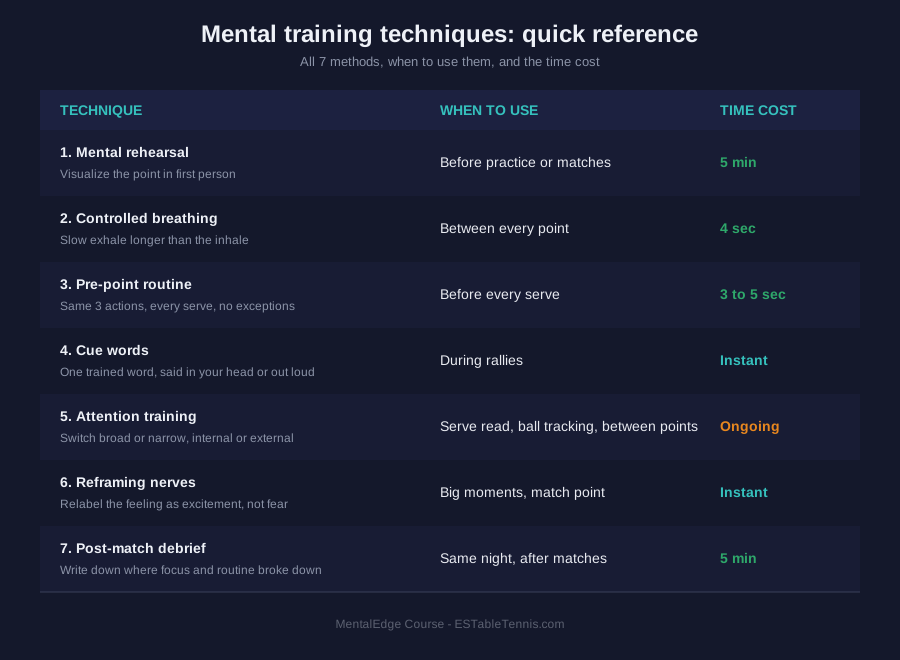
Mental training in table tennis is not a mood or a mantra. It is a set of specific, repeatable techniques, trained on a schedule, the same way you’d train a serve. This post covers seven of them, in the order most players can actually build them, along with a straight answer to how long it takes before you notice a difference.
What Mental Training Actually Is (and Isn’t)
Mental training is not “staying positive.” Staying positive is a feeling, and feelings are unreliable under pressure, which is exactly when you need the system to hold. Mental training is a set of trained behaviors: a specific breath, a specific sequence of movements before you serve, a specific phrase you say to yourself at 9-9, rehearsed enough times in low-stakes moments that they still work when the stakes are not low.
The arm does what it was drilled to do because the drilling happened thousands of times before the match. The mind works the same way. It just gets drilled far less often, mostly because nobody ever showed most players what the drills looked like.
The seven techniques below are the actual drills. None of them require talent. All of them require repetition, which is the one thing table tennis players already understand better than almost anyone.
Table tennis makes this harder than most sports, not easier. A tennis player gets twenty-five seconds between points to reset. A table tennis player gets somewhere around ten, sometimes less if the server is fast, which means there’s no real time to think your way back to calm mid-match.
Whatever mental system you’re running has to fire automatically, in the gap between one rally ending and the next serve landing, which is exactly why these techniques need to be drilled in practice long before they’re needed in a match. There’s no thinking your way into a good mental state in ten seconds. There’s only the state you already trained.
1. Mental Rehearsal (Visualization)
Before Mr. Ramkissoon ever stepped up to serve in a match he cared about, he had already served that point in his head a hundred times, in the actual gym, against the actual opponent, with the actual sound of the ball off his forehand. This is not wishful daydreaming. It’s called mental practice, and sport scientists have been studying it seriously for decades because it works on the same neural pathways as physical repetition, just without the wear on your joints.
The technique that actually holds up under research isn’t “picture yourself winning.” It’s specific, first-person, sensory rehearsal: you feel the paddle in your hand, hear the ball, see the exact angle of your opponent’s racket, and play the point out point by point, including the part where something goes slightly wrong, and you handle it. Five minutes before practice, five minutes before a match, is enough. The players who skip this step aren’t lazy, usually. They just never learned it’s a real technique and not a superstition.
2. Controlled Breathing Between Points
Your heart rate spikes during a rally whether you notice it or not, and if you walk straight into the next serve without doing anything about it, you’re serving with a nervous system that’s still fighting the last point. The fix takes about four seconds, and nobody tells beginners this exists. A slow exhale, longer than the inhale, between every single point, resets the body enough that the next shot isn’t inherited panic from the last one.
I’ve written a full breakdown of the exact table tennis breathing techniques that work mid-match, including the one that fits inside the eleven seconds you’re actually allowed between points.
3. A Fixed Pre-Point Routine
Mr. Ramkissoon’s two taps on the table before every serve looked like a tic. It wasn’t. A fixed routine, done the exact same way whether the score is 5-1 or 9-9, is one of the most well-documented tools in competitive sport for a simple reason: it gives your brain something familiar to do at the exact moment it’s most likely to spiral. The routine doesn’t need to be elaborate.
It needs to be identical every time, so your body starts the point from a state it recognizes instead of a state built by whatever just happened on the last one. I built out a full pre-serve routine players can copy directly, but the short version is: pick three small physical actions, do them in the same order before every serve, and never skip the sequence just because you’re winning easily or losing badly.
4. Cue Words and Self-Talk
The words in your head during a rally are either helping you or actively working against you, and there’s rarely a neutral option. “Don’t miss this” primes your brain with the word “miss.” A single trained cue word, something short and physical like “smooth” or “watch,” redirects attention to the action you actually want instead of the outcome you’re afraid of. This isn’t a slogan taped to a water bottle.
It’s a rehearsed habit, the same word every time, used enough in practice that it shows up automatically under pressure instead of getting drowned out by whatever your nerves are saying louder.
Focus isn’t a single dial you either have or don’t. It has a direction and a width, and the best players in the world switch between four modes without thinking about it: broad focus to read an opponent’s stance before the serve, narrow focus to track the ball onto the racket at contact, internal focus between points to check in on your own grip or footwork, external focus to lock onto the target you’re aiming at.
Most players get stuck in one mode, usually internal and narrow, which is exactly the setting that makes a missed shot replay in your head instead of clearing out before the next point. I go deep into this model, and the specific drills that train each mode, in the full piece on table tennis focus techniques.
6. Reframing Nerves as Fuel
Here’s the part nobody explains well: the physical feeling of anxiety and the physical feeling of excitement are almost identical. Faster heart rate, tighter chest, that jittery hum in your hands before you serve for match point. The only real difference is the sentence your brain attaches to it. “I’m nervous, this is bad” and “I’m fired up, this is good” are describing the exact same body.
Players who learn to relabel that sensation, out loud if they have to, perform better under the same physiological load than players who fight it. This one sounds almost too simple to work, which is usually a sign a player hasn’t tried it yet. The full mechanics of why it works, and how to actually retrain the sentence, are in the piece on table tennis anxiety tips and the deeper dive on overcoming performance anxiety.
7. The Post-Match Mental Debrief
Every serious player reviews their footwork after a bad loss. Almost nobody reviews their head. A mental debrief is short, five minutes, done the same night while it’s still fresh: where did your focus actually go at the score that mattered, what cue word did you use or forget to use, did your breathing routine survive contact with pressure or did you abandon it at 8-8. Write it down.
The pattern that shows up across ten losses is worth more than the emotional autopsy of any single one, and it’s usually the same pattern, over and over, until someone finally writes it down and looks at it plainly. Players working through recurring collapse points, the kind covered in the piece on match point pressure, almost always find the pattern faster once they start logging it instead of just remembering it badly.
A Simple Weekly Schedule for Building These Habits
Most players who try to add mental training fail for the same reason people fail at any new habit: they try to install all seven techniques on a Tuesday and expect them to survive Saturday’s match. That never works. The seven techniques above aren’t meant to be adopted all at once. They’re meant to be layered in, one at a time, over roughly seven weeks, so each one has time to become boring before the next one gets added. Boring is the goal. A technique you still have to think about isn’t ready for a match yet.
Week one is breathing, and only breathing. Every single point, win or lose, the same slow exhale, in practice and in matches both. It feels mechanical at first, and that’s fine; mechanical is what you want under pressure. Week two adds the pre-point routine on top of the breathing, so now there are two small, fixed actions stacked together before every serve.
Week three adds a single cue word, chosen in advance, used the same way every time your focus starts to drift mid-rally. By week four, you’re running three techniques together without much conscious effort, which is exactly the point where most players start to notice they’re not spiraling after a bad point the way they used to.
Weeks five and six are where visualization and attention training get added, in that order, because both take longer to feel natural and both benefit from the calmer baseline the first three techniques have already built. Visualization gets five minutes before practice sessions, not just before big matches, so it becomes a habit rather than a pre-tournament ritual that feels forced because it’s unfamiliar. Attention training happens inside practice itself: a coach or training partner calling out “broad” or “narrow” between drills is enough to start building the switch as a trained reflex instead of something you only discover you’re bad at during a tournament.
Week seven is reframing, added last on purpose, because it’s the hardest one to fake. Reframing nerves as fuel only works once the other six are already running quietly in the background, because a player who’s still consciously juggling a breathing pattern and a cue word has no spare attention left to relabel a feeling in real time. Once the first six are automatic, reframing becomes the last small adjustment, not the whole workload.
The post-match debrief runs the entire time, from week one onward, because it’s the tool that tells you whether any of this is actually working. Five minutes, the same night, every match: what held up, what got abandoned under pressure, what needs another week before it’s trusted in a close game.
A player who runs this schedule honestly for seven weeks doesn’t end up with seven separate tricks. They end up with one mental game, built the same deliberate way their forehand was built, one repetition at a time.
How Long Until You See Results
Roland asked Mr. Ramkissoon this question too, expecting many years. The honest answer is closer to weeks than years, but only if the techniques are actually drilled and not just read about once. Breathing and pre-point routines tend to show up first, usually within two or three weeks of consistent match use, because they’re the most mechanical of the seven. Reframing and cue words take longer, closer to a full season, because they’re fighting years of the opposite habit.
None of it works if it’s only practiced in your head between matches. It has to happen in real points, against real opponents, enough times that it stops feeling like an exercise and starts feeling like how you already play.
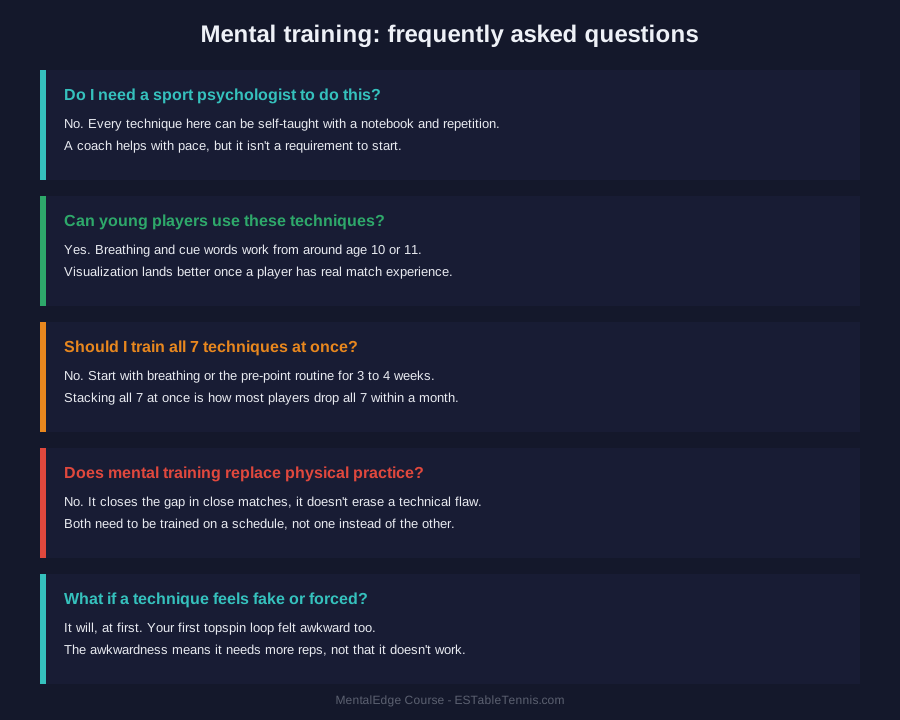
Frequently Asked Questions
Do I need a sport psychologist to do mental training?
No. Every technique above is something a player can build alone, with a notebook and a willingness to repeat it in practice. A sport psychologist helps with pace and accountability, the same way a coach helps with a stroke you could technically fix yourself, but it isn’t a requirement to start.
Can young players use these techniques, or is this only for adults?
Kids as young as ten or eleven can learn a breathing routine and a cue word without much trouble. Visualization and reframing tend to land better once a player has enough match experience to visualize accurately, usually early-to-mid teens, but there’s no hard cutoff.
Should I train all seven techniques at once?
No. Pick one, usually breathing or the pre-point routine since they’re the most mechanical, and run it in every match for three or four weeks before adding a second. Stacking all seven immediately is how most players abandon all seven within a month.
Does mental training replace physical practice?
No, and treating it that way is its own mistake. Mr. Ramkissoon’s forehand had a real, fixable flaw for twenty years. Mental training won a lot of points anyway, but it didn’t erase the gap; it just meant the gap wasn’t the thing that decided the match.
What if I try a technique and it feels fake or forced?
It will, for a while. A cue word said out loud for the first time feels ridiculous. So did your first attempt at a topspin loop. The awkwardness is the sign the technique hasn’t been drilled enough yet, not a sign it doesn’t work.
Roland switched clubs eventually, chasing better sparring partners and a better robot. He still lost to Mr. Ramkissoon every time they played, right up until the year Mr. Ramkissoon’s knees finally gave out, and he stopped competing. The forehand hitch was never fixed. It never needed to be. The man had trained the one part of the game everyone else in that gym assumed couldn’t be trained at all, and it turned out to be the part that mattered most when the score got close.
Structured mental training, built out week by week instead of guessed at between matches, is exactly what the MentalEdge Course walks you through.
 Do I need a sport psychologist to do mental training?
No. Every technique above is something a player can build alone, with a notebook and a willingness to repeat it in practice. A sport psychologist helps with pace and accountability, the same way a coach helps with a stroke you could technically fix yourself, but it isn’t a requirement to start.
Can young players use these techniques, or is this only for adults?
Kids as young as ten or eleven can learn a breathing routine and a cue word without much trouble. Visualization and reframing tend to land better once a player has enough match experience to visualize accurately, usually early-to-mid teens, but there’s no hard cutoff.
Should I train all seven techniques at once?
No. Pick one, usually breathing or the pre-point routine since they’re the most mechanical, and run it in every match for three or four weeks before adding a second. Stacking all seven immediately is how most players abandon all seven within a month.
Does mental training replace physical practice?
No, and treating it that way is its own mistake. Mr. Ramkissoon’s forehand had a real, fixable flaw for twenty years. Mental training won a lot of points anyway, but it didn’t erase the gap; it just meant the gap wasn’t the thing that decided the match.
What if I try a technique and it feels fake or forced?
It will, for a while. A cue word said out loud for the first time feels ridiculous. So did your first attempt at a topspin loop. The awkwardness is the sign the technique hasn’t been drilled enough yet, not a sign it doesn’t work.
Roland switched clubs eventually, chasing better sparring partners and a better robot. He still lost to Mr. Ramkissoon every time they played, right up until the year Mr. Ramkissoon’s knees finally gave out, and he stopped competing. The forehand hitch was never fixed. It never needed to be. The man had trained the one part of the game everyone else in that gym assumed couldn’t be trained at all, and it turned out to be the part that mattered most when the score got close.
Structured mental training, built out week by week instead of guessed at between matches, is exactly what the MentalEdge Course walks you through.
Do I need a sport psychologist to do mental training?
No. Every technique above is something a player can build alone, with a notebook and a willingness to repeat it in practice. A sport psychologist helps with pace and accountability, the same way a coach helps with a stroke you could technically fix yourself, but it isn’t a requirement to start.
Can young players use these techniques, or is this only for adults?
Kids as young as ten or eleven can learn a breathing routine and a cue word without much trouble. Visualization and reframing tend to land better once a player has enough match experience to visualize accurately, usually early-to-mid teens, but there’s no hard cutoff.
Should I train all seven techniques at once?
No. Pick one, usually breathing or the pre-point routine since they’re the most mechanical, and run it in every match for three or four weeks before adding a second. Stacking all seven immediately is how most players abandon all seven within a month.
Does mental training replace physical practice?
No, and treating it that way is its own mistake. Mr. Ramkissoon’s forehand had a real, fixable flaw for twenty years. Mental training won a lot of points anyway, but it didn’t erase the gap; it just meant the gap wasn’t the thing that decided the match.
What if I try a technique and it feels fake or forced?
It will, for a while. A cue word said out loud for the first time feels ridiculous. So did your first attempt at a topspin loop. The awkwardness is the sign the technique hasn’t been drilled enough yet, not a sign it doesn’t work.
Roland switched clubs eventually, chasing better sparring partners and a better robot. He still lost to Mr. Ramkissoon every time they played, right up until the year Mr. Ramkissoon’s knees finally gave out, and he stopped competing. The forehand hitch was never fixed. It never needed to be. The man had trained the one part of the game everyone else in that gym assumed couldn’t be trained at all, and it turned out to be the part that mattered most when the score got close.
Structured mental training, built out week by week instead of guessed at between matches, is exactly what the MentalEdge Course walks you through.
Leave a Reply