
Anita played out of a small club behind a hardware store in Princes Town, the kind of place where the lighting buzzed and the second table had a wobble nobody ever fixed. She was good. Good enough that her coach stopped giving her technical notes by her third year and started giving her something else instead: a question. After every match she lost that she should have won, he would ask the same thing. “Where was your head at 8-all?” She never had a good answer. The shot was the same shot she hit a thousand times in practice. Her feet were in the right place. Her arm did what it always did. But something behind her eyes had wandered off somewhere, usually to the scoreboard, sometimes to the spectator coughing near the door, once, memorably, to whether she’d left her stove on. The ball came back exactly where she expected it not to.
What Anita’s coach was really asking, without the vocabulary for it, was a question sport psychologists have spent fifty years trying to answer properly: where does attention go under pressure, and can a player choose to put it somewhere better? The answer is yes, and the focus techniques that make it possible are specific enough to train, not vague enough to just hope for.
Why Does Your Mind Wander Mid-Rally in Table Tennis?
Your mind wanders because attention runs on two independent dials, width (broad versus narrow) and direction (internal versus external), and pressure knocks both out of your control. Attention in table tennis isn’t one thing. It has two dials, and a player who understands both has more control over their own head than they think.
The first dial is width: broad or narrow. Broad attention takes in the whole situation, your opponent’s stance, the angle of their elbow before a serve, the general shape of how the rally is developing. Narrow attention locks onto one point, usually the ball at the exact moment of contact. The second dial is direction: internal or external. Internal attention turns inward, toward your own body, your grip, the angle of your wrist, the tightness in your shoulder. External attention points outward, toward the ball, the target, the spin coming off your opponent’s racket.
This four-way model comes from the sport psychologist Robert Nideffer and explains something coaches have always sensed but rarely named: the best players aren’t locked into a single style of attention. They switch. Broad-external to read the serve. Narrow-external to track the ball onto the racket. Broad-internal between points to plan the next tactic. The skill isn’t having sharp focus. It’s knowing which kind of focus the next half-second requires, and getting there before the ball arrives.
Anita’s problem wasn’t a lack of focus. She had plenty. It was aimed at the wrong thing, and no focus techniques exist to fix a problem nobody has correctly named yet.
Why Is Watching Your Own Technique Under Pressure a Mistake?
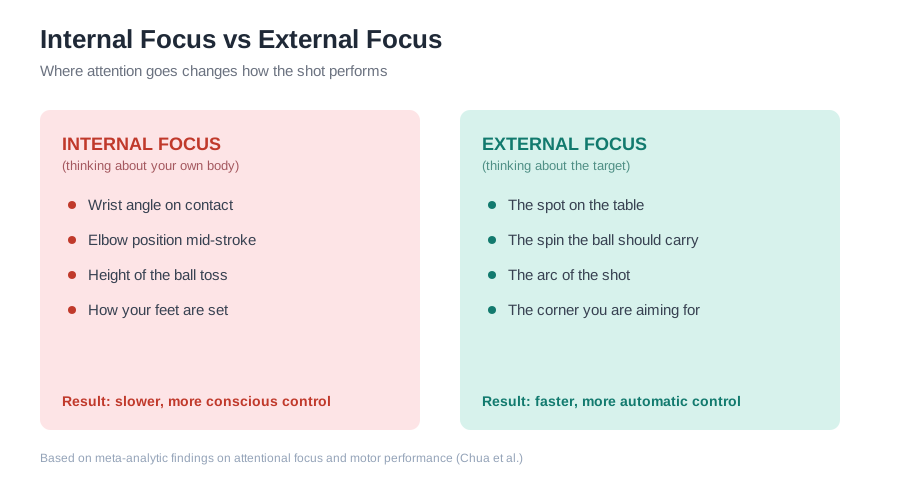
Focusing on your own technique under pressure is a mistake because it drags an autopilot skill back into conscious control, making it worse, not better. Here’s the part most players get backwards, and it costs them exactly the points they care about most. When the score gets tight, the instinct is to think harder about your own technique. Watch your wrist. Don’t rush the stroke. Get the elbow right. It feels responsible, like you’re taking the moment seriously. It’s the opposite of helpful.
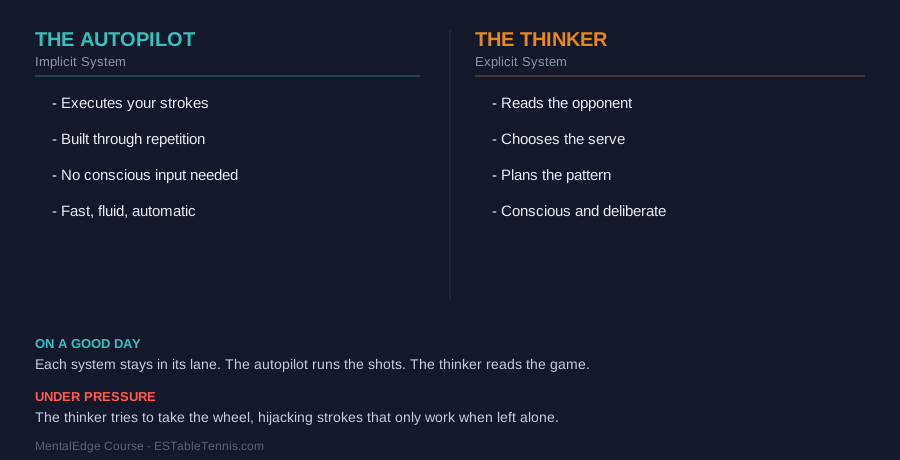
Your stroke runs on something closer to autopilot than conscious control. Years of repetition built it into a system that doesn’t need supervision, the way you don’t think about which muscles move your legs while walking. The research on this, led by the psychologist Gabriele Wulf across more than two decades of studies, shows that an external focus, attention placed on the target or the ball’s effect rather than on your own body, produces better and more durable performance than an internal focus, especially once a skill is already learned (background on attentional focus research). Turning your attention inward at the exact moment you need your trained stroke to run freely interrupts the very system you’re relying on. You de-automate the automatic. The shot that worked a thousand times in practice gets rebuilt from scratch under pressure, badly, in real time.
This is the same mechanism behind choking at match point, where conscious monitoring of a skill that should run itself causes it to collapse. Focus and composure aren’t separate problems. They’re the same problem wearing different clothes.
What Is the Quiet Eye Technique in Table Tennis?
The quiet eye technique is a final, steady fixation on the ball or target held slightly longer than untrained players manage, right before contact, and it’s trainable. The sport scientist Joan Vickers spent years studying what elite performers do with their eyes in the final moments before a critical action, and found something measurable and trainable. She called it the quiet eye (research on quiet eye training and performance). Experts don’t just see the ball better. They look at it longer, more deliberately, in that last sliver of time before contact.
In table tennis, this maps almost perfectly onto the hardest moment in the sport: receiving serve. You have less than half a second to read spin, speed, and placement, and most amateur players spend that window with their eyes moving too much, scanning the opponent’s body, the racket angle, the ball toss, all at once, none of it long enough to register. The fix is a sequence rather than a single skill. Soft eyes during the setup, taking in the broad picture of stance and racket position. Then, in the last instant before the racket meets the ball, hard eyes: one fixed, quiet point of focus on the contact zone, held a beat longer than feels natural.
It feels unnatural at first because most players have never deliberately practiced where their eyes go. They’ve practiced their strokes for years and never once practiced their gaze.
What Are the Best Focus Techniques for Table Tennis?
None of this is abstract. Here are seven specific techniques, each one trainable in practice before you ever need it in a match.
1. Anchor to a single external cue word
Pick one word per situation, not five. “Spin” when receiving serve. “Target” when attacking. “Long” when you’re tempted to go for too much too early. The word should point outward, at the ball or the target, never inward at your own body. A cue word works because it occupies the part of your mind that would otherwise be free to wander toward the scoreboard.
2. Run the soft-eyes-to-hard-eyes sequence on every serve receive
Broad awareness during your opponent’s setup, then one quiet, fixed look at the contact point. Treat this as a drill on its own, separate from technique work, until it becomes the default rather than something you have to remember.
3. Train your quiet eye deliberately, not by accident
Most players develop whatever gaze habits they happen to fall into. Spend ten minutes of a practice session doing nothing but serve-receive, with a coach or training partner watching specifically for how long your eyes settle before you move. It’s a strange thing to drill. It’s also one of the few attentional skills with a direct research base showing it improves under pressure, not just in calm conditions.
4. Catch yourself narrowing inward late in long matches
Fatigue does something predictable to attention: it shrinks and turns inward. You start thinking about your tired legs, your aching shoulder, your own mounting frustration. The fix isn’t willpower. It’s a pre-decided action, a single deep breath and a return to your external cue word, used every single time you notice the narrowing happening, not just when you remember to.
5. Use a between-point reset to clear whatever just happened
A bad point leaves residue. The next point inherits whatever you were thinking about during the last one unless you deliberately clear it first.
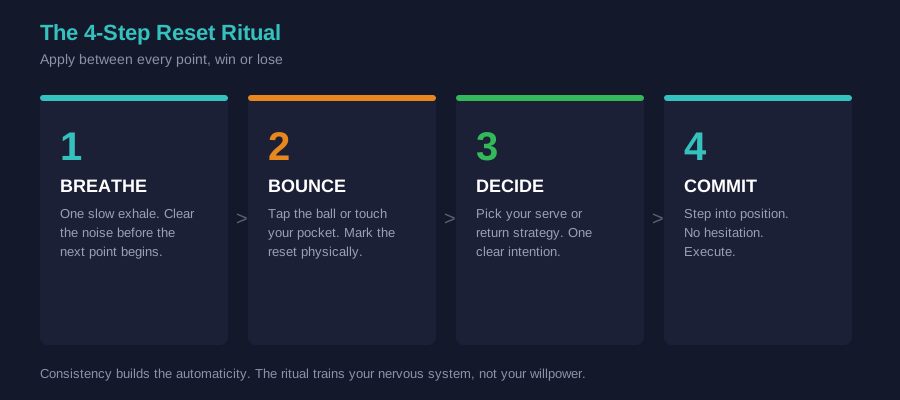
Turn slightly away from the table. One breath, slower than feels necessary. A short, specific decision about the next point’s tactic. Then re-approach. This takes under five seconds, and it is the single most underused tool in amateur table tennis, mostly because it looks like nothing is happening, which is exactly the point.
6. Practice attentional switching as its own drill
Most practice sessions train shots. Almost none train the switch between broad and narrow attention deliberately. Build a drill where you call out “broad” or “narrow” mid-rally to a partner and have them name what they should be looking at in that instant. It feels artificial in practice. It builds the exact muscle that match play demands without warning.
7. Fold a focus cue into your existing pre-serve routine
If you already have a pre-serve routine, the cue word and the quiet-eye fixation belong inside it, not bolted on separately. A routine works partly because it’s consistent. Adding a focus step to a routine you already trust is far easier than trying to remember a new mental habit cold, mid-match, at 9-all.
What Breaks Your Focus During a Table Tennis Match?
Three things reliably break focus during a match: the scoreboard, your opponent’s reaction, and your own internal commentary about how the match is going. None of these is useful information in the half-second before contact. All three are internal or backward-looking, exactly the wrong direction for the dial to point.
The earliest sign that focus has slipped usually isn’t a missed shot. It’s a thought. “I can’t lose this game.” “Why did I miss that?” “He’s going to serve short again.” Each of these thoughts pulls attention inward and backward at the precise moment it should be outward and forward. Catching the thought, rather than waiting for the missed shot that follows it, is the actual skill. Pairing it with controlled breathing technique gives you a physical action to take the instant you notice the thought arriving, instead of just noticing it and hoping it passes on its own.
Anxiety research backs this up directly. The leading framework here, attentional control theory, holds that anxiety doesn’t just make you nervous; it actively shifts your attention away from the goal-directed system you want in charge and toward a more reactive, stimulus-driven one (research on anxiety and attentional control under pressure). You don’t lose focus because you’re weak. You lose it because anxiety is doing exactly what anxiety does, and the antidote is a trained habit, not a hope that it won’t happen this time. A broader review of the neuroscience behind this kind of pressure-induced performance drop backs the same pattern across sports far beyond table tennis (neuropsychological review of performance under pressure).
Anita’s coach was never going to get a satisfying answer to “where was your head at 8-all,” because she didn’t have the vocabulary for what was happening to her own attention in real time. Nobody had ever taught her that focus has a width and a direction, that you can choose both, and that focus techniques like the ones above are trainable the same way a backhand loop is trainable: badly at first, then automatically, eventually without thinking about it at all. Which, it turns out, is the entire point.
What Are the Seven Focus Techniques at a Glance?
Here’s a quick-reference recap of all seven focus techniques covered above. Each one targets a specific, named failure point covered in this guide, not a generic checklist borrowed from somewhere else.
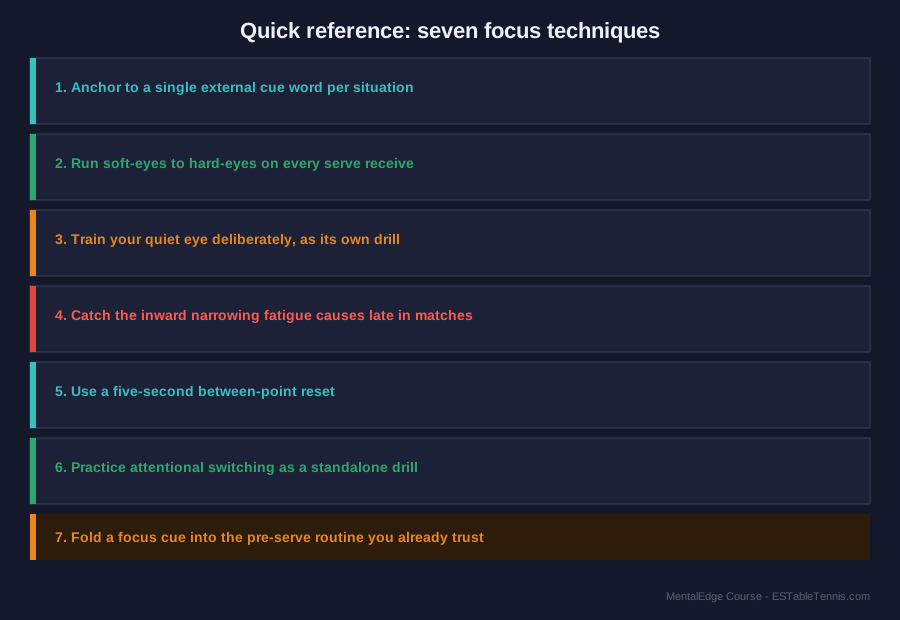
None of these focus techniques require new equipment or extra hours at the club. They require the same thing your strokes required when you first learned them: deliberate, slightly uncomfortable repetition, applied specifically rather than vaguely, until the new habit stops needing your permission to show up.
Build this into your training the way you’d build any other shot. Repetition first, automaticity later. Start with MentalEdge if you want a structured path through this and the rest of the mental game, or grab the free guide to start with the fundamentals.
How Long Does It Take for Focus Techniques to Become Automatic?
Focus techniques typically take a few weeks of deliberate practice to feel automatic, the same timeline as learning a new grip or stroke. Players ask this more than almost anything else, usually after the first practice session where a cue word feels clumsy and the quiet-eye drill feels like staring at nothing for no reason. There’s an awkward middle period where the new habit competes with the old one for your attention, which is, ironically, the exact thing you’re trying to train. That period ends the moment the technique stops requiring a decision and starts happening on its own.
A useful marker: you’ll know a focus technique has become automatic when you notice yourself using it after the fact, not before. You catch your eyes settling on the contact point and realize you weren’t trying to do that this time. That’s the autopilot system absorbing what used to require the thinking system’s supervision, which is the entire goal.
The mistake most players make here is practicing focus techniques only when things are going badly, treating them like a fire extinguisher instead of a skill. A fire extinguisher you’ve never tested before the fire is a gamble. Focus techniques rehearsed only in practice, against a feeding machine, in conditions with zero pressure, transfer poorly to a match where the stakes feel real. Train them under manufactured pressure deliberately: scored games where a miss costs double, serve-receive drills against a partner instructed to disguise serves aggressively, practice sets played from a losing position. The discomfort is the point. It’s the same discomfort you’ll feel at 8-all in a real match, except now you’re feeling it somewhere that doesn’t cost you a tournament.
What’s the Difference Between Concentration and the Right Kind of Focus?
The right kind of concentration is relaxed and pointed outward at the ball or target. The wrong kind is tense and pointed inward at your own body, and only one holds up under pressure. Gritting your teeth and staring intently at the ball with white-knuckle effort isn’t the same as the kind of attention that wins points. Effortful, strained concentration tends to narrow internally, dragging your awareness back toward your own tension, your own doubt, your own grip pressure, exactly the trap described earlier in this piece. A relaxed external lock on the ball outperforms a tense internal scramble every time the research has measured it, which is part of why so many players who “try hardest” in the biggest moments play their worst tennis there too.
This is worth saying plainly because it contradicts most of what gets shouted from the sidelines of junior tournaments. “Concentrate!” is not useful instruction. It doesn’t tell a player where to put their attention, only that they should have more of it, generically, somewhere. Specific focus techniques succeed precisely because they replace a vague command with a concrete target: this word, this point in space, this single fixed look a fraction of a second before contact. Vague effort and trained attention are not the same currency, and only one of them spends well under pressure.
Frequently Asked Questions
For the complete system that turns these focus techniques into a match-day habit, the MentalEdge Course walks through it step by step.
Leave a Reply