
There is a man in Tunapuna named Roger who has, over the course of eleven years and more tournaments than he would care to count, perfected the art of losing at exactly 10-9. Not 10-8. Not 11-9 in deuce. Specifically 10-9, his serve, the one point that ends everything if he just does what he has done four thousand times in practice. He does not choke in any dramatic, visible way. He does not double fault his serve into the net. He simply, quietly, plays the worst shot available to him, a soft push that a club beginner would have the sense to avoid, and the gymnasium exhales around him like it expected nothing else.
I have watched Roger do this so many times that I started keeping a private, slightly cruel tally. It is not that Roger lacks talent. He has a forehand that, in the first nine points of any game, looks like it belongs to someone ranked forty places above him. The talent was never the problem. The problem arrives precisely at match point, his own or his opponent’s, and it arrives every single time in the same disguise: he starts thinking about his hand.
That is the whole secret of match point pressure, and almost nobody tells you this directly. The hand was never the problem. The thinking about the hand is the problem. The moment Roger’s brain shifts from playing the point to monitoring the execution of the point, the movement that took years to automate becomes, again, a sequence of decisions made by a frightened amateur. Sports scientists have a name for this. They call it reinvestment, and it is the single most documented cause of choking under pressure in skilled performers.
This guide breaks down how to handle pressure at match point in table tennis: what actually happens in your body and brain in those final seconds, why your practice strokes disappear right when you need them most, and the specific, repeatable habits that let you play match point the same way you played point one. No vague encouragement. No “just relax.” Just the mechanics of staying functional when the score says everything is on the line.
What Actually Happens to Your Body at Match Point in Table Tennis?
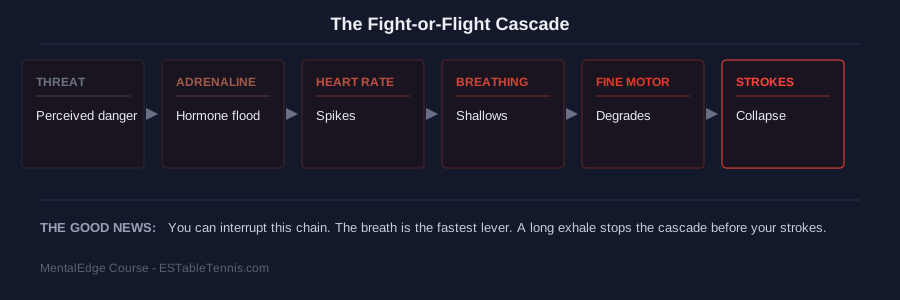
Your heart rate spikes past your comfortable range within seconds, your hands sweat, and your peripheral vision narrows, not because the shot got harder, but because your brain decides this point matters more than the forty before it. Your heart rate does not wait for permission. At 9-9 it might sit at a comfortable 130 beats per minute, the same range it held through most of the game. At match point, with nothing yet having changed in the actual physical task in front of you, it can spike past 160 in under three seconds. Your hands sweat. Your peripheral vision narrows. None of this happens because the shot got harder. It happens because your brain has decided, correctly or not, that this single point now matters more than the forty that came before it.
This is the mechanism behind the Yerkes-Dodson law, a relationship between arousal and performance that has held up since 1908 and applies as cleanly to table tennis as it does to surgery or public speaking. The original research found that performance improves with physiological or mental arousal only up to a point, after which further arousal causes performance to decline. The problem at match point is not that you feel nervous. Feeling nervous is fine, even useful. The problem is that match point pushes most players well past their peak arousal zone and into the part of the curve where fine motor control starts to fail.
Table tennis punishes this more than almost any other sport, because the margins are so small. A topspin loop that clears the net by four millimeters at 9-3 needs the exact same four millimeters at match point. Your opponent has not gotten taller. The table has not gotten smaller. What changes is the precision of your own hand, and the precision of your hand changes because of a process called reinvestment.
Reinvestment, a term from research on skill breakdown under pressure, describes what happens when an experienced player starts consciously controlling a movement that used to run on autopilot. You learned your forehand loop years ago. It now lives in procedural memory, the same part of the brain that knows how to ride a bicycle without thinking about balance. At match point, anxiety pulls that movement back into conscious, step-by-step processing. You start thinking about your elbow. You start thinking about contact point. The stroke that used to take care of itself now has a frightened supervisor standing over it, and supervised movements are slower, stiffer, and far less accurate than automatic ones.
This is why players who look completely composed in practice fall apart in competition, and why the gap between practice performance and match performance has nothing to do with how hard they trained. It has to do with what their attention does under load. If you want the deeper mechanics of why this gap exists, the breakdown of mental tactics for losing a big lead covers the same nervous system response from a different angle: the moment everything starts slipping rather than the moment it is about to end.
What Should You Do in the Seconds Before Match Point?
Run a fixed three-step routine: a physical reset, one slow exhale, and a single word that points your attention at the next shot instead of the scoreboard. There is a gap between when the previous point ends and when you serve or receive the next one. Most players treat that gap as dead time, something to get through. At match point, that gap is the only part of the point you can actually control before the ball starts moving, and it is where the entire outcome usually gets decided.
A pre-point routine is not superstition. It is a deliberate, repeatable sequence that gives your nervous system a known pattern to follow instead of letting it improvise under stress. Players who use one consistently report less of the racing, scattered feeling that defines a choke, because the routine itself becomes the focus, not the consequence of missing the shot.
Build yours around three fixed elements, done in the same order every single time, no exceptions for the score:
First, a physical reset. Step back from the table. Bounce the ball twice, no more, no less. The specific count does not matter as much as the consistency of the count. Your brain reads repetition as safety.
Second, one slow exhale. Not a deep dramatic breath that draws attention to itself, just a longer exhale than inhale, four seconds out against two seconds in. This activates the parasympathetic nervous system just enough to pull your heart rate back toward your performance zone without dragging your energy down with it.
Third, a single word. Not a pep talk. One word that points your attention at the next shot rather than the scoreboard. “Watch.” “Through.” “Now.” The word matters less than the fact that it occupies the verbal part of your mind that would otherwise be narrating the stakes.
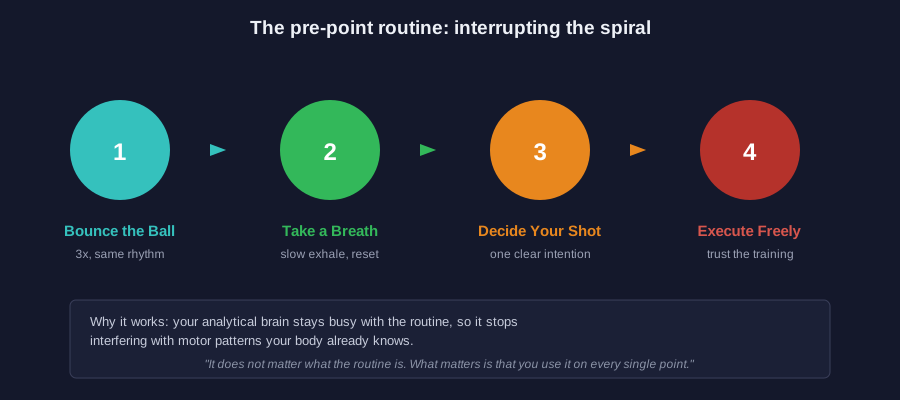
This entire sequence should take under ten seconds. Anything longer starts to feel performative, and your opponent will notice. The point of the routine is not to look composed. It is to actually become functional again before the ball leaves your hand or your opponent’s racket.
For the breathing component specifically, the box breathing and 4-6 patterns covered in the full breakdown of table tennis breathing techniques go into more depth than fits here, including which pattern to use depending on whether you are over-aroused or under-aroused heading into the point.
Why Should You Play Your Simplest Shot at Match Point, Not Your Best One?
Under pressure, motor control narrows toward whatever movement needs the least conscious adjustment, so a shot you have hit ten thousand times survives match point far better than a flashy winner. There is a specific trap that catches strong players more than weak ones at match point: the temptation to end the point with something spectacular. A player who has a genuinely dangerous loop kill will often go looking for it at 10-9, reasoning that one big shot ends the suffering immediately. This is almost always the wrong decision, and it has nothing to do with the shot’s difficulty in isolation.
Under elevated arousal, your motor control narrows toward whatever movement requires the least conscious adjustment. A shot you have hit ten thousand times in roughly the same way, a standard serve to the same spot, a backhand block you could do with your eyes shut, survives the pressure of match point far better than a shot that requires fine-tuned timing and a slightly altered swing path. The flashy winner depends on exactly the kind of precise motor sequencing that reinvestment degrades first.
Roger from Tunapuna, the man who has lost more 10-9s than anyone I know, makes this mistake almost every time. He goes for the kill shot at match point instead of the high-percentage push or block that got him to match point in the first place. He is not lacking in skill. He is choosing the wrong moment to ask his body for something difficult.
The fix is a decision made before the point starts, not during it: commit in advance to playing your three highest-percentage shots only, the ones that require the least adjustment under stress. For most players this means a deep, controlled serve, a consistent third-ball attack you have drilled hundreds of times, or a patient rally shot rather than an early finish. Decide this during your pre-point routine, in the word you choose or the breath you take, so there is no decision left to make once the ball is live.
This same logic explains why composed players often look almost boring at match point. They are not boring. They have simply removed every unnecessary variable from a moment that already has enough uncertainty in it.
How Should You Handle Match Point Against You Differently?
Treat match point against you as identical to point one of the next game. The shot has the same physical requirements as any other; the scoreboard is information for your opponent, not a variable in your swing. Everything above applies whether the match point belongs to you or your opponent, but match point against you carries an extra layer that deserves its own attention. There is a specific, almost physical sensation of time speeding up when you are one point from losing, a sense that the next eight seconds will define the entire match regardless of how the previous forty minutes actually went. That sensation is not accurate, but it feels true enough to change how you play.
The single most useful reframe here, the one I give every player I coach the first time they ask about this, is treating match point against you as identical to point one of the next game. Not in a forced, motivational-poster way. In a strictly tactical way. The shot you are about to play has exactly the same physical requirements as any other shot. The scoreboard is information for your opponent and the umpire. It is not a variable in your swing.
Equipment plays a quieter role in this than most players admit. A blade that feels slightly unfamiliar, a rubber that has lost its tack, a grip that shifts half a centimeter under sweaty palms, none of these cause a loss on their own, but they add one more thing your brain has to monitor at the exact moment it should be monitoring nothing. If you have ever found yourself adjusting your grip mid-point at match point, the equipment was already a problem before the pressure made it visible. Getting that sorted away from competition, not during it, removes one more excuse for your attention to drift toward.
If you are not confident your current setup actually matches how you play under pressure, PingPath walks through equipment fit in a few minutes and removes the guesswork, so match point becomes about your shot selection and nothing else.
How Do You Actually Train Yourself Out of Choking at Match Point?
You train out of choking by rehearsing the exact scenario: starting practice games at 9-9 instead of 0-0, and adding real (if small) consequences to practice points so your nervous system stops treating match point as a novel threat. Most advice on this subject stops at the mental reframe, as if knowing the right thought is the same as having the right reflex under load. It is not. The players who handle match point well are not the ones who read the most about sports psychology. They are the ones who have practiced being uncomfortable on purpose, often enough that match point starts to feel like a situation they have already survived rather than one they are facing for the first time.
The simplest version of this is playing practice games that start at 9-9 instead of 0-0. This sounds almost too obvious to mention, and that is exactly why most players never do it. Ten minutes of starting every practice game at the score that usually breaks them rewires the association between that scoreline and panic. After enough repetitions, 9-9 stops feeling like a crisis and starts feeling like a score you have been in a hundred times, because you have.
A second method, slightly harder to set up but more effective, is adding consequence to practice points without adding danger. Play a set where every match point, yours or your partner’s, requires the loser to do ten push-ups immediately, no pause, no negotiation. This will feel artificial for the first few sessions. It works because your nervous system does not fully distinguish between a real consequence and a rehearsed one, provided the rehearsed one is taken seriously. The American Psychological Association has documented this kind of stress inoculation training extensively, primarily in clinical and performance contexts, and the underlying principle transfers directly to competitive sport: controlled, repeated exposure to a manageable stressor reduces the physiological response to that stressor over time.
The goal of both drills is the same. You are not trying to eliminate the nervousness of match point. You are trying to make sure your body has already met this specific kind of pressure enough times that it stops treating it as a novel threat. Novel threats are what trigger the reinvestment spiral covered earlier. Familiar ones do not.
What Mistakes Make Match Point Pressure Worse?
The most common mistakes are replaying the previous miss, looking at the scoreboard, deliberately slowing everything down, and apologizing in advance for a miss that hasn’t happened yet. A handful of habits show up across almost every player who struggles at match point, and most of them feel helpful in the moment, which is exactly why they persist. Several of these overlap with the broader nerve patterns covered in general anxiety tips for table tennis, but match point sharpens each one because there is no next point to recover on.
Replaying the previous miss. If you double-faulted the serve that got you to match point, your brain wants to understand what went wrong before you serve again. Resist this. Analysis belongs after the match, not inside the ten seconds before the next point. Mid-point analysis is reinvestment wearing a different costume.
Looking at the scoreboard. The score already lives in your head. Looking at it again adds nothing useful and pulls your eyes and your attention away from your opponent’s racket angle, which is the actual information you need.
Slowing everything down deliberately. Some players try to manage nerves by taking unusually long pauses before serving, believing that more time equals more control. Past a certain point this backfires, giving your nervous system more time to build the very anxiety you are trying to manage. Ten seconds of routine, covered earlier, beats forty-five seconds of stalling.
Apologizing in advance. Telling your opponent, your partner, or yourself some version of “I always mess this up” before the point starts is a verbal commitment your brain takes more seriously than you think. The self-fulfilling prophecy effect is well established in psychology, and competitive sport is one of its most reliable environments. Say nothing instead, or say your single word.
What’s the Real Lesson From Roger’s Missed Match Points?
Roger is sixty-one years old now and still plays in the same Tunapuna league, still arrives at match point with that same forehand that looks, for nine points out of ten, like it belongs to someone better than he officially is. I asked him once, between games, what goes through his head right before that tenth point. He thought about it longer than I expected and said, “I start hoping it goes in.” Hoping. Not deciding. Not executing. Hoping, the way you hope for rain when you have already left the umbrella at home.
That is the difference between every player who handles match point well and every player who does not. It is not talent, and it is rarely even nerve in the colloquial sense. It is whether, in the ten seconds before the ball is live, you are running a routine you trust or simply hoping the outcome takes care of itself. Hope is not a strategy. A bounce, a breath, and a word are.
If you want the full system this guide draws from, the complete framework for staying composed when the score turns against you lives inside MentalEdge, built around the same pressure points covered here and trained the way Roger never bothered to.
Frequently Asked Questions
Why do I choke at match point in table tennis?
You choke because anxiety pulls a stroke that normally runs on autopilot back into conscious, step-by-step control, a process called reinvestment. The movement that used to take care of itself gets a frightened supervisor standing over it, which makes it slower and less accurate.
How do I stay calm at match point?
Run the same short pre-point routine every time: step back, one slow exhale longer than your inhale, and a single word that points your attention at the next shot rather than the score.
Should I go for my best shot or my safest shot at match point?
Your safest, most repeated shot. Under pressure your motor control narrows toward whatever needs the least conscious adjustment, so a heavily drilled shot holds up better than a low-percentage winner.
How can I practice handling match point pressure?
Start practice games at 9-9 instead of 0-0, and add a small real consequence to lost points, like push-ups, so your nervous system meets the scenario enough times to stop treating it as a novel threat.
How is match point against you different from match point in your favor?
Mechanically it isn’t: the shot needs the same precision either way. The difference is entirely in your head, a felt sense of time speeding up that isn’t accurate but changes how you play unless you treat the point as identical to point one of the next game.
Leave a Reply