
There’s a particular kind of quiet that falls over a sports hall when the score flips. I’ve watched it happen dozens of times across tournaments in the Caribbean, a player leads 9-4 in the fifth, the crowd starts drifting toward their side, and then something shifts. Not on the scoreboard. Not yet. Something behind the eyes. The player starts playing carefully instead of freely, and carefully, in table tennis, is the same thing as playing badly.
By the time the score reaches 9-9, the player who was winning has stopped playing their game. They’re playing the lead. Or rather, they’re playing not to lose the lead, which is a completely different activity with a completely different nervous system response behind it. Learning how to come back from losing a big lead in table tennis is less about the scoreboard than about that response.
Coming back from a big lead you’ve lost is one of the hardest things in this sport. But understanding how to come back from losing a big lead in table tennis begins, strange as it sounds, with understanding what happened to the player who gave it away.
Why Is a Big Lead a Mental Trap in Table Tennis?
A big lead is a trap because it activates loss aversion: losing points you already have feels roughly twice as painful as gaining new ones, which triggers the same threat response as being behind. A five-point lead in the fifth game of a match should be a position of total freedom. You’ve already done the hard work. The math is heavily in your favor. A reasonable person would relax.
Table tennis players are not, in the relevant moment, reasonable people. They are organisms with nervous systems that evolved to respond to threat, and a five-point lead in a deciding game activates exactly that system, because now there’s something to lose.
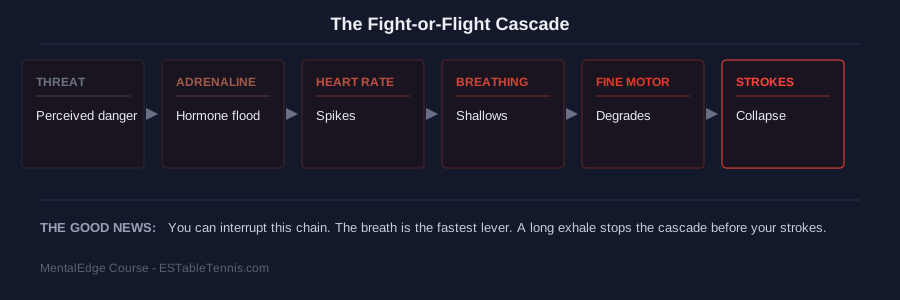
Research from behavioral economics has documented what psychologists call loss aversion, the finding that losses hurt roughly twice as much as equivalent gains feel good. A player with a five-point lead isn’t thinking about winning five more points. They’re thinking about losing five points, which suddenly feels like the most catastrophic thing that could happen in a sports hall in Chaguanas on a Tuesday evening.
This is the trap. And the player on the other side of the net, the one who is five points down, has accidentally escaped it, because there is nothing left to protect.
Why the Trailing Player Has the Mental Advantage
Five points down in the fifth game is, objectively, a bad position. The match could end in the next two minutes. Most casual observers watching from the bleachers would give up on you. This is, paradoxically, exactly the mental state that produces the best table tennis.
When there’s nothing left to lose, the prefrontal cortex stops interfering with the basal ganglia. In plain terms: the thinking brain stops second-guessing the playing brain. You’ve spent years training your body to move correctly, contact the ball correctly, read spin correctly. That body knowledge lives in your motor memory. The only thing that stops it from working is conscious thought layered on top of it, and being five points down with nothing to protect removes most of that thought.
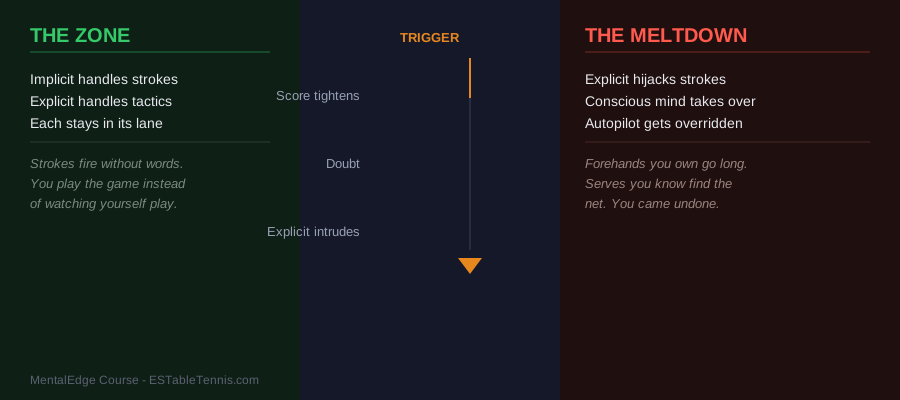
This is why comebacks feel effortless when they happen. It’s not that the trailing player suddenly discovered talent they didn’t have five minutes ago. It’s that the leading player’s mental collapse removed the interference that was already present in the trailing player’s game.
If you’ve ever played worse in matches than in practice, you’ve already met this mechanism. The match environment loads the mind with things that don’t exist on the practice table: consequence, audience, score, history. Being five down in the fifth strips most of that away. You’re already in the place you practice from.
What Mindset Shift Actually Enables a Comeback?
The mindset shift that enables a comeback isn’t winning a point. It’s deliberately redirecting attention away from the scoreboard and onto the only thing you control: the next ball. Here’s the thing nobody tells you directly: the comeback doesn’t start when you win a point. It starts when you stop caring about the score.
Not in a passive way. Not defeat dressed up as peace. I mean something more precise: a deliberate decision to redirect your attention away from the scoreboard and toward the only thing you can actually control, which is the next ball.
I’ve coached players who could articulate this intellectually and still couldn’t do it in a match. The gap between knowing and doing is filled by something habitual, a routine so practiced it runs even when the mind is under siege. This is what a reset ritual is: a physical and mental sequence that interrupts the score-watching loop and returns your attention to the present.
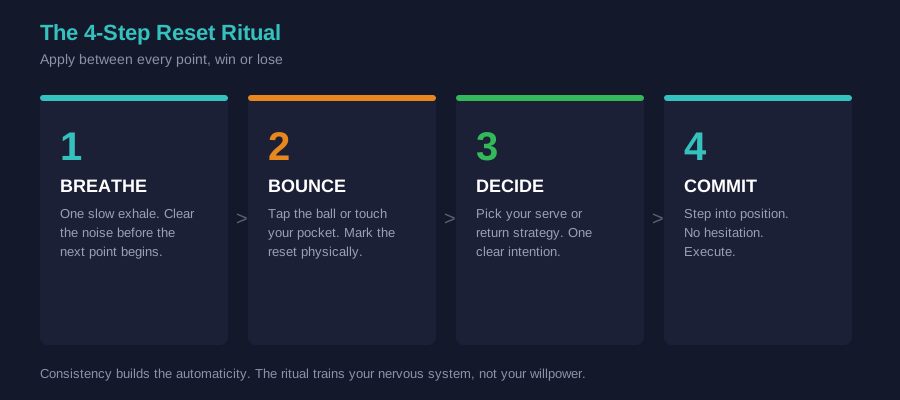
A good reset ritual has four components. It is physical, meaning it involves a deliberate body action that you can do between every point. It is brief, meaning it takes no longer than four seconds. It is consistent, meaning it doesn’t change based on the score. And it ends with an intention, not a hope, a specific tactical thought about the next point, not a general plea to play better.
How Do You Execute a Comeback Point by Point?
Comebacks don’t happen in bulk. You don’t decide to score five points. You decide to play the next point as well as you can, and then you do that again, and at some point you look up, and the score has changed.
Here’s what the mental execution actually looks like, broken down into the specific things that happen between points when you’re chasing a deficit.
Reset Between Every Point
After each point, win or lose, you run your reset ritual. Bounce the ball once. Take one slow breath, exhaling longer than you inhale. Set your stance. Pick your intention for the next point. This is it. Every time. The same sequence whether you just hit a winner or threw an easy ball into the net.
The consistency is what makes it work. Controlled exhalation activates the parasympathetic nervous system, which counters the fight-or-flight response that pressure triggers. But that only happens reliably if the habit is automatic. If you only do the breathing when you’re nervous, you’ve already lost the point before it starts, because your body reads it as a distress signal rather than a routine reset.
Play Offense, Not Survival
The biggest tactical error trailing players make is playing to extend rallies rather than to win them. This feels cautious and sensible. It is actually suicidal, because it hands control to the leading player and lets them settle into comfortable defensive patterns.
A comeback requires you to maintain your offensive game even when it feels reckless. The leading player is already tightening up. Their loops are getting safer, their serves are getting less creative, their placement is becoming conservative. This is the moment to attack, because the shots you’re attacking are worse than the ones you were facing five minutes ago.
This doesn’t mean hitting harder. It means hitting with the same intent you had when you were neutral in the score. The problem is that the score makes neutral feel dangerous. The solution is to stop watching the score.
Play One Point Ahead, Not Five
Being five points ahead can feel like being five points down. That is an overwhelming number if you hold it all at once. The mental reframe that actually works is simpler: you’re not five points down. You’re trying to score the next point. When you score it, you’ll be one point closer. You can think about that point when you get there.
This sounds obvious. It’s almost impossible to do under pressure unless you’ve practiced it, because the brain under stress defaults to catastrophizing the full gap rather than focusing on the next step. Psychological resilience research consistently shows that breaking overwhelming situations into immediate, actionable steps is the most reliable way to maintain performance under load.
Let the Score Work For You
As the gap closes, something interesting happens to the leading player. What was comfortable at 9-4 becomes uncomfortable at 9-7. The awareness that they’re losing points triggers another wave of tension. Their grip tightens. Their timing rushes. The errors that never came at 9-4 start appearing at 9-7 and 9-8.
You don’t have to do anything special to create this. You just have to keep playing your game, point by point, and the mathematics of the situation will do the psychological work on the player across the net.
I’ve watched this specific dynamic enough times to know that the trailing player who closes from 9-4 to 9-8 has usually won the match before the ninth point is played. Not because they’ve found some tactical superiority. Because the leading player, now watching a comfortable margin disappear, has started playing scared in a way they weren’t at 9-4.
How Do You Handle Deuce After Closing a Big Gap?
Keep running your reset ritual on every single point. At 10-10 both players are starting from zero, but you’ve been playing free and offensive while they’ve been playing tight, and that momentum is yours if you don’t stop to think about it. Getting to deuce from a deficit is one thing. Winning from deuce after you’ve just closed a five-point gap is another, because now you’re the one who’s been chasing and the other player has been gifting you points and neither of you quite knows what the mental state of this match actually is.
The answer is simple, if not easy: keep running the reset. Every point. The score is 10-10, which means both players are starting from zero. The only difference is that you’ve been playing free, offensive table tennis for the last seven points, and the other player has been playing tight, defensive table tennis. That momentum is real, and it’s yours if you don’t stop to think about it.
The worst thing you can do at 10-10 is start playing cautiously, because you’ve finally leveled the score. This is the same trap the leading player fell into at 9-4. The match is tied. There’s nothing to protect. Play the next point like you’re still five down, because that’s the mental state that got you here.
How Does Equipment Affect a Comeback?
Equipment that requires maximum precision to perform works against you in a comeback, since your nervous system under pressure is not offering maximum precision. Equipment with more margin for timing error holds up better in exactly this moment. There’s a specific moment in a comeback when equipment choices matter more than at any other point in a match. When you’re five points down and playing freely, you’re relying entirely on feel and instinct. The decisions you made weeks or months ago about rubber type, hardness, and thickness are now the only hardware between your instincts and the ball.
Players who’ve chosen equipment primarily for performance metrics in practice often discover at 9-8 in the fifth that the rubber that gives them maximum speed requires maximum precision, and their current nervous system state is not offering maximum precision. The equipment is technically superior and functionally wrong for the moment they’re in.
This is one of those connections between equipment and mental performance that doesn’t appear in gear reviews. ITTF equipment specifications define what’s legal to use, but they say nothing about which legal equipment will support your mental game when the match is on the line. The equipment you can trust when your hands are slightly tighter than usual is the equipment that matches the physical state your nervous system produces under pressure, not the state it produces in a Tuesday afternoon practice session.
If you regularly notice that your consistency drops sharply in high-pressure moments, the answer might not be more mental training. It might be equipment that requires less precision to execute correctly, rubber that gives you more margin for the slight timing errors that pressure introduces into every player’s game, regardless of skill level. This is the same principle behind why your grip matters more under pressure than in practice: when tension creeps into your hand, every mechanical variable gets amplified.
What Should You Do If You’re the One Blowing the Lead?
A blown lead is a predictable neurological response to having something to protect, not a character flaw, and the prevention is the same reset ritual run after every point regardless of score. Everything I’ve said so far is written from the perspective of the trailing player. But at some point in your table tennis life, you will be the player at 9-4 who gives it away, and you will need to understand what happened.
The mental collapse that produces a blown lead isn’t a character flaw. It’s a predictable neurological response to a specific set of pressures. You got tight because you had something to protect. Your movements got smaller. Your game got more conservative. You stopped attacking because the attacks felt riskier than they had at 4-4.
The prevention is exactly what I described for the trailing player: a reset ritual practiced until it’s automatic, run after every point regardless of the score. The players who hold leads are not fundamentally different from the players who blow them. They’ve just built habits that give them access to the same mental state at 9-4 as they had at 4-4.
There’s a line I’ve come back to enough times that I’ve stopped questioning whether it’s true: the score doesn’t tell you how you’re playing. It tells you how you were playing. The game is always in the next point.
How Do You Build the Habits That Make Comebacks Normal?
Simulate the pressure in practice before you face it in a match: run practice sets that start from a deficit, and reset deliberately between every point even with no audience watching. Coming back from a five-point deficit isn’t a talent. It’s a skill, and like all skills, it’s built in practice, not discovered in matches.
The most effective training approach is to simulate the pressure in practice before you face it in a match. Run practice sets where the trailing player starts each game with a 5-0 deficit and works from there. Run sets where both players reset deliberately between every single point, even on practice tables with no audience, so the habit forms before the nervous system needs it.
The competitive table tennis environment is not a good place to build new habits. It’s a place to execute habits you’ve already built. Players who discover for the first time in a semifinal that they need a reset ritual are discovering it too late. Players who have run that ritual ten thousand times in practice find it available exactly when they need it, because the body knows what to do even when the mind is temporarily unavailable.
This is the whole game, really. Mental performance in table tennis is not about being fearless. It’s about having so many reliable habits that fear becomes a minor inconvenience rather than a governing force. The players who come back from five points down aren’t braver than the players who don’t. They’re just more practiced at returning to themselves between points.
What’s the Quick Reference for Coming Back From a Big Lead?
If you’re mid-match and need the short version, here it is.

The players who come back from 9-4 down have not discovered courage at 9-8. They’ve just stopped paying attention to the number on the board and started paying attention to the only thing that was ever actually in front of them: the next ball.
If you want to go deeper on the mental side of this, my free ebook covers the specific techniques that keep you composed when the score stops being comfortable. Download it here.
Frequently Asked Questions
Why do players blow big leads in table tennis?
A lead triggers loss aversion, the same threat response as being behind, because there’s now something to protect. Players tighten up, play conservatively, and hand momentum back to their opponent.
How do you come back from losing a big lead in table tennis?
Run a fixed reset ritual after every point, keep playing offense instead of retreating into survival mode, and focus on winning the next point rather than the size of the deficit.
Why does the trailing player sometimes play better than the leader?
With nothing left to protect, the trailing player’s thinking brain stops interfering with trained motor memory, which is the same relaxed state most players only reach in practice.
What should I think about when I am down by a lot of points?
Only the next point. Treating the full deficit as one number to overcome triggers catastrophizing; breaking it into a single actionable step at a time is what resilience research shows actually works under pressure.
How can I practice coming back from a big deficit before it happens in a real match?
Run practice sets where you deliberately start 5-0 down and reset between every point, so the habit is already automatic before your nervous system needs it in competition.
Leave a Reply