
I watched a kid play at the Chaguanas Sports Complex once, maybe sixteen years old, who had the most beautiful forehand drive I had ever seen from a junior player. The arc was perfect. The contact point was perfect. His footwork looked like he had been doing it since he could walk.
He lost that match 0-3. Every game was close. He lost every close game the same way: the ball going fractionally wide at exactly the points where he needed it to stay on the table.
His coach was standing next to me. I asked what he thought was wrong. He said the kid just needed more experience. I didn’t say anything. But I had seen what the coach hadn’t looked for. The boy gripped his paddle like he was afraid of dropping it into a drain.
That’s a grip problem. And grip problems don’t just hurt your shots. They sit quietly behind every inconsistency in your game, every inexplicable miss under pressure, every match you lose while playing better than your opponent.
This guide covers how to grip a ping pong paddle correctly, what the most common mistakes actually look like from the outside, and why fixing your grip might be the highest-value change you make to your game this year.
Why Is Your Grip the Root of Problems You Think Are Something Else?
Your grip is the only point of contact between you and every shot you play. When it’s slightly wrong, the force transfer is wrong, and no amount of practice, footwork, or mental work compensates for it. The grip is the only point of contact between you and every shot you have ever played. Every stroke transfers force through that connection. When the connection is wrong, the force goes wrong, and no amount of practice, footwork, or mental work compensates for it.
I have coached players who spent months trying to fix inconsistent topspin by adjusting their swing path, contact point, and timing. The real issue, in most of those cases, was that they held the paddle in a way that introduced a slight rotation on contact. Fix the grip, and the swing suddenly works the way it was trained to work.
Grip also has a direct relationship with your mental game. A tight grip is almost always a sign of a tense player, and a tense player makes errors at the worst moments. That connection matters more than most coaches acknowledge, and I will come back to it in detail later in this guide.
What Are the Main Grip Types, and Which One Should You Use?
There are two fundamental grip families in table tennis: the shakehand grip and the penhold grip. Within each family, there are important variations. Before you decide which one fits your game, understand what each one is built for and what trade-offs it carries.
The Shakehand Grip
This is the dominant grip in modern international table tennis. The name describes exactly what you do: you hold the paddle the way you would shake someone’s hand, with the blade running vertically between your thumb and index finger and the remaining three fingers curled around the handle.
The shakehand grip allows equal power and reach on both the forehand and backhand sides. That’s why it has become the standard for most players outside East Asia. It adapts well to the loop-dominated styles that define the modern game at every competitive level.
The Penhold Grip
In the penhold style, you hold the blade like a pen: the handle points downward, the blade faces away from you, and the index finger and thumb pinch the blade face near the bottom edge. The remaining fingers curl around or extend flat on the back of the blade, depending on which variation you use.
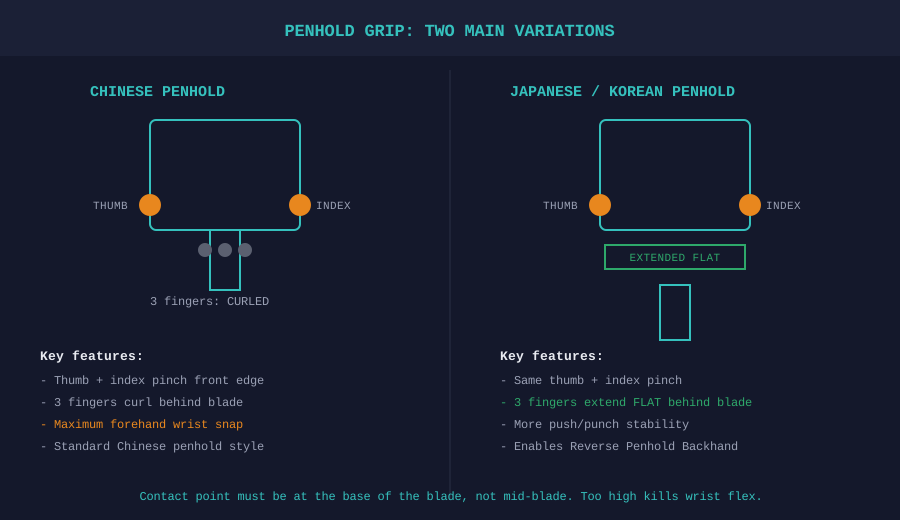
There are two main penhold styles. The Chinese penhold has the back fingers curling tightly behind the blade. The Japanese/Korean penhold has those same fingers extending flat across the back face. A more recent development, the Reverse Penhold Backhand (RPB), lets penhold players generate topspin on the backhand side using the reverse face of the blade, which had historically been the major weakness of the style.
The penhold grip suits players who favor a strong forehand, fast wrist action close to the table, and a short game. It dominated in China and parts of East Asia for decades, though the shakehand grip is now far more common even at the elite level internationally.
For most players reading this, especially those moving from recreational to competitive play, the shakehand grip is the right starting point. The rest of this guide focuses primarily on shakehand fundamentals, with specific notes on penhold where they add real value.
How Do You Grip a Ping Pong Paddle Correctly Using Shakehand?
There’s the version of the shakehand grip players arrive at naturally, and there’s the version that actually works. They often look similar from a distance. The difference is in the precise placement of the index finger and the amount of tension the player carries in the hand.
Here’s the correct sequence for setting a shakehand grip:
Step 1: Rest the blade flat in your non-playing hand. Don’t pick it up yet. Look at the handle. Most modern shakehand handles taper slightly. Where you position each finger around that taper matters more than most players expect, and it’s easier to set the grip correctly when you’re not already holding it.
Step 2: Bring your playing hand to the handle as if reaching out to shake someone’s hand. Your palm faces the side of the handle, not the top or bottom. Your thumb rests on the rubber on the forehand side of the blade. Your index finger rests on the rubber on the backhand side. These two fingers control the paddle face. Everything else in the grip follows from their placement.
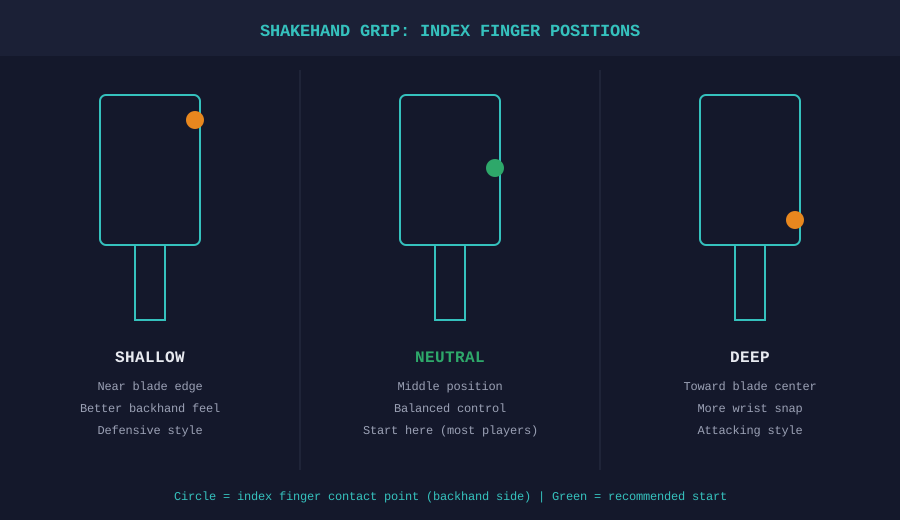
Step 3: Check your index finger position. The index finger lies along the backhand side of the blade face. How far up the blade it extends determines the feel and function of the entire grip. There are three common positions, each with different effects on your game:
- Shallow (near the edge of the blade): More stability on the backhand side. Better for defensive and all-round players who prioritize consistency over raw power.
- Neutral (middle of the blade face): A balanced feel on both sides. This is where most players should start, and where many stay throughout their playing careers.
- Deep (extending toward the blade center): More forehand feel and wrist snap. Favored by players who loop heavily on the forehand and are willing to trade some backhand stability for added power on their primary attacking stroke.
Step 4: Curl your remaining three fingers around the handle. They support and anchor the paddle. Don’t grip tightly with these fingers. Think of them as a rest, not a clamp. The paddle should feel secure without any strain in the hand or forearm.
Step 5: Test the tension. A correct shakehand grip feels secure but not rigid. Your wrist should move freely. If you can’t flick your wrist without the paddle feeling like it might shift, you’re gripping too tightly. Aim for about 30 percent of your maximum squeeze during neutral play. You’ll be surprised how much wrist movement that unlocks.
How Do You Grip a Ping Pong Paddle Correctly Using Penhold?
If the penhold grip fits your game, the setup is different but the principle is the same: relaxed enough to let the wrist move freely, secure enough that the blade doesn’t shift on contact.
Chinese penhold: Place the tip of the handle between your index finger and thumb as if holding a large pen. The index finger and thumb pinch the front face of the blade near the bottom edge. The remaining three fingers curl around the back of the blade and hold it lightly.
Japanese/Korean penhold: The pinch position of index finger and thumb is the same, but the three back fingers extend flat rather than curling. This produces slightly more stability for fast pushes and punches, though with somewhat less natural range for the RPB stroke.
The most common error in self-taught penhold players is gripping too high up the blade. This kills wrist flexibility immediately. The contact point between your pinching fingers and the blade should sit at the very base, right where blade meets handle.
What Are the 7 Most Costly Grip Mistakes, and How Do You Fix Them?
Most grip problems aren’t dramatic. They’re small deviations that compound over thousands of repetitions into major inconsistencies. Here are the seven I see most often, in order of how much damage they do to a game over time.
Mistake 1: Gripping too tightly. This is the most common mistake at every level, and the one that directly links your grip to mental collapse under pressure. When you’re nervous, your hand tightens. A tight grip kills wrist snap, forces you to generate power with your arm instead of your wrist and shoulder, and makes every shot feel heavier than it should. The fix: at any natural pause in play, consciously release the grip to about 30 percent of your maximum squeeze. The paddle will feel less secure. That’s exactly the right feeling.
Mistake 2: Pressing the thumb too hard into the blade. Your thumb should rest on the rubber, not press down into the blade face. Hard thumb pressure restricts wrist movement on the forehand side and makes topspin loops feel stiff and mechanical. The fix: light contact only. The thumb rests; it doesn’t brace.
Mistake 3: Wrapping the index finger too far across the blade. Some players, especially those from a defensive background, extend the index finger almost to the middle of the blade on the backhand side. This provides extra stability but cuts forehand range significantly. The fix: keep the index finger within the lower third of the blade face.
Mistake 4: Ignoring the handle shape. Most modern paddles come with flared, straight, or anatomical handles. Flared handles suit players with looser grips and more wrist-play. Straight handles suit players who favor a locked wrist for consistency. Anatomical handles try to split the difference and often satisfy neither. If your grip feels wrong despite everything else being right, the handle shape might be the actual problem. I covered this decision in detail in the guide to choosing the best table tennis racket, which includes handle selection for different playing styles and grip types.
Mistake 5: Shifting the grip mid-rally. Some players unconsciously readjust their hold between forehand and backhand shots during a rally. It’s a habit usually built in the early stages of learning two-sided play. The fix: drills that force rapid forehand-backhand transitions, with a deliberate grip check after each set of shots.
Mistake 6: Not maintaining grip consistency under fatigue. In long matches, the grip loosens or shifts as the hand tires. This is most damaging in the fifth set, which is also when the score is closest and the margin for error is smallest. The fix is conditioning: grip endurance work off the table, like squeezing a firm ball for thirty-second intervals, repeated regularly as part of your training routine.
Mistake 7: Copying a professional’s grip without understanding why. I have watched players shift to a very shallow index finger position because their favorite player uses it, without understanding that this player runs a heavily forehand-dominant game supported by exceptional footwork that compensates for the reduced backhand feel. Their grip works for their game. It may not work for yours. The fix: build your grip around your actual style, not someone else’s highlight reel.
How Does Grip Pressure Connect to Your Mental Game?
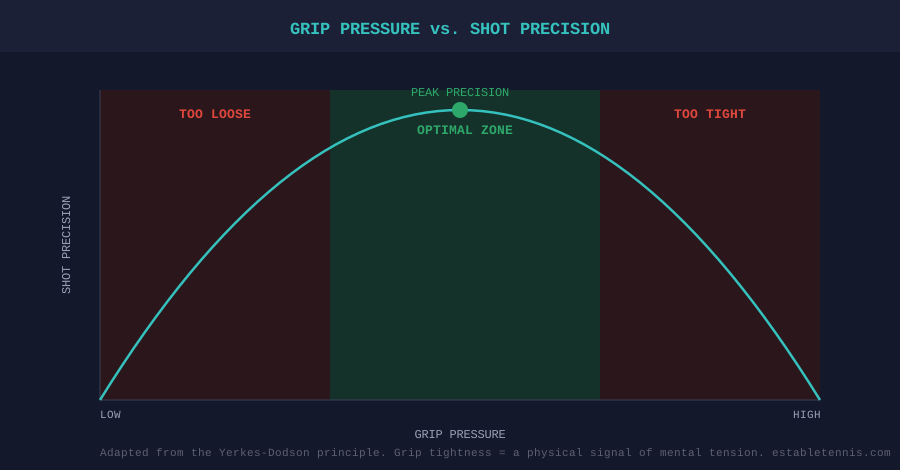
Grip pressure is a mental performance indicator, not just a technical detail. Stress tightens the hand first, and that tightening degrades fine motor precision at exactly the moments that matter most. Here is something I have watched happen in match after match, at junior tournaments and open club events: a player who looked perfectly composed in the warmup starts missing shots in the third game that he was making easily in the first. His stroke looks the same. His footwork looks the same. But something is off.
Almost always, his hand has tightened.
Stress increases muscle tension throughout the body, and the hands, which carry a high concentration of motor neurons, are among the first places that tension shows up. In table tennis, where the margin between a ball that clips the edge and one that goes wide is measured in millimeters, a subtle shift in grip pressure is the difference between a point won and a point lost.
This is why the grip is not just a technical issue. It’s a mental performance indicator. A player who knows how to grip a ping pong paddle correctly and has trained that grip under real match conditions will notice when the hand tightens. That noticing is itself a form of self-regulation, a small window in which you can interrupt the tension spiral before it takes over.
Research published in the US National Library of Medicine confirms that fine motor precision degrades measurably under high arousal states. Your grip is not immune to anxiety. Training it correctly is only half the work. Learning to hold it when the score is 9-10 in the fifth is the other half.
I have seen players use a deliberate grip check, a brief squeeze-and-release between points, as a reset tool. It does the same thing a controlled breath does: it interrupts the physical signal of anxiety before it becomes a performance problem. If you want to understand more about why the body responds this way under competitive pressure, the full guide to managing performance anxiety in table tennis covers the physiology in detail and gives you practical tools to work with it.
How to Test Whether Your Grip Is Actually Working
The simplest test: take a hundred forehand loops and a hundred backhand pushes. After each shot, without looking at your hand, ask yourself whether the paddle is still in the same position it started. Do this honestly, not optimistically.
If the paddle shifts consistently after forehand shots, your grip is too loose or your index finger is too shallow. If it shifts after backhand shots, your thumb pressure or grip depth needs adjustment.
The second test is more revealing: run for five minutes before the drill. The mistakes your grip makes under physical fatigue are the mistakes it will make at 8-9 in the fifth game. A grip that holds under fatigue in practice is far more likely to hold when the match depends on it.
These two tests tell you more about how to grip a ping pong paddle correctly than any checklist or diagram because they expose what the grip actually does under conditions that matter, not what it looks like in a slow-motion tutorial video.
How Do You Choose Equipment That Works With Your Grip Style?
Your grip style should determine your equipment choices, not the other way around. A tight, locked-wrist grip doesn’t need a fast, high-throw rubber, since that combination sends every shot long. Your grip style should inform your equipment choices, not the other way around. This matters more than most beginners realize, and it’s a principle the equipment industry has no particular financial reason to make clear.
A player with a tight, locked-wrist shakehand grip doesn’t need a fast, high-throw rubber. That combination sends every shot long. A player with a loose, whippy wrist and a shallow index finger can handle more speed because the wrist itself controls the power. Get this relationship wrong and you’ll spend months chasing a problem in your swing that actually lives in your equipment choice.
Handle shape matters here too. A flared handle locks the hand into a natural shakehand position and suits players who want grip stability without thinking about it. A straight handle gives more freedom to shift slightly between forehand and backhand positions, which suits players who vary their game more across the table.
According to the ITTF Equipment Regulations, the blade must be flat and rigid. This means the blade won’t compensate for grip inconsistencies. Every deviation in your hold shows up directly in shot quality. That’s not a design flaw. It’s the game being honest with you about your technique.
What’s the Real Takeaway About Grip and Mental Performance?
That kid at the Chaguanas Sports Complex came to me the following week. He said his coach had told him to work on his mental strength. I told him to start somewhere his coach hadn’t looked: his right hand.
We spent twenty minutes adjusting his grip and drilling with a consciously relaxed hold. He said it felt wrong. He said the paddle felt like it might fly out of his hand. I told him that feeling was exactly right. It was the absence of tension he had been carrying since he first picked up a paddle.
Three weeks later, he won the junior event at a club tournament. His forehand hadn’t changed. His footwork hadn’t changed. His coach told me the mental coaching had worked.
Equipment and mental performance are never separate from each other. A grip that’s wrong creates physical tension. Physical tension creates errors. Errors create anxiety. Anxiety makes the grip worse. You know where that cycle ends.
The good news is it runs the other way too. Fix the grip, and you interrupt the cycle at its source.
Want to build the mental side to match your technique? Download the free ebook Staying Calm Under Pressure and get the framework I use with competitive players to stop anxiety from wrecking what they have built at the table. Get it free here.
Frequently Asked Questions
What’s the correct way to hold a ping pong paddle?
For the shakehand grip, hold the handle like shaking someone’s hand, thumb resting on the forehand rubber, index finger along the backhand side, with about 30 percent of your maximum squeeze.
Should I use a shakehand or penhold grip?
Shakehand, for most players, especially those moving from recreational to competitive play. It gives equal power and reach on both forehand and backhand and suits the loop-dominated modern game.
Why do I keep missing shots even though my technique looks right?
Often the problem is grip, not stroke. A slightly wrong grip introduces rotation on contact that no amount of swing adjustment can fix.
How tight should I grip my table tennis paddle?
About 30 percent of your maximum squeeze. Secure enough that the paddle doesn’t shift, loose enough that your wrist moves freely.
Why does my grip get worse during a match?
Stress tightens your hand, and a tighter grip kills wrist snap and degrades fine motor precision exactly when the match is closest and the margin for error is smallest.
Leave a Reply