Finding the best table tennis racket is something most players get completely wrong. Over 300 million people play table tennis worldwide. I was shocked when I first read that too. And yet, walk into any sporting goods store, and you’ll find people grabbing the cheapest paddle off the shelf, slapping it around for a few weeks, and then wondering why they can’t return a simple topspin serve. I’ve been there. Done that. Bought the terrible $12 racket. Lost embarrassingly.
Here’s the truth: the best table tennis racket isn’t necessarily the most expensive one, or the one the pros use on YouTube. It’s the one that matches your skill level, your playing style, and honestly, your budget. A world-class blade in the hands of someone who just learned how to serve is basically wasted money. But what is the right beginner paddle? That thing can genuinely transform your game overnight.
I’ve been playing table tennis for over 20 years now, starting in my aunt’s basement with a warped wooden paddle that had more duct tape on it than rubber. Over the years, I’ve tried dozens of rackets, made plenty of expensive mistakes, and learned what actually matters when you’re picking a paddle. In this guide, I’m going to walk you through everything, from understanding what makes a great racket to specific recommendations for every level, to keeping your equipment in top shape.
Whether you’re just picking up a paddle for the first time or you’re ready to go semi-competitive, I’ve got you covered. Let’s dig in!

What Makes a Table Tennis Racket the “Best” for You?
Okay, so here’s the first thing I wish someone had told me when I started getting serious about table tennis: there is no single “best” racket for everyone. I spent way too long chasing the idea of some magical paddle that would fix all my problems. Spoiler alert: it doesn’t exist. What does exist is the best racket for you, and figuring that out starts with understanding the three core components of any table tennis racket: the blade, the rubber, and the sponge.
The blade is the wooden (or carbon) base of your racket. Think of it as the skeleton. Blades vary in stiffness, thickness, and material composition. A softer, all-wood blade gives you more control and feel, great for beginners and defensive players. A stiffer carbon-fiber blade generates more speed and power, which advanced offensive players love. But here’s the catch: more speed means less control. I learned that the hard way when I borrowed a friend’s carbon blade and proceeded to smash every ball off the table for 20 minutes straight. Not my proudest moment.
The rubber goes on top of the blade, and this is honestly where most of the magic happens. There are different types: inverted (smooth surface, most common), pips-out (little bumps facing outward), and anti-spin rubber. Inverted rubber is your go-to for most players because it generates excellent topspin and is versatile in attack and defense.
Pips-out rubber produces less spin and is often used by defensive or blocking-style players. The rubber’s texture, thickness, and hardness all affect how the ball responds to your hits. Choosing the wrong rubber for your game is like putting racing tires on a family sedan; it just doesn’t make sense.
The sponge is the layer between the rubber sheet and the blade. Sponge thickness is measured in millimeters, typically ranging from 1.5mm to 2.5mm. Thicker sponges boost speed and spin but sacrifice control. Thinner sponges are slower and easier to control, making them ideal for newer players. I always recommend beginners start with a sponge around 1.8mm: it gives you a nice balance without completely overwhelming your developing technique.
Now, here’s something important: the “best” racket is deeply personal. A defensive player who loves keeping the ball in play needs a completely different setup than an aggressive looper who wants to smash winners. That’s why I get a little frustrated when people ask “what’s the best paddle?” without giving any context. It’s like asking “what’s the best car?” Well… best for what? City driving? Off-roading? Track racing? Same deal here.

Another thing worth knowing is the difference between pre-made rackets and custom-assembled setups. Pre-made rackets (also called “ready-made” or “combo” paddles) come with the blade and rubber already attached. They’re convenient, often cheaper, and totally fine for beginners and recreational players. Custom setups, where you choose your blade and rubbers separately, are for intermediate and advanced players who want to fine-tune their game.
I didn’t bother going custom until about three years into serious play, and honestly, it made a noticeable difference once I actually knew what I was doing.
Your playing style is the biggest factor in choosing the right racket. Offensive players want speed and spin; they’re always attacking, looping, and smashing. Defensive players want control and the ability to place the ball precisely. All-around players sit in the middle, wanting a bit of everything. Figure out which one you are (or want to be), and let that guide every racket decision you make from now on.
Use the PingPath app if you want AI to tell you your perfect setup in 60 seconds. It was created for players who are stuck guessing what they’re doing wrong, guessing how to improve, and honestly… wasting months repeating the same mistakes. That’s exactly why something like PingPath hits different. Instead of grinding blindly, you get a clear path, real insights, smarter feedback, and a way to actually see your progress without overcomplicating things. Tools like this are designed to simplify the selection process and remove mental noise (a topic I cover in my table tennis psychology guide), so you can focus on what actually matters: winning more points and improving faster. If you’re serious about leveling up and not just “playing for fun,” trying PingPath isn’t optional… It’s the shortcut most players wish they had earlier.
What Are the Best Table Tennis Rackets for Beginners?
For beginners, prioritize control over speed: a softer blade, thinner sponge between 1.5mm and 1.8mm, and moderate rubber hardness in the $30 to $40 range. Man, if I could go back and talk to my beginner self, the first thing I’d say is: stop trying to buy the fastest paddle in the store. I see this mistake constantly. New players think that a faster, more powerful racket will make them better. It does the opposite. When you’re just starting out, control is everything. You need to be able to keep the ball on the table consistently before you start worrying about speed and spin.
For beginners, the golden rule is: prioritize control over speed. You want a racket that forgives your mistakes, and trust me, you’re going to make a lot of them. A paddle with a softer blade, thinner sponge (1.5mm to 1.8mm), and moderate rubber hardness is your best friend at this stage. It gives you the feel and feedback you need to develop proper technique. Once your strokes are solid, then you can start upgrading.
Some excellent beginner options include the STIGA Performance and the JP WinLook Sets. Both of these rackets are pre-made, affordable (sitting nicely in that $20–$45 range), and designed with control-oriented specifications. The STIGA Performance in particular has been a favorite recommendation of mine for years; it’s got a 5-ply blade, basic inverted rubber on both sides, and ratings that genuinely suit a player who’s still learning the game. The JP Winlook is similarly forgiving and is widely available online and in stores. You don’t need to spend a lot of money here. Save that for later.
The biggest mistake I see beginners make, besides buying a speed demon racket, is buying a novelty paddle. You know the ones. They’ve got fancy designs, weird grips, and zero useful information on the packaging. They look cool. They play terribly. Stick to reputable brands like STIGA, Joola, Butterfly, or DHS, even at the entry level. These brands are manufactured to consistent quality standards. That random “pro paddle” you found for $8 online with 5,000 suspiciously perfect reviews? Leave it alone.
Budget-wise, you really don’t need to spend more than $20–$50 as a beginner. I’d actually say the sweet spot is right around $30–$40. Below $20, you’re often getting rubber that’s so dead and unresponsive that it actually makes developing good spin technique harder. Above $50, you’re paying for performance features your technique isn’t ready to use yet. The $30–$40 range gives you decent rubber responsiveness, a usable blade, and enough durability to last through your learning phase.
One more tip for beginners: pay attention to grip type. Most Western players go with the shakehand grip (holding it like a handshake), which the vast majority of pre-made paddles are designed for. If you’re interested in the penhold grip (popular in East Asian playing styles), make sure you’re specifically buying a penhold racket, because the handle design is completely different. I tried a penhold racket for about a month once out of curiosity. Interesting experiment. Went back to shakehand pretty quickly.
What Are the Best Table Tennis Rackets for Intermediate Players?
At the intermediate level, look for a racket with more speed and better rubber quality than a beginner paddle, roughly 80 to 85 speed and 75-plus control, in the $50 to $100 range. So you’ve been playing for a year or two, you can keep a rally going, you’ve got a decent serve, and your basic forehand loop is starting to come together. This is the fun stage. This is also the stage where you start feeling like your beginner paddle is holding you back, and you know what? You’re probably right.
The jump from beginner to intermediate is when upgrading your racket actually starts making a real, tangible difference in your game. At this point, you’ve developed enough technique to feel the difference between rubber types, to notice the responsiveness of different blades, and to actually benefit from a bit more speed and spin. I made my first real upgrade at this stage and genuinely felt like I’d been playing with one hand tied behind my back before.
Here’s what to look for at the intermediate level: You want a racket with a bit more speed than your beginner paddle, improved rubber quality (especially better spin generation), and still a reasonable level of control. You don’t want to go full attack monster yet unless you’re really committed to that style. A well-balanced racket with speed ratings around 80–85 and control ratings of 75+ is a solid target.
The Killerspin Jet 800 Speed N2 and the STIGA Pro Carbon are two pre-made options I’ve seen work really well for intermediate players. The Stiga option in particular benefits from Stiga’s reputation for high-quality rubber: the rubber on Stiga paddles is noticeably better than most brands at a similar price point. If you’re playing more defensively, check out the Stiga Defensive Pro: it’s designed specifically for players who like to chop, block, and counter, and it delivers excellent control and placement precision.

Offensive vs. defensive rackets: this distinction starts to matter a lot at the intermediate level. If you love to attack, loop, and dictate play, you want a faster blade with grippy inverted rubber that generates heavy topspin. If you prefer staying back, reading the opponent, and using placement and spin variation, you want a more controlled blade with rubber that gives you excellent feel and touch. Buying the wrong type for your style is frustrating.
I tried playing offensively with a defensive setup once because I liked how it looked. Spent the whole session confused about why my loops had zero pace. Read the specs and match them to your game.
At the intermediate level, rubber quality becomes critical. I can’t stress this enough. The rubber is doing most of the work when it comes to spin generation and ball speed. Intermediate-level pre-made paddles often use better-grade rubbers than beginner paddles, but if you want to really level up, this is the stage to consider your first custom setup, pairing a mid-range blade with a quality rubber sheet like the Dignics 05 or Tenergy 05. The difference in spin generation from a quality rubber is honestly jaw-dropping the first time you feel it.
Expect to spend $50–$100 at the intermediate level for a quality pre-made option, or similar for a basic custom setup. It’s a meaningful investment, but it’s also the stage where you’ll actually feel the return on that investment in your game. Don’t cheap out here; you’re at the point where equipment quality genuinely matters.
What Are the Best Table Tennis Rackets for Advanced Players?
Advanced players build custom setups, pairing a separately chosen blade and rubber, typically budgeting $150 to $300 or more for a serious competitive setup. Advanced players, and I mean people competing at club level and above, operate in a completely different world when it comes to equipment. At this level, pre-made rackets are mostly off the table (pun intended). Almost every serious player has a custom-assembled setup, and the differences between blades and rubbers are debated with a level of intensity that would surprise casual observers. I’ve been in locker room conversations at club tournaments that were basically equipment nerd-fests. Good times.
For advanced play, custom-assembled setups are the gold standard. This means separately purchasing your blade and your rubber sheets (one for each side). The number of combinations is honestly staggering: there are hundreds of blades and dozens of rubbers to choose from. But let me break it down in a way that actually makes sense.
For offensive/attacking players, the Butterfly Timo Boll ALC blade is one of the most respected options out there. It’s a carbon-fiber-infused blade (Arylate-Carbon) that delivers blistering speed while maintaining just enough feel to keep your game precise. Pair it with Tenergy 05 rubber (also from Butterfly), and you’ve got one of the most popular offensive setups in competitive table tennis. Fair warning: Butterfly equipment is expensive. The Tenergy 05 alone runs around $70–$80 per sheet. But the performance is real, and I’ve seen players genuinely transform their game with this setup.
For advanced players who prefer all-around play (still attacking but with more control and variation), the Stiga Infinity VPS V blade combined with Tenergy 05 fx rubber is a fantastic combination that doesn’t completely destroy your bank account. The blade’s vibration-dampening system gives you exceptional feel, which is really important when you’re trying to execute touch shots and drop shots at competitive speed.
ITTF approval matters once you start competing in official tournaments. The International Table Tennis Federation maintains a list of approved rubbers and equipment, and your setup needs to be compliant to play in sanctioned events. Most rubbers from reputable brands carry the ITTF logo on the packaging. Look for it before you buy if competition is your goal. I once saw a guy show up to a local tournament with non-approved rubber and get disqualified before playing a single point. Brutal. Don’t be that person.
One upgrade that genuinely changed my game was switching from a standard flared handle to an anatomic handle. Sounds minor, right? But the ergonomics affected my grip stability during long matches in a way I didn’t expect. It reduced fatigue and improved my backhand consistency noticeably. The point is: at the advanced level, the small stuff matters. Handle shape, rubber hardness, and blade stiffness are these micro-adjustments that compound into real competitive advantages.
Booster chemicals are also something advanced players talk about, though I’ll just mention them briefly because it’s a gray area in competitive play. Some players apply chemical “boosters” to their rubbers to temporarily increase speed and spin. It’s controversial and banned in ITTF-sanctioned play, so I’m not recommending it, just acknowledging it exists so you know what people are talking about.
At the advanced level, budget $150–$300+ for a serious custom setup. It’s expensive. It’s also what it takes to compete seriously. Think of it as an investment in your sport.
What Do Table Tennis Racket Speed, Spin, and Control Ratings Mean?
Speed, spin, and control ratings aren’t standardized across brands, so use them to narrow your options but always cross-reference real player reviews before buying. This is the section that I wish had existed when I first started taking table tennis seriously, because racket ratings confused me for an embarrassingly long time. Every racket you look at online or in a store comes with ratings, usually three numbers representing speed, spin, and control on a scale that varies by brand (some use 1–10, some use 1–100). And here’s the frustrating thing: these ratings aren’t standardized across manufacturers.
Speed measures how fast the ball leaves your racket after contact. A high speed rating means the ball rebounds quickly and powerfully. This sounds great until you’re a beginner trying to keep the ball on the 9-foot table and everything is flying off into the next room. Speed is not always your friend. In fact, for most recreational players, a medium speed rating (around 70–80 on a 100-point scale) is more useful than a blazing fast racket that requires elite-level timing to control.
Spin measures how much grip the rubber has on the ball, which directly determines how much topspin, backspin, or sidespin you can generate. This is arguably the most important rating for developing your game. Modern table tennis at any level above casual play is dominated by spin. A high spin rating means more deceptive serves, more aggressive loops, and more varied gameplay. I’d honestly prioritize spin over speed when choosing a racket: learning to generate and read spin is the biggest skill gap between casual and competitive players.
Control measures how forgiving the racket is, and how easy it is to place the ball where you want it. High control ratings mean the ball is more predictable and easier to direct. Low control rackets are fast and spinny but require very precise technique to use effectively. Here’s my general rule of thumb: the lower your skill level, the more you should prioritize control. I’ve watched beginners get handed a pro-level high-speed low-control racket and absolutely flail. It’s not about the racket being bad: it’s about the skill not being there yet to harness it.
The sweet spot varies by play style. For beginners, I recommend looking for control ratings of 85+ and speed ratings under 75. Intermediate offensive players might target speed around 80, spin around 90, and control around 75. Advanced attackers often use setups with speed 90+, spin 95+, and control as low as 60, but they’ve got the technique to handle it.
Here’s a trap I’ve seen people fall into: treating manufacturer ratings as the absolute truth. They’re not. Different brands use different scales, different testing methods, and honestly, some amount of marketing is baked into those numbers. A brand might rate its rubber at 95 for speed when another brand’s 85-rated rubber is actually faster in real use.
The ratings are a useful starting point and a rough guide, but reading independent reviews and watching comparison videos from experienced players is way more reliable. My buddy once bought a racket purely based on the numbers without reading any reviews, and it was a regrettable $80 mistake.
The practical takeaway: use ratings to narrow your options, but always cross-reference with real player reviews before buying. YouTube is your friend here. Some excellent table tennis equipment review channels test rackets objectively and give you genuine comparative feedback. Those are worth 100 times more than the sticker on the packaging.

How to Take Care of Your Table Tennis Racket
Okay, real talk, I destroyed two perfectly good rackets in my early years because nobody told me how to take care of them. One got warped because I left it near a heater. One had a rubber that basically died within a few months because I never cleaned it. Both of those situations were completely avoidable, and I want to spare you the same frustration.
Cleaning your rubber is the most important maintenance habit you can build. After every session, every single one wipes your rubber down with a damp cloth or a dedicated table tennis rubber cleaner. The rubber surface accumulates dust, sweat, and tiny debris that reduce its tackiness and grip over time. If you’ve ever picked up a paddle that feels smooth and slippery on the rubber surface, that’s a paddle that hasn’t been cleaned properly.
The difference in spin generation between clean rubber and dirty rubber is genuinely surprising. I started cleaning my rubber religiously about five years ago, and it extended the life of my rubber sheets by months.
After cleaning, protect the rubber surface with rubber protective sheets, those thin plastic films that cover the face of the paddle. Every good racket case comes with these, or you can buy them separately. They prevent the rubber from oxidizing when exposed to air, which gradually hardens the rubber and kills its elasticity. Sounds fussy, but takes about 15 seconds and makes a real difference. I didn’t use them for years and then couldn’t figure out why my rubber felt noticeably worse after just a few weeks. Facepalm moment.
Storing your racket properly matters more than most people think. Never leave your racket in a hot car, near a radiator, or anywhere with extreme temperature swings. Heat warps the blade. A warped blade is essentially a ruined blade, because the rubber sheets no longer make flat contact with the ball. Always store your racket in a hard case (not just the thin sleeve that sometimes comes with cheaper paddles) and keep it at room temperature. A decent hard case costs $10–$20 and is one of the best investments you can make for protecting a quality paddle.
Knowing when to replace your rubber is another skill worth developing. Most high-quality rubber sheets last around 50–80 hours of active play before their performance starts to degrade noticeably. The rubber loses its tackiness, the sponge starts losing elasticity, and your spin and speed both drop off. You might not notice it day to day, but if you haven’t changed your rubber in 6–12 months of regular play and everything feels slightly flat and unresponsive, the rubber is probably due for replacement. For competitive players, replacing rubber every 2–3 months is common. For recreational players, once or twice a year is usually fine.
Common mistakes that kill good rackets: leaving them in direct sunlight, storing them without the protective film on the rubber, dropping them face-down on rough surfaces, and, this one hurts to admit, sitting on them. Yeah, I sat on a pretty good paddle once. It was in my gym bag, I forgot it was there, and I sat down on the bag. The blade cracked. I was devastated. The lesson? Keep your racket in its case and your case somewhere safe. These things are not indestructible.
One more thing: never use household cleaners on your rubber. No glass cleaner, no hand sanitizer, no random spray. These chemicals degrade the rubber compounds and can permanently damage the surface. Stick to water and a dedicated rubber cleaner. It’s cheap, it works, and it won’t destroy your equipment.
What Table Tennis Brands Can You Actually Trust?
After 15 years of buying, borrowing, and occasionally rage-quitting with table tennis equipment, I’ve developed pretty clear opinions about which brands are worth your money and which ones are riding on hype or name recognition. Let me give you the honest breakdown.
Butterfly is widely considered the gold standard in table tennis equipment. Based in Japan, they manufacture some of the most technologically advanced blades and rubbers in the world. Their Tenergy rubber line is used by many of the world’s top professionals, and their blades, like the Timo Boll ALC and Viscaria, are benchmarks in the industry. The downside? Butterfly is expensive. Genuinely expensive. But the quality is real, and if you’re at the intermediate-to-advanced level, their equipment justifies the investment. I’ve never felt ripped off buying Butterfly.
Stiga (Swedish brand) is my personal favorite for the price-to-quality ratio. They make excellent equipment across all price ranges, from solid beginner paddles to serious competitive setups, and their quality control is consistently good. The Stiga Infinity blade series and their pre-made paddles, like the Stiga Pro Carbon, have earned a great reputation for good reason. If you want quality without always paying Butterfly prices, Stiga is where I’d send you first.
Joola is a German brand with a long history in tournament table tennis. They’ve been the official ball supplier for several world championships, and their rackets and rubbers are well-regarded, especially for intermediate players. Their Rhyzm rubber series offers excellent value for the performance level, and their pre-made paddles are among the best in the $40–$80 range. Good, reliable brand, no nonsense.
DHS (Double Happiness) is a Chinese brand that dominates the domestic Chinese market, which is saying something given that China produces a huge proportion of the world’s elite players. DHS makes the official ball for World Table Tennis events. Their Hurricane 3 rubber is one of the most famous rubbers in the sport and is used by many Chinese national team players. DHS offers fantastic value, often outperforming European brands at the same price point. The one caveat: DHS equipment can be hit or miss with fakes, so buy from verified retailers.
Yasaka and Nittaku (both Japanese brands) deserve honorable mentions. They’re smaller in terms of global market presence but produce genuinely excellent blades and rubbers that are popular among serious club players. Yasaka’s Mark V rubber is actually one of the all-time classic table tennis rubbers that’s been around for decades and still holds up as a solid choice.
Where to buy matters as much as what you buy. Stick to reputable online retailers like Megaspin, Tabletennis11 (TT11), Paddle Palace, or the manufacturer’s official stores. Amazon can work, but it is rife with counterfeit products: always check the seller, look for ITTF logos on rubbers, and be suspicious of deals that seem too good to be true. I bought what I thought was Butterfly Tenergy 05 off a random Amazon seller once for $25 when it normally retails for $55+. It was a fake. The rubber felt completely wrong. Lesson painfully learned.
Budget brands that actually punch above their weight: Palio (Chinese brand, excellent entry and intermediate options), XVT, and Galaxy/Yinhe all offer solid equipment at accessible prices. They’re not going to compete with top-tier Butterfly or Stiga, but for beginners and intermediate players, they offer genuinely good value that can surprise you.
What’s the Bottom Line on Choosing a Table Tennis Racket?
Alright, we’ve covered a lot of ground here, and I want to bring it all back to the most important point: the best table tennis racket is the one that fits your game, your skill level, and your goals. There is no universal answer. The pro-level setup that makes a world champion dangerous can make a beginner completely helpless. And the simple, control-oriented beginner paddle that helps a new player develop solid technique is doing exactly what it should.
Here’s a quick recap of the key takeaways.
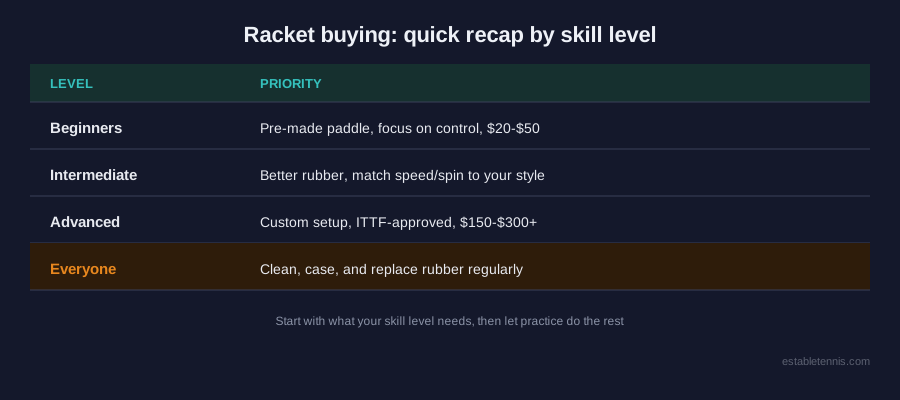
Don’t get paralyzed by choice. The table tennis equipment world can feel overwhelming with its thousands of options, specs, and brand loyalties. Start with what your skill level needs, buy from a trusted brand, and focus most of your energy on practice. Equipment matters, but it’s never a substitute for time on the table.
I’d genuinely love to hear from you: what racket are you currently playing with? Are you happy with it, or are you thinking about upgrading? Drop your thoughts, questions, or your own racket recommendations in the comments below. There’s a huge community of players out there, and the best advice often comes from someone who’s been exactly where you are right now. Now get out there and play. And if the mental side of competition is limiting you as much as your equipment, the free ESTableTennis ebook on staying calm under match pressure is worth your time.
Frequently Asked Questions
What is the best table tennis racket for beginners?
A pre-made paddle with a softer blade, thinner sponge (1.5mm to 1.8mm), and moderate rubber hardness in the $30 to $40 range, prioritizing control over speed.
Should I buy a pre-made racket or build a custom setup?
Pre-made for beginners and most recreational players. Custom setups, choosing blade and rubber separately, make sense once you’re intermediate or advanced and can feel the difference in rubber quality.
How much should I spend on a table tennis racket?
$30 to $40 as a beginner, $50 to $100 as an intermediate player, and $150 to $300 or more for a serious advanced competitive setup.
How often should I replace my table tennis rubber?
Most rubber lasts 50 to 80 hours of active play. Competitive players often replace it every 2 to 3 months; recreational players can usually get by with once or twice a year.
Do racket speed and spin ratings mean the same thing across brands?
No. Ratings aren’t standardized, so a brand’s 95 speed rating might actually be slower than another brand’s 85. Use ratings to narrow options, then check independent reviews.
Leave a Reply