
There’s a sports hall in San Fernando I drove past for three years before I finally walked inside. Not because I didn’t know what it was: the kind of place where the lights are too bright and the crowd is twelve people who all know each other and the floor has that particular squeak from the wrong mop product. I knew it because I’d competed in halls like that since I was fifteen, and I’d built a complicated relationship with walking through that door.
A table tennis competition mindset isn’t about being fearless. Every player I’ve ever coached who claimed to feel nothing before a match was either lying or not taking it seriously enough to be nervous. The ones who win consistently aren’t the ones without fear. They’re the ones who’ve figured out what to do with it.
What Does a Table Tennis Competition Mindset Actually Mean?
A table tennis competition mindset is a set of mental habits you build before the match, manage during it, and review after it. It’s not a mood. It’s not confidence you either have or don’t. It’s a process, and like every other process in this sport, it gets better with deliberate practice.
Most players treat their mental state on match day the way they treat the weather: something that happens to them, not something they shape. That’s the first mistake. The second is believing that the goal is to feel calm. Calm is fine for practice. Competition asks for something different. It asks for controlled readiness, which is a different animal entirely.
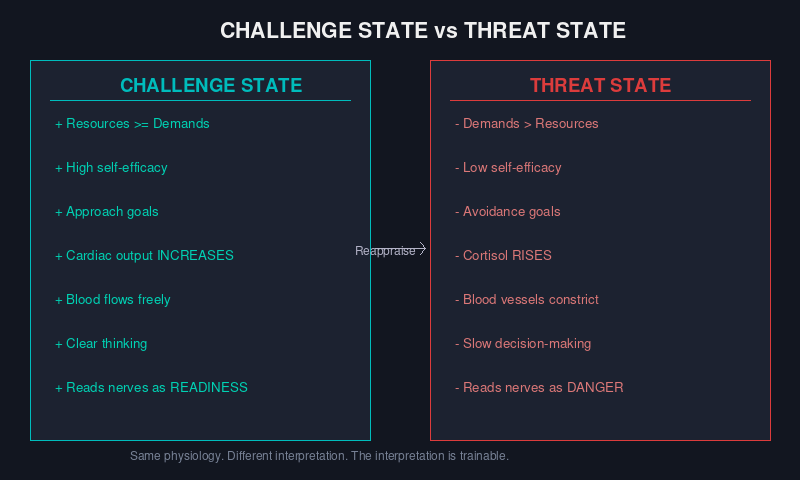
Sports psychology researchers call this the difference between a challenge state and a threat state. In a challenge state, your brain reads the match as something you’re equipped to handle. Blood flow to your muscles and prefrontal cortex increases. Decision-making sharpens. In a threat state, the same physiological arousal routes differently. You get vasoconstriction, cortisol, and a narrowed attention field that makes every edge ball feel like a catastrophe.
The goal of a table tennis competition mindset is to show up in a challenge state as often as possible, and to have a system for pulling yourself back there when you drift.
Why Does Your Mind Work Against You in Competition?
Your mind works against you because it detects threat signals like the scoreboard or crowd and reroutes processing toward survival mode, shrinking your working memory and triggering explicit monitoring of skills that should run automatically. Here’s what actually happens when the pressure goes up. Your brain detects threat signals, things like a scoreboard, a watching crowd, a stronger opponent. It reroutes processing resources to survival-mode functions. Your working memory shrinks. Your attention narrows. And crucially, it starts monitoring your own movements in a way that breaks the automatic execution you spent hundreds of hours building.
This is what sports psychologists call explicit monitoring, and it’s the direct cause of what players describe as “overthinking.” Your backhand topspin doesn’t fail because you forgot how to do it. It fails because you started thinking about how to do it, and conscious attention to a well-learned motor skill is like sand in a gear. The gear runs fine without it.
At 9-9 in the fifth, a player who hasn’t built a table tennis competition mindset will feel that narrowing, that tightening, and will respond by trying harder to execute correctly. The player who has built one knows that tightening is a signal to widen their attention outward, find a target on the table, and let the trained body do what it already knows.
Understanding why your mind works against you is half the solution, because once you recognize the mechanism, you stop fighting the feeling and start routing around it instead.
What Are the 5 Mental Habits That Build a Competition Mindset?
1. The Pre-Match Activation Routine
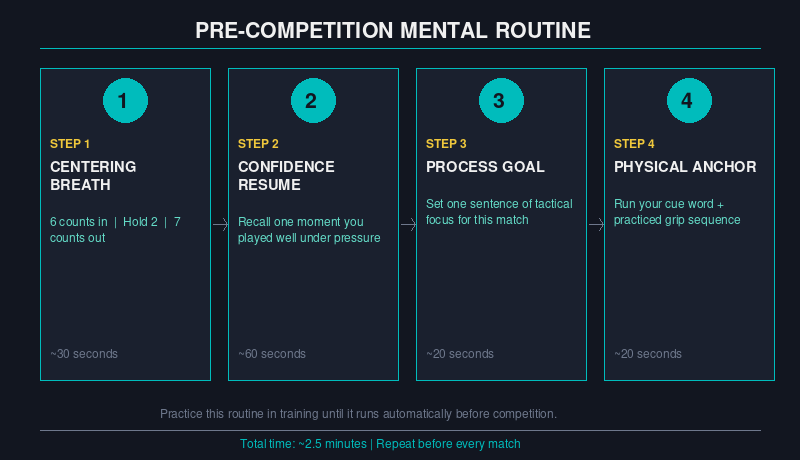
Your brain needs a signal that competition mode has started. Without one, it stays in the uncertain middle ground between relaxation and readiness, and that uncertainty is where anxiety lives. A pre-match activation routine closes that gap by design.
The routine has three jobs: it regulates arousal to your optimal zone, it narrows your attention to the match at hand, and it primes the specific physical sensations of playing well. How long it takes doesn’t matter. Fifteen minutes is fine. Forty-five is fine. What matters is that it’s fixed enough to become a trigger.
The structure that works for most competitive players runs like this: physical warm-up to get blood moving, a few minutes of controlled breathing to bring arousal to the right level, deliberate mental rehearsal of two or three of your strongest shots, and a single cue phrase that you’ve paired with good performance enough times that hearing it in your own head works. If you want to build the specific breathing technique that most competitive table tennis players use, the guide to table tennis breathing techniques covers the 4-6 pattern and how to make it automatic before a match.
2. Process Goals, Not Outcome Goals
Before you walk out to play, you need a goal. The wrong goal is winning. The right goal is the specific behavior that gives you the best chance of winning.
Outcome goals create anxiety because they’re outside your control. You can play the best match of your life and lose. Process goals are entirely within your control, which means meeting them builds confidence regardless of the scoreboard. “Serve short to the forehand corner and follow up on anything above net height” is a process goal. “Win this match” is not.
Set one tactical process goal before the match and one mental process goal. This is core to building a table tennis competition mindset that doesn’t depend on the scoreboard for its stability. The tactical goal keeps your attention on execution. The mental goal, something like “reset after every error within three seconds,” gives you something to work on when the execution goal isn’t enough. Between games, review the process goals, not the score. The score is information. The process goals are your actual job.
3. The Between-Point Reset
Matches aren’t lost in single points. They’re lost in sequences of points where a player stops competing in the present and starts reacting to the past. The between-point reset is the mechanism that breaks that pattern.
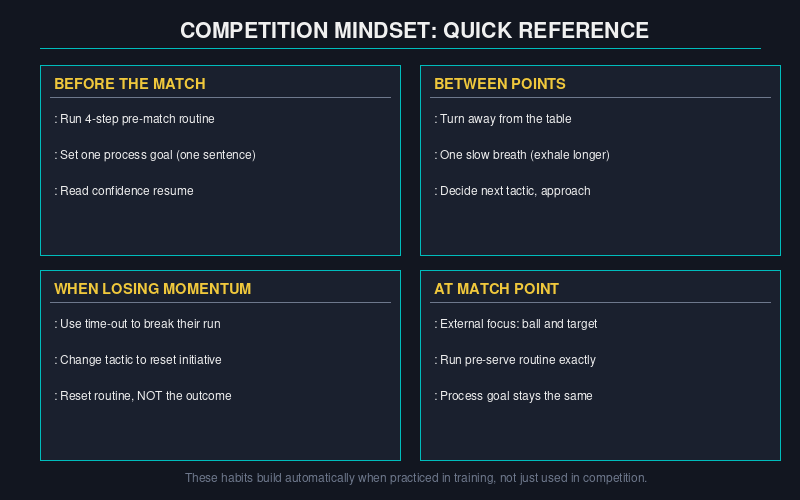
It takes three to five seconds and it has two parts. First, you physically interrupt the emotional reaction: turn away from the table, take one controlled exhale, let your shoulders drop. Second, you redirect attention forward: decide on your next serve or your next receive tactic, then step up to the line. That’s it. The goal isn’t to feel nothing. The goal is to give the brain a new task before the old emotional loop can complete.
The research on pre-point routines is consistent: players with fixed between-point rituals perform better under pressure than players without them, and the effect gets stronger as the stakes rise. Building this habit in practice, not just deploying it in competition, is what makes it work when you need it. The full framework for building a pre-serve routine that functions under pressure is in the ping pong pre-serve routine mental guide, and the between-point reset is the same principle applied in the opposite direction.
4. Managing Pressure Moments
Match point pressure is its own category of mental challenge, and it deserves a specific plan rather than a general intention to stay calm.
At deuce, at match point, and when serving for the match, one thing is true: you’re going to feel heightened arousal. The research-backed approach is to reframe it. Tell yourself “I’m excited” rather than “I’m nervous.” These two states are physiologically almost identical, but the label changes which one your brain runs. Anxiety is threat-coded. Excitement is challenge-coded. The reframe costs nothing and it works.
The second thing to know about pressure moments is that your default tactics tend to get more conservative exactly when aggressive tactics give you the better odds. This is a documented pattern in competitive table tennis: players under pressure shorten their swing, aim for the center of the table, and telegraph their intentions. Your opponent’s coaching staff knows this about you. Build your pressure-moment plan before the match, not in the middle of it. Decide what you’ll serve at deuce. Decide what your third-ball plan is when you’re serving for the match. If you want a deeper breakdown of what goes wrong at match point and why, the piece on match point pressure in table tennis covers the five most common mistakes in detail.
5. The Post-Match Mental Review
Most players end a match with either celebration or frustration and then move on. Neither teaches them anything. A post-match mental review turns every match, win or loss, into data that builds a better competition mindset over time.
It takes ten minutes. Ask yourself three questions: What did I do well mentally that I want to repeat? What did I do poorly mentally that I want to change? What’s one specific adjustment to my pre-match or between-point process? Write it down. Not because the writing is magic, but because writing forces precision, and precision is how you actually improve rather than just intending to.
Over a season of honest post-match reviews, patterns emerge. You’ll find the specific situations that pull you out of a challenge state. You’ll find the opponents, the scores, the environments that trip you up. Once you see them clearly, you can prepare for them specifically instead of hoping this time will be different.
How Do You Build Your Competition Mindset Before a Tournament?
You build it the same way you build physical fitness: by scheduling mental preparation with the same discipline as drilling and conditioning, starting in the week before the tournament. Tournament preparation isn’t just physical. Building a table tennis competition mindset requires the same scheduled investment as physical training. Every competitive player schedules practice sessions, drilling time, and physical conditioning. Very few schedule mental preparation with the same discipline. The ones who do tend to arrive at a tournament already knowing what they’re going to do with their nerves, instead of figuring it out during the match.
In the week before a tournament, run your pre-match routine every day in practice, even when the stakes are low. The routine only works under pressure if your nervous system already recognizes it as a signal. Build that recognition in low-stakes sessions so it’s automatic when you need it.
Two days before the tournament, write out your tactical process goals. Not for each specific match, which you can’t fully plan, but for your general game plan and the adjustments you’d make against different playing styles. This preparation reduces the cognitive load on match day, which keeps more working memory available for actual competition.
On the day itself, arrive early enough that logistics don’t create stress. The player who’s rushing to find a parking spot twenty minutes before their first match has already spent mental resources they’ll need later. Arriving calm is a tactical choice. Build it into your schedule deliberately. The complete framework for building these techniques into regular training is in the table tennis mental training techniques guide, which covers the seven core methods and how to sequence them across a training week.
What Mindset Mistakes Do Competitive Players Make?
Trying to Eliminate Nerves Instead of Using Them
Nerves are fuel. The arousal you feel before a match is your body preparing itself. The players who waste time trying to feel nothing before they compete are throwing away an advantage. The correct goal is to route that arousal toward readiness instead of dread.
Practically, this means stopping the fight. When you feel nervous, don’t tell yourself to calm down. Tell yourself you’re excited. Don’t try to lower your heart rate to resting level before a match. That’s not what your body needs. Use controlled breathing to take the edge off excessive anxiety, not to flatten the arousal completely.
Letting the Scoreboard Set the Emotional Agenda
The scoreboard is information. It tells you where the match stands. It tells you nothing about whether you’re playing well, whether your process is working, or what the next point will bring. Treating it as the primary measure of how things are going is one of the most reliable ways to let a lead collapse or let a deficit feel insurmountable.
The player who loses five in a row from 8-5 up didn’t lose because of some mysterious momentum shift. They lost because they looked at 8-5 and started playing to protect a lead instead of continuing to play to win points. Protection mode is explicit monitoring at the tactical level. The fix is the same: return to process, return to specific execution targets, and compete the next point as if the score is 0-0.
Skipping the Mental Warm-Up
You wouldn’t walk straight to the table and start playing without a physical warm-up. Your muscles aren’t ready, your timing is off, and you’d start the match below your actual level. The exact same logic applies to mental preparation, and the exact same number of players ignore it.
A three-minute mental warm-up before you touch the table, running through your cue phrase, doing one round of controlled breathing, and briefly visualizing two or three shots you intend to play, changes the state you start the match in. Not dramatically. Enough to matter. In a sport where matches are decided by single points, enough to matter is enough.
How Does Equipment Affect Your Competition Mindset?
Uncertainty about your equipment is itself a threat signal your brain picks up before you play a single point, making a challenge state harder to reach. This is the part most mental performance guides leave out, and it matters more than people admit.
Walking into a match unsure whether your equipment is right for your game is a threat signal your brain picks up before you play a single point. It’s a background anxiety that makes a challenge state harder to reach. Players who compete with equipment they genuinely trust, not equipment they’re rationalizing or still testing, start from a more stable mental baseline.
This doesn’t mean you need expensive equipment. It means you need equipment you know. If you’re still second-guessing your rubber choice or wondering whether your blade is right for your style, that uncertainty costs you mental bandwidth in competition that you can’t afford to spend there. Sorting your equipment before tournament season is part of your table tennis competition mindset work, not a separate task. If you’re unsure what rubber or setup actually fits how you play, PingPath can match you to the right setup based on your playing style, which removes that particular source of match-day doubt before it gets in the way.
Worth remembering on the equipment side: every legal rubber and blade you might agonize over is held to the same ITTF equipment standards. The gear is regulated. The fit, and what the fit does to your head, is the variable.What Happens When Your Mental Game Breaks Down Mid-Match?
A mid-match breakdown is a threat state, not a loss of skill, and it’s reversible the moment you choose to reverse it. Every competitive player knows the feeling: you’re competing fine and then something happens, a bad call, a lucky edge, a sequence of errors, and the whole mental structure starts to slide. Your attention goes internal. Your tactics get cautious. Your body tightens. The question isn’t whether this will happen. The question is what you do when it does.
The first response is to recognize it for what it is, a threat state, not a genuine performance problem. You haven’t forgotten how to play. You haven’t run out of skill. Your brain has routed its resources away from performance and toward self-protection. That routing is reversible, but you have to decide to reverse it.
The second response is to do one concrete thing with your body: take a slow exhale, let your shoulders drop, adjust your grip pressure. Physical action changes mental state faster than mental action changes mental state. Your brain is listening to your body. Give it a different signal. The breakdown of what goes wrong in your mental game under sustained pressure, and the specific tools for each scenario, is covered in the table tennis breathing techniques guide and in the mental training techniques piece above.
Frequently Asked Questions
How Do You Build a Competition Mindset in Table Tennis?
You build it the same way you build a forehand: through deliberate, consistent practice of specific mental habits. Start with a fixed pre-match routine, add a between-point reset ritual, set process goals before every match, and do a ten-minute mental review after. Run these habits in practice sessions before tournaments, not just in competition. The habits only hold under pressure if your nervous system already knows them.
What Is the Difference Between Training Mindset and Competition Mindset?
Training mindset is exploratory. You’re building skills, testing options, tolerating errors because errors are information. Competition mindset is executive. You deploy what you have, commit to your choices, and manage your emotional state actively. Neither is better than the other. Mixing them up is the problem: competing in training mode means you never commit, and training in competition mode means you never experiment.
How Do You Stay Calm During a Close Match in Table Tennis?
The goal isn’t calm. Calm is for practice. In a close match, you want controlled readiness, the kind of arousal that fuels fast decisions and sharp execution. Use a controlled exhale between points, apply a fixed pre-point ritual, and redirect your attention to a specific execution target rather than the score. If you’re too tight, reframe the nerves as excitement rather than trying to flatten them out.
Does Confidence in Table Tennis Come From Winning?
Winning contributes to confidence, but it’s not the primary source. Confidence comes from evidence: from knowing your serve works under pressure, from remembering specific matches where you came back, from having a pre-match routine that consistently puts you in a good mental state. Players who base confidence only on recent results have fragile confidence. Build it on process evidence instead, and it holds up when the results go the wrong way.
Can You Improve Your Table Tennis Mindset Without a Coach?
Yes. The core mental skills, breathing regulation, pre-point routines, self-talk, process goal-setting, don’t need a coach to practice. They need consistency and self-honesty. Start with one habit, run it for four weeks until it’s automatic, then add another. The MentalEdge course covers the full curriculum if you want a structured path, but the habits themselves are buildable on your own with deliberate practice.
If you want the full system behind building a table tennis competition mindset, the MentalEdge course covers every mental skill in this article in depth, with drills and exercises designed specifically for competitive table tennis players. Or if you’re just starting to build your mental game, the free mental training ebook is the right place to begin.
Leave a Reply