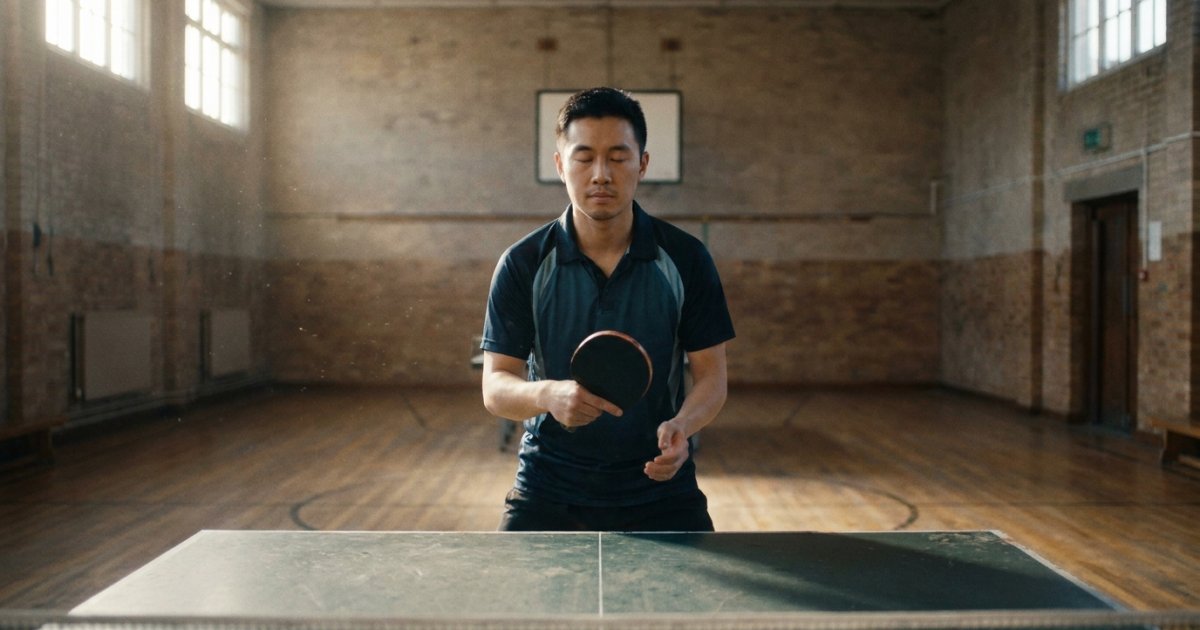
There is a training hall attached to a primary school in Rio Claro where the coaches make every junior player, some as young as ten, sit still with their eyes closed for five minutes before they are allowed to touch a paddle. The younger ones hate it. They fidget. They peek. They ask when it’s over.
The older ones, the ones still training years later, do not skip it anymore. Not once. One of them told me, a little embarrassed, that he plays every important point of a match in his head before he ever plays it on the table, and that by the time the real point arrives, it feels less like the first time and more like the tenth.
That is not superstition, and it is not a mental trick in the vague sense people usually mean when they say “visualize success.” It is a specific, trainable skill with a real mechanism behind it, and most players who try it fail because nobody ever showed them the version that actually works.
Table tennis visualization techniques that actually work: use the PETTLEP model, real posture, real environment, real-time pacing, and real match emotion, not a vague image of yourself winning. Rehearse specific points (your serve, your serve-receive, a clutch point at deuce) in first-person detail, three times a week, five to eight minutes at a time.
What Is Visualization in Table Tennis, and Why Does It Actually Work?
Visualization works because your brain does not fully distinguish between vividly imagining a movement and physically performing it. This is called functional equivalence, and it is the reason mental rehearsal shows up in sport science research as a genuine performance tool rather than a feel-good exercise.
Holmes and Collins laid out the modern version of this in a 2001 paper in the Journal of Applied Sport Psychology, one of the most cited papers the journal has published. Their argument, backed by imaging studies, is that detailed mental rehearsal activates many of the same neural pathways used in physical execution. The closer the imagined version matches the real one, in posture, environment, timing, and emotion, the more it transfers.
This is also why the casual version, sitting on a couch picturing yourself “playing well,” does almost nothing. A vague image with no sensory detail and no physical posture does not resemble the real skill closely enough to activate the same pathways. Vividness and specificity are not optional extras. They are the entire mechanism.
What Is the PETTLEP Model, and Why Does It Beat “Picture Yourself Winning”?
PETTLEP is the structured framework built from that research, and it beats generic visualization because it forces every session to resemble the real performance across seven specific dimensions, instead of leaving the image loose and easy to skip corners on.
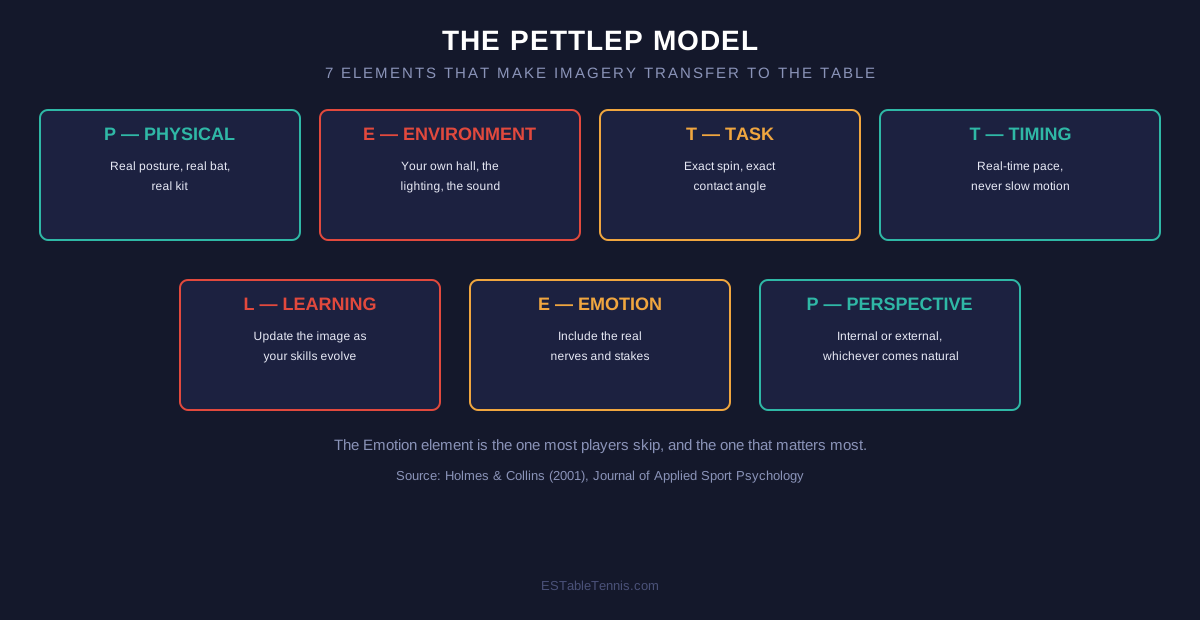
| Element | What It Means for You |
|---|---|
| Physical | Stand up, hold your actual bat, wear your kit. Do not visualize slouched in a chair. |
| Environment | Picture your own club’s hall, the lighting, the sound of nearby tables, not a generic gym. |
| Task | Image the exact spin, the exact angle of contact, not a blurry “good shot.” |
| Timing | Run the image in real time. Do not slow the serve down to study it. |
| Learning | Update the image as your game changes. Image this month’s forehand, not last year’s. |
| Emotion | Include the real nerves, the crowd, the stakes, not a calm, detached version. |
| Perspective | Internal (through your own eyes) or external (watching yourself). Use whichever comes naturally. |
Most players who abandon visualization skip the Emotion element without realizing it. They picture the shot in a calm, detached state, which builds a calm version of the skill that does not necessarily transfer to the actual arousal of a match at 9-9. Include the real nerves in the image. You are not rehearsing a shot in a vacuum. You are rehearsing the shot under the exact conditions you will need it in.
On Perspective specifically: internal imagery, seeing the point through your own eyes, tends to suit players focused on the feel of execution, the contact, the follow-through. External imagery, watching yourself from outside as if on video, tends to suit players who think more in terms of positioning and shape, where they are standing relative to the table and their opponent.
Neither is more correct than the other. Try both across a few sessions and notice which one you slip into without effort. That is the one to build your regular practice around, though switching to the other occasionally, particularly when working on footwork and court positioning, can be useful too.
How Do You Build a Visualization Script for Your Own Game?
Build your script around specific situations you already know show up in your matches, not generic “playing well.” Four situations are worth scripting first.
Your serve. The serve is self-paced, which makes it the easiest skill to rehearse well. Stand at the table, bat in hand, and imagine your three most reliable serves landing exactly where you intend, feeling the contact, hearing the sound off the rubber, in your own hall.
Serve-receive. Image reading your opponent’s toss, stepping in, making contact early. Include the uncertainty on purpose; you do not always know what spin is coming, and imagine yourself adjusting and executing well despite that uncertainty, rather than only rehearsing the version where you already know the answer.
Post-mistake recovery. After a badly missed shot in your imagined rally, spend two or three seconds picturing the correct version of the stroke before moving on. This gives your brain a corrected version to file instead of leaving the miss as the most recent memory of that shot.
Clutch-point rehearsal. Specifically image winning points at deuce, closing out a match point, recovering from 7-9 in the fifth. This pre-programs your response so the situation feels familiar rather than unprecedented the first time it actually happens in a tournament that matters.
Opponent-specific rehearsal. If you know who you are playing next, imagine their known patterns directly, their favorite serve, the side they like to attack, the shot they lean on under pressure, and rehearse your planned response to each one landing exactly. This is the version tournament players use in the days before a match they have scouted, and it is the closest visualization gets to an actual game plan.
What’s a Realistic Weekly Protocol for Building This Skill?
Three sessions a week, five to eight minutes each, is enough to build this into a real skill without it becoming another thing you quietly stop doing after two weeks.
Start with one centering breath to settle into the session. Then imagine your three best shots from the past week executing perfectly, in real time, full sensory detail, physical posture and all. Follow that with one specific challenge scenario, a deuce point, a short ball you normally struggle to attack, and imagine yourself producing the correct response, not a vague good outcome.
If you have a specific opponent coming up, close with three of your planned tactical patterns landing exactly as intended. Finish with one more centering breath.
Do this before practice, not only before matches. The players at that hall in Rio Claro do not save it for tournament week. It is part of the ordinary Tuesday session, which is exactly why it holds up when the stakes get real.
What If You Cannot “See” Anything When You Close Your Eyes?
Some players close their eyes and get nothing, no picture, no scene, just a blank. This is a real and fairly common experience, sometimes called aphantasia, and it does not mean visualization is closed to you.
PETTLEP was never only about the visual channel. It is about rehearsing the full sensory and physical experience, and for players who do not generate strong mental pictures, the kinesthetic and auditory channels carry most of the weight instead. Stand in your real stance, actually move your arm through the stroke at low intensity, and focus on the feel of the movement and the sound of contact rather than forcing a picture that will not come.
Players who describe themselves as “not visual” often assume the whole technique does not apply to them and skip it entirely. That is the wrong conclusion. Shift the emphasis toward what you do feel and hear clearly, and run the same PETTLEP structure around that instead. The mechanism, rehearsing the real skill under real conditions, still works even when the dominant channel is physical sensation rather than a mental picture.
What’s the One Mistake That Makes Visualization Backfire?
The most common mistake is letting the image drift toward failure without correcting it, picturing yourself missing the ball, netting the serve, or watching the score slide the wrong way, and simply letting that play out.
Visualization is a skill you control, not a passive movie you sit back and watch. If the image goes wrong, whether you meant it to or not, stop it immediately, rewind, and replay the correct version before continuing. An uncontrolled image that fails rehearses failure just as effectively as a controlled one rehearses success. That is not a reason to avoid visualization. It is a reason to learn to seize control of the image the moment it drifts, which is itself part of the skill you are training.
New practitioners often notice this drift happening several times in a single early session. That is normal. Catching it and correcting it is the actual training, in the same way that catching a technical flaw mid-stroke and adjusting is how physical practice improves anything. The skill is not “never imagine failure.” The skill is never leaving a failure image unedited.
There is a mental-equipment layer here too. If you are not sure how your current blade or rubber responds, your visualization will be vague by necessity, because you cannot script the precise feel of contact for gear you do not actually know. Players who have settled on equipment they trust can rehearse the exact sensation of a shot. Players who are still guessing at their setup end up visualizing a blurrier version of the game, which weakens the entire exercise before it starts.
Frequently Asked Questions
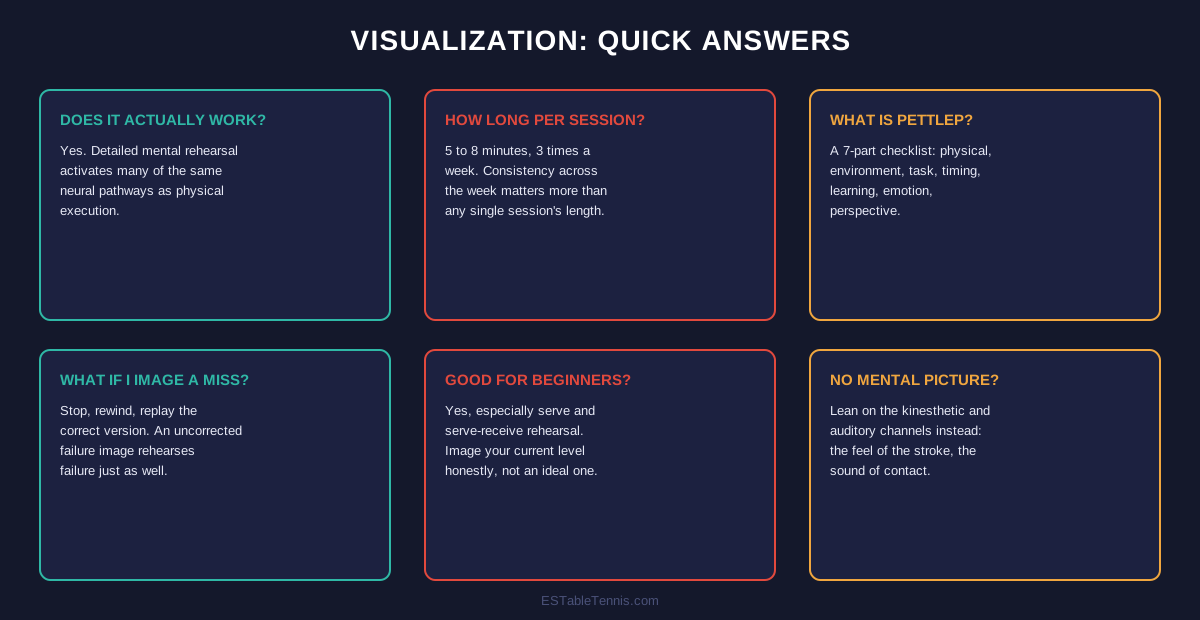
Does visualization actually improve match performance, or is it just relaxation?
It does more than relax you. Research on functional equivalence shows detailed mental rehearsal activates many of the same neural pathways used in physical execution, which is why specific, sensory-detailed imagery transfers to performance in a way generic relaxation does not.
How long should a visualization session last?
Five to eight minutes, three times a week, is enough to build this into a real skill. Longer sessions are not necessarily better; consistency across the week matters more than the length of any single session.
What is the PETTLEP model in simple terms?
It is a checklist that makes your mental rehearsal match the real thing across seven elements: physical posture, environment, task detail, real-time timing, updated skill level, real emotion, and your natural viewing perspective.
What if I picture myself missing the shot?
Stop the image immediately, rewind, and replay the correct version before continuing. An uncontrolled image that ends in failure rehearses the failure just as effectively as a controlled one rehearses success.
Can beginners use visualization, or is it only for advanced players?
Beginners benefit too, especially for serve and serve-receive rehearsal, though the image should reflect your current skill level honestly rather than an aspirational version of a shot you have not developed yet.
Does Visualization Only Help Confidence, or Can It Actually Build New Skills?
Visualization does both, and treating it as only a pre-match confidence trick undersells what it can do for a skill you are still learning.
When you are working on a genuinely new stroke, a reverse pendulum serve you just learned, a backhand loop your coach only introduced last month, mental rehearsal reinforces the motor pattern between physical practice sessions. You are not inventing the movement in your head. You are re-running a movement you have already started to groove physically, at a moment when your body is not available to practice it (on the drive home, before bed, waiting for a table). This does not replace physical repetition. It extends it.
The distinction matters because it changes what you imagine. Skill-building visualization should closely track your current, real ability, including the parts that still feel a little unfamiliar, rather than an idealized future version of the stroke you have not earned yet.
Confidence-building visualization, by contrast, leans on shots and situations you already execute reliably, so you are rehearsing proof you can already produce rather than a hope you might. Most players only use the second kind. The first kind is where a lot of the unclaimed improvement is sitting.
A simple way to keep them separate in your own practice: use your serve, serve-receive, and clutch-point rehearsal (already reliable shots) for the confidence side of the session, and reserve a short block afterward, sixty to ninety seconds, for whatever new movement your coach is currently working on with you, imagined honestly at its current, imperfect stage.
Visualization also has a specific home in the hour before a tournament match, sitting in the car, in a hallway, wherever you find a quiet corner. This is not a replacement for your physical warm-up. It is what you run through in the gaps of it, between stretches, while you wait for a table, in the walk from the changing room to the hall. Used this way, it becomes part of your pre-match routine rather than a separate task competing for time you do not have.
What Should You Do With This Tonight?
You do not need a quiet room or a meditation app. You need five minutes, your actual bat, and the willingness to picture the game exactly as it really feels, nerves included, rather than a comfortable, edited version of it.
Start tonight with your serve. Three reps, full sensory detail, real time. Add serve-receive tomorrow. By the end of the week, you will have a five-minute habit that costs you nothing and, according to the research behind it, is doing more for your game than most players’ entire warm-up routine.
The junior players in Rio Claro do not visualize because someone told them it sounded impressive. They do it because the ones who kept doing it are the ones still playing years later, closing out points that used to close them out instead. They still fidget less than the ten-year-olds, but not one of them will tell you it feels natural. They will tell you it works, which in a sport this unforgiving is the only endorsement that has ever mattered to them.
For the full picture of how mental rehearsal fits alongside the other tools that stop pressure from wrecking your game, see how to stop choking in table tennis and table tennis mental training techniques. And if you want a structured system to build this and the rest of your mental game around, start with the free ebook: How to Remain Calm When It’s Crunch Time.
Leave a Reply