I have a box in the back of my car that I have not opened in about two years. Inside it are forty-eight table tennis balls, most of them orange, a few white, a couple cracked along the seam. I know, without checking, that at least a third of them are celluloid balls I bought before 2016, back when every club in Trinidad still had a stash of the old stock, and nobody wanted to talk about the changeover. I kept them because I could not bring myself to throw out something that still worked. My players noticed the difference before I admitted it. One afternoon, a junior I was coaching at the TTTTA hall stopped mid-drill and said the ball was “talking funny.” She was twelve. She was right.
The difference between a celluloid ball and a modern plastic ABS ball is not a marketing story. It is a tactile, acoustic, and ultimately psychological shift in how the game feels. Most recreational players, and even many club-level competitors, are still playing with the wrong ball for their situation without knowing it. This guide to table tennis ball types is for those players. By the time you finish reading it, you will know exactly what type of ball to buy, what star rating means in practice, and why the ball in your bag is either helping or quietly hurting your game.
Why Do Table Tennis Ball Types Actually Matter?
Ball type matters because it’s the only equipment both players share, and training with one type while competing with another miscalibrates the predictive model your nervous system has built. The ball is the only piece of equipment in table tennis that both players share. Your paddle is yours. Your rubber is yours. But the ball sits in the middle, and whatever it does, both of you experience it equally. That sounds neutral. It is not.
If you train exclusively with 1-star practice balls and then walk into a match using 3-star competition balls, you are playing with a different object than the one your hands have learned. The bounce height is slightly different. The acoustic feedback when you make contact is different. The margin of error on a tight topspin loop is different. Your nervous system has been calibrated for one thing, and it is now facing another.
I have watched players blame their rubber, their grip, their nerves, their sleep the night before, when the real explanation was sitting on the table in plain sight: they trained with one type of ball and competed with another. The mental disruption this causes is real. Your brain builds a predictive model of how the ball will behave. When that model is wrong, you do not just miss a shot. You lose a little bit of trust in your own reflexes. That loss of trust is what unravels matches.
So before we talk about seams and materials and star ratings, understand this: choosing the right table tennis ball type is not an equipment technicality. It is a decision that directly affects your mental consistency at the table.
Why Does the History of Table Tennis Ball Changes Still Matter?
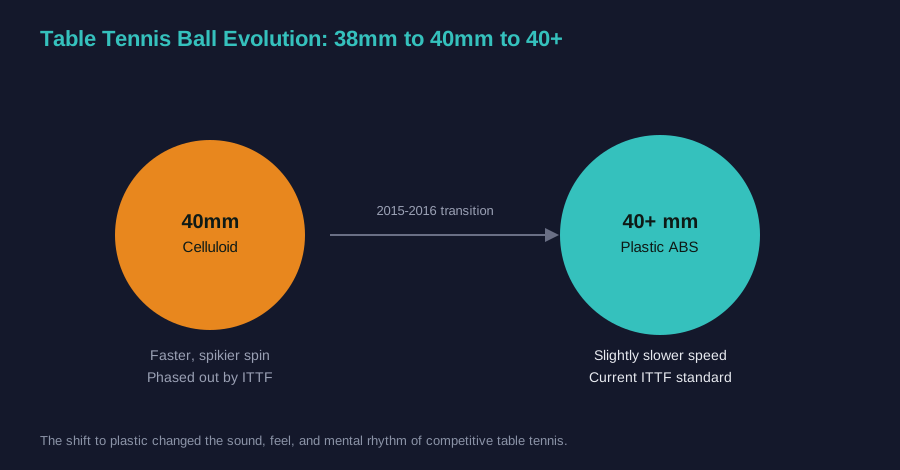
The ITTF switched from 38mm celluloid to 40mm, then in 2015 mandated plastic ABS balls for all competition, so old celluloid stock still circulating in shops and clubs no longer matches what you will face in a sanctioned match. For most of the twentieth century, table tennis balls were made from celluloid, a material derived from cellulose nitrate that is also, incidentally, highly flammable. The International Table Tennis Federation (ITTF) governed ball specifications tightly, and for decades, those specifications described a 38mm celluloid ball.
In 2000, the ITTF increased the standard ball size from 38mm to 40mm. The stated reason was to slow the game slightly and make it more television-friendly. Players adjusted. The transition took a few years but was largely complete by the mid-2000s. Then, in 2015, the ITTF made a far more significant change: they mandated a switch from celluloid to plastic (ABS: acrylonitrile butadiene styrene) for all competition balls.
The new plastic balls are often called “40+” balls, which is a mildly confusing designation. The “+” does not mean they are larger than 40mm in any meaningful competitive sense. It refers to the slightly increased diameter tolerance that comes with the manufacturing process for seamless plastic balls, typically landing between 40mm and 40.6mm. The ITTF approved plastic balls for all top-level competition starting in July 2015, and the current ITTF-approved ball list includes only plastic ABS balls.
Why does this history matter for a player buying balls today? Because celluloid balls are still in circulation. Shops still sell old stock. Some clubs have crates of them. If you are a competitive player who accidentally trains with celluloid, you are training with an object that will not exist in any match that counts.
What’s the Difference Between Celluloid and Plastic (ABS) Balls?
If you have only ever played with plastic balls, this section will not mean much to you directly. If you started playing before 2016, it might explain something you have been feeling but not naming.
Sound
Celluloid balls make a sharper, higher-pitched sound on contact. Players who grew up with them describe plastic balls as sounding “duller” or “thuddy.” The sound of a ball on rubber is part of how your brain receives feedback about the quality of contact. Players who trained intensively on celluloid balls sometimes report a period of six months or more where they felt they were reading the ball incorrectly with plastic. The feedback loop they had built was miscalibrated.
Spin
This is the change that affected high-level competition the most. Celluloid balls were generally considered more spin-sensitive. The same stroke produced a more visible spin effect on a celluloid ball than on a modern plastic ball. When plastic balls were introduced, many topspin-dominant players felt their most powerful weapon had been blunted. Defenders and all-round players, by contrast, often found the plastic balls slightly easier to control. The long rallies came back.
Bounce and Trajectory
Plastic balls bounce very slightly higher than celluloid at equivalent impact speeds. The trajectory off the table is marginally different. On the receiving end, this sounds trivial. For a player trying to flick a short ball to the corner at 9-10 in the fifth game, “marginally different” is not trivial at all.
Durability
Plastic balls crack differently from celluloid balls. Celluloid tends to dent before it cracks, and a dented celluloid ball bounces unpredictably but survives longer. Plastic balls are more brittle. They survive longer under normal use but shatter more suddenly when they fail. You will rarely notice the failure coming.
What Do Table Tennis Ball Star Ratings Actually Mean?
Walk into any table tennis shop, and you will see balls rated with one, two, or three stars. This rating system is one of the more misunderstood conventions in the sport. Most players assume more stars means “better” in some absolute sense. The reality is more specific than that.
1-Star Balls
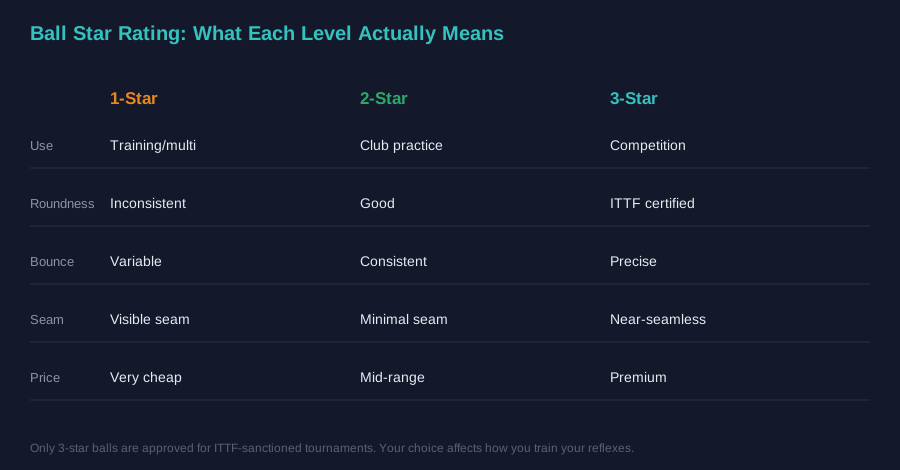
One-star balls are training balls. They are manufactured to less precise tolerances than the competition balls. Their roundness, seam quality, and bounce consistency are all lower. They are significantly cheaper, which is why clubs buy them in bulk for multi-ball drills and beginner sessions.
The important thing to understand about 1-star balls is not that they are bad. They are perfectly functional for practicing footwork, warming up, or running repetitive drills where the quality of each shot matters less than the volume of shots. The problem is when players use them exclusively, then compete with 3-star balls. You are not just upgrading to a better ball. You are switching objects.
2-Star Balls
Two-star balls occupy the middle ground. Better roundness and seam quality than 1-star, but not certified to the standard required for sanctioned competition. They are common in club evenings and recreational leagues. For a player whose competition is informal, 2-star balls are a perfectly rational choice. For a player preparing for ITTF-affiliated tournaments, they are a training compromise worth knowing about.
3-Star Balls
Three-star balls are competition-grade. They meet ITTF specifications for roundness, seam quality, bounce height, and hardness. Only 3-star balls from the ITTF-approved list are permitted in sanctioned competition. For a competitive player, 3-star balls should be the training standard, not just the competition standard. The point is not prestige. The point is that your nervous system trains on what you give it, and it should be training on the same object you will face in a match.
What’s the Difference Between Seamless and Seamed Balls?
Seamed balls are fused from two hemispheres and can have a barely perceptible ridge. Seamless balls are made as one piece. For most club players, a quality 3-star seamed ball makes the difference academic. Traditional table tennis balls are made by fusing two hemispheres together, which creates a visible seam running around the circumference of the ball. On a well-made ball, this seam is nearly imperceptible to touch and has minimal effect on play. On a cheap ball, the seam can be felt as a ridge, and it creates measurable inconsistency in how the ball bounces and spins.
Seamless balls are manufactured as a single piece. Most high-quality modern plastic balls aim for seamless or near-seamless construction. Brands like Nittaku and DHS have produced seamless plastic balls that have received ITTF approval. The debate among serious players is whether seamless balls are meaningfully better than a well-made seamed ball, or whether the seam on a quality 3-star ball is already so close to imperceptible that the seamless premium is not worth it.
For most club players, this debate is academic. Buy any ITTF-approved 3-star ball from a reputable brand and the seam is not going to be your problem. Where seam quality genuinely matters is at the elite level, where players are sensitive to the smallest variations in ball trajectory, and in multi-ball training, where a machine feeding a seamed ball at high speed can produce more pronounced seam wobble.
Should You Use a White or Orange Table Tennis Ball?
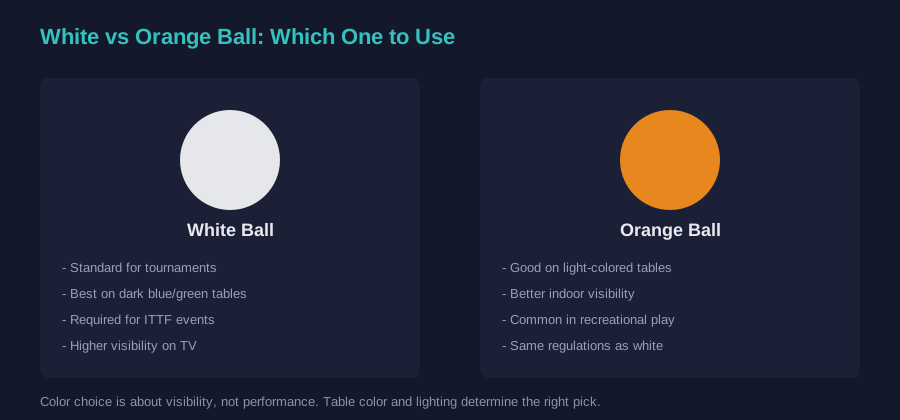
White and orange balls are made to identical specs. The only difference is visibility. Use white against dark tables, orange against light backgrounds. This is the question I get from parents buying balls for their children most often. White or orange? The answer is genuinely straightforward and has nothing to do with the ball performing differently. White and orange table tennis balls are manufactured to identical specifications. The color is purely a visibility choice.
White balls are the standard for all ITTF-sanctioned competition. The international table tennis table surface is dark blue or dark green for exactly this reason: the white ball is highly visible against a dark surface. If your table is dark, white balls are the correct choice.
Orange balls are useful in situations where the background is light: a training room with beige walls, a gymnasium with light-colored flooring, an outdoor setup in bright sunshine. In those environments, a white ball against a light background creates a visibility problem that an orange ball solves. The Wikipedia overview of table tennis notes that ball color is selected to contrast with the playing environment, which is the most useful frame for this decision.
There is no performance difference. There is no mental edge to one color over another. The only thing that matters is whether you can see it clearly when it is moving at speed in your training environment.
How Does Ball Type Connect to Your Rubber and Grip?
Plastic balls are less forgiving of grip errors than celluloid was, so a grip that was merely imprecise before becomes a visible liability now, and softer rubbers in the 35-45 hardness range tend to compensate better for plastic’s lower spin sensitivity. Here is the connection that most equipment guides miss, and it is the one that matters most for competitive players: the ball you use interacts directly with your rubber, your grip, and the mental model you build of how your shots behave.
The transition from celluloid to plastic changed the effective speed of the game at the highest levels. Professional players adapted by adjusting their rubber selection, their stroke technique, and even their grip pressure. Getting your grip right matters more with plastic balls than it did with celluloid, because plastic balls are less forgiving of grip errors that create an inconsistent contact angle. A grip that was merely imprecise with celluloid becomes a visible liability with plastic.
This is not a theoretical connection. I have watched players switch to a proper grip and feel, for the first time, exactly what the ball is doing on contact. The plastic ball reduced sensitivity to imperfect contact means the feedback you get from a poor grip is delayed. You miss a few shots. You adjust instinctively. And then the adjustment you made to compensate for the grip problem becomes its own problem. The cascading mental damage from equipment mismatches is something I have written about in detail on this site, because it is genuinely underappreciated as a source of match-day anxiety.
The relationship between ball type and rubber is also worth understanding. Softer rubbers in the 35-45 degree hardness range tend to compensate better for the lower spin sensitivity of plastic balls. Harder rubbers that rely on high-speed contact to generate spin become less forgiving. If you recently switched to plastic balls and your game felt like it “got worse” without an obvious reason, check your rubber hardness before you check anything else.
How Does Ball Quality Affect the Mental Side of Your Game?
There is a specific kind of confidence that comes from having trained with the correct equipment consistently. It is not arrogance. It is something closer to calibration. Your predictions about how the ball will behave are accurate. When you decide to play a short push, you know how far the ball will travel. When you commit to a topspin loop, your expectations about where it will land are built on accurate data.
Research on performance anxiety from the American Psychological Association consistently points to uncertainty as a major driver of pre-competition stress. Players who are uncertain about their equipment feel that uncertainty as anxiety, even if they cannot identify the source. A player who has trained on cheap, inconsistent balls and then competes on high-quality 3-star balls is not just dealing with an unfamiliar object. They are experiencing a fundamental uncertainty about their own predictions, which their nervous system registers as a threat.
This is why the ball selection principle for competitive players is simple: train with what you compete with. Use 3-star approved plastic balls in all serious training. Use 1-star or 2-star only for drills where shot quality is not the point. Never use celluloid for any serious purpose. This is not about being precious with equipment. It is about giving your nervous system consistent data so it can build accurate predictions, and accurate predictions are the foundation of calm under pressure.
I have heard coaches argue that players should occasionally train with worse balls to build adaptability. There is a version of this argument that makes sense: if you sometimes face a cracked or inconsistent ball in a match, you need some exposure to handling the unexpected. But the deliberate, daily use of inferior training balls to build character is, in my experience, a recipe for producing players who perform inconsistently and do not know why. You want predictability in your equipment so your mental energy can go toward the opponent, not toward decoding what the ball is doing.
What Are the Best Table Tennis Ball Brands?
The ITTF maintains an approved equipment list that covers balls, and cross-referencing it before you buy is worth thirty seconds of your time. Within that list, a few brands have earned consistent praise from competitive players at every level.
Nittaku Premium 40+ balls are widely considered among the best plastic balls currently available. The manufacturing consistency is high, the seam quality is excellent, and they are used at many of the highest-level international events. They are also expensive. If you are buying in bulk for training, they are not the rational choice.
DHS (Double Happiness) D40+ balls are the official ball of the World Table Tennis Championships and many ITTF events. They are slightly harder than some alternatives, which some players find more suitable for their game, and they are competitively priced for competition-grade balls. The DHS D40+ is a reasonable default recommendation for any competitive player.
Butterfly G40+ balls are another ITTF-approved option with a strong reputation, particularly among players who prefer a slightly softer feel on contact. Butterfly quality control is consistently high.
For bulk training balls, the Xushaofa 40+ seamless balls offer reasonable consistency at a price point that makes buying a hundred at a time a practical decision. They are not competition-grade in terms of ITTF approval, but for high-volume drilling, the tradeoff is sensible.
The practical advice is this: match your ball selection to your purpose. For competitions, use whatever ball the tournament specifies. For serious training, match that ball as closely as possible. For high-volume drilling and footwork work, buy bulk training balls of reasonable quality and accept the tradeoff consciously.
What’s the Quick-Reference Summary for Choosing a Ball?
After several thousand words, here is the short version for anyone who wants to bookmark this section.
What type of ball should you use? Plastic ABS 40+ ball. Celluloid is discontinued for competition and should not be used for serious training.
What star rating do you need? 3-star for competition and serious training. 1-star or 2-star for high-volume drills and beginner lessons.
White or orange? White for dark tables and all official competitions. Orange for light-colored training environments where visibility is a problem.
Seamless or seamed? Either is fine for most players. Quality control on major branded seam balls makes the practical difference small.
What brand? DHS D40+ or Nittaku Premium 40+ for competition. Xushaofa or similar bulk plastic balls for training drills.
The mental rule: Train with what you compete with. Consistency in your equipment is how you build consistency in your predictions, and consistent predictions are what calm looks like from the outside.
The ball you play with is sending your brain data every second you are at the table. Give it accurate data, and your brain will give you accurate responses. Give it noise, and you will wonder why your match performance keeps slipping away from what you know you can do in practice. If that last sentence sounds familiar, it is worth reading about why players perform worse in matches than in practice, because the equipment variable is only one part of a larger pattern most players never fully diagnose.
The ball does not forgive imprecision. It never has. But the right ball, used consistently, stops lying to you.
If you want to understand how mental state and equipment choices interact at a deeper level, the MentalEdge course covers the full system. It is where this conversation continues.
Frequently Asked Questions
What’s the difference between a 1-star, 2-star, and 3-star table tennis ball?
The star rating reflects manufacturing tolerance for roundness, seam quality, and bounce consistency. Only 3-star balls meet ITTF competition specifications; 1 and 2-star are training and recreational grade.
Should I train with the same ball I compete with?
Yes. Training with a different ball than you compete with miscalibrates your nervous system’s predictions about bounce, spin, and contact sound, which shows up as unexplained inconsistency in matches.
Are celluloid table tennis balls still used in competition?
No. The ITTF mandated plastic ABS balls for all sanctioned competition starting in 2015. Celluloid balls still circulate in shops and old club stock but shouldn’t be used for serious training.
White or orange table tennis ball, which should I buy?
White for dark-colored tables and all official competition. Orange only if your training environment has a light-colored background where a white ball is hard to see.
Why did my game feel worse after switching from celluloid to plastic balls?
Plastic balls are less spin-sensitive and less forgiving of grip errors than celluloid. Check your rubber hardness and grip before assuming your technique declined.
The ball you play with is sending your brain data every second you are at the table. Give it accurate data, and your brain will give you accurate responses. Give it noise, and you will wonder why your match performance keeps slipping away from what you know you can do in practice. If that last sentence sounds familiar, it is worth reading about why players perform worse in matches than in practice, because the equipment variable is only one part of a larger pattern most players never fully diagnose.
The ball does not forgive imprecision. It never has. But the right ball, used consistently, stops lying to you.
If you want to understand how mental state and equipment choices interact at a deeper level, the MentalEdge course covers the full system. It is where this conversation continues.
Leave a Reply