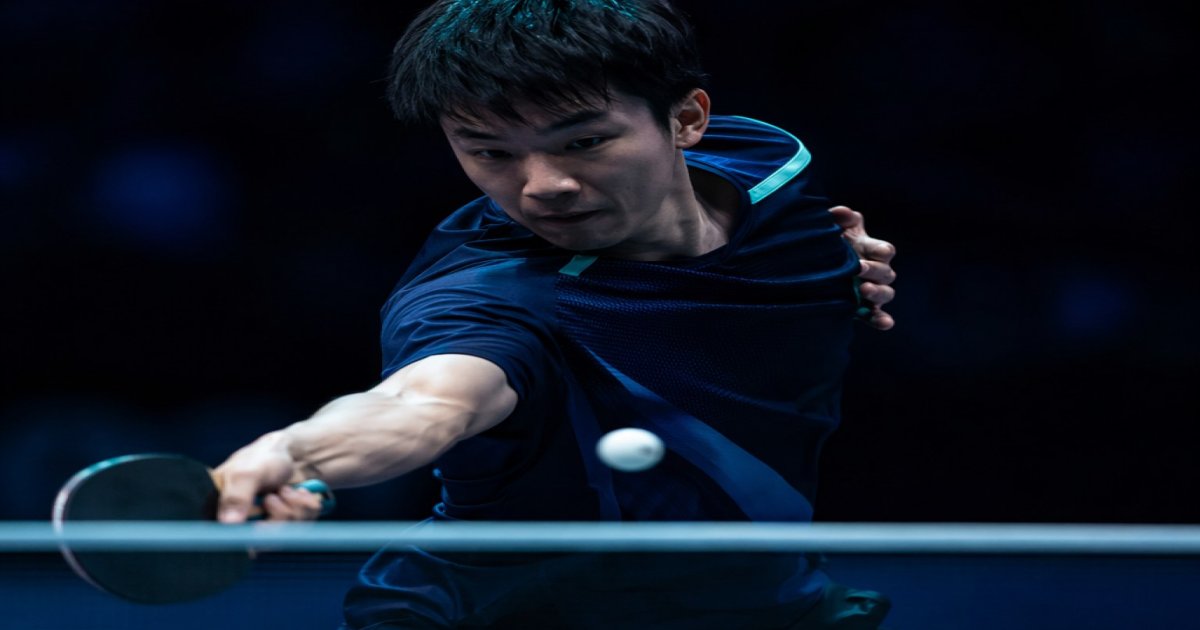
A player in Chaguanas spent an entire season convinced her topspin loop had a hard ceiling, the same moderate arc she’d been producing for a year no matter how much harder she swung. A visiting coach watched exactly one repetition and told her to stop swinging harder and start swinging lower, dropping the racket beneath the ball before the stroke even began. That one correction contains most of how to generate more topspin. The next loop she hit cleared the net by half the margin and landed with twice the kick off the bounce. Nothing about her effort had changed. Everything about her starting position had.
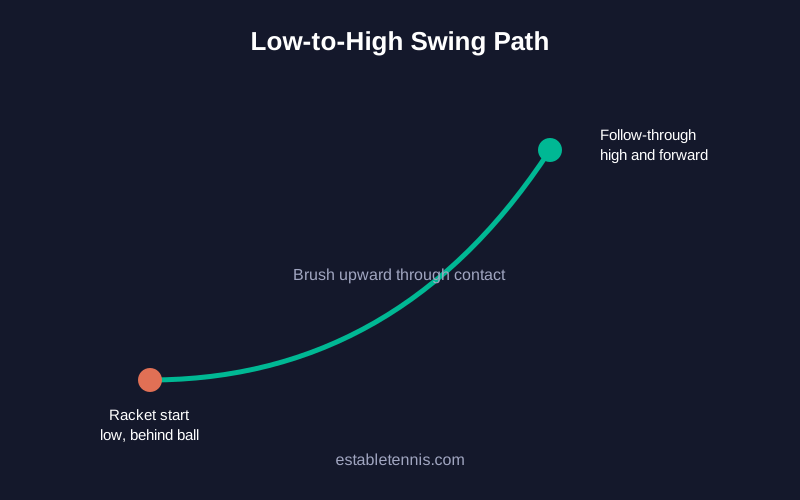
Start the racket lower and further back than the ball’s contact point, then brush upward and forward through the ball with an accelerating swing, closing the racket angle slightly at contact. More topspin comes from a steeper low-to-high swing path and faster racket-head speed at contact, not from swinging harder in a flat, direct line.
Topspin generation is the single most sought-after skill among intermediate players, and it’s also the one most commonly capped by a single, invisible technical habit rather than a lack of raw effort or athleticism.
Why does swinging harder often fail to produce more topspin?
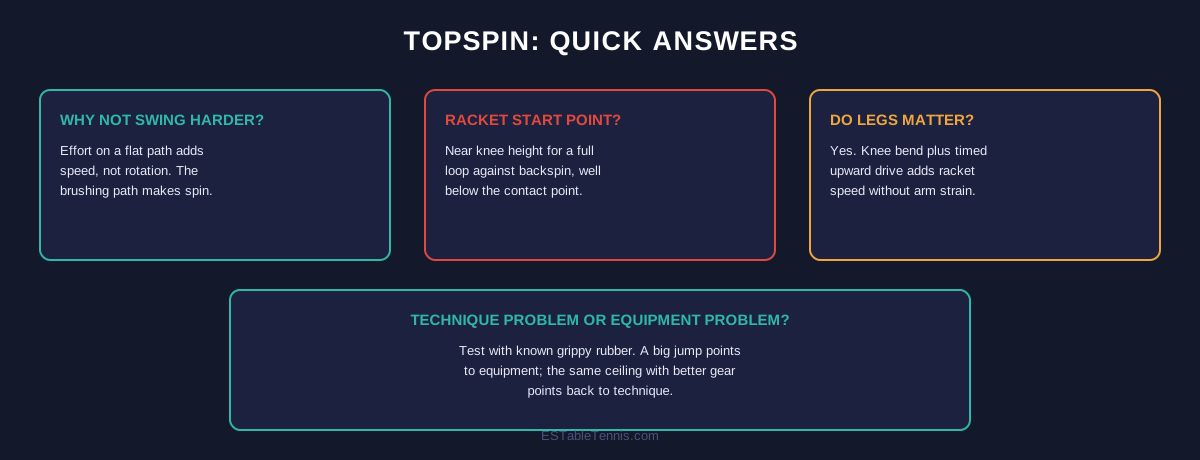
Because raw effort applied to an incorrect swing path just produces a faster version of the same flat, low-spin contact: more speed, not more rotation. Topspin comes specifically from the brushing angle and low-to-high path of the swing, not from how much muscular effort goes into it. A player swinging harder without correcting the underlying path is optimizing the wrong variable entirely, and often ends up with less control rather than more spin.
How low should the racket actually start before a topspin swing?
Lower than most players instinctively position it: often close to knee height for a full loop against backspin, dropping the racket well below the ball’s eventual contact point so the swing has genuine room to travel upward through the shot. A racket that starts near or above the contact point has no meaningful upward path left to travel, capping topspin regardless of how fast the arm moves afterward.
What’s the role of leg drive in generating topspin?
Significant, and frequently neglected by players who treat topspin as purely an arm and wrist motion. A slight knee bend before the stroke, followed by an upward leg extension that times with the arm’s swing, adds meaningful racket-head speed and upward trajectory to the shot without requiring more arm strength alone. This lower-body contribution is one of the more overlooked power sources in advanced topspin technique.
How does racket angle need to change for topspin against different incoming spin?
Against backspin, the racket angle should stay slightly more open at the start of the swing, closing gradually through contact to lift the ball while still imparting topspin. Against a ball with little spin or existing topspin, a more closed racket angle throughout the swing works better, since there’s less need to fight against backspin’s downward-dragging effect. Misjudging this adjustment is one of the most common reasons a loop against backspin sails long or dives into the net.
Does rubber and sponge choice affect how much topspin a player can generate?
Considerably. Higher-grip rubber and appropriately matched sponge thickness, covered in our guides on choosing rubber for beginners and rubber hardness explained, directly determine how efficiently a correct brushing motion actually translates into ball rotation. A player with technically sound topspin mechanics but poorly matched, low-grip equipment will still underperform their actual technical ceiling.
What’s a common compensating habit that limits topspin without the player realizing it?
Contacting the ball too flat, too early in the swing’s upward path, rather than waiting to brush through it at the ideal point of maximum racket-head speed and steepest upward trajectory. This habit often develops from a player rushing the shot under time pressure, and it becomes such an ingrained pattern that a player can genuinely believe they’re already brushing correctly when video review would reveal a much flatter contact than they perceive in real time.
How does follow-through affect topspin, even after contact has already happened?
A full, high follow-through, continuing the racket’s upward path well past the point of contact, reflects and reinforces a swing that was already generating good topspin. A truncated, short follow-through often indicates the swing decelerated too early, right around the moment of contact, which directly reduces the spin actually imparted. Follow-through isn’t purely cosmetic; it’s a visible signal of whether the entire swing maintained its acceleration through the critical contact window.
What’s a good isolated drill specifically for building topspin generation?
Multiball practice against fed backspin, covered in more depth in our guide on multiball training table tennis, lets a player repeat the same loop attempt dozens of times in a short session without the interruption of chasing down missed shots, building the low-to-high swing pattern through sheer repetition against a consistent, predictable feed.
How does grip pressure affect topspin generation specifically?
A relaxed grip through the majority of the swing, tightening only briefly at the moment of contact, allows for faster racket-head acceleration than a grip held tightly throughout the entire motion. Excess tension anywhere in the hand, wrist, or forearm restricts the whip-like acceleration that generates the fastest racket-head speed at exactly the moment it matters most, which is why coaches consistently emphasize relaxation during the backswing even when every instinct pushes a player toward gripping harder for more perceived control.
What’s the connection between topspin generation and confidence in a match?
A player who has only built moderate, capped topspin often develops a passive, waiting game plan by necessity: their loop simply isn’t dangerous enough to initiate points confidently, which shapes their entire tactical approach around defense and consistency rather than attack. Once genuine topspin generation improves, many players report their entire match psychology shifting alongside it, since a loop that actually threatens an opponent changes what shots and risks feel available in the moment, not just what’s technically possible.
Does topspin generation differ between forehand and backhand loops?
Yes, meaningfully, mirroring the broader mechanical differences covered in our guides on forehand and backhand technique. A forehand loop can draw on full hip and shoulder rotation plus leg drive for its low-to-high path, while a backhand loop relies more heavily on forearm and wrist snap within a more compact swing, which generally produces a lower topspin ceiling than a fully developed forehand loop, though a well-trained backhand loop remains a genuine weapon at higher levels of play.
How does a player know if their current topspin ceiling is technique-limited or equipment-limited?
Test with a known-good, higher-grip rubber temporarily if possible: if topspin output increases significantly with better equipment despite unchanged technique, the ceiling was at least partly equipment-driven. If topspin output stays similarly capped even with better rubber, the limitation is more likely rooted in swing path, contact timing, or racket-head speed rather than the gear itself. This diagnostic distinction, covered in principle throughout our equipment guides, saves considerable frustration compared to guessing at the cause.
What’s a realistic progression for topspin development over time?
Early development usually focuses on simply making consistent contact with a low-to-high path at all, regardless of how much actual rotation results. Intermediate development adds leg drive and full hip rotation to meaningfully increase racket-head speed and spin intensity. Advanced development focuses on subtle contact timing and angle adjustments that let a player vary topspin intensity deliberately, shot to shot, rather than producing one fixed intensity regardless of tactical need.
How does watching your own topspin on video reveal gaps invisible in real time?
Video review, even simple smartphone footage, frequently reveals a much flatter contact angle and shorter follow-through than a player perceives while actually swinging: the felt sensation of a big, committed loop often doesn’t match the visual reality captured on camera. This gap between perception and actual mechanics is one of the most common reasons players plateau on topspin despite genuinely believing their technique is already sound; the fix often isn’t more effort, but an honest look at what the swing is actually doing.
How does contact point timing interact with topspin intensity?
Contacting the ball at the apex of its bounce, or slightly on the rise, generally allows for more aggressive topspin generation than waiting until the ball has begun to drop, since the ball’s own upward momentum at that point works with rather than against the racket’s upward brushing path. Waiting too long and contacting the ball late, on the descent, forces a player to fight against the ball’s downward trajectory, which caps how much of the swing’s energy converts cleanly into topspin rather than being partially absorbed correcting for bad timing.
What’s the difference between a loop drive and a loop kill, and how does topspin generation differ between them?
A loop drive prioritizes heavy, controlled topspin with a moderate pace, designed to set up or continue an attacking sequence rather than end the point immediately. A loop kill sacrifices some spin for significantly more raw speed, aiming to end the point outright against a ball that’s already sitting in an attackable position. Understanding this distinction helps a player consciously choose how much to prioritize spin versus pace on a given shot, rather than applying the same technique indiscriminately regardless of tactical situation.
Does topspin generation training carry injury risk if done incorrectly?
Yes, particularly to the shoulder and elbow, if a player relies excessively on arm and wrist effort to compensate for missing hip rotation and leg drive. This compensating pattern places repetitive strain on smaller joints that were never designed to generate the bulk of a loop’s power, and it’s one of the more common overuse injury patterns among self-taught intermediate players who never fully incorporated the larger, more efficient muscle groups into their topspin mechanics.
How does a coach typically diagnose a capped topspin ceiling in a student?
Usually by watching the racket’s starting height and the overall swing path relative to the ball’s contact point, since these two visual cues reveal most technical limitations faster than any other observation. A racket that starts too high, too close to the eventual contact point, is one of the most common and most immediately correctable issues a coach identifies, often within a single observed repetition, exactly the pattern that unlocked the player in Chaguanas within one corrected swing.
Is there a mental or psychological barrier that limits topspin generation, separate from pure technique?
Often, yes. A player who has experienced overhitting or losing control while attempting bigger, more aggressive loops in the past may unconsciously hold back on subsequent attempts, producing a technically incomplete swing out of learned caution rather than a genuine mechanical limitation. Recognizing this psychological hesitation as distinct from an actual technical gap matters, since the fix for hesitation is confidence-building through controlled repetition, not further technical correction that isn’t actually the root problem.
What’s a sensible order for introducing topspin-generation elements to a developing player?
Contact consistency first, then a properly low starting position and upward swing path, then leg drive and hip rotation layered on top once the upper-body mechanics are reliable, and finally contact timing refinement to vary intensity deliberately. Introducing leg drive before basic contact consistency is solid, for instance, often overwhelms a player with too many simultaneous adjustments, producing worse results than a patient, sequential build would achieve.
How does match-realistic practice differ from isolated topspin drilling, and why does a player need both?
Isolated drilling against a consistent, predictable feed builds the raw movement pattern without the added complexity of reading varied incoming spin. Match-realistic practice, against an opponent’s genuinely inconsistent shots, tests whether that movement pattern holds up when the incoming ball’s spin, speed, and placement aren’t perfectly predictable. A player who only drills in isolation often finds their topspin breaks down in real matches, precisely because match conditions introduce variability the isolated drill never prepared them to handle.
Does topspin generation improve or plateau with age, and does that affect how a player should train it?
Younger players often develop faster, more flexible rotational mechanics, while older players sometimes compensate with more refined timing and technique to produce comparable results with less raw physical speed.
Neither pattern means topspin generation is unavailable to a player starting later in life: it simply means the specific training emphasis, leaning more on timing and technique refinement versus pure physical rotational speed, may need to adjust based on a player’s actual physical starting point rather than assuming one training approach fits every age and body type equally.
According to ITTF equipment regulations, rubber grip and thickness are tightly standardized precisely because unregulated spin-generating equipment would otherwise let gear substitute for the genuine technical skill covered throughout this guide, a reminder that the ceiling on topspin was always meant to be technique, not equipment loopholes.
Eight inches lower, one corrected repetition, an entire season’s plateau gone in a single afternoon. Most technical breakthroughs in this sport look exactly that unremarkable from the outside, and exactly that significant to the player who finally felt the difference for themselves.
Drop the racket. Trust the path. Let the ball do the rest.
Quick Recap: How to Generate More Topspin
Generating more topspin comes from starting lower, brushing steeper, and accelerating the racket faster through contact, not from swinging harder in a flat, direct line. The player in Chaguanas never needed more effort. She needed one coach, one repetition, and a starting position eight inches lower than the one she’d been using for an entire season.
Frequently Asked Questions
Why doesn’t swinging harder produce more topspin?
How low should the racket start for a topspin loop?
Does leg drive actually matter for topspin generation?
Does rubber choice affect how much topspin I can generate?
How can I tell if my topspin ceiling is a technique or equipment problem?
The player in Chaguanas still tells that story to newer club members, usually right before making them drop their own racket lower than feels natural. Most of them resist for exactly as long as she did, and for exactly the same reason: it feels wrong until the ball proves otherwise.
Curious whether your current rubber is actually helping or capping your topspin? PingPath gives you a fitted recommendation in under three minutes.
Leave a Reply