
How do you hit a proper table tennis forehand?
The forehand is the shot most players think they already understand, borrowed instinctively from whatever racket sport they played before. That instinct is almost always wrong, and unlearning it is the real first lesson.
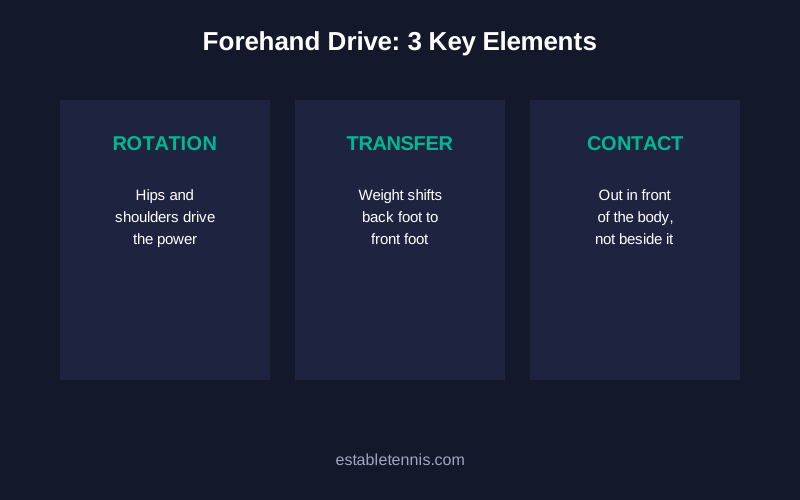
Rotate your hips and shoulders to draw the racket back and slightly low, then swing forward and upward through the ball, brushing the surface to generate topspin while your weight transfers from your back foot to your front foot. Contact should happen out in front of the body, not beside it.
What’s the correct grip for a forehand shot?
How does body rotation drive the forehand, rather than just the arm?
A forehand powered purely by the arm is weaker, less consistent, and far more injury-prone over time than one driven by hip and shoulder rotation, which uses the body’s larger muscle groups to generate racket-head speed. The arm’s job is largely to guide the racket through the correct path and angle; the power itself should come from the torso rotating through the shot, transferring energy up through the kinetic chain into the racket.Where should contact with the ball actually happen?
Out in front of the body, at a comfortable distance that allows a full, uninterrupted swing path. Contact too close to the body cramps the swing and limits power; contact too far in front sacrifices control and consistency. Most beginners contact the ball too late, beside or behind their body, which is one of the most common and most fixable technical errors in the sport.How does weight transfer actually work during a forehand?
Weight should shift from the back foot to the front foot as the swing moves forward, mirroring the same weight-transfer principle found in golf, baseball, and most other rotational sports. This transfer adds momentum and power to the shot without requiring additional arm strength, and it’s one of the clearest visual signals separating a technically sound forehand from an arm-only swing that looks similar but produces far less consistent power.What’s the difference between a forehand drive and a forehand loop?
A drive is a flatter, more direct shot with moderate topspin, typically used against a ball with little spin already on it. A loop is a heavier topspin shot, using a more pronounced low-to-high brushing motion, typically used to attack backspin or to build an aggressive point against a defensive opponent. The loop is generally considered the more advanced shot, requiring more precise timing and racket angle control than a basic drive.Why do so many players develop a cramped, arm-only forehand?
Often because early practice happens too close to a wall or table, without enough room to complete a full rotational swing, or because a coach never explicitly corrected the habit before it became ingrained. Once a cramped, arm-dominant forehand becomes muscle memory, unlearning it takes considerably more deliberate practice than building the correct pattern would have taken from the start, which is exactly why early instruction matters more than most beginners realize.How does equipment affect forehand consistency?
A blade or rubber mismatched to a player’s current swing speed and consistency, covered in our guides on carbon blades for beginners and rubber selection, can make an otherwise correct forehand technique feel inconsistent or unreliable. A player working on forehand fundamentals should rule out equipment mismatch before assuming every inconsistency is purely a technical error.What’s a good practice drill to build forehand consistency?
Shadow swings without a ball, focused purely on the rotational movement pattern, followed by multiball feeding drills where a coach or partner feeds a consistent stream of balls to the same spot, letting a player groove the same swing repeatedly without the variability of a live rally. This kind of repetitive, isolated practice, covered more broadly in our guide on table tennis drills, builds muscle memory far faster than sporadic practice during unstructured matches.How does the forehand differ across offensive and defensive playing styles?
An offensive player’s forehand emphasizes aggressive topspin generation and a full, committed swing designed to initiate and finish points quickly. A defensive player’s forehand often prioritizes control and placement over raw spin and power, using a shorter, more compact motion suited to blocking and countering rather than attacking first. Neither approach is objectively superior: the right forehand style follows a player’s broader tactical identity rather than existing as a single universal technique.What’s the connection between forehand consistency and mental confidence?
The forehand is often a player’s primary attacking weapon, and inconsistency in that specific shot tends to erode confidence disproportionately compared to a similar inconsistency in a secondary shot. A player who can’t trust their forehand under pressure often starts avoiding forehand opportunities entirely, retreating to safer, more passive shots even when an aggressive forehand would have been the better tactical choice, a clear example of technical inconsistency bleeding directly into match psychology.How much does footwork actually matter for a good forehand?
Enormously, and it’s frequently underestimated relative to arm and torso mechanics. A technically perfect forehand swing executed from a late, off-balance position produces an inconsistent result regardless of how correct the arm motion looks. Good footwork gets a player into position early enough to execute the full rotational swing from a balanced, set stance, which is covered in more detail in our guide on how to improve table tennis footwork.What’s a common misconception about forehand power?
That power comes primarily from arm strength or a bigger, more dramatic swing. In reality, a compact, well-timed swing driven by hip and shoulder rotation generates more usable power and more consistent spin than a large, arm-dominant swing that sacrifices timing and racket-head acceleration for sheer size. Some of the most powerful forehands in the sport look deceptively small and economical, precisely because the power comes from rotational timing rather than swing size.How long does it typically take to develop a reliable forehand?
Basic forehand consistency, enough to sustain a controlled rally, usually develops within the first one to two months of regular, focused practice. A genuinely reliable, match-ready forehand that holds up under pressure and against varied spin typically takes six months to a year of consistent training, since match conditions introduce variability that isolated practice drills don’t fully replicate.How does the forehand serve as a foundation for more advanced shots?
Nearly every advanced offensive shot in table tennis (the loop, the smash, the flick) builds directly on the same rotational mechanics and weight transfer principles established in a basic forehand drive. A player who skips proper forehand fundamentals in favor of rushing toward flashier shots often finds those advanced shots capped by the same underlying mechanical gaps that were never addressed at the foundational level. This is why coaches consistently return to forehand fundamentals even with intermediate and advanced players, rather than treating it as a beginner-only topic to move past quickly.What’s the role of the non-racket arm during a forehand swing?
The non-racket arm plays a genuine, if underappreciated, role in balance and rotational counterbalance during a forehand swing, similar to its function in a golf swing or a baseball throw. A player who lets the non-racket arm hang loosely or drop entirely during the swing often loses some of the rotational stability that arm provides, which can subtly affect timing and balance even if the racket arm’s mechanics look otherwise correct.How should a player diagnose their own forehand inconsistency?
Start by isolating whether the inconsistency is timing-related (contact point varies shot to shot) or power-related (some shots feel controlled, others feel rushed or overhit). Timing inconsistency often traces back to footwork and positioning rather than the arm swing itself, while power inconsistency more often points to inconsistent weight transfer or grip tension. Correctly diagnosing which category a specific inconsistency falls into focuses practice time on the actual root cause rather than generically “practicing forehands” without a clear target.Does forehand technique need to change against different rubber types?
Slightly, yes. Facing an opponent’s pimples-out or long pips rubber, covered in our guides on inverted vs pimples-out rubber and long pips table tennis, often calls for a slightly more controlled, less committed forehand swing initially, since the incoming ball’s spin behavior is less predictable than what a player’s forehand timing was built around through practice against standard inverted rubber.What’s a realistic progression for forehand development over a player’s first year?
The first few months typically focus purely on consistent contact and basic rotational mechanics, without much emphasis on power or spin variation. The middle of the first year usually introduces more deliberate topspin generation and the beginnings of a proper loop, once basic drive consistency is solid. By the end of a dedicated first year, most players have a forehand capable of both controlled drives and increasingly confident loops, though full mastery of advanced forehand variations typically continues developing for years beyond that first milestone.How does mental pressure specifically affect forehand execution in matches?
Pressure tends to shorten and rush a player’s forehand swing, cutting off the full rotational motion in favor of a quicker, safer, but less powerful and less consistent version of the shot. This is a well-documented pattern across racket sports broadly, not unique to table tennis, and it’s part of why deliberately practicing forehands under simulated pressure (not just relaxed, unhurried repetition) builds the kind of composure that holds up when a match actually matters.What’s the single most valuable forehand drill for an intermediate player?
Random placement drills, where a partner or coach feeds balls to varying, unpredictable locations rather than the same spot repeatedly, force a player to combine footwork and forehand mechanics under conditions closer to real match play than a static, single-spot drill provides. This single adjustment (introducing controlled unpredictability) is often the missing link between a forehand that looks good in isolated practice and one that actually holds up in competitive rallies. According to ITTF equipment regulations, blade and rubber specifications are standardized precisely so that technique, not equipment loopholes, remains the deciding factor in shots like the forehand, a rule framework that quietly protects the value of everything covered in this guide. The wall never gets tired of two hundred repetitions, and neither should a player who actually wants a forehand worth trusting once a real opponent is standing on the other side of the table. Nobody enjoys the first week. Almost everyone who stuck around stopped noticing it by the third. A forehand built this way doesn’t announce itself with anything flashy in an actual match. It just keeps landing, point after point, long after an arm-only swing built on borrowed instinct would have broken down.Why do so many self-taught players plateau specifically on their forehand?
Because a forehand built without early correction tends to compensate its way to short-term success (enough contact and enough placement to win casual points) without ever developing the rotational mechanics that hold up against faster, more consistent opponents. This compensation pattern feels like progress for a while, since it does produce results against similarly self-taught opponents, right up until it meets someone whose forehand was actually built on sound fundamentals from the start. That collision is usually the moment a self-taught player finally seeks out proper instruction, often years later than would have been ideal. The fix at that later stage is the same as it would have been on day one, just harder to implement once the compensating habit is deeply ingrained: slow down, rebuild the rotational pattern from the ground up, and accept that the forehand will temporarily feel worse before it becomes genuinely better. Patience at the beginning is cheaper than a rebuild years later, though almost nobody believes that until they’ve lived through the second option themselves. The rotation does the work. The arm just carries the racket along for the ride, if you let it. Two hundred repetitions against a wall have taught more forehands than any single piece of advice ever could, this article included. Everything else is decoration on top of that one lesson. Show up, rotate, transfer your weight, and let the shot arrive out in front where it belongs. Repeat until it stops feeling like a lesson at all. The wall doesn’t lie about your technique. It just returns whatever you actually gave it. Simple as that. Nothing about it needs to be complicated. It just needs the repetitions. End of story. Every good forehand started exactly this ordinary. Yours can too.Quick Recap: Table Tennis Forehand
A reliable table tennis forehand is built from rotation, weight transfer, and a contact point out in front of the body, not raw arm strength or a bigger swing. Two hundred repetitions against a wall feel tedious in the first week and invisible by the third, which is exactly the point of the drill nobody explains until it’s already working.Frequently Asked Questions
What’s the most common mistake beginners make with their forehand?
Contacting the ball too close to or behind the body rather than out in front, which cramps the swing and limits both power and consistency.
Does forehand power come from the arm or the body?
Primarily the body: hip and shoulder rotation combined with weight transfer generates more power and consistency than an arm-dominant swing.
What’s the difference between a forehand drive and a forehand loop?
A drive is flatter with moderate topspin, typically used against low-spin balls. A loop uses a more pronounced brushing motion for heavier topspin, often used to attack backspin.
How long does it take to build a consistent forehand?
Basic consistency develops within one to two months of focused practice; a fully match-ready forehand under pressure typically takes six months to a year.
Does equipment affect forehand consistency?
Yes. A blade or rubber mismatched to a player’s current swing speed and technique can make an otherwise correct forehand feel unreliable.
Leave a Reply