
On a Sunday afternoon at the Diego Martin Sporting Complex, a boy of maybe fourteen was taking apart grown men twice his size, and he was doing it holding the paddle the way you’d hold a pen about to sign a check. No one in the room seemed bothered by this. They’d seen him before.
What got the visiting players, the ones who drove down from Chaguanas or San Fernando for the open tournament and had never settled the penhold vs shakehand question for themselves, was how fast his forehand arrived. There was no windup they could read, no tell in the shoulder. The ball just showed up on their side of the table, spinning in a direction they hadn’t planned for.
I asked him once, between matches, why he never switched to the grip everyone else in the room was using. He shrugged and said the other grip felt like holding someone else’s hand. That’s the whole argument in one sentence, really, though it took me a few more years of coaching to understand why.
The penhold vs shakehand debate gets treated online like a religious argument, with people picking a side and defending it as if the other grip is a mistake. It isn’t. Both grips have won World Championships.
Both grips have also lost matches they should have won, because the player holding the paddle never fully trusted what was in their hand. That trust is the real subject of this post, and the grip is just the vehicle for getting there.
What’s the Difference Between Penhold and Shakehand Grips?
The shakehand grip is held like a handshake with even power on both wings. The penhold grip is held like a pen, trading backhand power for more wrist freedom. The shakehand grip is exactly what it sounds like. You hold the paddle the way you’d shake a stranger’s hand, thumb on one face of the blade, index finger on the other, the remaining three fingers wrapped around the handle.
It’s the grip most people picture when they think of table tennis, and it’s the grip roughly two-thirds of competitive players worldwide now use, including most of the current Chinese national team.
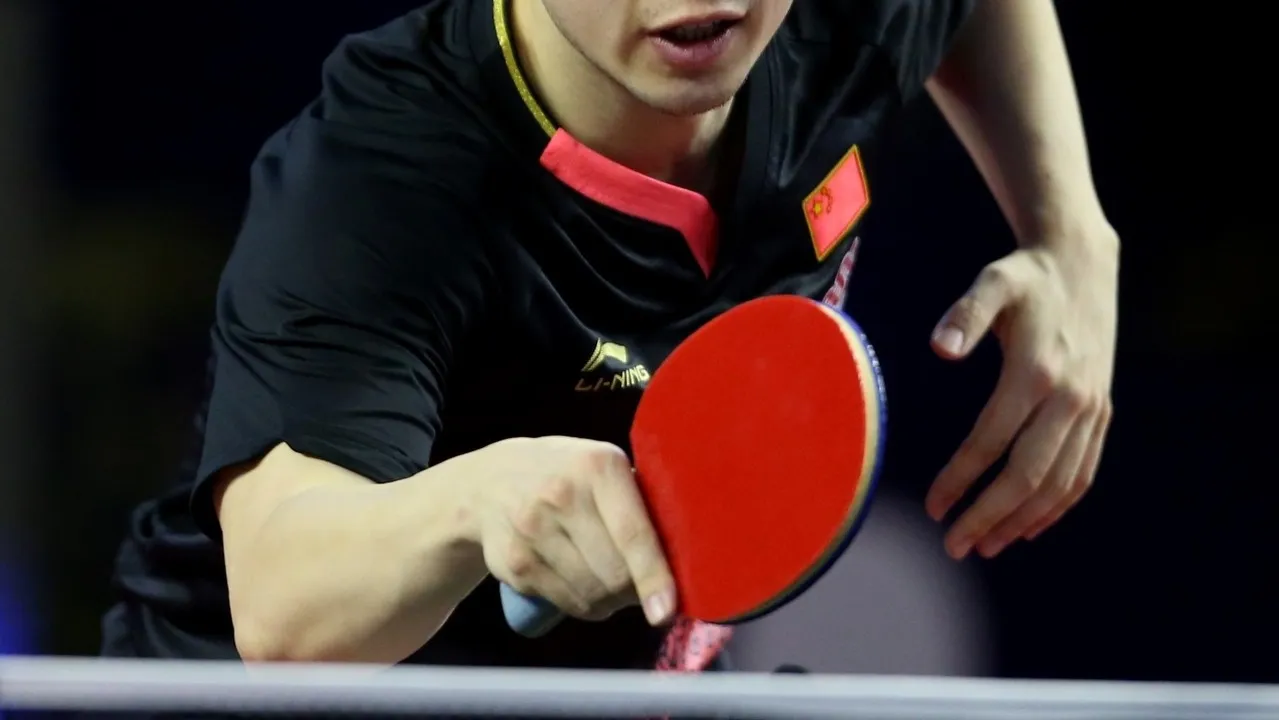
The penhold grip is different in a way that matters more than it looks. You pinch the handle between your thumb and index finger, close to where the blade meets the grip, the same way you’d hold a pen or a calligraphy brush. The other three fingers sit on the back of the blade, either curled tightly against it (the Chinese style) or splayed flat across it (the Japanese and Korean style).
Only one side of the paddle gets used for most shots, unless the player has trained the reverse penhold backhand, a more recent development that lets penhold players flip the racket and hit off the reverse face.
Neither grip is a costume. Each one changes what your hand, wrist, and forearm can physically do to the ball, and that changes what kind of player you become. This isn’t a question with a universal right answer. It’s a question with a right answer for you, and the only way to get there is understanding what each grip actually gives up and what it actually buys.
What’s the Case for Using a Shakehand Grip?
Shakehand exists because it solves a problem penhold never fully solved: an even, hard-hitting stroke on both wings. A shakehand player can hit a full topspin loop off the backhand side with something close to the same power and spin as the forehand, because the wrist and forearm mechanics work the same way on both sides of the body. That symmetry is the entire selling point.
It also happens to be the more forgiving grip to learn. New players pick up a natural, controlled stroke faster with shakehand because the grip mirrors motions the hand already knows: gripping a hammer, holding a tennis racket, shaking someone’s hand at a job interview. Coaches default to teaching shakehand first for exactly this reason. You get competent faster, and competent early wins matter for a beginner’s confidence more than most coaches admit.
The tradeoff shows up in one specific spot: the crossover point, the awkward no-man’s-land in the middle of your body where you have to decide, mid-rally, whether a ball is a forehand or a backhand. Wait a beat too long at the crossover, and you either shank the shot or get caught switching grips mid-swing. Every shakehand player, from a Saturday club regular to Ma Long himself, has to manage that decision point. It never fully goes away.
What’s the Case for Using a Penhold Grip?
Penhold gives up backhand symmetry and buys something else instead: wrist freedom. A penhold grip allows something close to 270 degrees of wrist rotation around the blade, compared to roughly 180 degrees for shakehand. That extra range is why penhold forehands can disguise spin so effectively and why the fastest, most violent forehand attacks in the sport still tend to come from penhold players.
The wrist can snap the blade through more angles in less time, which means more spin variation and less warning for the opponent.
Penhold also erases the crossover problem entirely. Because most shots come off the same face of the blade, there’s no moment of hesitation about which side to use. The player just moves their feet to get the forehand in position, which is why penhold players, historically, tend to show noticeably better footwork than their shakehand counterparts. The grip forces the feet to do work the shakehand grip lets the arm do instead.
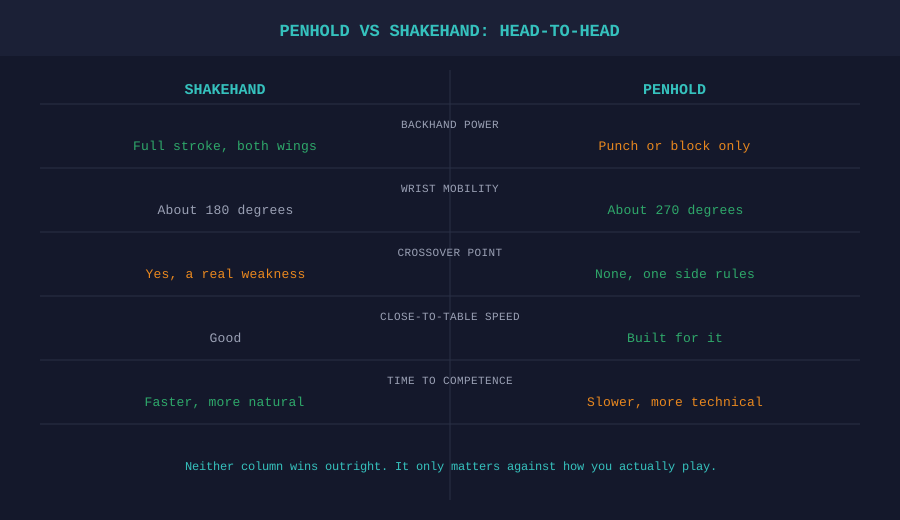
The cost is real, though. Traditional penhold backhands are limited to a push, a block, or a short punch, none of which can generate serious topspin without the reverse penhold backhand, a technique that takes years to build and still doesn’t fully close the gap against a well-trained shakehand backhand loop. This is the single biggest reason fewer top players choose penhold today than did thirty years ago. The game has gotten faster and more backhand-heavy, and penhold pays a real tax for that shift.
What Are the 5 Critical Differences Between Penhold and Shakehand?
Strip away the marketing language and the fan loyalty, and the penhold vs shakehand comparison comes down to five variables that show up in almost every match, at almost every level. Each one trades an advantage for a limitation. None of them cancel out cleanly, which is exactly why the debate never settles.
1. The Backhand Crossover Point
Shakehand players live with a permanent decision point in the middle of the table. Penhold players don’t have one, because one side of the racket handles almost everything. If your matches are getting decided by balls landing right at your body, this difference alone might matter more to you than anything else on this list.
2. Wrist Mobility and Spin Disguise
The extra range of motion in a penhold grip lets a player change the racket angle later in the swing, which makes it harder for an opponent to read spin before contact. Shakehand still generates plenty of disguise through timing and stroke length, but it can’t match the raw wrist mobility of penhold, particularly on serves.
3. Reach and Court Coverage
Shakehand’s grip on the handle, further back from the blade, gives a slightly longer effective reach and makes wide balls easier to track down without a full step. Penhold players compensate with faster, more constant footwork, but they generally play closer to the table and cover less ground on any single shot.
4. Time to Competence
A beginner with a shakehand grip usually looks like a table tennis player within a few sessions. A beginner with a penhold grip usually needs longer to feel comfortable, because the hand position is less intuitive and the backhand requires an entirely different stroke pattern to learn from day one. If you’re coaching a large group of new players, shakehand gets more of them playing real points faster.
5. Who Is Actually Winning With Each Grip Today
Look at the current top ten in the world rankings, and shakehand dominates almost completely. Xu Xin remains one of the only elite-level penhold players still competing at the very top, and he does it with a reverse penhold backhand built through more hours of specialized training than almost any shakehand player needs to reach the same level. That doesn’t make penhold worse. It makes penhold a grip that demands more from the player to reach the same ceiling, which is a very different statement than saying it can’t get there.
Why “Which Is Better” Is the Wrong Question
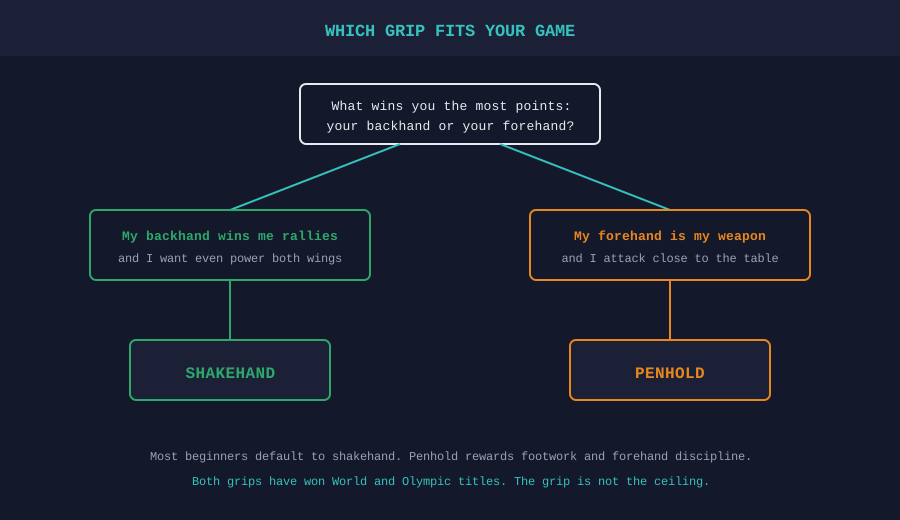
Neither grip wins more points on its own. A grip is a tool, and a tool only performs as well as the technique built on top of it. The actual question that decides matches isn’t penhold versus shakehand; it’s whether the player trusts the tool in their hand enough to swing freely at 9-9 in the fifth.
This is where equipment and mental performance actually meet, and it’s the part most coaching advice skips entirely. A player who picked penhold because a coach told them to, but who never fully bought into the tradeoff, hesitates at exactly the moments that matter.
They start second-guessing the grip instead of executing the shot, and that hesitation is the same explicit-monitoring failure that shows up in choking under pressure: conscious thought interrupting a movement that should run on trained instinct.
The grip itself rarely loses the match. The doubt about the grip does.
A 2020 kinematic study comparing shakehand and penhold forehand strokes, published in the journal Applied Sciences, found measurable differences in wrist angle and racket velocity between the two grips during forehand loop strokes, confirming what coaches have argued from observation for decades. The biomechanics are genuinely different. But biomechanics only explain the shot. They don’t explain the player’s confidence in the shot, and you build that confidence separately from the grip itself.
What Mistake Costs Players Years When Choosing a Grip?
The most common error isn’t picking the wrong grip. It’s picking a grip based on a highlight reel and abandoning it eighteen months later, the moment progress slows down, which resets the entire learning curve back to zero. Grip switches happen for real reasons sometimes: a hand injury, a genuine ceiling in match results, a player who spent one season on penhold and realized the backhand limitation was costing them more than the forehand snap was earning back. Those are legitimate reasons to switch.
But switching because a video of Wang Chuqin’s forehand looked impressive, or because a friend said shakehand is objectively superior, wastes years most players don’t have to waste. Pick the grip based on how you actually play right now, give it a real trial of several months of consistent training, and only reconsider once you have enough matches to know whether the limitation you’re running into is the grip’s fault or your technique’s fault. Most of the time, it’s the technique.
There’s a second, quieter version of this mistake. It shows up in players who never officially switch grips but who play with one foot in each camp anyway, holding a shakehand racket but gripping it too far up toward the blade in a way that mimics penhold habits, or holding a penhold racket loosely enough that it slides during fast exchanges.
Half-committing to either grip produces the disadvantages of both without the advantages of either. Pick one fully, hold it the way it’s meant to be held, and let the rest of your training build on top of a stable foundation instead of a compromise.
How Do You Match Equipment to Your Grip?
Once your grip is settled, match your blade to it: a penhold-oriented blade built for continuous forehand looping, or a symmetrical two-wing blade for shakehand. Once the grip is settled, the blade needs to match it. A DHS Hurricane Hao is built specifically around the Chinese penhold forehand, with a blade shape and weight distribution designed for continuous forehand looping rather than a symmetrical two-wing game.
Putting a shakehand-oriented blade in a penhold hand, or the reverse, undoes a lot of the advantage the grip itself provides.
On the shakehand side, a blade like the Butterfly Timo Boll ALC is built around exactly the even, two-wing balance that makes shakehand worth choosing in the first place. Handle shape matters here too. Chinese penhold players generally use a shorter, straight handle designed for the pinch grip, while Japanese and Korean penhold players often prefer a slightly different handle profile to support the flat, splayed finger position.
Buying a penhold blade with a shakehand-style flared handle is a small mistake that adds up over thousands of repetitions.
If you already read the post on how to choose a table tennis blade, the same variables of weight, ply count, and speed rating apply here, just filtered through whichever grip you’ve committed to. And if the grip itself still feels unnatural in your hand no matter which blade you attach to it, go back to the fundamentals in how to grip a ping pong paddle correctly before assuming the problem is your choice between penhold and shakehand at all.
A grip that’s held wrong will feel wrong no matter which family it belongs to.
Frequently Asked Questions
Do Beginners Progress Faster With Shakehand or Penhold?
Shakehand mirrors natural hand motions most new players already know, which means a beginner typically produces a controlled, useful stroke within a few sessions. Penhold is not worse for beginners long-term, but it demands more patience early, particularly for the backhand.
Who Does the Penhold Grip Actually Suit?
If your forehand is your primary weapon and you naturally play close to the table with quick feet, penhold rewards that style with more wrist snap and zero crossover hesitation. Players who rely on a strong two-wing rally game tend to feel restricted by penhold’s backhand limitations.
Should You Switch Grips Mid-Career?
A grip switch resets months or years of trained muscle memory, so it should only happen for a documented reason, like injury or a clear technical ceiling, not because of a highlight video. Give any grip several months of committed training before judging whether it’s actually the limitation.
Does the Reverse Penhold Backhand Fix Penhold’s Weak Backhand?
Modern Chinese penhold players train a reverse penhold backhand that allows real topspin off the backhand side, narrowing the historical weakness. It still requires significantly more specialized training to reach the same backhand consistency a shakehand player builds by default.
Have Elite Players Won Titles With Both Penhold and Shakehand?
Shakehand currently dominates the world rankings, but penhold players have held World Championship and Olympic gold in the past, and Xu Xin still competes at the top level with a reverse penhold backhand today. The grip sets the ceiling higher for one style over another. It doesn’t set a hard limit on either one.
Neither grip made that fourteen-year-old in Diego Martin good. Hundreds of hours of repetition did that, and the grip just happened to be the shape his hand was comfortable repeating those hours in. Pick yours the same way, then stop asking the question and start putting in the hours.
If you want help figuring out which grip and blade combination actually fits your game, the PingPath advisor walks through it in a few minutes.
Leave a Reply