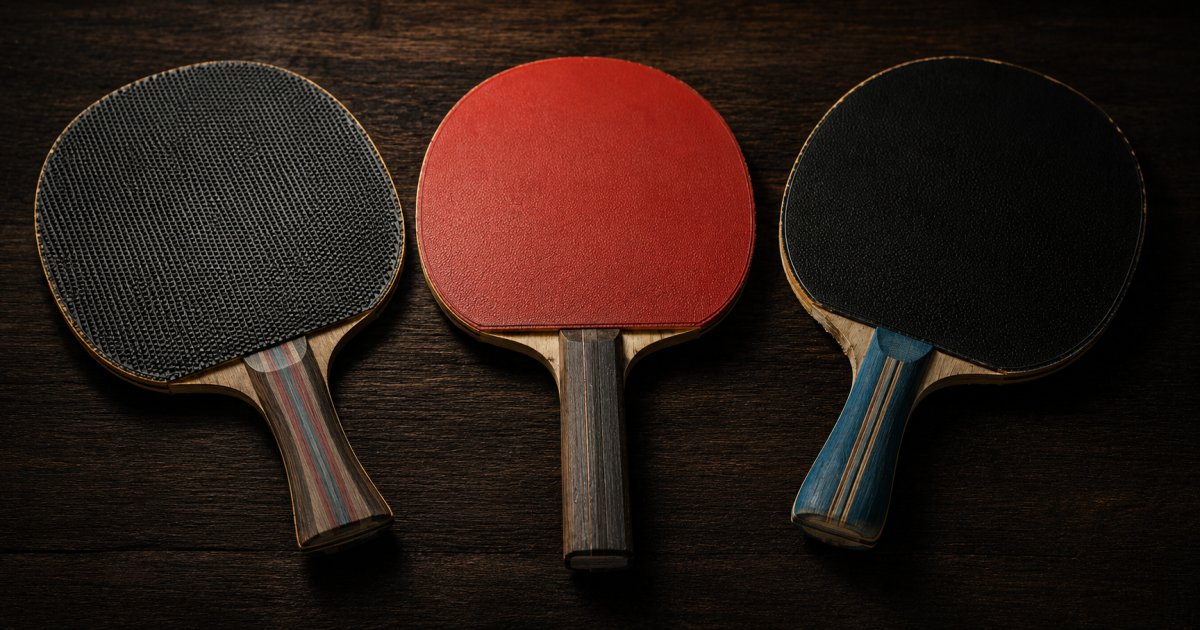
A coach I know in Montevideo, a former national team player who now runs a club out of a converted warehouse near the port, has a ritual for every new student. Before they touch a ball, he makes them hold three different blades and describe what they feel. Not what they think. What they feel. The weight in the hand, the balance point, the way the handle sits against the palm. He says you can tell almost everything about whether a blade will work for someone from that first thirty seconds, before a single shot is played.
I think he’s right, though not in the mystical way it might sound. What he’s actually doing is filtering for one thing: whether the tool feels like an extension of the hand or like an obstacle. Because a blade that feels wrong before you play it will feel wrong under pressure, and a blade that feels wrong under pressure will get you beaten by players you have no business losing to.
The mistake most players make when choosing a blade isn’t buying the wrong one. It’s not understanding what they’re buying at all. They read specifications, look at speed ratings, compare prices, and miss the two or three variables that actually determine whether a blade helps or hurts their game.
Here’s how to choose a table tennis blade without making those mistakes.
What Does a Table Tennis Blade Actually Do?
A blade controls two things: the feel of contact and base speed. It does not control spin or topspin trajectory, which are almost entirely a rubber function. Before you evaluate any specific blade, you need to understand what a blade controls and what it doesn’t, because most of the confusion in blade selection comes from misunderstanding this.
A table tennis blade controls two things primarily: the feel of contact (how much of the ball’s information you receive through the handle) and the base speed before rubber is added. That’s it. The blade does not control spin. Spin is almost entirely a rubber function. It does not control topspin trajectory, which is also rubber. What it does is determine how fast the combination moves, how much vibration feedback you receive, and how forgiving or demanding the sweet spot is.
This matters because players routinely blame their blade for problems that belong to their rubber, and choose a new blade looking for a fix that can only come from changing sheets. If your ball is landing short, your rubber sponge hardness is almost certainly the culprit, not your blade stiffness. If your loops feel flat, the topsheet is the variable to change. Get this distinction clear before you spend money on wood.
What Four Variables Actually Matter When Choosing a Blade?
Blade specifications come with long lists of attributes, but most of them are marketing language wrapped around four things that genuinely affect how you play.
1. Speed Rating: The Number That Misleads Players Most
Every blade carries a speed rating, usually on a scale from around 60 to 100 depending on the manufacturer. These numbers are almost impossible to compare across brands because there’s no standardised test method. A Butterfly OFF- blade and a Donic OFF- blade are not the same speed, and a DHS 95 and a Tibhar 95 don’t behave identically.
What the rating does tell you is relative positioning within a single brand’s lineup. And the principle it points toward is real: faster blades require more precise timing, and slower blades are more forgiving.
For most club players below a regional competitive level, an ALL or ALL+ rated blade will produce better results than an OFF rated one, because it keeps more balls on the table during technical breakdowns. The instinct to go faster is almost universal and almost always wrong. Speed amplifies errors. A blade rated OFF makes your timing windows narrower, your net errors more frequent, and your wide balls wider. This isn’t a weakness of your technique. It’s physics.
The exception is players who play primarily at the table, blocking and pushing, and need a blade that doesn’t slow down their already short swing. For those players, the speed rating matters less than stiffness, which is the next variable.
2. Stiffness: What the Dwell Time Argument Is Actually About
Table tennis blade stiffness (sometimes called flex or vibration) describes how much the blade bends during contact and how much feedback that generates. A stiff blade returns feedback quickly and sharply. A flexible blade dwells longer with the ball and returns softer feedback.
This is the variable that determines two things: how much control you have over placement, and how much physical feel you get about each shot.
Softer blades give you more dwell time, which means the ball stays on the rubber fractionally longer, which means you have slightly more contact time for spin generation and directional adjustment. For players who generate spin through brush and timing rather than raw arm speed, softer blades are usually better tools.
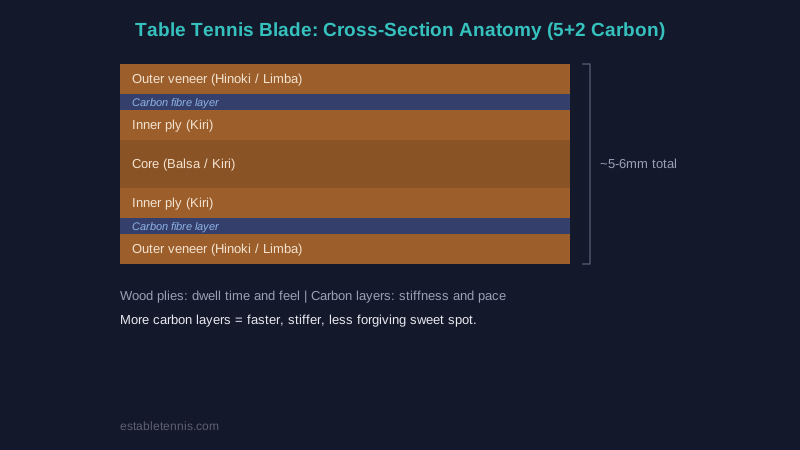
Stiff blades, typically carbon-composite constructions, return the ball faster with less dwell. They feel crisper. They’re better for players who hit through the ball flat-to-topspin at high pace, where the longer dwell of a softer blade becomes a timing interference rather than a benefit.
The practical signal: if you find yourself often shooting past the table on your drive or loop, and you’re not mis-timing the ball, a softer blade may be helping the rubber do too much work. If you find your topspins arriving without enough pace even when your technique is correct, a stiffer blade adds the missing energy.
3. Composition: Wood vs. Carbon
This is where most beginners focus first, and it’s actually the third most important variable behind speed and stiffness, because composition is largely what determines both of those things.
A pure wood table tennis blade (typically five-ply or seven-ply construction) offers more feedback, more dwell, and a more forgiving sweet spot. They’re the right choice for players still building consistent technique, because the extra contact time tolerates timing errors better than carbon does.
Carbon-composite blades add one or more layers of carbon fibre (or Aramid, Kevlar, ZLC, or other composites) to the wood core. Carbon makes the blade stiffer and faster, and it sharpens the sweet spot, meaning shots hit outside the centre become noticeably less effective. This is why carbon blades reward good technique and punish developing technique.
The common advice is to start with wood and move to carbon when your technique is consistent enough to use the extra pace without losing control. That advice is correct, but the threshold is higher than most players think. Most players playing at a social or club level with under five years of consistent training will get better results on an all-wood blade than on a carbon one, even if they feel like they’ve outgrown wood. The feeling of having outgrown your blade is often the feeling of having eliminated the technique errors that your slower blade was hiding.
4. Handle Shape: The Variable Nobody Mentions
The handle is where the blade physically meets your body, and an uncomfortable handle will quietly affect your technique in ways that are hard to diagnose.
The main shapes are flared (widening toward the end, the most common), straight (uniform width), anatomic (with a grip ridge moulded in), and conical (narrowing toward the end). There’s no objectively correct choice, but there are tendencies.
Flared handles are the most common because they sit naturally for most shake-hand grips and feel secure under pressure. Straight handles give more wrist freedom for players who use a lot of wrist in their forehand. Anatomic handles are suited to players whose natural grip pressure falls on the ridge point. Conical handles are uncommon but preferred by some players with smaller hands.
The test is simple: hold the blade and play at full speed for ten minutes. If you have to think about your grip, the handle is wrong. If it disappears from your awareness and you’re just playing, it’s right.
What’s the Speed-Control Trade-Off in Blade Selection?
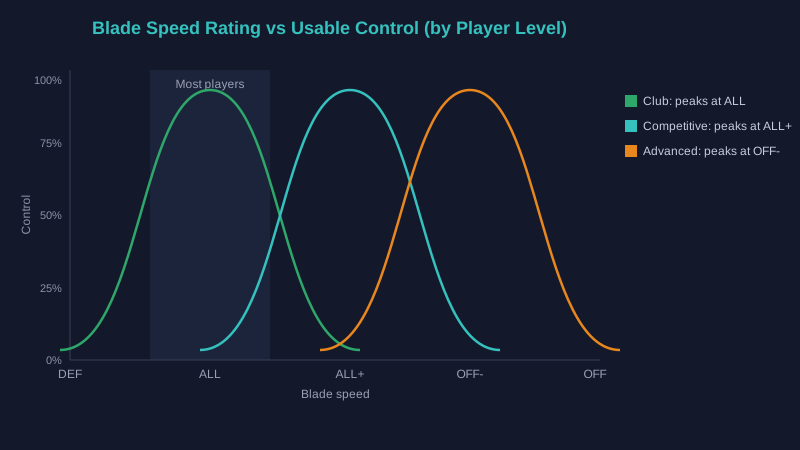
Blade speed and control follow a curve, not a straight line. Too slow loses predictability. Too fast narrows your timing windows faster than technique can compensate. The relationship between blade speed and control follows a curve, not a straight line. Below a certain speed threshold, blades lose control because the ball doesn’t respond predictably. Above a certain speed threshold, control degrades because the timing windows narrow faster than technique can compensate.
The optimal range for most club players sits at ALL to ALL+ on the speed scale. The optimal range for competitive club players (regular tournament participation, solid technical foundation) sits at ALL+ to OFF-. Only players with genuinely fast, consistent technique and regular match play at a high level typically benefit from OFF-rated blades.
How Should You Choose a Blade Based on Your Playing Style?
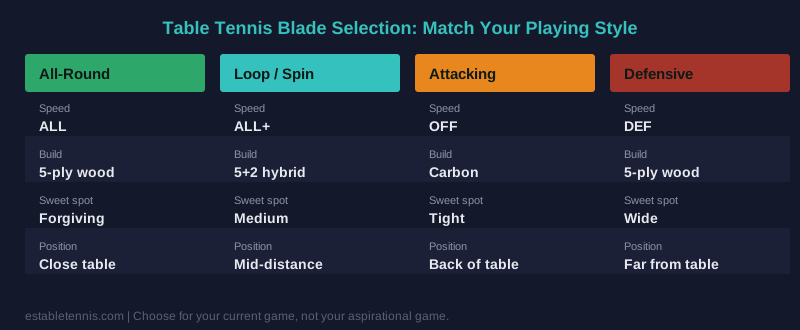
Rather than recommending specific products (which change with availability, price, and manufacturing batches), the more useful framework is matching blade characteristics to playing style. Use this as your filter before reading reviews.
All-Round / Control Players
You play close to the table, mix push, block, and loop, and rely on placement over pace. You need a table tennis blade with: low-to-mid speed rating (ALL), flexible construction (5-ply wood), forgiving sweet spot. A stiff blade will punish the short game. A fast blade will send your blocks off the end.
Loop-Dominant / Topspin Players
You play mid-distance, generate high spin through looping technique, and finish points with topspin-to-topspin exchanges. You need: mid speed (ALL+), medium stiffness (5-ply or 5+2 wood-carbon hybrid with softer carbon layer), medium sweet spot. You want enough dwell for spin, enough rigidity for pace transfer.
Attacking / Power Players
You play at distance, drive and smash at high pace, and prioritise speed over spin. You need: high speed (OFF to OFF+), stiff construction (carbon), sharp sweet spot. The blade is the engine. You’ve accepted the trade-off.
Defensive / Chopper Players
You play far from the table, chop and lob, and win by controlling pace and variation. You need: low speed, maximum flexibility (5-ply wood, specifically defensive blades with wider dimensions), forgiving sweet spot. Speed is your enemy. You want maximum feedback and minimum unintended acceleration.
How Much Should You Spend on a Table Tennis Blade?
Below about sixty dollars, price tracks quality. Between sixty and one hundred twenty dollars covers solid performance from reputable manufacturers. Above that, you’re mostly paying for reputation and cosmetics. The table tennis blade market has a significant diminishing returns problem above a certain price point. Below around $60 USD, price generally correlates with quality: cheaper blades have worse wood quality, less consistent construction, and less reliable feedback. Between $60 and $120, you get solid performance across reputable manufacturers. Above $120, you’re largely paying for reputation, marginal material improvements, and cosmetics.
The blades that professional players use are optimised for professionals, meaning they’re fast, stiff, and unforgiving. Buying a professional-grade blade as a club player is like buying a Formula 1 tyre for your road car. The marginal gains at the top end require a level of consistency to extract that most players never reach.
For club players, the $60-$100 range from established manufacturers (Butterfly, Tibhar, Donic, Nittaku, DHS) produces blades that no player in that category will outgrow technically. The argument for spending more than that is almost never a performance argument.
How Does Blade Choice Affect Your Mental Game?
A mismatched blade adds psychological unpredictability. Part of your attention ends up monitoring the tool instead of the game, exactly the attention you need at 9-9 in the fifth. There’s a dimension of blade selection that equipment guides typically ignore, and it’s the one this site exists to address.
The wrong table tennis blade for your playing style introduces unpredictability. Not just technical unpredictability, meaning shots going places you didn’t intend, but psychological unpredictability. When you don’t fully trust your equipment, part of your attention is monitoring the tool rather than the game. That fraction of attention is exactly what you need at 9-9 in the fifth game.
A blade that matches your technique removes that variable. You stop thinking about it. The equipment becomes the automatic part of the system, and your attention goes where it belongs: to the ball, the opponent, and the point.
This is why I built PingPath. The decision tree most players follow when choosing equipment (read reviews, buy the most expensive thing that fits the budget, hope for the best) consistently produces mismatches. PingPath works through your playing style, experience level, and technical tendencies and produces a specific recommendation that accounts for all the variables above. Try the PingPath blade advisor before your next purchase.
What Are the Most Common Table Tennis Blade Mistakes?
Most of the frustration players experience with blade selection comes down to the same three mistakes, and none of them are about picking the wrong manufacturer.
Buying Based on a Professional’s Setup
Ma Long’s table tennis blade is a fast, stiff carbon construction optimised for a player who trains six hours a day and has spent twenty years perfecting his timing. Using that blade as a club player is the equivalent of wearing a sprinter’s spikes to a morning jog. The tool is designed for a movement pattern you don’t yet produce. The only thing it guarantees is that your errors become more expensive.
Switching Blades After One Bad Session
A table tennis blade takes time to calibrate to. Your body learns the timing of a specific combination through repetition, and changing that combination mid-development resets that learning. Give any new blade a minimum of three to four weeks of regular play before drawing conclusions. One bad tournament tells you nothing about the blade. It tells you about the tournament.
Treating the Blade as the Primary Variable
Most technique problems are rubber problems, most rubber problems are sponge hardness problems, and most sponge hardness problems are disguised as blade problems. Before changing your table tennis blade, change your rubber. The blade is the last variable to adjust in the equipment chain, not the first.
Does Your Table Tennis Blade Need ITTF Approval?
Yes if you compete in sanctioned events, but almost every blade from a recognized manufacturer is automatically compliant, since ITTF blade rules mainly govern wood composition, not construction type. If you play in any sanctioned competition, your blade must be ITTF approved. Practically speaking, almost every blade from a recognised manufacturer is automatically compliant with ITTF regulations because those regulations cover materials (no unusual chemical additives, no boosting of the wood core) rather than specific construction types.
The ITTF approval requirement applies to rubber, not blade, in most competition contexts. The blade rules concern the core composition (at least 85% natural wood by thickness) and the handle construction. If you’re buying from a legitimate manufacturer rather than an unknown brand, compliance is the default, not something you need to verify per purchase.
I covered the rubber approval question in more depth in the post on the ITTF approved rubber list for beginners, and the blade and rubber combination question connects directly to the thickness discussion in table tennis rubber thickness explained. Those two posts and this one form a complete equipment selection foundation. If you haven’t read them alongside this, the picture isn’t complete.
What’s the One Question That Cuts Through Blade Selection?
The single filter that matters: does this blade make your current technique feel more consistent, or does it make your errors feel worse? After everything above, if you want a single question that filters blade choices better than any specification: does this blade make my current technique feel more consistent, or does it make errors feel worse?
A blade that amplifies your errors is not a blade that will help you improve. It’s a blade that will frustrate you into blaming your technique for problems that belong to the equipment. A blade that makes your technique feel more consistent, meaning more of your intended shots arrive where you aimed them, is a blade that builds confidence and rewards practice.
The Montevideo coach’s thirty-second feel test is ultimately asking the same question without the words. You don’t need to speak. The hands already know.
If you want the structured version of that question answered for your specific game, the PingPath advisor walks through it systematically. For the grip fundamentals that determine which blade handle will work best for you, the post on how to grip a ping pong paddle correctly is the right starting point.
Frequently Asked Questions
What’s the difference between a table tennis blade and a paddle?
A blade is the wooden or wood-carbon platform alone, before rubber is glued on. A paddle, or racket, is the complete assembly: blade plus rubber on both sides.
Should a beginner use a carbon or wood blade?
Wood. Carbon blades sharpen the sweet spot and reward technique that’s already consistent, while a forgiving wood blade tolerates the timing errors a beginner is still working through.
How do I know if my blade is too fast for me?
If you’re shooting long on drives and loops even when your timing feels correct, your blade is likely faster or stiffer than your current technique can control.
How often should I replace a table tennis blade?
Rarely. Unlike rubber, a blade doesn’t wear out with play. Most players keep the same blade for years and only change it when their playing style genuinely shifts.
Does a more expensive blade make me a better player?
No. Above roughly one hundred twenty dollars, you are mostly paying for reputation and cosmetics rather than a performance gain, and a sixty-to-one-hundred-dollar blade from an established manufacturer will not be outgrown technically by a club player.
Leave a Reply