
There’s a player I coached a few years back, a quiet kid from Chaguanas who had been playing with the same rubber his uncle gave him, a no-name sheet so old the sponge had compressed to something resembling a kitchen sponge. He was losing matches he had no business losing. His technique was fine. His footwork was improving. The rubber was doing nothing he asked it to do.
When I told him the rubber wasn’t on the ITTF-approved list, he stared at me as if I had just explained gravity. “What list?” he said. Most beginners don’t know the list exists. More than that, most beginners don’t know why it matters, which is a separate problem.
The ITTF-approved rubber list for beginners isn’t just about playing in official tournaments, though that’s part of it. It’s a shortcut to sanity. It filters out the hundreds of rubbers that look legitimate, cost real money, and perform nowhere near what a developing player needs. Buying off the list by accident is one of the most common ways new players spend six months blaming their forehand when the problem is the sheet on their paddle.
What Is the ITTF Approved Rubber List?
The ITTF approved rubber list is a published database of rubbers that meet the federation’s technical specs for thickness, backing, and surface consistency, currently containing over 1,000 approved sheets. The International Table Tennis Federation maintains a published list of rubbers that meet its technical specifications. Every rubber on the list has been tested and approved for use in sanctioned competition. The list gets updated regularly, and as of 2024, it contains over 1,000 approved rubbers from manufacturers across the world.
What the list doesn’t tell you is which rubbers are good for beginners. That’s a different question, and it’s the one worth answering here. The approval process checks whether a rubber meets thickness limits, backing requirements, and surface consistency standards. It doesn’t evaluate playability for a player who’s still building a forehand loop.
For a beginner, the list matters for two reasons. First, if you ever want to play in a registered club or sanctioned tournament, your rubber must be on it. Second, every rubber that serious players, coaches, and reviewers discuss is on it, which means the list is a filtering layer that cuts out the garbage before you’ve spent money on it.
You can find the current ITTF-approved rubber list at the ITTF equipment page. It’s searchable by brand and model. Before you buy any rubber you found on a random Amazon listing or in a sports shop that mostly sells footballs, check it first.
Why Do Beginners Get Rubber Choice Wrong More Than Anyone Else?
Beginners get this wrong because they don’t yet have the feel to know when rubber is working against them, so they blame their technique for a problem that belongs to the equipment. The rubber market is enormous, and the marketing language around table tennis rubber is designed to confuse. Words like “professional grade,” “tournament ready,” and “high performance” appear on rubbers that would embarrass a serious player. None of those phrases appears on the ITTF’s certification. The certification says approved or not approved. Nothing more.
Beginners are especially vulnerable because they don’t yet have the feel to know when the rubber is working against them. A player who has spent three years developing a topspin loop knows within ten minutes when rubber is killing their spin. A player with three months of experience has no reference point. They assume the rubber is fine and that they’re the problem. That assumption costs them a lot of training hours.
There’s also a price trap. Very cheap rubber, the kind sold attached to complete beginners’ paddles for under twenty dollars, is often not on the approved list. It’s mass-produced, inconsistent, and functionally useless for skill development. But it’s also not obviously wrong to someone who doesn’t know what right feels like. The rubber spins, mostly. It controls, somewhat. It’s doing nothing you’ll ever need to unlearn, because you’re not actually learning anything from it.
This connects directly to the mental side of the game, which matters more than people expect at the beginner level. When your equipment is genuinely giving you unpredictable results, your brain starts compensating in ways it shouldn’t. You develop micro-adjustments, flinches, grip-tightening habits, all the things that tell your nervous system the table is hostile territory. We covered this in detail in the post on table tennis rubber thickness, where the same principle applies: bad equipment creates bad habits before you even know you have them.
What Are 7 ITTF-Approved Rubbers Worth Buying as a Beginner?
These aren’t the best rubbers in the world. They’re the right rubbers for someone building a game. Each one is ITTF approved, widely available, and genuinely suited to the mechanics a beginner is developing.

1. Butterfly Sriver
The Sriver has been on the approved list since before most people reading this were born. It’s not flashy, and it doesn’t pretend to be. What it does is give you honest feedback on every shot. When you mishit, you know it. When you connect properly, you feel the difference. For a beginner, that feedback loop is more important than any amount of extra speed.
Sriver is a medium-hard rubber with predictable spin and enough pace to develop loop strokes without the ball flying off uncontrollably. Butterfly has kept it in production for decades because it works. That’s the only endorsement worth trusting.
2. Yasaka Mark V
The Mark V occupies the same hall as the Sriver. Old, proven, consistent. Slightly softer in feel, which some beginners prefer because it gives a bit more forgiveness on off-center hits. The spin it generates is enough to start learning topspin rallies, which is the skill that separates beginners who improve from beginners who plateau.
You’ll see it on more club players’ paddles than any marketing campaign could account for. That’s not nostalgia. It’s people who know rubber refusing to switch away from something that still works.
3. DHS Hurricane 3 (2.0mm)
This one requires a caveat: at maximum thickness, Hurricane 3 is a high-performance rubber that demands a developed stroke. At 2.0mm, it’s a different animal. The slightly reduced sponge brings the speed down to a level a beginner can manage, and the Chinese tacky topsheet teaches you to brush the ball properly because there’s no forgiveness for sloppy contact.
If you’re the kind of beginner who learns by being punished for mistakes rather than being cushioned from them, Hurricane 3 at 2.0mm accelerates development faster than most other options. Just don’t go thicker until you’re ready, and check the ball type you’re training with, as tacky rubber responds differently to 40+ plastic balls than it did to celluloid.
4. Xiom Vega Europe
Vega Europe is a tensor rubber, meaning the sponge is slightly pre-tensioned for more speed and spin than its hardness rating would suggest. For a beginner, that sounds counterintuitive, but the spring effect actually helps players whose strokes aren’t yet generating their own spin. It rewards partial effort more than non-tensor rubbers do.
The trade-off is slightly less directional feedback. The ball goes where you aimed more consistently, but you feel the contact slightly less. Whether that’s a problem depends entirely on how you learn. Players who need to feel the ball tend to prefer Sriver or Mark V. Players who respond better to early success tend to develop faster on Vega Europe.
5. Stiga Calibra LT
Calibra LT is probably the most forgiving rubber on this list. It’s explicitly designed for players transitioning from recreational to club play, and STIGA built in a lot of off-center hit compensation. If you’re coming from a cheap complete paddle and the unpredictability has been affecting your confidence, this is the rubber that resets your expectations about what the game is supposed to feel like.
It won’t take you to the elite level. It’s not designed to. But it gives a beginner enough control to actually start understanding what they’re trying to build, which matters more than most equipment choices at this stage.
6. Donic Acuda S2
Acuda S2 sits at medium-hard and gives strong spin production for a beginner-friendly rubber. It’s notably good for players who’ve started working on serve development, because the topsheet grips well enough to start learning underspin and sidespin serves that will eventually become weapons. Serves are where beginners start converting the physical skill into match-winning decisions, and good rubber helps that connection happen earlier.
The Donic catalogue has grown substantially, but Acuda S2 remains one of the cleaner choices at the beginner-to-intermediate boundary.
7. Tibhar Evolution MX-S
MX-S is a slightly more advanced pick that works well for beginners who are progressing quickly and want rubber that won’t cap their development within a year. It’s ITTF-approved, widely available, and sits in a middle zone between beginner and club rubber that allows a longer growth runway before needing to switch.
The spin ceiling is higher than the first six options on this list. If you’re already in a club environment and training three or more times a week, MX-S gives you room to develop without immediately hitting the limits of what the rubber can do.
How Do You Read the ITTF List Without Going Crazy?
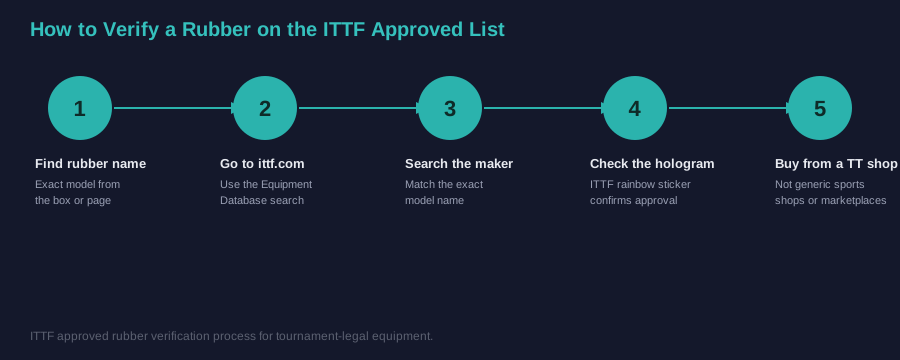
The list is a compliance document, not a buying guide. Identify rubbers from reviews or coach recommendations first, then verify the exact model and color appear on the list before buying. The list itself is a PDF or searchable database, depending on which ITTF page you land on. It lists rubbers by manufacturer and model name, and that’s mostly all it gives you. No performance ratings, no hardness scores, no guidance on whether a rubber suits a forehand or a backhand. It’s a compliance document, not a buying guide.
The practical approach is to identify rubbers you’re considering from reviews, coach recommendations, or community discussions, then verify they appear on the approved list before purchasing. Don’t start from the list and try to pick a rubber from it. That’s like trying to find a restaurant by reading a health inspection database.
What you’re looking for when cross-referencing: exact model name (not a variant or a re-badged version), the color you’re buying (red and black are sometimes listed separately for tacky rubbers), and the manufacturer name as ITTF spells it, which occasionally differs from how the brand markets itself in Western markets.
One thing that catches beginners: rubbers sold as part of complete paddles, meaning the paddle came pre-assembled, are often not individually listed on the ITTF-approved rubber list. The complete paddle itself may be approved as a unit under a different section of ITTF equipment rules, or it may not be approved at all. If you buy a pre-assembled paddle for under thirty dollars from a general sports retailer, assume it’s recreational equipment only and treat it accordingly.
Why Does Getting Rubber Right Early Matter for Your Mental Game?
Unpredictable rubber teaches your brain that connection quality doesn’t reliably produce consistent results, a belief that’s hard to unlearn even after you upgrade to better equipment. Most coaches who teach beginners focus almost entirely on technique. Grip, stance, stroke mechanics, and footwork. The equipment conversation gets treated as secondary, something to worry about once the player has built a foundation. I’ve watched that approach create problems for years.
When your rubber is working against you at the beginner stage, two things happen. The first is obvious: your shots don’t behave predictably. The second is less obvious but more damaging. Your brain starts forming its internal model of the game around unpredictable outcomes. It learns that connection quality doesn’t reliably produce consistent results. That’s an extremely difficult belief to unlearn later, because by the time you have good rubber and better technique, the nervous system has already decided the game is random.
Sports psychology research on skill acquisition shows clearly that consistent feedback during the early learning phase is critical to forming accurate motor patterns. When the feedback loop is corrupted by equipment, the learning is corrupted too. You’re not just wasting time with bad rubber. You’re building a brain that expects the game to be unreliable.
This is the same principle behind everything in mental performance training. The body and mind don’t separate practice from match conditions as neatly as coaches wish they did. They learn patterns, including patterns of unpredictability. Getting ITTF-approved rubber that’s actually designed for your level isn’t a luxury decision. It’s a foundational one.
How Do You Pick Between Forehand and Backhand Rubber?
Put a softer, more feel-oriented rubber like Sriver or Mark V on the backhand, and a slightly faster one like Vega Europe or Acuda S2 on the forehand. Beginners often buy two sheets of the same rubber, which is fine. As you develop, your forehand and backhand will start requiring different things. The forehand generates more power and benefits from slightly harder rubber that can handle the speed without losing control. The backhand generally benefits from slightly softer rubber that gives more feel for the shorter, more compact strokes typical of backhand play.
For the rubbers on this list, the practical split that works for most beginners is to put Sriver or Mark V on the backhand side for feel and control, and Vega Europe or Acuda S2 on the forehand side for slightly higher speed potential. None of these combinations will produce a dramatic performance gap. At the beginner level, the gap between your best and worst rubber combination is entirely within your technique, not your equipment.
The point isn’t to optimize the paddle. The point is to remove the variable of equipment from the equation so that your development is genuinely yours. When you improve, you know it’s you. When you make an error, you know it was your contact quality, not the rubber having a bad day. That clarity, the ability to attribute outcomes to your own decisions, is where mental resilience in table tennis starts to build.
What Rubber Thickness Should Beginners Use?
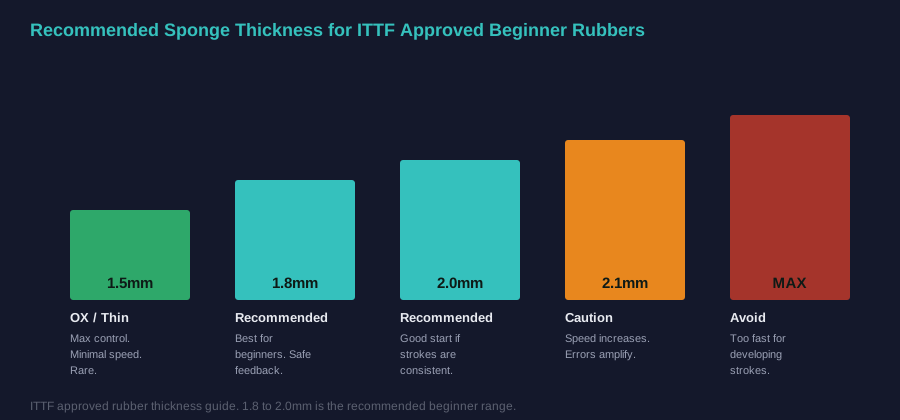
Beginners should stay between 1.8mm and 2.0mm sponge thickness, since thicker rubber amplifies every mistake before you are ready for it. Every rubber on the ITTF-approved list is available in multiple thickness options. For beginners, the general rule is to stay between 1.8mm and 2.0mm sponge thickness. We covered the full reasoning in the post on table tennis rubber thickness, but the short version is this: Thicker rubber is faster and harder to control. A 2.1mm or MAX rubber amplifies every mistake. A 1.8mm rubber gives you more time to correct contact quality before the ball leaves the table.
As your strokes become more consistent and you’re generating your own speed through technique rather than relying on rubber rebound, you move up in thickness. That transition happens naturally once your game develops. Don’t try to skip it.
Where Should You Buy ITTF-Approved Rubber Without Getting Fakes?
Buy from established table tennis retailers rather than general marketplaces, and check for the rainbow ITTF-approved hologram sticker on the packaging. Counterfeit rubber is a real problem in the market, particularly for popular models like DHS Hurricane 3, Butterfly Tenergy, and Victas rubbers. The counterfeits are sometimes close enough in feel to fool beginners, but lack the ITTF approval hologram that appears on legitimate rubber packaging.
Buy from established table tennis retailers rather than general marketplace sellers. In the Caribbean and wider international market, reputable online retailers include Megaspin, Tabletennis11, and the official brand websites. Check the packaging for the ITTF-approved hologram sticker, which is a rainbow-colored circular sticker that ships with every approved rubber sheet.
If a deal looks significantly cheaper than market rate for a premium rubber, it’s almost certainly counterfeit or expired stock. Neither option helps you develop. The price difference between legitimate and counterfeit rubber at the beginner level is often under fifteen dollars. Paying it is worth it every time.
When Should You Upgrade Beyond This List?
Upgrade once your strokes are consistent enough that you can feel the ceiling of your current rubber, not because you see club players using faster rubber. The rubbers on this list are appropriate for roughly the first one to two years of serious play. You’re ready to consider upgrading when your strokes have become consistent enough that you can feel the ceiling of what your current rubber allows. That feeling is specific: you’re generating more spin or speed than the rubber can cleanly transfer, and the ball is behaving slightly underneath your intention rather than with it.
Most beginners upgrade too early because they see club players using faster rubber and assume the rubber is what’s producing the results. It isn’t. The results are producing the rubber choice. Develop the foundation, then make the rubber match your game rather than trying to borrow someone else’s game through their equipment.
When you do upgrade, start from the ITTF-approved list again and cross-reference with reviews specific to your playing style and stroke development. The list doesn’t change. Your requirements do, and that’s what should drive the decision.
What’s the Rubber Conversation Nobody Has With Beginners?
A beginner in a club environment is surrounded by players who’ve found their rubber and stopped thinking about it. They’ll recommend what they use, which is almost never appropriate for someone who’s six months into the game. A Tenergy 05 recommendation to a beginner isn’t bad advice given maliciously. It’s someone sharing what works for them, without knowing that what works for a developed player actively harms a developing one.
Ask your coach. If you don’t have a coach, find a club player whose game is two to three years ahead of yours and ask what they used when they were at your level. That question gets better answers than asking what they use now.
The player from Chaguanas eventually got onto an approved rubber, a Mark V at 1.8mm, and within three months, he was winning matches he’d been losing for a year. His technique hadn’t changed significantly. His brain had stopped compensating for a rubber that was lying to him about his contact quality. That’s the whole argument for getting this right from the start.
If you’re not sure whether your current paddle meets the standard, run it against the ITTF list. And if you want to shortcut the equipment decisions entirely and get a recommendation matched to your actual playing style, PingPath does exactly that. Answer a few questions about your game, and you’ll get a specific rubber and blade recommendation rather than a list of options to research.
What Should You Look for When Checking the ITTF List?
Use the list as a filter, not a starting point. Check the exact model name of any rubber you are considering before spending money on it. The ITTF-approved rubber list has one job: confirming whether a specific rubber is cleared for sanctioned play. Use it as a filter, not a starting point. Check any rubber you’re seriously considering before you spend money on it, and check it by the exact model name you see on the product listing.
Every rubber recommended in this post is on the ITTF-approved rubber list. None of them are corner cases or provisional approvals. They’re permanent fixtures because they work and they meet every technical requirement the ITTF sets. An ITTF-approved rubber isn’t automatically the right rubber for you, but it’s the minimum standard worth paying attention to, and starting there filters out enough of the noise that the remaining choices are all legitimate ones.
The fastest path to the right choice is to use PingPath, the free equipment recommendation tool at pingpath.establetennis.com. It runs your playing style, experience level, and budget against the ITTF-approved rubber database and comes back with a specific recommendation rather than a list to research. It takes four minutes and removes most of the guesswork entirely.
Frequently Asked Questions
How do I know if my rubber is ITTF approved?
Check the exact model name and color against the official ITTF equipment list, and look for the rainbow-colored ITTF-approved hologram sticker on the packaging.
Do I need ITTF-approved rubber if I’m not playing in tournaments?
Not legally, but it’s still worth it. Rubbers off the approved list are usually inconsistent mass-produced sheets that teach your hands the wrong lessons before you can feel the difference.
What’s the best rubber thickness for a beginner?
1.8mm to 2.0mm. Thicker sponge amplifies mistakes faster than a beginner’s technique can correct for them.
Is the rubber that comes on a cheap pre-made paddle usually ITTF approved?
Often not. Rubber sold pre-assembled on paddles under thirty dollars from general retailers is usually recreational-grade and not individually listed on the approved database.
When should a beginner upgrade their rubber?
When your strokes are consistent enough that you can feel your current rubber’s ceiling, meaning you are generating more spin or speed than it can cleanly transfer, not just because other players use faster rubber.
What Should You Look for When Checking the ITTF List?
Use the list as a filter, not a starting point. Check the exact model name of any rubber you are considering before spending money on it. The ITTF-approved rubber list has one job: confirming whether a specific rubber is cleared for sanctioned play.
Every rubber recommended in this post is on the ITTF-approved rubber list. None of them are corner cases or provisional approvals. They are permanent fixtures because they work and they meet every technical requirement the ITTF sets. An ITTF-approved rubber is not automatically the right rubber for you, but it is the minimum standard worth paying attention to, and starting there filters out enough of the noise that the remaining choices are all legitimate ones.
The fastest path to the right choice is to use PingPath, the free equipment recommendation tool. It runs your playing style, experience level, and budget against the ITTF-approved rubber database and comes back with a specific recommendation rather than a list to research. It takes four minutes and removes most of the guesswork entirely.
Leave a Reply