A player in Point Fortin spent a full season getting quietly demolished by an opponent whose backhand did nothing. No spin, no pace, the ball just landed on the table like it had given up halfway across the net. He kept attacking it the way he attacked everything else, and kept watching it sail long or dive into the net, and kept assuming his opponent was simply better. What he was actually facing was the oldest equipment divide in the sport: inverted rubber vs pimples out.
She wasn’t. Her backhand was pimples-out rubber, and it was returning exactly the spin he put on the ball, back at him, and he had never once adjusted for it.
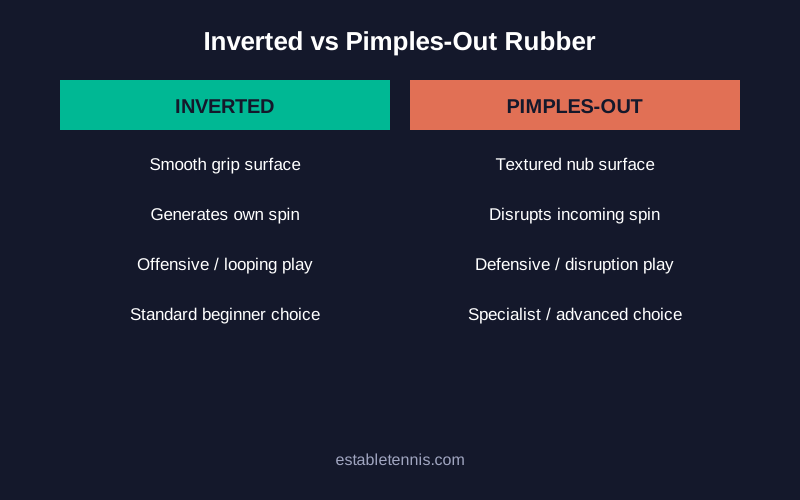
Inverted rubber has a smooth topsheet that grips the ball, letting you generate your own spin through friction. Pimples-out rubber has small nubs facing outward that reduce grip, which disrupts incoming spin and returns it altered rather than absorbed, making shots against it unpredictable if you’re not trained for it.
Most beginners never think about this choice because most beginners are handed a premade racket with inverted rubber on both sides and never question it. That’s usually correct. But understanding why pimples-out exists, and why it wrecks so many intermediate players the first time they face it, changes how you read a match entirely.
What is inverted rubber?
Inverted rubber is the smooth-surfaced sheet most players picture when they think of a table tennis racket: the pimples are molded on the underside, against the sponge, with a flat, tacky surface facing outward. That smooth surface grips the ball on contact, letting the player impart spin through the friction of their own stroke. It’s the standard for offensive, spin-based play and covers the vast majority of rackets sold, including nearly every beginner setup.
What is pimples-out rubber?
Pimples-out rubber flips the structure: the small nubs face outward, toward the ball, with the smooth side bonded to the sponge. Because the ball contacts individual pimples rather than a flat tacky surface, the rubber grips less and behaves less predictably under spin. Short pimples produce a flatter, faster return with reduced spin sensitivity.
Long pimples go further, actively reversing or scrambling incoming spin, which is what made the player in Point Fortin’s story so frustrating to play against.
Why does pimples-out rubber feel so unpredictable to play against?
Because your brain has learned to read spin through years of playing against inverted rubber, where the relationship between an opponent’s swing and the resulting ball flight is consistent. Pimples-out breaks that pattern.
A shot that looks like heavy topspin off an opponent’s pimples paddle might come back with almost no spin at all, or with the rotation partially reversed, because the pimples didn’t grip the ball the way an inverted sheet would have. The disorientation isn’t a skill gap: it’s a pattern-recognition failure, and it resolves quickly once you stop reading the opponent’s swing and start reading the actual ball flight in front of you.
Who should actually use pimples-out rubber?
Defensive and disruption-style players, primarily. Pimples-out rewards players who want to neutralize an opponent’s spin rather than generate their own: blockers, choppers, and players building a game around forcing errors rather than hitting winners.
It is not a beginner-friendly choice for someone still learning to generate their own spin, because it actively works against developing that skill. If you’re still in the early stages of learning to loop and drive, stay on inverted rubber; see our guide on choosing rubber for beginners for the specific starting specs.
How do short pips and long pips differ?
Short pips are closer in feel to inverted rubber: faster, flatter, less spin-reversal, more forgiving for an all-round attacking player who wants a change of pace on one side. Long pips go the opposite direction entirely: slower, wobblier, and capable of genuinely reversing incoming spin on certain shots, which is what creates the disorienting effect defensive specialists rely on. Long pips demand a completely different technical approach and are rarely recommended for a player’s first non-inverted rubber.
None of this is abstract theory disconnected from the store shelf, either: the practical decision most players actually face isn’t “inverted or pimples,” it’s whether to keep both an inverted forehand and experiment with a pimples backhand as a secondary weapon, which is a much lower-commitment way to explore the disruption style without rebuilding an entire game around it.
Can you mix inverted and pimples-out on the same racket?
Yes, and it’s common at intermediate and advanced levels: an inverted forehand paired with a pimples-out or long-pips backhand is a classic disruption setup. The forehand generates spin and pace normally, while the backhand scrambles whatever the opponent sends at it. This asymmetric approach requires deliberate practice on both sides separately, since the two rubbers behave by entirely different rules.
How do you know if pimples-out rubber is right for your game?
The honest signal is whether your instinct in a rally is to attack or to neutralize. Players who feel most comfortable extending points, absorbing pace, and waiting for an opponent’s error tend to take naturally to pimples-out play. Players who feel most comfortable initiating and finishing points with their own spin almost always regress when they try to force a pimples-out game onto themselves: the equipment fights the instinct instead of supporting it, which is the same mental-equipment mismatch covered in our piece on premade vs custom rackets.
None of this happens through willpower alone: the recalibration is a genuine perceptual skill, and it takes real match minutes against real pimples opponents before it becomes anything close to automatic. Treat the first handful of matches against any new pimples opponent as data collection, not a test you’re expected to pass on the first try.
What’s the practical way to practice against pimples-out rubber?
Stop watching the opponent’s racket angle and start watching the ball’s actual bounce and flight path off their paddle. The spin information you’d normally read from an inverted-rubber swing simply doesn’t apply. Slow the rally down deliberately for the first several points against any pimples player, treat every return as unknown until you’ve seen a few examples, and resist the urge to attack early until you’ve recalibrated.
How does anti-spin rubber differ from regular pimples-out?
Anti-spin rubber is a specialized variant of pimples-out construction with an unusually slick, low-friction topsheet designed to minimize grip almost entirely, regardless of how much spin an opponent puts on the ball.
Where standard pimples-out still allows some spin transfer through the structure of the pimples themselves, anti-spin is built to neutralize incoming spin as completely as the rules allow, producing a return that comes back with almost no rotation at all. It’s a niche, highly specialized tool used by a small number of defensive specialists and is generally not recommended as a first non-inverted rubber, since its extreme unpredictability makes it difficult to build reliable technique around even for experienced pimples players.
What’s the historical reason pimples-out rubber even exists?
Pimples-out predates modern inverted rubber technology: early table tennis rackets used pimpled rubber almost universally, since the smooth, high-grip inverted sheets that dominate the sport today weren’t developed and popularized until decades into the sport’s history.
As inverted rubber’s spin-generating potential became clear and offensive, loop-based play took over as the dominant style, pimples-out rubber shifted from being the default to being a specialized counter-strategy, a way for defensive players to disrupt the now-dominant spin game rather than compete with it directly. Understanding this history explains why pimples players are often perceived as playing an “old-school” or unusual style: in a sense, they’re preserving the sport’s original technical approach against a game that evolved around them.
How do you adjust your own shot selection against a pimples-out opponent?
Slow down your own pace and rely less on heavy spin, since pimples rubber is specifically built to neutralize exactly the kind of shot most attacking players default to. Shorter, more controlled shots that don’t depend on the opponent’s return behaving predictably tend to work better than committed, full-power loops, which pimples rubber is most effective at disrupting.
Many coaches recommend deliberately simplifying your shot selection against pimples opponents: fewer variables in your own swing means fewer things that can go wrong when the return comes back scrambled.
Does playing against pimples-out rubber improve your overall game?
Significantly, and this is one of the more underrated benefits of facing a stylistically different opponent regularly. Players who only ever face inverted-rubber opponents develop reads and instincts calibrated to a single, narrow spin pattern, which becomes a liability the first time they face genuine variety in a tournament setting.
Regular exposure to pimples, long-pips, and other disruption styles forces a player to develop the underlying skill (reading the actual ball flight rather than pattern-matching a familiar swing), discussed in our companion guide on how to read spin in table tennis, which transfers directly back into matches against conventional inverted-rubber opponents too.
What’s the mental adjustment required to face a pimples player for the first time?
Patience, more than any specific technical fix. The instinct in the first few points against an unfamiliar pimples style is often frustration: shots that should work suddenly don’t, and the temptation is to hit harder or more aggressively to force a result. That’s exactly the wrong response; it plays directly into the disruption strategy pimples rubber is built around.
The players who handle pimples opponents best are the ones who treat the first several points as pure information-gathering, willing to lose a few points early in exchange for actually learning how the specific rubber in front of them behaves, rather than trying to win immediately with a game plan built for a completely different opponent.
Are pimples setups harder to source and buy than inverted rubber?
Somewhat. Pimples-out and long-pips rubber occupy a much smaller share of the market than inverted rubber, since only a minority of players use them, which means fewer models, fewer stock options at a typical local shop, and often a need to order specifically from a specialist retailer rather than picking one off a general sporting goods shelf.
This scarcity is itself a small signal of how specialized the style is: it’s not something a shop assumes every customer wants, the way they’d assume for a standard inverted sheet.
Can a beginner experiment with pimples rubber just for fun, without committing to a defensive style?
Yes, and it’s a reasonable way to build a feel for how spin actually works before committing to it as a primary style. Many clubs keep a spare pimples racket available specifically for this kind of experimentation, letting players get a firsthand sense of how differently the ball behaves without needing to buy their own setup.
This kind of low-stakes exploration is valuable precisely because it makes the abstract concept of “spin reversal” concrete: reading about it is one thing, feeling your own topspin come back dead and wrong-footed off a pimples paddle is another entirely.
How do coaches typically decide whether to steer a player toward pimples-out rubber?
Rarely through a single conversation: it tends to emerge from watching a player’s natural tendencies over months of play. A player who consistently prefers extending rallies, absorbing pace rather than generating it, and finds satisfaction in forcing opponent errors rather than hitting clean winners is showing early signals that a disruption-based style, potentially including pimples rubber, might suit their temperament better than continuing to force an attacking inverted-rubber game that fights their instincts.
This diagnostic process mirrors the broader equipment-fit principle covered throughout our equipment content: the gear should follow the player’s natural tendencies, not the other way around.
What’s a common misconception beginners have about pimples-out rubber?
That it’s somehow a “lesser” or beginner-avoidance rubber, chosen by players who can’t handle a real attacking game. This is backwards. Pimples and long-pips defense, played well, is among the most technically demanding styles in the sport: it requires exceptional touch, precise racket control, and the tactical patience to construct points over many shots rather than finish them quickly.
The players who dismiss pimples-out as an easier path almost always struggle the most when they actually face a skilled pimples opponent, because the skill required is real, just differently distributed than in an attacking inverted-rubber game.
Does the mental-equipment crossover apply differently to pimples players?
Yes, in an inverted way from attacking players. An attacking player’s confidence typically depends on trusting their own spin generation: the equipment needs to reward committed, aggressive strokes. A pimples player’s confidence depends on trusting the unpredictability their equipment creates for the opponent, which means their relationship with their own gear is less about raw power and more about precision and touch.
Mismatched pimples rubber (too aggressive a pimple length for a player’s actual defensive instincts, or too passive a compound for a player who wants to occasionally counter-attack) creates the same mental fragility covered throughout our equipment content, just through a different mechanism than an inverted-rubber mismatch would.
The rubber itself never changes what it is mid-match: only your read of it does, and that read is a trainable skill like any other.
Most club-level pimples players will tell you the same thing, unprompted: the style found them, they didn’t choose it off a spec sheet. It grew out of how they already liked to construct a point, long before they knew the rubber category had a name.
Quick Recap: Inverted Rubber Vs Pimples Out
Getting inverted rubber vs pimples out right comes down to matching the equipment to where you actually are, not where marketing copy wants you to be. Revisit this whenever your game changes enough that the current setup starts feeling wrong.

Frequently Asked Questions
According to the ITTF equipment regulations, all racket coverings must meet specific approval standards before use in sanctioned competition.
Is pimples-out rubber illegal or banned?
Why does pimples-out rubber feel so hard to return?
Should beginners avoid pimples-out rubber entirely?
Do professional players use pimples-out rubber?
Does pimples-out rubber require different glue or maintenance?
The player in Point Fortin eventually figured it out, not through a lesson, but through fifteen straight minutes of getting embarrassed until he stopped trying to read her swing and started watching the ball. He never beat her that season. But he stopped losing to confusion, which turned out to be most of the battle.
Curious whether an inverted, pimples, or mixed setup actually matches how you play? PingPath maps your style to a specific rubber recommendation in under three minutes.
Leave a Reply