
A player in San Fernando once described facing anti spin rubber for the first time as “hitting a ball into a pillow that was also somehow winning.”
There was no pace coming back, no spin to read, nothing to grab onto: just a soft, dead return that landed exactly where it wanted to and made his own aggressive game feel, for the first time in years, completely irrelevant. That pillow is anti spin rubber table tennis in one sentence.
Anti spin rubber is a specialized inverted-style rubber with an unusually slick, low-friction topsheet that minimizes grip almost entirely.
It neutralizes incoming spin rather than reversing it, producing a dead, unpredictable-feeling return regardless of how much spin the opponent puts on the ball, making it a niche defensive and disruption tool.
Anti spin occupies the quietest, least understood corner of the rubber world: rarely discussed, rarely recommended, and yet capable of neutralizing an attacking player’s entire game plan in a way few other equipment choices can match.
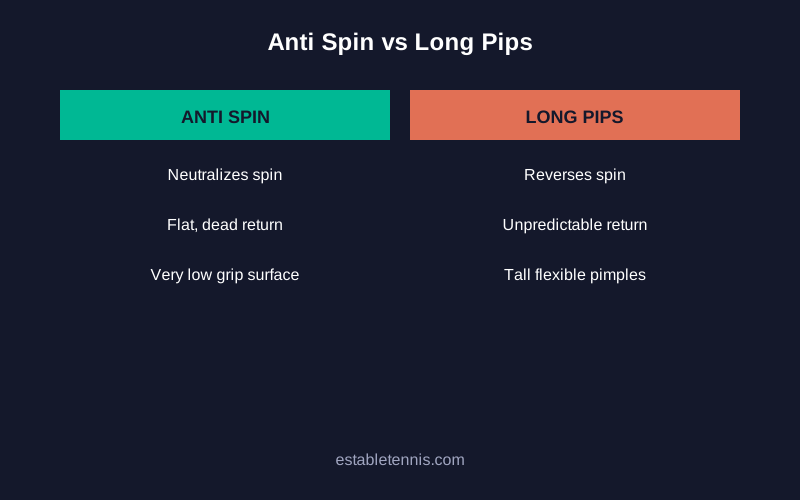
How does anti spin rubber actually work?
Unlike standard inverted rubber, which grips the ball to let a player generate their own spin, anti spin rubber is engineered with an extremely low-friction surface that minimizes grip almost entirely on contact.
This means very little of an opponent’s incoming spin transfers into the return, and very little of the anti spin user’s own swing translates into spin either: the ball simply comes back close to flat, regardless of what went into the shot on either side.
How is anti spin different from long pips?
Both disrupt attacking opponents, but through different mechanisms, a distinction covered from the other side in our companion guide on long pips table tennis.
Long pips actively reverses and scrambles incoming spin through its tall, flexible pimple structure.
Anti spin doesn’t reverse anything: it simply refuses to grip, producing a flat, low-spin return that neither amplifies nor reverses what was sent, which is a subtly different kind of confusing for an opponent trying to read it.
Why is anti spin rubber considered even more niche than long pips?
Because its extreme lack of grip makes it genuinely difficult to build an active, offensive game around, even a disruption-based one.
Long pips gives a skilled user some ability to influence and direct the reversal effect; anti spin’s near-total lack of grip limits the user’s own shot-making options almost as much as it limits the opponent’s.
This is why anti spin tends to appear as a small, tactical component of a broader defensive setup rather than a rubber a player builds their entire game around.
What does facing anti spin rubber actually feel like for an attacking player?
Disorienting in a specific, low-energy way. Rather than the wild, unpredictable reversal long pips produces, anti spin returns tend to feel flat, dead, and strangely unresponsive: the ball comes back with almost no spin information at all, which is its own kind of difficult to read, since players are used to calibrating their response based on spin cues that simply aren’t present in an anti spin return.
Who should actually consider using anti spin rubber?
A narrow slice of defensive specialists, typically players who already have a long pips or short pips setup on one side and are looking for an additional tactical variation, rather than players building their first defensive setup from scratch.
Anti spin is rarely, if ever, a sensible starting point for a beginner or even an intermediate player still developing fundamental shot-making skills, since its lack of grip offers almost nothing to build a developing spin game around.
Does anti spin rubber require a different sponge setup than standard rubber?
Often, yes. Since the disruptive effect depends on minimal grip rather than spin generation, many anti spin setups use thinner sponge or specific sponge densities tuned to keep the overall racket response predictable and controlled, rather than chasing the speed and power a thicker sponge would add.
This mirrors the same specialized approach covered in our guide on inverted rubber vs pimples out, where non-standard rubber types often call for non-standard supporting specs.
How do you actually play against anti spin rubber?
Similarly to facing long pips: slow down, simplify, and don’t rely on generating heavy spin, since anti spin specifically neutralizes exactly that kind of shot.
The key adjustment is recognizing that anti spin removes spin information almost entirely, so a player should focus on placement and pace variation rather than trying to “out-spin” a surface that isn’t going to transmit or reflect much spin either way.
Is anti spin rubber becoming more or less common at the club level?
Less common, if anything, as the broader table tennis meta has shifted increasingly toward fast, offensive looping styles at every level of competition, leaving less room in the average club’s playing population for the patient, highly specialized defensive approach anti spin rewards.
Where it does appear, though, it remains just as disruptive as ever, precisely because so few players get regular practice against it.
How does anti spin rubber affect serve returns specifically?
Serve returns are where anti spin’s neutralizing effect is most noticeable, since serves typically carry the heaviest, most deliberate spin in the sport.
An opponent’s best heavy-spin serve, designed to produce a predictable, spin-loaded return off most rubber types, comes back off anti spin close to flat and often shorter than expected, robbing the server of the advantage that spin was supposed to create in the first place.
Does anti spin rubber wear out or degrade differently than standard rubber?
The ultra-low-friction surface that defines anti spin can actually degrade in the opposite direction from standard rubber: rather than losing grip over time the way inverted rubber does, anti spin can sometimes develop slightly more surface texture through wear, which paradoxically increases grip and reduces the very disruptive effect the rubber was chosen for.
This means anti spin users need to monitor their rubber’s condition for a different reason than most players: not to preserve grip, but to preserve its deliberate lack of grip.
What’s the psychological effect of anti spin on an opponent over a match?
Beyond the immediate shot-by-shot confusion, anti spin tends to have a cumulative frustrating effect across a match, since an attacking player’s usual sources of confidence (clean, decisive winners) become much harder to produce against a surface that refuses to cooperate with pace or spin.
This frustration can compound mentally well beyond what the actual score might suggest, turning a close match into a lopsided one purely through accumulated tilt rather than a genuine skill gap.
Is anti spin rubber ever used on the forehand?
Rarely. The overwhelming majority of anti spin setups place it on the backhand, mirroring the standard long pips configuration, reserving the forehand for an inverted rubber capable of genuine attacking shots when an opportunity arises.
A primarily anti-spin-forehand setup would leave a player with very little offensive capability at all, which is why it almost never appears as the primary attacking side of a racket.
How does a coach identify a player who might benefit from trying anti spin?
Similarly to long pips, coaches typically look for players already showing strong patience, tactical awareness, and a preference for constructing points over many shots rather than finishing them quickly, and, more specifically for anti spin, players who already have some experience with a defensive or disruption-based setup and are looking for an additional tactical wrinkle rather than a first introduction to unconventional rubber.
What’s the manufacturing difference that gives anti spin rubber its low friction?
Anti spin topsheets are engineered with a smoother, harder surface treatment than standard inverted rubber, often combined with a distinct compound formulation that resists the natural tackiness most inverted rubbers are built around.
Where standard inverted rubber manufacturers optimize for maximum grip, anti spin manufacturers are solving the opposite problem: deliberately minimizing surface friction while still keeping the rubber legal and structurally sound under ITTF specifications.
Does anti spin rubber affect a player’s own serve the same way it affects returns?
Yes, and this is a genuine limitation for anti spin users to plan around. Just as anti spin neutralizes an opponent’s incoming spin, it equally limits how much spin the user can generate on their own serves off that side, meaning an anti spin backhand serve will carry far less rotation than the same swing would produce off inverted rubber.
Most anti spin users compensate by relying on their inverted forehand for spin-heavy serves, reserving the anti spin side primarily for its return-disrupting function during rallies rather than serve generation.
How does anti spin interact with a chop or defensive slice shot?
Chops and defensive slices, already built around controlled, low-risk shot-making, pair naturally with anti spin’s neutralizing character: a well-executed chop off anti spin rubber tends to produce an especially flat, difficult-to-attack return, compounding the defensive effect of the stroke itself with the defensive effect of the rubber underneath it.
This combination is part of why anti spin remains a persistent, if niche, choice among dedicated defensive specialists rather than disappearing from the sport entirely.
Is there a risk of over-relying on anti spin’s disruptive effect rather than developing broader defensive skills?
Yes, and coaches who work with anti spin users often flag this directly. A player who leans entirely on the rubber’s inherent disruption, without building genuine footwork, placement, and shot-selection skills underneath it, tends to plateau against opponents who’ve faced anti spin enough times to adjust their approach.
The rubber is a tool that amplifies a sound defensive game: it doesn’t substitute for building one in the first place.
How does anti spin rubber’s reputation affect how opponents prepare for it?
Increasingly, competitive players at higher levels do some advance preparation against anti spin specifically, since its rarity at lower levels means many players have genuinely never faced it before an important match.
A player who has done even minimal preparation (understanding the flat, low-spin nature of the returns before ever facing them live) adjusts considerably faster than a player encountering the rubber cold for the first time under real match pressure.
What’s a realistic expectation for how long it takes to feel comfortable using anti spin rubber?
Longer than most rubber transitions, precisely because the skill being built (constructing an effective game around minimal grip and minimal spin generation) is so different from what most players have spent years developing on standard rubber.
Many anti spin specialists describe a genuine adjustment period measured in months rather than weeks, which is part of why the style tends to attract patient, long-term-minded players rather than those looking for a quick tactical fix.
Quick Recap: Anti Spin Rubber Table Tennis
Anti spin rubber table tennis works by refusing to participate in the spin conversation altogether: no reversal, no amplification, just a flat, quiet neutrality that turns an attacking opponent’s biggest weapon into background noise.
It remains one of the rarest rubber choices in the sport precisely because building an entire game around that neutrality is harder than it looks, and rewarding only for the patient few willing to put in the months it takes.
According to ITTF equipment regulations, anti spin rubber must still meet standard approval requirements for thickness and construction despite its unusual surface treatment, ensuring the disruptive effect stays within regulated boundaries rather than an unchecked race toward ever-lower friction surfaces.
Anti spin rarely gets discussed in equipment forums the way flashy offensive gear does, and that quiet is fitting: it’s a rubber built entirely around refusing to make noise, in every sense of the phrase.
The players who genuinely master it tend to be the ones nobody predicted would, precisely because mastering nothing-happens takes a specific kind of patience that flashier equipment never asks for.
How does an opponent’s confidence specifically unravel against anti spin, shot by shot?
The unraveling tends to follow a recognizable pattern: an early over-hit or two born from misjudging the rubber’s dead response, followed by a hesitant overcorrection that produces weak, tentative shots the anti spin player can easily attack or place at will.
By the middle of a set, an attacking opponent facing anti spin for the first time is often playing a visibly smaller, more cautious game than the one they walked in with, which is exactly the outcome the rubber is designed to produce over the course of a full match rather than a single point.
This pattern is worth naming explicitly for any attacking player reading this before their first match against anti spin: expect the early frustration, expect the temptation to force the issue, and treat both as predictable, manageable stages rather than a sign the match is already lost.
Naming the pattern in advance is often enough to break its grip: a player who expects the early frustration and treats it as data, not disaster, rarely spirals the way an unprepared opponent does.
Pillows don’t usually win matches. This one, somehow, keeps doing exactly that.
Quiet weapons still win rounds. Anti spin has been proving that for longer than most of the players it beats have been alive.
Ask anyone who’s actually played against it. The pillow always wins in the end.
Every single time.
That’s the whole game, really.
No pace, no spin, no mercy. Somehow that’s enough.
A quiet weapon, doing quiet work, one flat return at a time.
End of story.
Simple as that.
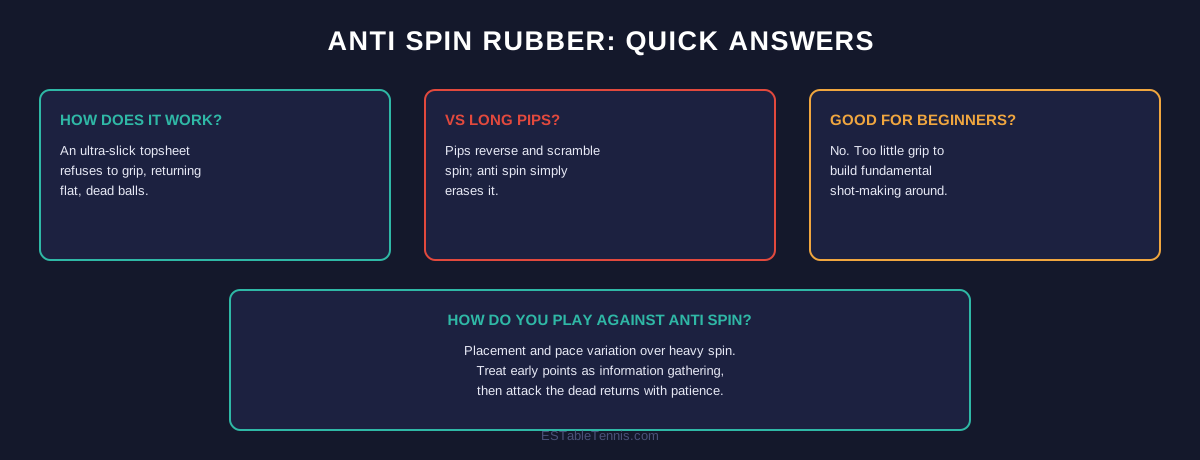
Frequently Asked Questions
Is anti spin rubber good for beginners?
What’s the difference between anti spin and long pips?
Why is anti spin rubber so rare compared to other rubber types?
How do you beat an opponent using anti spin rubber?
Does anti spin rubber degrade the same way standard rubber does?
The player in San Fernando lost that match, and most of the rematches that followed over the next year. He never quite learned to love facing anti spin.
But he stopped being surprised by it, which, against a rubber built entirely around surprise, turned out to be most of the battle.
Curious whether a disruption-focused setup like anti spin or long pips actually fits your game? PingPath gives you a fitted recommendation in under three minutes.
Leave a Reply