
A woman in her forties walked into a club in Port of Spain for the first time, watched two teenagers rally for ninety straight seconds without either one seeming to try particularly hard, and quietly decided the sport wasn’t for her before she’d hit a single ball. Six months later she was one of those same effortless-looking players, and the gap between those two moments was never talent. It was simply nobody explaining, on day one, what actually mattered and what didn’t.
Table tennis for beginners starts with a forgiving racket, a shakehand grip, and patient practice on contact consistency before spin or power matter at all. Most progress in the first few months comes from structured drilling, not match play, and equipment should stay simple until real hours reveal what a player’s actual game needs.
This sport rewards patience more than almost any other racket sport, and punishes the beginners who skip that patience in favor of rushing toward the flashy shots that first drew them to it.
What equipment should a beginner actually start with?
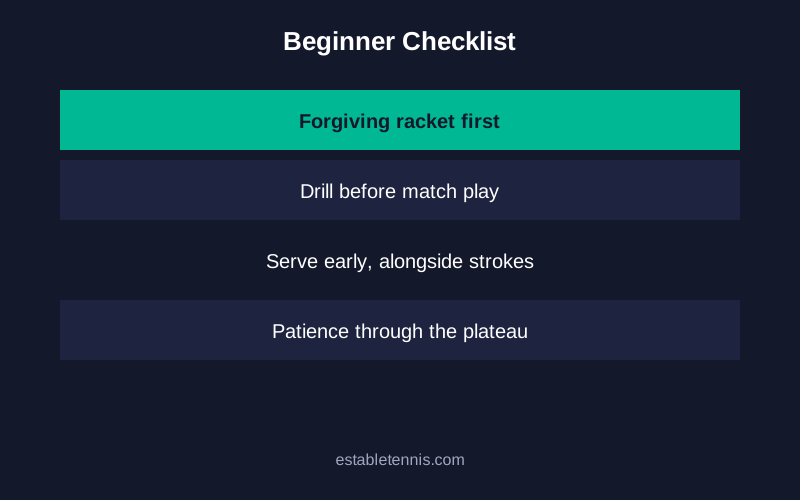
A moderate, forgiving premade racket, covered in depth in our guide on table tennis equipment for beginners, removes an entire layer of decisions a true beginner isn’t equipped to make well. Avoid fast, offensive-rated blades and rubber entirely at this stage: they amplify small technical errors rather than helping build the consistency a beginner actually needs first.
What’s the correct grip and stance to learn first?
Shakehand grip, holding the racket as if shaking hands, is the more common and generally easier grip for beginners to learn compared to penhold. Stance should keep feet shoulder-width apart, knees slightly bent, weight on the balls of the feet. The full fundamentals are covered in our guide on how to play table tennis.
How much should a beginner focus on drilling versus playing matches?
The large majority of early training, particularly in the first two to three months, since structured drilling, covered in our guide on table tennis drills, builds technical consistency far faster than unstructured match play a beginner isn’t yet equipped to handle productively. Most coaches recommend an 80-20 split favoring drills over matches in the earliest stages.
When should a beginner start learning to serve?
Early, actually, alongside basic stroke consistency: serve practice, covered in our guide on how to serve in table tennis, doesn’t require a partner and gives a beginner a genuine competitive tool once matches do begin. One well-mastered serve variation beats five poorly executed ones at this stage.
What’s a realistic timeline for a beginner to feel genuinely competent?
Most dedicated beginners, training two to three times weekly, reach a genuinely enjoyable, competent level within three to six months, covered in more detail in our guide on table tennis training plan for beginners. Players who rush toward advanced shots before basic consistency is solid typically take considerably longer to reach the same milestone.
Why do so many beginners quit within the first few months?
Frustration during the inevitable early plateau, usually somewhere in month two or three, catches most new players off guard, since the initial novelty has worn off but consistent technique still feels effortful rather than automatic. Beginners who understand this plateau is normal, rather than a sign of insufficient talent, are considerably more likely to push through it into genuine competence.
How does mental composure factor into a beginner’s early development?
More than most new players expect. Match nerves, frustration at early mistakes, and the specific pressure of close-range competitive play are universal experiences regardless of skill level, and building basic composure alongside technical skill from the start helps a beginner stick with the sport through its early frustrations rather than quitting prematurely.
What’s the single biggest mistake beginners make?
Rushing toward power and flashy shots before contact consistency is genuinely solid, which builds compensating habits that take longer to unlearn later than the patience would have taken to build correctly from the start. This impatience is completely understandable (drilling feels less immediately rewarding than a big loop or smash), but it’s consistently the biggest predictor of a frustrated, plateaued first year.
How does spin fit into a beginner’s early learning curve?
Spin, covered in our guide on how to spin in table tennis, is the sport’s defining technical element, but it shouldn’t be a beginner’s first priority. Basic contact consistency and footwork need to come first, since spin generation without a stable foundation underneath it tends to produce inconsistent, frustrating results rather than genuine progress.
What role does footwork play for a beginner, beyond just reaching the ball?
Good footwork, covered in our guide on how to improve table tennis footwork, gets a player into a balanced, stable position before swinging, rather than reaching or lunging at the last moment. Nearly every technical stroke flaw a coach diagnoses in a beginner eventually traces back to arriving late or off-balance, not the swing itself being fundamentally broken.
Should a beginner train alone, with a partner, or with a coach?
A combination works best when available: solo practice for serves and shadow footwork, partner practice for consistency rallies, and periodic coaching input to catch technical issues that self-assessment alone tends to miss. A beginner without regular coaching access can still make real progress through disciplined, consistent partner and solo practice.
How does a beginner know when it’s time to move beyond a structured beginner plan?
Once basic contact, footwork, one serve variation, and beginning spin generation all feel reasonably consistent, typically around the four-to-six-month mark for a dedicated player, a beginner has enough foundational skill to start identifying their own specific weaknesses and directing practice accordingly, rather than needing a prescribed, generic plan.
What’s the value of multiball training specifically for beginners?
Multiball, covered in our guide on multiball training, removes the frustration of chasing missed balls during a standard rally, letting a new player accumulate far more successful contacts per session than unstructured rally practice allows. Beginners with access to a patient feeder should prioritize this method heavily in the early months.
How should a beginner think about their first few months of competitive matches?
As learning opportunities rather than results to obsess over. Early matches will feel chaotic compared to structured practice, since opponents introduce unpredictable spin, pace, and placement a beginner isn’t yet fully equipped to handle. Treating early losses as information rather than failure keeps a beginner engaged through the natural early competitive struggles every new player faces.
How does age affect how someone should approach learning table tennis as a beginner?
Younger players often develop faster reflexes and looser, more adaptable technique, while adult beginners frequently progress faster in tactical understanding and patience, bringing more developed strategic thinking to their practice from the start.
Neither age group has an inherent advantage in ultimately becoming a good player: the sport rewards consistent practice at any age, though the specific strengths a beginner brings shape what early development actually looks like.
What’s a sensible way to track progress as a genuine beginner?
Simple, concrete markers (sustaining a rally of a given length, executing a specific serve consistently, holding a controlled backhand exchange) offer more useful tracking than vague impressions of “getting better,” which are hard to evaluate honestly.
Some beginners keep a simple log of milestones reached each month, which both motivates continued effort and provides concrete evidence of progress during stretches where improvement feels invisible day to day.
Does watching professional matches help a genuine beginner, or is it too advanced to be useful yet?
Limited value at first: a total beginner watching professional play mostly sees a blur of fast, powerful shots without understanding the spin, placement, and tactical setup behind each point.
After a few months of basic instruction, though, watching professional matches becomes a considerably richer learning tool, since the underlying patterns and tactics become visible in a way they simply aren’t to a completely untrained eye.
How should a beginner handle the frustration of losing to more experienced players early on?
Expect it, honestly, rather than treating every early loss as evidence of insufficient talent. A beginner losing decisively to established club members is a completely normal, universal experience, not a signal that the sport isn’t a good fit.
Players who frame these early losses as useful information (what patterns beat them, what shots they need to develop) tend to stick with the sport considerably longer than those who read early losses as a verdict on their potential.
What’s the role of a club or community in a beginner’s early development?
Considerable, beyond just providing practice partners. A supportive club environment normalizes the early struggles every beginner goes through, provides exposure to varied playing styles a single training partner wouldn’t offer, and often connects new players with coaching resources they wouldn’t have found training entirely alone.
Finding a genuinely welcoming club early can meaningfully affect whether a beginner sticks with the sport long enough to reach real competence.
How does a beginner’s mindset need to shift once they move beyond the earliest stages?
From simply surviving rallies to actively constructing points, shifting focus from pure contact consistency toward tactical decision-making: where to place a shot, when to attack versus defend. This shift usually happens naturally once basic technical consistency is solid enough that a player has mental bandwidth left over for tactical thinking, rather than needing every bit of focus just to make clean contact.
What’s a common misconception beginners have about what makes someone “good” at this sport?
That raw power and flashy shots define skill, when in reality consistency, placement, and tactical patience separate genuinely good players from those who simply look impressive in short bursts.
Beginners who chase the appearance of skill (big loops, hard smashes) before building the underlying consistency those shots depend on typically develop a shakier, more error-prone game than beginners who patiently build fundamentals first.
How does equipment reassessment fit into a beginner’s ongoing development?
Once a beginner has several months of consistent play behind them, revisiting equipment choice, covered across our equipment guides, becomes genuinely useful: by that point, real playing feedback reveals what a specific player’s developing style actually needs, rather than the guesswork that governs an initial beginner purchase.
Reassessing too early, before enough hours have accumulated to know what’s actually needed, tends to produce another round of guesswork rather than a genuinely informed upgrade.
What’s the honest timeline for a beginner to start feeling like they belong at their club?
Considerably faster than reaching genuine competitive skill, in most welcoming club environments, often within the first few weeks, well before technical competence catches up. Belonging and skill develop on different timelines, and a beginner shouldn’t wait for the second to feel entitled to the first, since most clubs value consistent, enthusiastic participation well before it’s matched by strong results.
According to the ITTF equipment regulations, the same standardized rules govern every level of the sport, meaning the patient fundamentals a beginner builds today translate directly and completely into whatever level they eventually reach, without needing to unlearn anything specific to a lower tier of competition first.
Ninety seconds of effortless-looking rally between two teenagers was never actually effortless. It was the visible tip of hundreds of unglamorous practice hours neither of them thought to mention, because by that point neither of them remembered those hours as anything other than simply how the sport works.
Nobody watching from the doorway ever sees the hundred repetitions behind a single clean shot. They only see the shot itself, which is exactly why so many beginners mistake genuine skill for natural talent rather than the accumulated, unglamorous practice it actually represents.
Give it six months before deciding whether this sport is for you. Almost every player who’s ever fallen in love with it needed at least that long to stop feeling like an outsider watching from the doorway themselves.
Pick up a racket. Start with something forgiving. Show up twice a week for longer than feels reasonable, and let month six arrive on its own schedule rather than trying to force it into week four.
The gap between watching from the doorway and being the player someone else is watching is smaller than it looks, and considerably more crossable than most first-timers assume standing at that same threshold.
Every club has a version of that woman from Port of Spain, someone who almost walked away before ever swinging a racket. Most of them are glad, in hindsight, that patience won out over that first instinct to leave.
Talent was never the deciding factor. Showing up twice a week, for six unglamorous months, always was.
Everyone good at this started out watching from that same skeptical doorway.
Step in anyway. The rally you’re watching now used to be someone else’s impossible standard too.
Simple as that.
Twenty minutes is all it takes to find out for yourself whether this sport is actually for you.
Almost every player who’s ever quit early wishes now they’d given it those twenty minutes anyway.
You have nothing to lose but a little pride, and a fair amount to gain besides.
End of story.
Worth it, every single time.
Now go.
Pick up the racket.
Today, if you can.
Or this week, at the very least.
Quick Recap: Table Tennis for Beginners
Table tennis for beginners rewards patience over ambition: a forgiving racket, structured drilling, and a willingness to feel unimpressive for a few months before consistency finally clicks. The woman in Port of Spain nearly walked away before touching a ball. Six months of patient, unglamorous practice was the only real difference between that moment and the effortless-looking rally she eventually became part of herself.
Frequently Asked Questions
What equipment should a total beginner buy?
How many times a week should a beginner practice?
Should beginners focus on drilling or playing matches first?
When should a beginner learn to serve?
How long until a beginner feels genuinely competent?
She still tells that story to newer members walking in looking exactly as skeptical as she once did, usually right before handing them a racket and asking if they’ve got twenty minutes to just try.
Want a free foundation to build your mental game alongside your technical fundamentals? Download the free ebook on staying calm and winning more matches.
Leave a Reply