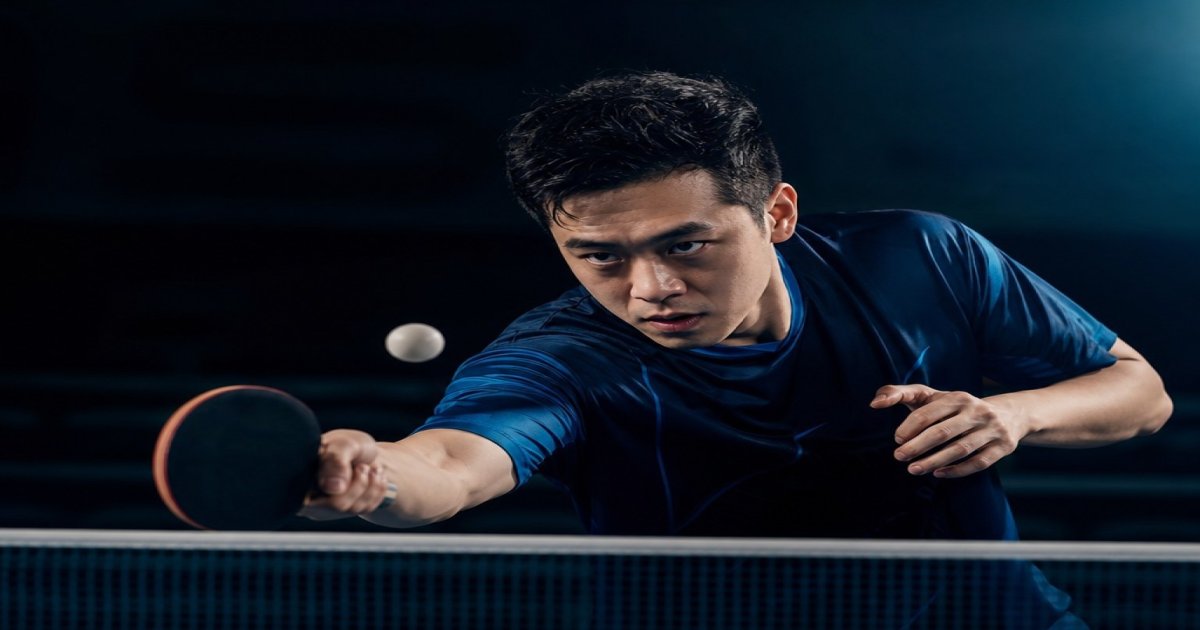
Learning how to play table tennis starts with unlearning every instinct borrowed from another sport.
Every player who has ever picked up a table tennis racket for the first time has made the same mistake within the first thirty seconds: gripping it like a tennis racket, swinging like they’re playing squash, and wondering why the ball keeps flying off the end of the table.
Table tennis looks like a smaller, gentler version of other racket sports from the outside. It isn’t. It’s a different sport wearing a familiar shape, and almost none of the instincts a new player brings from elsewhere actually transfer.
Table tennis is played by two or four players hitting a lightweight ball back and forth over a net on a table, scoring points when an opponent fails to return it legally.
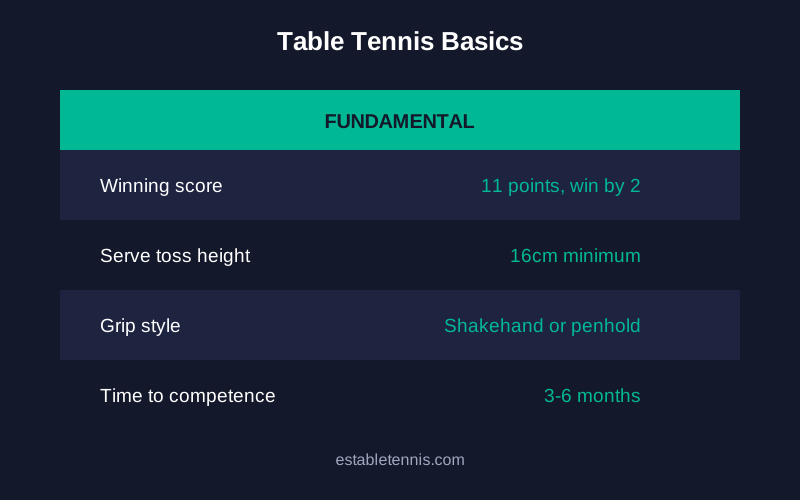
Players use a shakehand or penhold grip, serve diagonally to start each point, and win games to 11 points, needing a 2-point lead. Matches are typically best of five or seven games.
The rules themselves take about ten minutes to learn. The actual game (grip, stance, stroke mechanics, and the specific mental discipline it demands) takes considerably longer, and most of what makes a player genuinely competent has almost nothing to do with the rulebook at all.
What equipment do you need to start playing table tennis?
A racket (paddle), a ball, and a table with a net are the only requirements. For a genuine beginner, a premade racket (blade and rubber already factory-matched) removes an entire layer of equipment decisions that aren’t useful to make before you’ve played at all, covered in depth in our guide on table tennis equipment for beginners. Balls are lightweight, 40mm in diameter, and come in different star ratings indicating quality, though any legal ball works fine for learning the fundamentals.
How do you hold the racket correctly?
Two grips dominate the sport: shakehand, where you hold the handle as if shaking someone’s hand, and penhold, where you grip the handle more like holding a pen, with the blade’s playing surface facing downward.
Shakehand is the more common grip globally and generally easier for beginners to learn, since it allows a more natural forehand and backhand switch without rotating the wrist as dramatically as penhold requires.
What’s the correct stance and ready position?
Feet roughly shoulder-width apart, knees slightly bent, weight on the balls of your feet rather than flat-footed, and the racket held in front of the body at roughly waist height.
This ready position lets a player move quickly in any direction and react to the ball’s spin and speed without having to first shift out of a flat-footed, unprepared stance.
Most beginners stand too upright and too flat-footed, which is the single most common reason for late reactions to fast shots.
How do you actually hit the ball: forehand and backhand basics?
A forehand drive starts with the racket drawn slightly back and low, then swung forward and slightly upward through contact, brushing the ball to generate topspin rather than hitting it flat.
A backhand drive follows similar principles on the opposite side of the body, generally with a shorter, more compact swing since the body’s natural range of motion is more limited on that side.
Both strokes covered in more depth in our dedicated guides on table tennis forehand and table tennis backhand technique.
How does serving work in table tennis?
The ball must be tossed at least 16 centimeters straight up from an open palm before being struck, and must bounce once on the server’s side of the table before crossing the net and bouncing once on the opponent’s side.
Serves alternate every two points in most formats, and a huge amount of competitive advantage comes from serve variation (spin, placement, and disguise), covered fully in our guide on how to serve in table tennis.
How is scoring structured in a match?
Games are played to 11 points, and a player must win by at least 2 points, meaning a game can extend well past 11 if both players keep trading points at deuce.
Matches are typically best of five or best of seven games at competitive levels, though casual play often uses a single game or a shorter best-of-three format.
Points are scored on every serve regardless of who served, unlike some racket sports where only the server can score.
What’s the single biggest mistake beginners make?
Treating every shot as a chance to hit the ball as hard as possible. Table tennis at every level beyond the very beginning is a game of spin, placement, and consistency far more than raw power: a controlled, well-placed shot that stays in play beats a powerful shot that misses the table nine times out of ten.
Beginners who slow down, focus on clean contact and consistent placement, and resist the urge to smash every ball improve dramatically faster than beginners chasing power from day one.
How does spin actually change the way the game is played?
Spin is arguably the sport’s defining technical element, and it’s almost invisible to someone watching from outside the game for the first time.
The same swing can produce wildly different ball behavior depending on the angle and direction of racket contact, and reading an opponent’s spin (covered in depth in our guide on how to read spin in table tennis) is one of the genuine skills that separates a beginner from an intermediate player far more clearly than raw athleticism does.
How long does it actually take to get reasonably good at table tennis?
Most players reach a genuinely competent, enjoyable level of play within three to six months of regular practice, two to three sessions a week, assuming they focus on fundamentals rather than trying to shortcut straight to advanced spin and power.
The players who plateau early are almost always the ones who skipped the unglamorous fundamentals (clean contact, consistent footwork, controlled placement) in favor of chasing flashy shots before the basics were solid.
Where should a genuine beginner start practicing?
With a training partner or coach who can feed consistent, predictable shots, rather than jumping straight into competitive matches against players of unknown skill level.
Consistent, repetitive practice against predictable feeds builds the muscle memory for clean contact and footwork far faster than the chaos of an actual match, which introduces variable spin, pace, and placement before a beginner’s fundamentals are ready to handle that variability.
Structured drills, covered in our guide on table tennis drills, are worth introducing early rather than waiting until “you’re good enough” to drill properly.
What’s the mental side of table tennis that beginners never see coming?
The sport’s speed and close proximity between players creates a uniquely intense psychological pressure that’s rarely visible from outside the game.
Points happen in fractions of a second, and a single moment of hesitation or overthinking translates directly into a missed shot in a way slower-paced sports don’t punish as immediately.
This is the mental-equipment crossover that runs through this entire site: a player’s confidence in a given shot is inseparable from whether their gear actually supports that shot, and the two compound each other far more in table tennis than in almost any other racket sport.
Should a beginner focus on singles or doubles first?
Singles play builds the fundamental technical and tactical skills (shot selection, footwork, spin reading) more directly, since a player is solely responsible for covering the entire table.
Doubles introduces additional complexity around positioning and alternating shots with a partner, which is easier to layer on top of solid singles fundamentals than to learn simultaneously with basic stroke mechanics.
Most coaches recommend building a foundation in singles before treating doubles as a serious focus.
What role does footwork play beyond just reaching the ball?
Good footwork isn’t just about physically getting to where the ball will land: it’s about arriving early enough to set up a controlled, balanced stroke rather than a rushed, off-balance lunge.
Beginners often focus entirely on arm and racket technique while neglecting footwork, not realizing that a technically perfect stroke executed from an unbalanced, late position produces an inconsistent result regardless of how correct the arm motion looks in isolation.
Footwork fundamentals are covered in depth in our guide on how to improve table tennis footwork.
How does table tennis differ from ping pong, or are they the same thing?
Functionally, modern competitive table tennis and casual “ping pong” describe the same sport: the name “ping pong” historically referred to an early trademarked version of the game, while “table tennis” became the standard term for the sport as it developed into its current competitive form.
Some casual players use looser rules or lower-quality equipment under the “ping pong” label, but the underlying game, when played to official rules, is identical regardless of which name is used.
What’s a realistic first goal for a total beginner?
Sustaining a controlled rally of ten or more shots with a practice partner, focusing purely on clean contact and consistent placement rather than power or spin.
This modest-sounding goal is actually a meaningful technical achievement for a true beginner, since it requires basic footwork, consistent racket angle, and enough touch to avoid either overhitting or underhitting the ball, the foundation every more advanced skill gets built on top of.
How important is watching professional matches for a beginner’s development?
Genuinely useful, but only once a beginner has enough foundational understanding to recognize what they’re actually watching.
A total beginner watching a professional match mostly sees a blur of fast, powerful shots without understanding the spin, placement, and tactical setup behind each point.
After a few months of basic instruction, though, watching professional play becomes a much richer learning tool, since the patterns and tactics become visible in a way they simply aren’t to an untrained eye.
What’s the biggest equipment mistake beginners make when starting out?
Buying equipment built for advanced, offensive players before having the technique to use it: fast blades, aggressive rubber, and high-speed setups that amplify every small technical error rather than helping a beginner build consistency.
This mirrors the broader equipment-fit thesis running through every gear guide on this site: start forgiving, and let your actual technique, developed through real practice hours, tell you when it’s time to move toward faster, less forgiving equipment.
What’s the difference between recreational and competitive table tennis?
Recreational play often skips or loosens rules around serve height, ball toss, and even proper scoring, focusing purely on enjoyment rather than strict regulation.
Competitive table tennis, whether club-level or professional, enforces these rules precisely, partly because small technical details (a hidden serve, an improper toss) can create real, exploitable advantages if left unchecked.
A player planning to eventually compete benefits from learning the strict version of the rules early, rather than picking up loose recreational habits that need correcting later.
How does age affect how quickly someone picks up table tennis?
Younger players often develop faster reflexes and looser, more adaptable technique, but adult beginners frequently progress faster in the tactical and mental aspects of the game, since they bring more developed strategic thinking and patience to their practice.
Neither age group has an inherent advantage in ultimately becoming a good player: the sport rewards consistent practice and patience at any age, though the specific strengths a beginner brings to the table do shape what early development looks like.
What’s a sensible practice schedule for a genuine beginner?
Two to three sessions a week, each focused on a specific, narrow skill rather than trying to improve everything simultaneously.
A session dedicated purely to forehand consistency, followed by one focused purely on footwork, produces faster, more measurable improvement than unfocused practice that tries to cover serving, both strokes, and match play all in the same hour.
Narrow, deliberate practice consistently outperforms broad, unfocused practice at the beginner stage.
According to the ITTF equipment regulations, official rackets, balls, and table dimensions are all precisely standardized, which is part of why the sport translates so consistently from a club in Chaguanas to an Olympic final, despite how different those two settings otherwise look.
None of this needs to be memorized before your first session either. Show up, hold the racket the right way, and let the fundamentals accumulate one repetition at a time, the same way every player who’s ever gotten good at this sport actually did it.
Thirty seconds in, everyone grips it wrong. A few months in, almost nobody remembers doing that.
The instincts you bring from other sports will mostly betray you here, and that’s fine: unlearning them is just the first rep.
Ten shots in a row without a mishit feels small the first time you manage it. It never feels small the second time, once you realize what it actually took to get there.
Start there. Everything else follows.
Simple as that. Now go pick up a racket.
The rest is just repetition and patience.
Everyone starts here.
No exceptions.
Quick Recap: How to Play Table Tennis
Learning how to play table tennis starts with the boring parts (grip, stance, clean contact, basic footwork), and every flashy shot you’ll eventually want to hit sits directly on top of that unglamorous foundation.
Players who rush past it in favor of power and spin almost always end up circling back to fix the fundamentals eventually, at a cost in time and frustration that patience upfront would have avoided entirely.
Frequently Asked Questions
What’s the easiest way to learn how to play table tennis as a beginner?
Do I need expensive equipment to start playing table tennis?
How many points do you need to win a game in table tennis?
Is table tennis the same as ping pong?
How long does it take to get good at table tennis?
Every player who ever became genuinely good at this sport started exactly where you are now, gripping the racket wrong and swinging like they were playing something else entirely.
The only real difference between them and the players who quit within a month is that they kept showing up long enough for the fundamentals to stop feeling foreign.
Want a free foundation to build your mental game alongside your technique? Download the free ebook on staying calm and winning more matches.
Leave a Reply