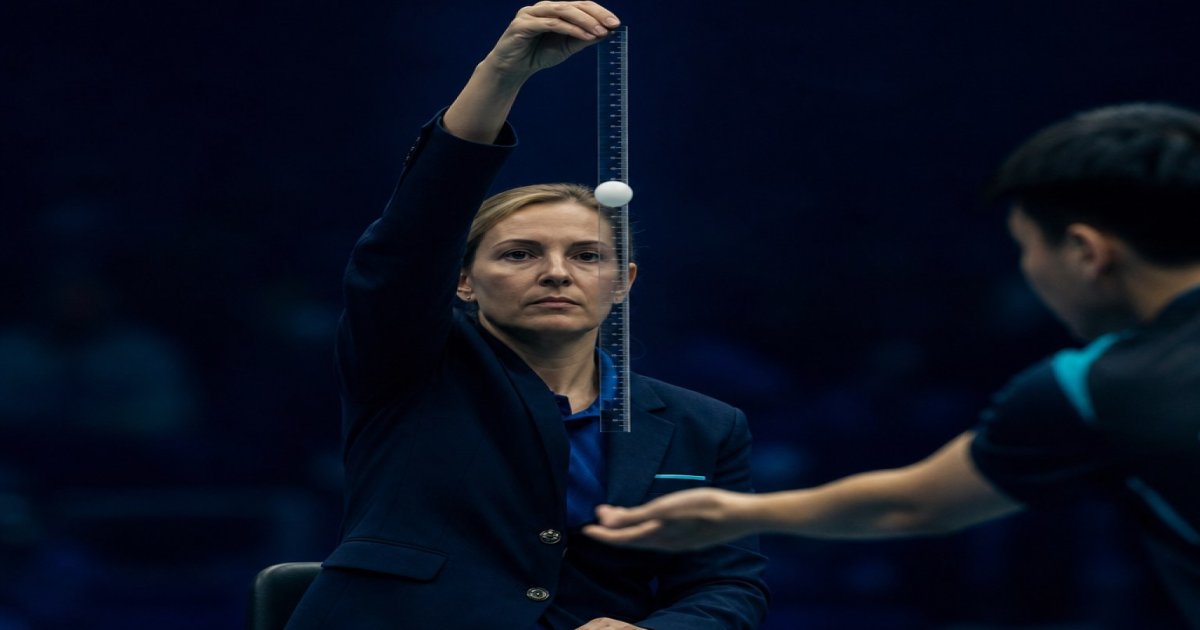
An umpire in a regional tournament once paused a match for four full minutes to settle a dispute over whether a serve’s toss had cleared sixteen centimeters, measuring the air itself with the flat certainty of someone who had clearly had this exact argument before. Table tennis rules do that to people: total confidence right up until somebody actually checks. The players on either side of the table had been playing for a decade. Neither of them had actually read the rule closely enough to know the number by heart.
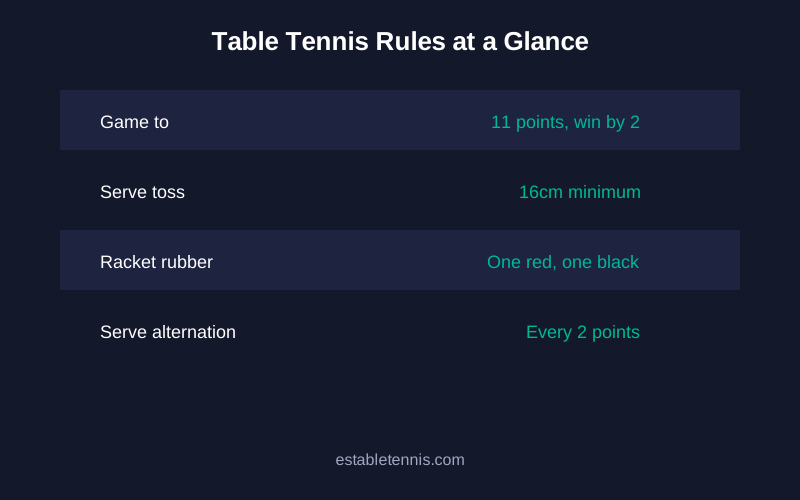
Matches are played to 11 points with a required 2-point winning margin, typically best of five or seven games. Serves must toss at least 16cm from an open palm and bounce once on each side of the table. Rackets must have one red and one black rubber side, and players alternate serves every two points.
Most players learn the rules informally, through observation and correction during actual play, which means gaps and misconceptions persist for years without ever being deliberately closed.
How is scoring structured in an official match?
Games are played to 11 points, and a player must win by at least 2, meaning a game can extend well past 11 if both players keep trading points at deuce. Matches are typically best of five or seven games at competitive levels. Points are scored on every serve regardless of who served, unlike some racket sports where only the server can score.
What are the legal requirements for a serve?
The ball must rest on an open, flat palm, be tossed vertically at least 16 centimeters, and be struck only as it descends, covered in more depth in our guide on how to serve in table tennis. The server’s free hand and arm cannot obstruct the receiver’s view of the ball, and it must bounce once on the server’s half before crossing the net.
How does the serve rotation work throughout a game?
Serves alternate every two points in standard singles and doubles play, switching to every point once a game reaches 10-10 (deuce), to reduce any serving advantage during the game’s most decisive stretch. Players also switch sides of the table between games, and in the final game of a match, switch sides again once either player reaches 5 points.
What equipment rules govern legal rackets?
One side of the racket must be red, the other black, covered in depth in our guide on red rubber vs black rubber. This rule exists purely for visibility, letting opponents and umpires track which surface struck the ball, not because either color carries any performance difference.
What counts as a legal return during a rally?
The ball must be struck so it passes over or around the net and lands on the opponent’s side of the table without touching the striking player’s own side first. A ball that clips the net but still lands legally on the opponent’s side (a “let” on a serve, or simply a legal return during a rally) continues play normally, except during a serve, where a net-clipped serve that still lands legally is replayed rather than counted.
What happens if the ball touches a player’s body or clothing?
If the ball touches any part of a player’s body or clothing before returning it legally, the point goes to the opponent, treated the same as any other failure to make a legal return. This includes the racket hand below the wrist, which counts as an illegal contact point rather than a legal racket surface.
How do doubles-specific rules differ from singles?
Serves in doubles must travel diagonally, from the right half of the server’s side to the right half of the receiver’s side, and partners must alternate hitting the ball throughout each rally, in a fixed rotating order. Missing this alternation, even accidentally, results in a lost point, making doubles positioning and communication considerably more tactically demanding than singles.
What’s a rule most casual players don’t actually know, but that matters at competitive levels?
The specific toss-height requirement and the rule against obstructing the receiver’s view with the free hand are both frequently overlooked in casual play but strictly enforced in officiated competition. A player who’s only ever played casually can develop toss and obstruction habits that suddenly become illegal, and costly, the first time they enter sanctioned competition.
What happens if a player obstructs their opponent’s view during a serve?
An umpire calls a let and the serve is replayed without penalty the first time, but repeated or deliberate obstruction can result in a warning or point penalty, depending on the severity and whether it appears intentional. This rule exists specifically to prevent servers from using their body or free arm to hide the moment of contact, which would otherwise let them disguise spin far more effectively than the rules intend to allow.
How do let calls work during a rally, beyond just serves?
A let, replaying the point without awarding it to either player, can occur if a ball is disrupted by an outside interference (a ball rolling onto the table from another game, for instance) or in specific serve situations like a serve clipping the net before landing legally. Lets are relatively rare during open rally play compared to serves, where they’re a standard, expected part of normal competitive play.
What’s the rule around time limits and stalling during a match?
Officiated matches include an expedite system that activates if a game runs unusually long without reaching a natural conclusion, after which players must attempt to win each point within a limited number of shots or risk losing the point automatically.
This rule exists to prevent excessively defensive, stalling play from making a match unreasonably long, ensuring the format stays watchable and fair for both competitors.
How does the rule about switching sides work across a full match?
Players switch sides of the table after each completed game, and in the deciding final game of a match, switch sides again once either player reaches 5 points, specifically to neutralize any environmental advantage (lighting, background, air current) one side of the table might otherwise consistently offer.
What equipment specifications beyond the red/black rubber rule are actually regulated?
Blade thickness, rubber thickness, and overall racket construction all fall under specific ITTF approval standards, ensuring no player gains an unfair advantage through non-standard equipment. The blade itself must be predominantly natural wood, and rubber surfaces must meet approved pimple density, height, and material standards, all verified through an official equipment approval process.
Does the rulebook address unsporting conduct, and what happens if it occurs?
Yes. Umpires can issue warnings and, for repeated or severe conduct violations, point or game penalties for behavior including deliberate delay, verbal abuse, or equipment abuse like slamming a racket. These conduct rules exist to maintain the sport’s competitive integrity and keep matches fair and respectful regardless of how heated a competitive moment becomes.
How do the rules handle a dispute that a player wants to contest during a match?
Players can request umpire clarification on a specific call, and in higher-level sanctioned events, video review may be available for certain disputed points, though the availability of review varies considerably by tournament level and governing body. At the club and recreational level, most disputes are settled simply through mutual agreement or an on-site umpire’s final call.
How do the rules differ between recreational play and sanctioned competition?
Recreational play frequently ignores or loosens rules around serve toss height, obstruction, and even strict scoring, focusing on enjoyment rather than precise regulation. Sanctioned competition enforces these rules exactly, partly because small technical details, like a hidden serve or an improper toss, can create real, exploitable advantages if left unchecked at a level where matches genuinely matter for rankings and advancement.
What’s the actual reasoning behind the 11-point game format, rather than the older 21-point standard?
The sport shifted from a 21-point to an 11-point format specifically to make individual games faster and more spectator-friendly, and to reduce the impact of a single dominant server racking up long unanswered scoring runs under the old rules. Shorter games also mean serve advantage evens out more quickly across a match, since players switch serving responsibility more frequently relative to the game’s total length.
How does the expedite system actually work in practice during a slow-paced game?
Once a game reaches a certain time threshold without a natural conclusion, typically ten minutes, the expedite system activates, requiring the server to win the point within thirteen shots of their serve or automatically lose it to the receiver. This shifts the pressure decisively toward the server, encouraging faster, more decisive play rather than allowing an excessively cautious, defensive rally style to stall a match indefinitely.
Are there different equipment rules for youth or junior competition compared to adult events?
Core equipment specifications generally stay consistent across age divisions, though some junior development programs use modified, larger, lower-bounce balls or smaller tables specifically to help younger players develop fundamentals before transitioning to full adult equipment specifications. These modifications are training tools rather than changes to the official competitive rulebook itself.
How do the rules handle a racket that breaks or becomes damaged mid-match?
A player whose racket breaks during play is typically permitted a reasonable amount of time to replace or repair it, though the specific allowance varies by tournament regulations and umpire discretion. This rule exists to prevent equipment failure, which is outside a player’s direct control in the moment, from unfairly deciding a match’s outcome.
What’s the rule around coaching during a match, and how does it differ by tournament level?
Many tournaments permit brief coaching during timeouts or between games, though rules vary considerably on when and how coaches can communicate with players during active play. Some formats prohibit any coaching signals during a live point entirely, while others allow limited communication during breaks between games, reflecting a broader tension in competitive sports between player autonomy and coaching support.
How does understanding the actual rulebook change how a player approaches close, contested matches?
A player who genuinely knows the rules, rather than relying on general impressions built from years of casual observation, is better equipped to advocate for themselves during a disputed call and less likely to be caught off guard by an unfamiliar but legitimate ruling. This knowledge gap, more than any technical or tactical skill, is often what separates a player who handles a contested match calmly from one who becomes visibly rattled by an unexpected but entirely correct umpire decision.
According to the official ITTF equipment and competition regulations, the full rulebook is publicly available and updated periodically, meaning any player serious about competitive play has direct access to the exact same standard every umpire is trained to enforce, rather than relying on secondhand impressions passed down informally through a club.
Most players never actually read that document cover to cover, and most never need to, until the exact moment a close, important match hinges on a rule they’d only ever half-understood. That’s precisely the moment a four-minute pause to measure the air becomes considerably more expensive than the ten minutes it would have taken to read the rule properly beforehand.
Rules feel like the least interesting part of any sport to actually study, right up until a contested point in a deciding game makes the gap between knowing and half-knowing suddenly very expensive. A decade of casual play had taught both players in that story everything except the one number that mattered most in that specific moment.
Read the actual rulebook once, all the way through, even the parts that feel tedious. It costs an afternoon. It saves considerably more than that the first time a real dispute actually arrives.
The rulebook doesn’t care how long you’ve played, or how naturally talented you are, or how many trophies sit on a shelf somewhere. It applies the same sixteen centimeters to everyone, every single time, regardless of reputation.
That’s precisely what makes it worth actually reading, rather than absorbing secondhand through years of half-remembered corrections during casual play.
Read it once, properly, before the next match that actually matters to you.
Ten minutes now beats four minutes of measuring the air later, in front of an opponent who happened to read the document you skipped.
Simple as that.
Nobody enjoys reading a rulebook cover to cover on a Saturday afternoon. Nobody enjoys losing a close match to a rule they never bothered to learn either.
Pick whichever discomfort you’d rather live with, and act accordingly this week.
End of story.
Sixteen centimeters isn’t a lot to ask anyone to remember. It just took one long, expensive pause for two experienced players to finally learn it properly.
Don’t wait for your own version of that pause to learn yours.
Worth the afternoon, every time.
Truly.
Go read it now.
The whole document, start to finish, no skipping the boring middle sections.
Especially the boring middle sections.
Those are always the parts that end up mattering most, eventually, when least expected.
An afternoon well spent, by any honest measure.
Do it before your next tournament, not after.
Your future self, mid-dispute, will thank you.
Guaranteed.
Every single time.
No exceptions.
Really.
Truly.
Ten minutes with the rulebook tonight beats a four-minute measured-air standoff in front of a crowd next season.
Quick Recap: Table Tennis Rules
Table tennis rules govern far more than most casual players ever bother to learn: scoring, serve mechanics, equipment specifications, doubles rotation, and conduct standards all shape competitive play in ways that only become obvious the first time a casual habit runs into a strict umpire’s call.
That four-minute toss-height dispute never needed to happen. The rule had been sitting in plain text the entire time, unread by two players with a combined twenty years of experience between them.
Frequently Asked Questions
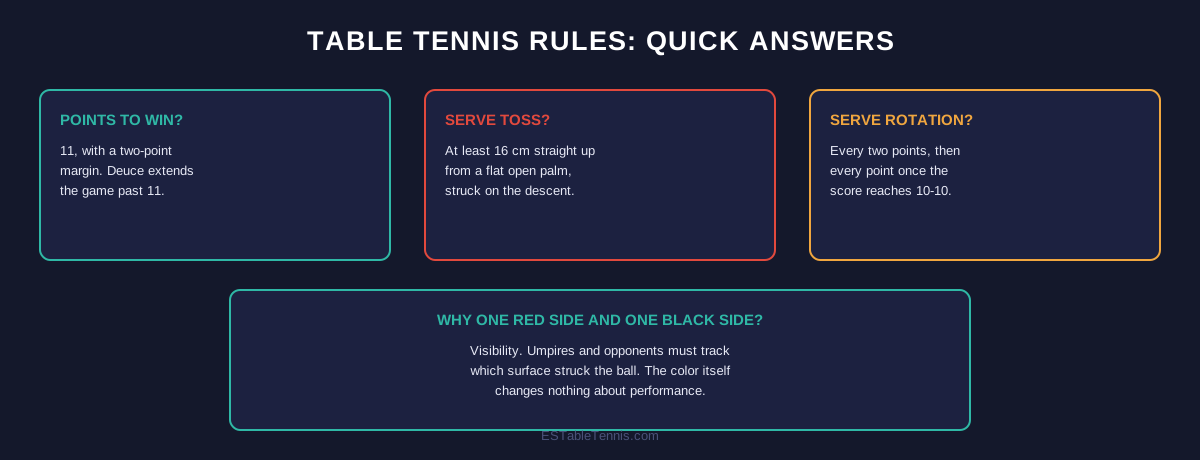
How many points do you need to win a game in table tennis?
What’s the minimum legal toss height for a serve?
Why does the racket need one red and one black side?
How does serving alternate during a game?
What happens if the ball touches my hand or clothing during a rally?
The umpire measured the air one more time, called the toss legal, and the match resumed exactly where it had paused. Neither player argued the ruling. Both of them, for the first time in a decade, finally knew the actual number.
Want a free foundation to build your mental game alongside your rules knowledge? Download the free ebook on staying calm and winning more matches.
Leave a Reply