
I watched a player lose a match he should have won by three games, and the opponent never cheated once in a way that could be proven. A ball clipped the edge on a crucial point in the third game. The opponent called it out. My player looked at me from across the table with that particular expression I have learned to read over many years of coaching, the one that says: Is this real? Is this happening? He lost the next five points without the score ever really being in doubt again.
The edge ball probably was out. Or it wasn’t. Nobody in that gymnasium could say with certainty. What I can tell you is that the match ended there, in that moment of doubt and rising anger, not at the final 11-7 in the fifth. The score was just the paperwork. Handling a cheating opponent in table tennis is rarely about the call itself. It is about what the call does to the six inches between your ears.
Every competitive table tennis player will face a cheating opponent, or someone who appears to be cheating, at some point in their career. It might be a deliberate bad call. It might be a score dispute. It might be an opponent who shouts at the wrong moment, delays serve deliberately, or turns close edge balls into a pattern across a whole match. Knowing how to deal with a cheating opponent in table tennis is not a nice-to-have skill. It is a survival skill for anyone who wants to compete seriously.
This is not a post about the rules, though the rules matter and we will cover them. This is a post about what happens inside your head when you believe you are being robbed, and how to keep that head functional enough to win anyway.
Why a Cheating Opponent in Table Tennis Wrecks Your Mental Game
The psychological damage from perceived cheating is disproportionate to the actual harm. One bad call costs you one point. But the mental fallout, if you let it, costs you the next five.
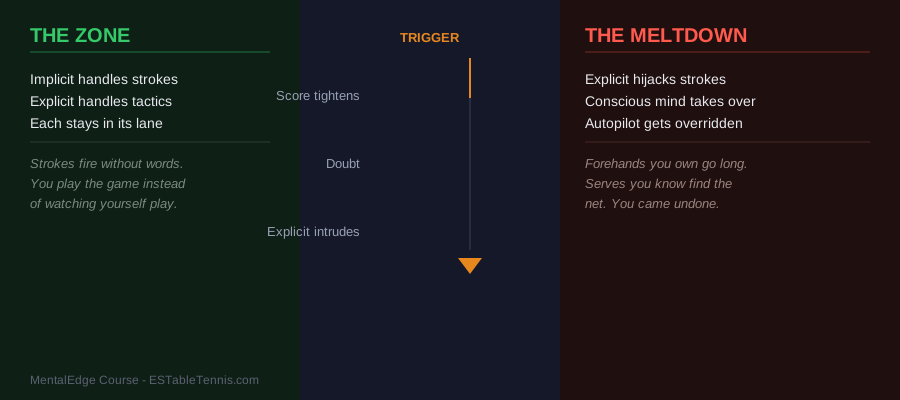
The reason is rooted in something called the injustice effect. When we believe we have been treated unfairly, the brain’s threat response activates just as it does for physical danger. The American Psychological Association describes anger as a natural response to perceived threats, injustice, or violations of personal boundaries. At the table tennis table, that anger floods your system at exactly the moment you need fine motor control, calm decision-making, and present-moment focus.
Anger and precision do not coexist well. Your grip tightens, your breathing shallows, your service routine gets rushed. You start playing the person across the table instead of playing the game. You want to punish them with a winner, which is exactly how you start making unforced errors on balls you would normally put away without thinking.
The opponent, whether they are cheating deliberately or not, has now gained something far more valuable than a single point. They have moved inside your head and set up residence.
How Do You Separate a Single Bad Call From an Actual Pattern?
A single bad call is one data point, not a conspiracy. Watch for a second and third borderline call before treating it as a genuine pattern worth acting on. Here is the first thing I tell players when they come off the table furious about a bad call: one point is one point. It is not evidence of a conspiracy. It is not proof that the whole match is compromised. It is a single data point, and you cannot do anything useful with a sample size of one.
What you can do is watch for a pattern. If the same opponent makes a second borderline call, and then a third, that is different information. That is a pattern, and patterns are worth something. A single bad call is not.
The practical drill here is simple: after any disputed point, give yourself a mental label. Not a judgment. Just a label. Noted. That is it. One word, said internally, and then you return to your pre-serve routine. You file the information without letting it trigger anything. If it happens again, you file again. If it happens a third time, you have a pattern, and you can act on it, calmly, through the right channels.
Players who learn how to deal with a cheating opponent in table tennis at a high level all do some version of this. They stay in data-collection mode rather than reaction mode. The opponent never gets the emotional discharge they may be looking for, and you stay sharp enough to compete.
What Are the ITTF Rules for Disputed Calls?
Under ITTF rules, genuine doubt about whether a ball was in or out entitles you to call a let and replay the point. You’re never required to concede or keep playing through real uncertainty. There is a specific kind of powerlessness that comes from not knowing your rights. You feel wronged but you don’t know what you can do about it, so the anger has nowhere to go except inward, where it corrodes your focus.
Knowing the rules changes that. The ITTF Handbook covers the laws of table tennis in full, and the relevant section for disputes is clearer than most players realize. Under ITTF rules, if you are not sure whether a ball was good or not, you are entitled to call a let. A let replays the point. You are not required to concede the point to avoid an argument, and you are not required to keep playing if you genuinely did not see whether the ball was in or out.
The key phrase in the rules is a genuine doubt. If you had genuine doubt, a let is appropriate. If you clearly saw the ball go out and your opponent is claiming it was good, that is a dispute, and you can ask for the umpire if one is available, or state your case to the referee at the tournament level.
Most club-level and recreational matches run without an umpire present. In those situations, the responsibility falls on both players to call their own lines honestly. When that system breaks down, here is the honest truth: you cannot force an opponent to be honest. What you can do is refuse to be passive about it, ask calmly and directly for the call to be reviewed, and if the pattern continues in an officiated tournament, request an umpire through proper channels.
Knowing this going in removes the powerlessness. You have options. Using them calmly is the skill.
How Do You Use Your Pre-Serve Routine to Reset After a Bad Call?
Your pre-serve routine creates a gap between a bad call and your next action, and that gap is exactly where composure lives. I wrote in detail about the pre-serve routine and its role in mental performance in another post on this site, and I want to connect those ideas here because they are directly relevant. The pre-serve routine is not just a technical habit. It is a neurological reset switch, and you need it most precisely when a bad call has just scrambled your system.
The routine creates a gap between the stimulus (the bad call, the disputed score, the opponent’s behavior) and your response (the next serve or return). That gap is where mental composure lives. Players who don’t have a consistent routine have no gap at all. The anger from the bad call flows directly into the next point, which flows directly into the one after that, and before long the opponent is up 4-0 in the game and your head is still back on the disputed call three minutes ago.
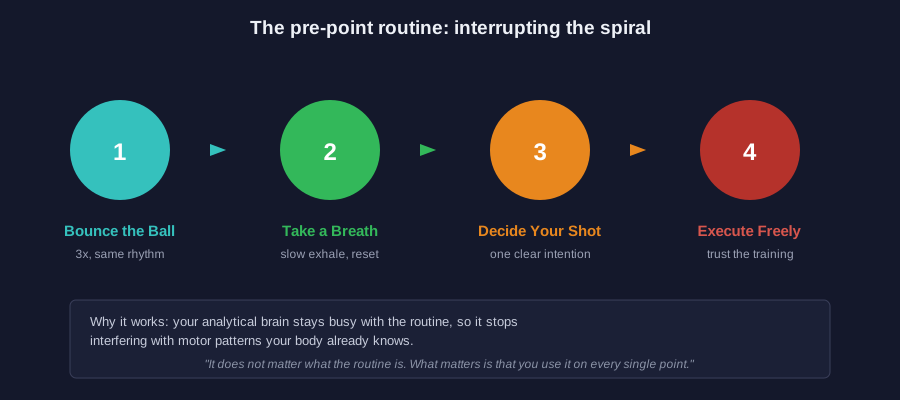
When you feel the heat of an unfair call rising, your routine becomes non-negotiable. Bounce the ball the same number of times. Breathe the same way. Look at the same spot on the table. The familiarity of the routine is itself calming, because the nervous system reads pattern and repetition as safety. You are essentially telling your brain: we have been here before, we know what to do next, we are fine.
Read more about building a pre-serve routine that holds up under this kind of pressure in the full guide on ping pong pre-serve routine mental performance.
Why Should You Play the Score, Not the Injustice?
The score doesn’t care that you were wronged. It only records what happens next, so treating every point as a clean slate protects your result even when treating it as a moral ledger doesn’t. This is the hardest one. It requires a kind of discipline that most players have to train explicitly, because it runs against every instinct when you feel wronged.
The score right now does not care about the bad call. It does not care that you are right. It only records what happened, not what should have happened. And if you spend the next four points trying to even the score in a moral sense, the actual score is going to get worse.
I have watched players who were genuinely cheated against lose matches they were winning because they could not separate their emotional account from their competitive one. The emotional account said they were owed something. The competitive account, the only one that matters for the result, said they were down and needed to play better to change it.
Playing the score means treating every point as a clean slate. The disputed call already happened. You cannot retrieve it. What you can influence is the next rally, which begins when you decide to stop carrying the last one.
This connects directly to the research on what happens to performance when players ruminate on negative events during competition. Research published in the Journal of Sport and Exercise Psychology shows that rumination following negative in-competition events significantly increases anxiety and reduces subsequent performance quality in skill-based sports. Table tennis is exactly this kind of task. Ruminating costs you more than the bad call ever did.
Why Does Trusting Your Equipment Matter Against a Cheating Opponent?
Trusting your equipment removes one variable from your mental load at exactly the moment your load is highest, so you are not left wondering whether an odd bounce was the rubber or your own tension. This one surprises players every time I bring it up in the context of a cheating opponent in table tennis, so let me explain the logic carefully.
When you are playing under emotional stress, your equipment becomes a factor in a way it isn’t during a comfortable practice session. You start noticing the feel of the rubber differently. A ball that skims the edge in a tense moment with a familiar paddle lands differently in your mind than the same ball with a setup you are not fully confident in.
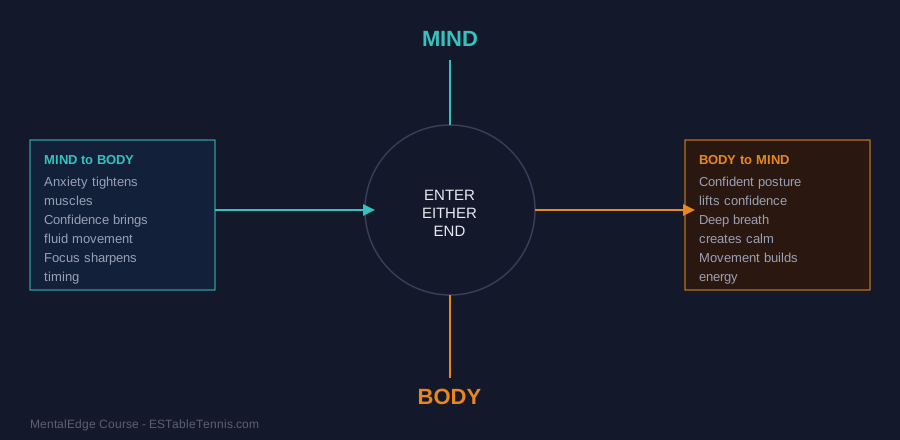
Equipment you genuinely trust removes one variable from your mental load at exactly the moment your mental load is highest. You don’t need to wonder whether that edge ball felt wrong because of the rubber or because of the tension in your grip. You know your equipment. You can trust what it tells you.
The inverse is also true. Players who are not confident in their setup become significantly more fragile under the stress of disputed calls. Every slightly odd bounce becomes a question mark. Every missed shot gets blamed on the equipment rather than the actual cause, which is usually the mental state the dispute already triggered.
If this is a recurring problem for you, think carefully about your current setup. The PingPath tool on this site gives personalized rubber recommendations based on your actual playing style and mental performance tendencies. Equipment confidence isn’t a shortcut to handling cheating opponents better. But it removes a variable from the equation, and in a mentally stressed match, every variable you can remove is worth something.
How Should You Act Once the Cheating Pattern Is Clear?
State what you observed calmly and once, without accusation, ask for an umpire if one is available, and stay composed, since staying composed removes the incentive for the tactic to continue. At some point the data-collection phase ends and the pattern is undeniable. Three or four calls have gone against you on crucial points, each one borderline at best. Now what?
The first thing is to say something, calmly. Not an accusation. Not a demand. A statement of what you observed, delivered without emotional charge. Something like: That looked in to me. I’d like to replay the point. Full stop. No escalation, no sarcasm, no loaded language. You state your position once, clearly.
If this is an officiated tournament match, ask for the umpire at the next opportunity. This is your right under ITTF regulations. The umpire’s job is to adjudicate exactly these disputes, and using that system is not weak or unsporting. It is what the system is for.
If there is no umpire and your opponent refuses to accommodate a let on a genuinely disputed call, you have limited options at the enforcement level. But you have full options at the mental level. You can choose not to hand them the larger prize, which is your focus. Staying composed while stating your case calmly, then returning to your game, is itself a competitive act. It signals that the tactic is not working, which removes the incentive to continue it.
Players who know how to deal with a cheating opponent in table tennis without crumbling are harder to provoke. Opponents who cheat strategically, not just opportunistically, usually do it because they believe it will destabilize you. Take that belief away, and you remove the reason to continue.
What’s the Real Mental Skill Behind Staying Composed?
Everything in this post rests on a single underlying idea: the match inside your head and the match on the table are two separate events, and you choose which one you’re competing in.
The internal match is the one where you relitigate every bad call, build a case for why you were robbed, and carry the emotional weight of each disputed point into the next rally. That match is unwinnable by definition, because there is no referee for it, no final score, and no resolution that will make you feel whole again before the game ends.
The external match is the one on the table. Points, games, a score that moves in one direction or the other based on what happens on the next ball. That match you can win. But only if you’re actually in it.
Every strategy in this post, from separating a point from a pattern to using your pre-serve routine as a reset to playing the score rather than the injustice, is a method for staying in the external match. Choosing that match, again and again, after each provocation, is the real skill. Rules knowledge and tactical composure are the scaffolding. The discipline to keep choosing the right match is the building.
The truth about cheating opponents is a quiet one: they rarely decide matches on their own. What decides matches is what you do in the two seconds after you believe you have been cheated. Most players hand the match over in that moment without realizing it. The few who don’t win more often than they should.
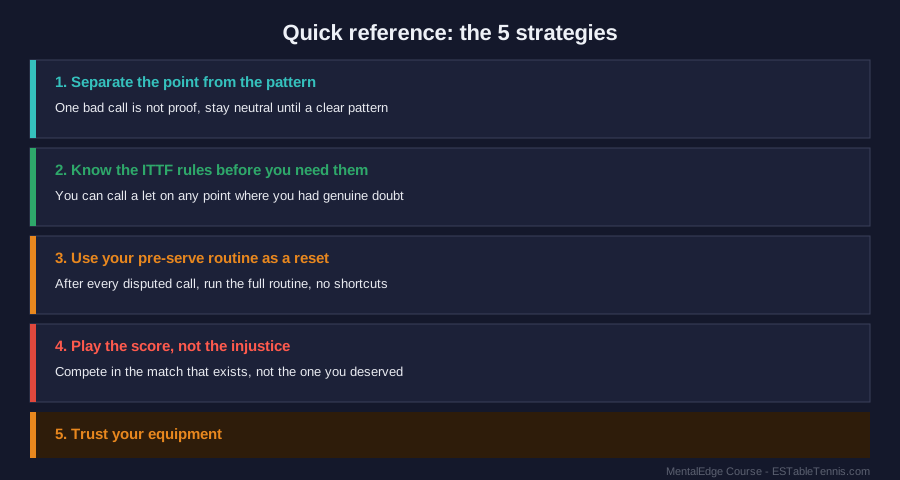
What Are the 5 Strategies at a Glance?
For a fast reminder before you face a cheating opponent at a tournament, here is the distilled version of everything above.
What’s the Bigger Picture Here?
Learning how to deal with a cheating opponent in table tennis is, at its core, learning how to manage emotional adversity in real time. Facing a cheating opponent forces you to develop a mental discipline that most players never build deliberately. That skill transfers well beyond disputed calls. It applies to bad line judges, hostile crowds, opponents who gamesmanship their way through a match, and the internal self-sabotage that shows up when you are playing the biggest match of your season.
If you want to go deeper on the mental side of competition, the post on why you play worse in matches than in practice covers the foundational psychology behind this. The post on coming back from a big lead addresses the same core theme from a different angle: keeping your head in a match after something has already gone wrong.
The mental game is the game. Equipment matters. Technique matters. But the player who wins the match inside the skull wins the one on the table most of the time.
Download the free ebook, How to Remain Calm When It’s Crunch Time and Win More Matches, for a full framework on building this kind of mental toughness, one match situation at a time.
Frequently Asked Questions
What should I do if my opponent makes a bad call in table tennis?
If you have genuine doubt about whether the ball was in or out, you’re entitled to call a let and replay the point under ITTF rules. State your position once, calmly, without accusation.
How do I stay calm after an unfair call in table tennis?
Run your pre-serve routine exactly as you always do. The routine creates a gap between the bad call and your next action, and that gap is where composure lives.
Is one bad call proof that my opponent is cheating?
No. Treat it as a single data point, not a pattern. Only a second or third borderline call is worth acting on.
What are the ITTF rules for disputed points?
If either player has genuine doubt about a call, a let can be called and the point replayed. In officiated matches, either player can request the umpire adjudicate.
Why do I keep losing points after a bad call goes against me?
Because rumination on the disputed call, not the call itself, is what actually costs you the next several points. Research shows dwelling on a negative event during competition increases anxiety and reduces performance.
Leave a Reply