
A new club member in Arima once asked for “the plan” on his very first night, expecting a laminated sheet with a clear week-by-week path to competence. His coach laughed, not unkindly, and told him the plan was simple enough to say out loud: show up twice a week, drill more than you rally, and stop expecting week four to feel like week twelve.
He wrote nothing down. The player came back anyway, and eight months later he understood exactly why nothing needed writing down in the first place.
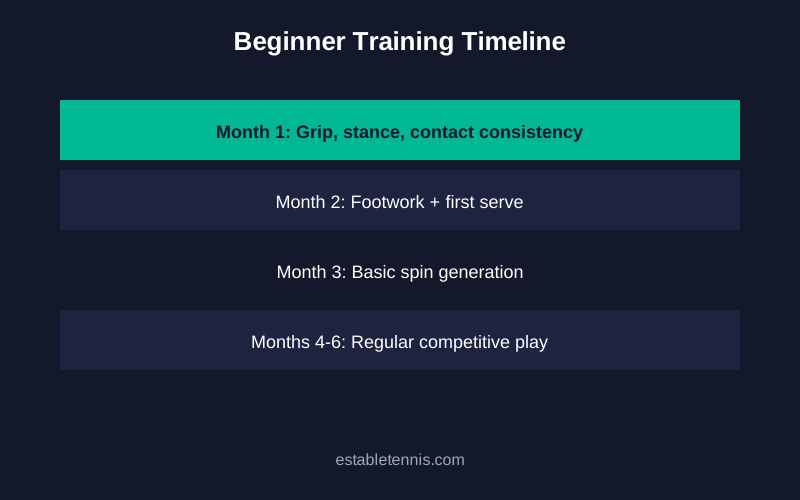
Train two to three times a week, spending the majority of early sessions on isolated drills (contact consistency, footwork, one serve variation) rather than full matches. Progress from forehand and backhand consistency in the first month, to basic spin generation in months two and three, before introducing regular competitive match play.
Most beginner training plans fail not from bad information but from impatience: rushing toward match play and flashy shots before the unglamorous foundation is actually solid enough to support them.
What should the very first weeks of training actually focus on?
Basic contact consistency and grip, covered in our guide on how to play table tennis, before worrying about power, spin, or match tactics at all. A beginner who can sustain a controlled ten-shot rally with a partner, focused purely on clean contact, has built a more valuable foundation in that first month than a beginner who’s already attempting loops and smashes without reliable basic contact underneath them.
How much of early training should be drilling versus playing actual matches?
The large majority, particularly in the first few months. Structured, isolated drills, covered in our guide on table tennis drills, build technical consistency far faster than unstructured match play, which introduces variability a beginner isn’t yet equipped to handle productively. Most coaches recommend an 80-20 split favoring drills over matches for at least the first two to three months.
When should a beginner start learning to serve, relative to other skills?
Early, actually: serve practice, covered in our guide on how to serve in table tennis, doesn’t require a partner and can be developed in parallel with basic stroke consistency rather than waiting until strokes feel fully solid. Since every point in the sport begins with a serve, building at least one reliable serve variation early gives a beginner a genuine tool to use once they do start playing actual matches.
What’s a realistic month-by-month progression for a dedicated beginner?
Month one typically focuses on grip, stance, and basic forehand and backhand contact consistency. Month two introduces basic footwork patterns and a first serve variation. Month three begins layering in basic spin generation, particularly topspin, covered in our guide on generating more topspin. By months four through six, most dedicated beginners are ready for regular competitive match play alongside continued drilling.
Should a beginner train alone, with a partner, or with a coach?
A combination works best when available: solo practice for serves and shadow footwork, partner practice for consistency rallies and basic drilling, and periodic coaching input to catch technical issues that self-assessment alone tends to miss.
A beginner without regular coaching access can still make real progress through disciplined partner and solo practice, though occasional coaching input, even infrequent, helps avoid ingraining incorrect habits that become harder to fix the longer they persist.
How does equipment choice fit into a beginner’s training plan?
A moderate, forgiving premade racket, covered in our guide on table tennis equipment for beginners, removes an entire layer of decisions a true beginner isn’t equipped to make well, letting training time focus entirely on technique rather than equipment experimentation.
Equipment reassessment can wait until a beginner has enough hours logged to actually know what their game needs, typically several months into consistent training.
What’s a common mistake beginners make with their own training plan?
Rushing toward advanced shots (loops, smashes, aggressive serves) before basic contact consistency is genuinely solid, which tends to build compensating habits that take longer to unlearn later than the patience would have taken to build correctly from the start.
This impatience is understandable, since drilling feels less immediately rewarding than flashy shots, but it’s consistently the single biggest predictor of a plateaued, frustrated first year.
How should a beginner know when it’s time to move from a structured plan to more self-directed training?
Once basic contact, footwork, one serve, and beginning spin generation all feel reasonably consistent, typically somewhere around the four-to-six-month mark for a dedicated player, a beginner has enough foundational skill to start identifying their own specific weaknesses and directing practice accordingly, rather than needing a prescribed, generic plan to follow.
How many days a week should a genuine beginner actually train?
Two to three sessions weekly is generally the sweet spot for sustainable, steady progress without risking burnout or overuse injury from too much too soon.
A beginner training daily, particularly in the excitement of a first few weeks, often burns out or develops repetitive strain issues before the habit has a chance to become a sustainable long-term routine. Consistent, moderate frequency over many months outperforms intense, short-lived enthusiasm every time.
What’s the role of multiball training specifically within a beginner’s plan?
Multiball, covered in our guide on multiball training, is particularly valuable for beginners specifically because it removes the frustration of chasing missed balls during a standard rally, letting a new player accumulate far more successful contacts per session than unstructured rally practice would allow. Beginners with access to a coach or patient training partner willing to feed should prioritize this method heavily in the early months.
How should a beginner handle the inevitable plateaus that come with early training?
Plateaus are a normal, expected part of skill development, not a sign that a training plan has failed or that natural talent is lacking.
Most beginners experience a noticeable plateau somewhere in the second or third month, right as the initial novelty wears off and consistent technique still feels effortful rather than automatic. Continuing the same disciplined, patient practice through this plateau, rather than abandoning the approach or randomly changing methods, is usually what actually breaks through it.
Does mental training have a place in a beginner’s early development, or is that purely for advanced players?
Even genuine beginners benefit from some early attention to composure and focus, since match nerves and frustration at early mistakes are universal experiences regardless of skill level.
Building basic mental resilience alongside technical skill from the start, rather than treating it as an advanced-player concern to address later, helps a beginner stick with the sport through the inevitable early frustrations that cause many first-time players to quit within the first few months.
How does a beginner know if their current training plan needs adjusting?
If specific skills feel stuck despite consistent practice, or if certain fundamentals from month one still feel unreliable well into month three or four, that’s a signal worth addressing directly, often through a coach’s outside perspective rather than continuing to repeat the same approach that isn’t producing results.
A training plan should be a living framework, adjusted based on actual progress, not a fixed schedule followed rigidly regardless of what real feedback from practice sessions reveals.
What’s a sensible way to balance solo practice against partner-dependent training?
Serves, shadow footwork, and basic shadow swings can all be practiced alone effectively, while consistency rallies, drilling against a live feed, and match play all require a partner or coach.
A beginner without constant partner access should still make meaningful progress by prioritizing the solo-practicable skills during unaccompanied time, saving partner sessions specifically for the skills that genuinely require another person.
How should a beginner think about tracking their own progress over time?
Simple, concrete markers (sustaining a rally of a given length, executing a specific serve consistently, holding a controlled backhand exchange) offer more useful progress tracking than vague impressions of “getting better,” which are hard to evaluate objectively.
Some beginners keep a simple log of specific milestones reached each month, which both motivates continued effort and provides honest, concrete evidence of progress during the inevitable stretches where improvement feels invisible day to day.
What’s the value of occasionally playing against a wide range of opponents, even as a beginner?
Facing different playing styles, even informally, exposes a beginner to variation their regular training partner might not provide: someone with a completely different grip, a more aggressive or more passive natural style, or simply a different body type and reach.
This variety, even in casual, low-stakes settings, builds a broader base of pattern exposure than training exclusively with the same one or two partners ever could on its own.
How does a beginner’s training plan need to adjust once they start entering actual competitive tournaments?
Tournament preparation typically shifts some training emphasis toward simulated match pressure and specific serve-and-return sequences likely to arise against real, varied opponents, rather than the purely foundational drilling appropriate for the earliest months.
This shift usually happens naturally once a beginner has built enough basic competence that competitive entry starts to feel like a reasonable next step, rather than being forced prematurely before the underlying foundation is actually ready for it.
Does a beginner’s physical conditioning matter alongside technical and tactical training?
Yes, though it’s often overlooked in favor of purely technical focus. Basic footwork endurance and general fitness support the repetitive movement demands of extended training sessions and matches, and a beginner who neglects general conditioning entirely sometimes finds their technical progress limited less by skill and more by simple physical fatigue during longer, more demanding sessions.
What’s a sensible approach to handling frustration and slow progress as a beginner?
Expecting a nonlinear, sometimes frustrating progress curve from the outset (rather than assuming steady, predictable weekly improvement) helps a beginner stay committed through the inevitable plateaus and occasional apparent regressions that are a completely normal part of skill development in this sport.
Players who frame early frustration as evidence that something is wrong, rather than as an expected part of the process, are considerably more likely to quit prematurely, often right before a breakthrough that patience alone would have eventually delivered.
How does a beginner’s training plan differ if they’re an adult starting later in life versus a child?
Adult beginners often bring more developed strategic thinking and patience to their training, which can partially offset the faster physical reflexes and adaptability younger players typically have.
A sensible adult beginner’s plan leans slightly more into tactical understanding and deliberate, focused practice quality, while a child’s plan can lean more heavily on high-repetition, playful drilling that builds foundational coordination through sheer volume and enjoyment rather than deliberate strategic focus.
What’s the single most important habit a beginner can build in their first few months?
Consistency of attendance, more than any single technical element covered elsewhere in this guide. A beginner who trains moderately but consistently for six months will almost always outpace one who trains intensely but sporadically, since skill development in this sport rewards steady, accumulated repetition far more than occasional bursts of intense effort separated by long gaps.
According to ITTF equipment regulations, competitive standards remain identical regardless of a player’s training background, meaning a beginner’s patient, methodical development against these standardized rules is exactly what eventually lets them compete on level terms with anyone else who trained the same disciplined way before them.
Eight months is a long time to wait for a laminated sheet that was never coming. It’s also, by every honest account from every player who’s actually done it, roughly the amount of time it takes for patient, unglamorous practice to stop feeling like an act of faith and start feeling like a simple, obvious fact.
No plan survives contact with real practice unchanged, and that’s fine: the framework in this guide is a starting point worth adjusting as actual progress reveals what each individual player specifically needs more or less of.
Show up twice a week. Drill more than you rally. Stop expecting week four to feel like week twelve, because it never does, for anyone, no matter how talented they eventually turn out to be.
The players who quit almost always quit right around the third month, exactly when the plateau feels most permanent and least fair. The ones who stayed simply kept showing up through it.
That’s the entire secret, if it can even be called one. Consistency, not talent, decides most of what happens in a beginner’s first year.
Write nothing down if you don’t need to. Just show up, twice a week, for longer than feels reasonable at first.
The player in Arima never got his laminated sheet, and eight months later, he understood exactly why he never needed one to begin with.
Simple as that.
Start this week, not after the perfect plan finally arrives, because it never actually does.
Everyone good at this started exactly this unimpressive.
Yours can too.
End of story.
Book your next session today.
Worth every unglamorous minute.
Truly.
Really.
Go.
Now.
Tonight, if you can.
Or tomorrow. Just don’t let it slip past the week.
Quick Recap: Table Tennis Training Plan for Beginners
A good table tennis training plan for beginners prioritizes patient, structured drilling over rushed match play, building contact consistency and basic footwork before spin, power, or competitive tactics enter the picture at all.
The coach in Arima never wrote anything down, because the plan itself was never complicated: show up, drill more than you rally, and let month twelve arrive on its own schedule rather than trying to force it into week four.
Frequently Asked Questions
How many days a week should a beginner train table tennis?
Should beginners focus on drilling or playing matches first?
When should a beginner start learning to serve?
What equipment should a beginner start with?
How long before a beginner is ready for regular competitive matches?
That new member never got his laminated sheet. Eight months later, he was the one explaining to newer members why no such sheet had ever existed, and why none of them needed one either.
Want a free foundation to build your mental game alongside your technical training plan? Download the free ebook on staying calm and winning more matches.
Leave a Reply