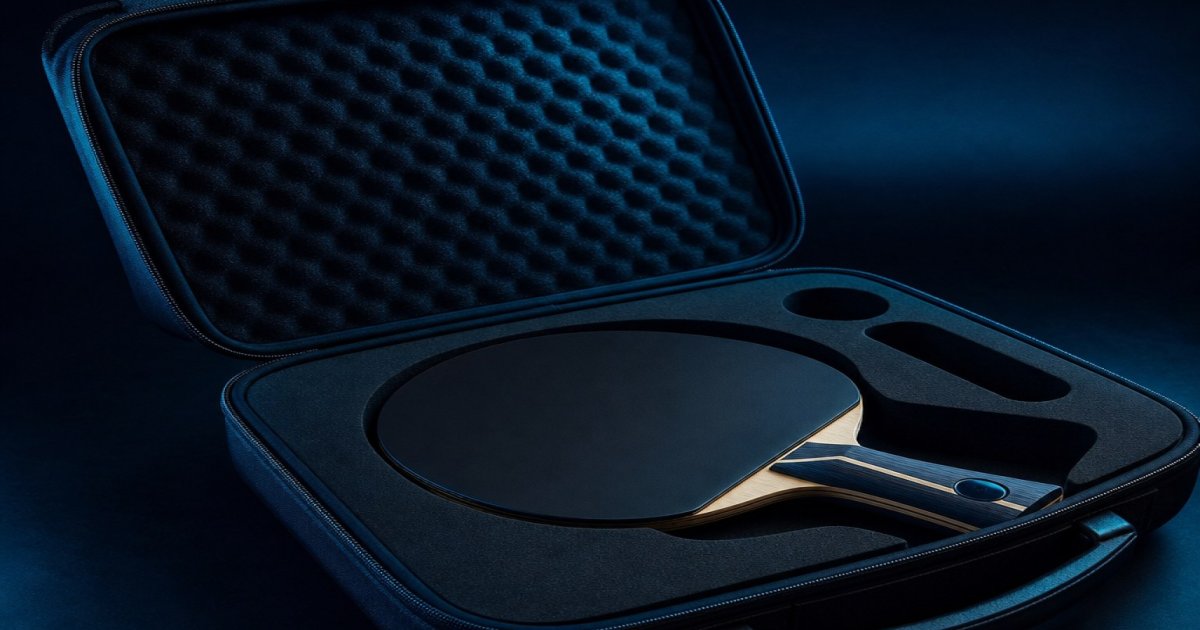
Two players in the same San Fernando club bought identical rackets the same week. One kept his in a hard case with a protective sheet over each rubber, every single time, even for a quick lunch-break hit. He understood how to protect table tennis rubber; his clubmate was about to learn the expensive way.
The other tossed his loose into a gym bag between a sweaty towel and a water bottle. Eighteen months later, one racket still played like new. The other had a forehand rubber gone tacky-dead and edges starting to lift, and its owner was convinced his particular rubber model was simply “one of the bad batches.”
It wasn’t. It had just never once been protected from the exact conditions that kill rubber fastest.
Use a protective rubber sheet over both sides between sessions, store the racket in a case away from direct sunlight and heat, keep it away from moisture, and avoid letting it press against dusty or textured surfaces.
Most rubber degradation comes from air exposure, UV light, and heat, not actual playing wear.
Most players think of rubber protection as an optional extra for serious competitors. It’s actually the difference between a rubber that lasts its full expected lifespan and one that dies at half that, regardless of how well or how often it’s played on.
Oxidation doesn’t announce itself with a dramatic failure. It just quietly takes a little grip and a little bounce, every single week, until one day the difference is impossible to miss.
What actually degrades table tennis rubber over time?
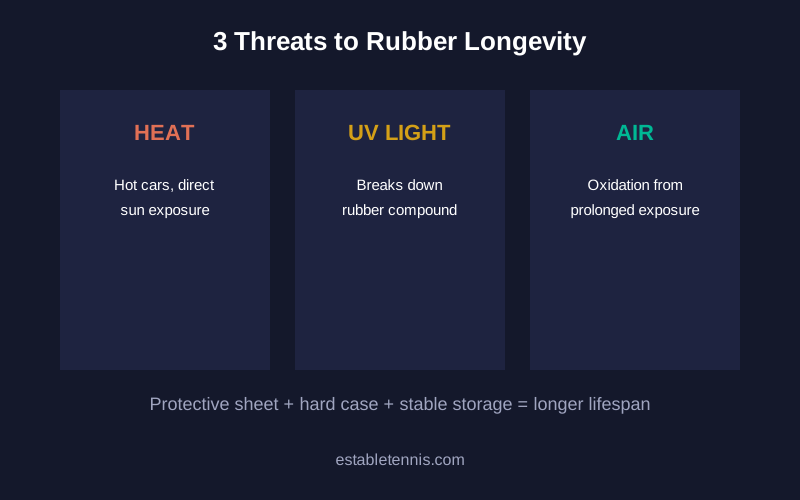
Three factors do the vast majority of the damage: oxidation from prolonged air exposure, UV light breaking down the rubber compound, and heat accelerating both processes.
Actual on-table playing wear is a real but comparatively minor contributor for most recreational and club players: a racket left in a hot car for a season does more damage than a hundred matches of actual play.
A sheet costs a fraction of a rubber replacement and takes seconds to apply: it’s hard to think of a better return on a small habit anywhere else in this sport’s equipment routine.
Why do protective sheets matter so much?
A protective sheet, pressed over the rubber’s tacky surface between uses, blocks direct air contact and prevents dust from settling into the grip-generating texture.
This slows oxidation dramatically and keeps the surface clean, meaning less frequent deep cleaning is needed. See our companion guide on how to clean table tennis rubber for how the two habits work together.
Skipping the sheet exposes the rubber to air constantly, even while the racket sits untouched in a bag.
A dashboard on a sunny afternoon does more damage in an hour than most players manage in a full season of actual play. The trade car storage makes is almost never a good one.
Where’s the worst place to store a racket?
A hot car, direct sunlight through a window, or any environment with significant temperature swings.
Heat softens and accelerates the breakdown of the rubber compound, and UV exposure chemically degrades it even faster than heat alone.
A racket left on a dashboard or in direct sun for a single afternoon can lose noticeable grip and responsiveness that no amount of cleaning will bring back.
A gym bag full of sharp corners, water bottles, and a stray shoe is not a safe neighborhood for a delicate rubber sheet to spend its downtime in.
Does a hard case actually matter, or is a soft cover enough?
A hard case offers meaningfully better protection, primarily against physical impact and pressure: a racket tossed loose into a gym bag can get crushed against other equipment, warping the blade slightly or creating uneven pressure points on the rubber that affect the playing surface over time.
A soft cover is better than nothing, but a hard case combined with protective sheets on the rubber itself is the actual standard for anyone serious about equipment longevity.
Stability is the underrated goal here, more than any single extreme condition: rubber handles a predictable environment far better than it handles constant swings from one condition to another.
How does humidity affect rubber, and does it need special handling?
High humidity can soften sponge temporarily (changing how the racket feels, covered in our piece on rubber hardness) and, over longer exposure, contribute to the same oxidation process that degrades grip.
Very low humidity and dryness can also make rubber more brittle over time. Neither extreme is ideal, and a case that regulates against both, rather than open air storage in an unpredictable climate, is the safer default.
Neglect compounds silently over weeks a racket sits untouched, the exact stretch of time nobody’s paying attention to it at all.
Does how often you play affect how much protection matters?
Protection matters more, not less, for players who train infrequently. A racket in daily use gets handled and stored regularly enough that neglect rarely compounds for long.
A racket that sits in a bag for weeks between sessions is exactly the scenario where unprotected air and heat exposure quietly does the most damage, since nobody’s checking on it in between.
Under a minute, most nights, for a habit that quietly protects hundreds of dollars of equipment across a season.
What’s a realistic, low-effort protection routine?
Apply a protective sheet to both rubber sides immediately after wiping the racket down post-session, store it in a hard case, and keep that case somewhere climate-stable: never a car trunk, never a windowsill.
This entire routine adds under a minute to your post-session habits and is the single highest-leverage thing a player can do to extend equipment life beyond what cleaning alone achieves.
By the time edge lifting is visible to the naked eye, the underlying damage has usually been quietly accumulating for weeks.
How do you know if protection habits are already too late?
If the rubber has visible edge lifting, a dull or matte look where it used to have a slight sheen, or grip that a proper cleaning doesn’t restore, the degradation has likely moved past what protection alone can prevent: that’s a replacement conversation, not a maintenance one. See our guide on how long table tennis rubber lasts for the specific signs.
How does protection interact with cleaning as a combined routine?
Protection and cleaning solve two different halves of the same problem: cleaning removes contamination that’s already accumulated, while protection prevents that accumulation from happening as fast in the first place.
See our companion guide on cleaning table tennis rubber for the removal side of the equation. Treating either habit as sufficient on its own leaves a gap: a rubber that’s protected but never cleaned still accumulates the buildup that does occur, while a rubber that’s cleaned regularly but never protected between sessions is fighting a losing battle against constant fresh exposure.
What’s the actual mechanism behind UV damage to rubber?
Ultraviolet light breaks down the polymer chains that give rubber its elasticity and structural integrity, a chemical process similar to what causes rubber tires, hoses, and other exposed rubber products to crack and degrade with sun exposure over time.
Table tennis rubber is a thinner, more delicate compound than a tire, meaning the same UV exposure that takes years to visibly damage a tire can meaningfully degrade table tennis rubber’s performance in a matter of weeks or months of regular exposure, which is why a single sunny windowsill or car dashboard is a far bigger threat than most players intuitively assume.
Does travel for tournaments create special protection challenges?
Yes, significantly. Travel exposes equipment to a compressed set of risk factors: car trunks in transit, unfamiliar hotel room temperature swings, checked luggage handling that a hard case protects against far better than a soft bag.
Players traveling for tournaments should treat their equipment case with the same care they’d give any fragile, valuable item in transit, keeping it in climate-controlled cabin space rather than checked baggage whenever the format of travel allows for that choice.
How do club and shared facility conditions affect protection needs?
Players who store equipment at a club rather than exclusively at home have less control over the storage environment: club storage areas aren’t always climate-regulated, and equipment left there for extended periods between sessions can be exposed to whatever temperature and humidity swings the facility itself experiences.
Bringing equipment home between sessions, rather than leaving it at a club long-term, gives a player more direct control over storage conditions, even though it’s a slightly less convenient habit than simply leaving gear on-site.
Is there a meaningful difference between cheap and expensive protective sheets?
The core function (blocking air and dust exposure) is achieved by even basic, inexpensive protective sheets, so the price difference mostly reflects material durability and how many uses a given sheet withstands before needing replacement rather than a fundamental difference in protective effectiveness.
A budget sheet used consistently outperforms an expensive sheet that gets skipped half the time out of inconvenience: consistency of use matters considerably more than the specific product tier chosen.
What’s the long-term financial case for taking protection seriously?
Rubber that lasts its full expected lifespan rather than degrading prematurely from neglect represents real, calculable savings over a playing career: a rubber that would otherwise need replacing every four months due to poor storage habits, stretched to a full six or seven months through basic protection, adds up to a meaningfully lower total equipment spend across a year of regular play.
This is a case where a small, cheap, unglamorous habit produces a return that easily outweighs its minor inconvenience.
How does protection interact with the glue bond underneath?
A well-maintained protective routine indirectly supports bond integrity too: excessive heat and moisture exposure, the same factors that degrade the rubber compound itself, can also stress the glue bond over time, particularly at the edges where the rubber meets the blade.
A rubber that’s been well protected tends to show less edge lifting over its lifespan than one exposed to repeated heat and humidity swings, tying the protection habit back to the gluing process covered in our companion guide on how to glue table tennis rubber.
What’s a good way to build protection into an existing routine without it feeling like extra work?
Anchor it to something you’re already doing rather than treating it as a standalone task: apply the protective sheet immediately after the post-session wipe-down, as the very next physical motion before the racket goes into its case.
Habits that get bolted onto an existing routine, rather than introduced as a separate standalone step, are far more likely to actually stick over months and years than habits that require remembering to do something at a completely different time or in a different context.
Does the type of case matter beyond just hard versus soft?
Within hard cases specifically, ventilation and interior padding both matter.
A fully sealed, non-ventilated case can trap residual moisture from a rubber that wasn’t completely dry when packed away, which works against the protective goal rather than supporting it.
A case with light ventilation, or a habit of ensuring the racket is fully dry before closing the case, avoids this specific failure mode.
Interior padding that holds the racket firmly in place, rather than letting it shift and knock against the case walls during transport, reduces physical impact risk on top of the environmental protection a hard shell provides.
How should protection habits change for a player who only plays occasionally?
Counter to what might seem intuitive, infrequent players benefit even more from consistent protection habits than frequent players do, precisely because their equipment spends more total time sitting in storage relative to time spent actively playing.
A racket played twice a week and properly protected between sessions experiences far less cumulative exposure than a racket played once a month and left unprotected in a bag the rest of the time: the degradation clock runs whether or not the racket is being used, which makes storage habits the dominant factor for anyone whose actual playing frequency is low.
Two identical rackets, one careful owner and one careless one, will tell this story every time, not because the rubber itself was ever different, but because everything that happened to it between matches was.
Eighteen months is a long time to run an accidental experiment, but sometimes that’s exactly what it takes for the lesson to actually land.
The bad batch excuse is almost always a good habit excuse in disguise: the manufacturer rarely fails; the storage routine usually does.
Buy the case first, always. It’s the cheapest insurance policy on the whole equipment list.
Side by side, the two rackets told a story neither owner could argue with, and one of them finally listened.
Wear from actual play is a badge of honor. Wear from neglect is just a waste, and the two are easy to tell apart once you know what to look for.
It costs nothing to protect a rubber sheet for its first week. It costs plenty to replace one that never made it to month four.
None of this is complicated. It’s just easy to forget until the difference is too obvious to ignore anymore.
Take care of the rubber and the rubber takes care of you, right up until the day it doesn’t and you finally understand why.
Quick Recap: How To Protect Table Tennis Rubber
Getting how to protect table tennis rubber right comes down to matching the equipment to where you actually are, not where marketing copy wants you to be.
Revisit this whenever your game changes enough that the current setup starts feeling wrong.
Frequently Asked Questions
According to the ITTF equipment regulations, all racket coverings must meet specific approval standards before use in sanctioned competition.
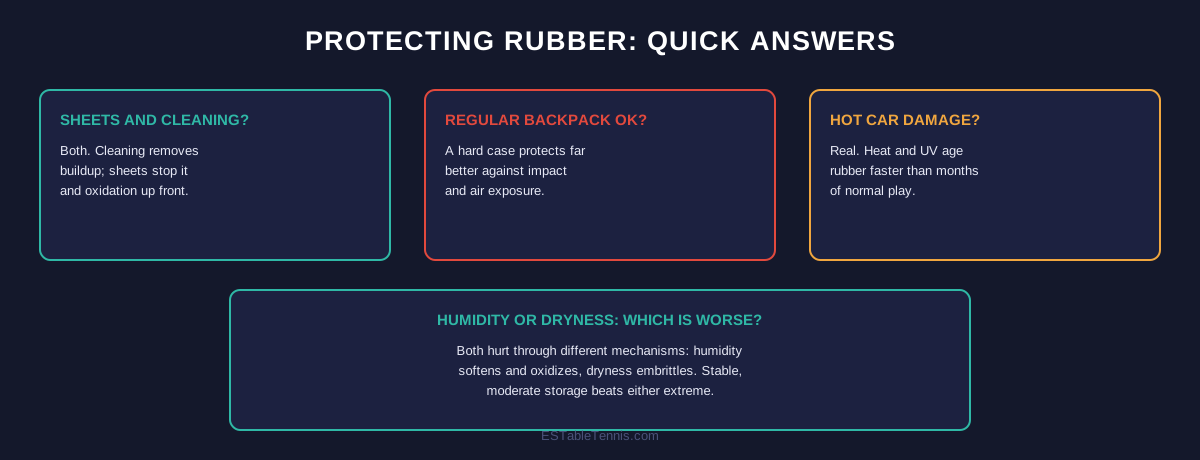
Do I really need a protective sheet if I clean my rubber regularly?
Can I store my racket in a regular backpack?
Does leaving a racket in a hot car really damage it that much?
How much does rubber protection actually extend its lifespan?
Is humidity or dryness worse for table tennis rubber?
The player with the dead forehand rubber eventually replaced his racket, and this time bought a hard case along with it, not because anyone convinced him with an argument about oxidation rates, but because he’d finally seen, side by side, what eighteen months looks like with protection and without it, and the difference wasn’t subtle enough to argue with.
Want a full care routine matched to how often you actually play and where you store your gear? PingPath gives you a fitted setup and maintenance plan in under three minutes.
Leave a Reply