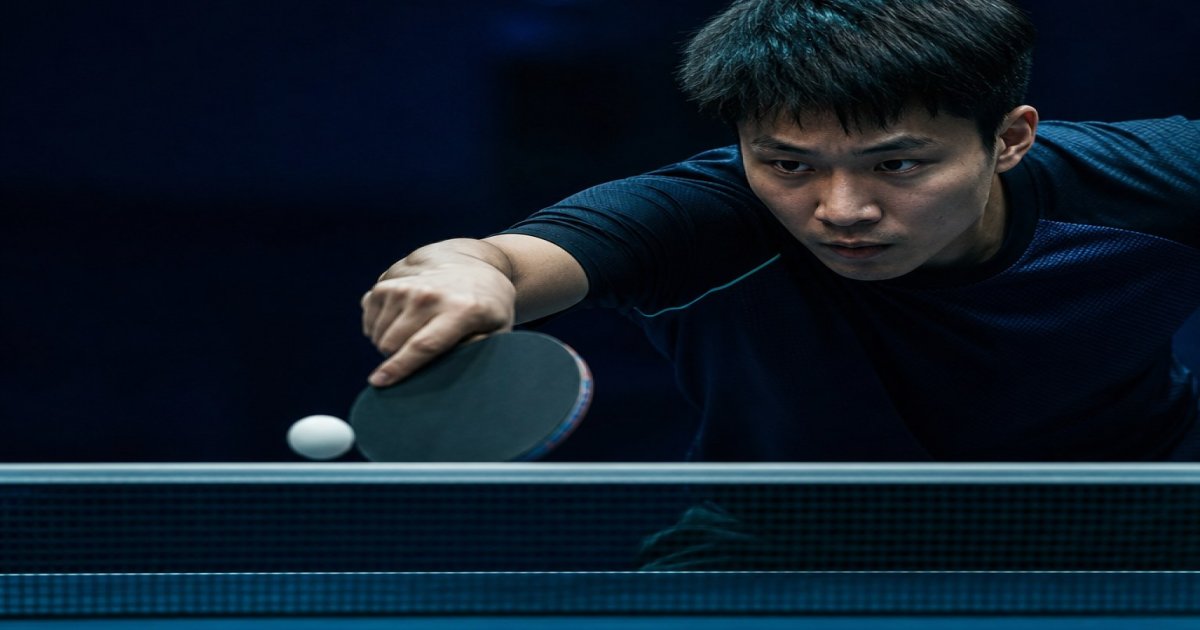
A player in Diego Martin lost three straight points to the exact same short serve before finally trying something different on the fourth: instead of pushing it back safely, he snapped his wrist and flicked it aggressively cross-court, catching his opponent completely off guard. He’d known the flick existed for over a year. He’d just never trusted it enough to actually use it until safe options ran out entirely.
A flick is an aggressive, wrist-driven attacking shot used against a short ball close to the net, where a full swing isn’t possible. Snap the wrist and forearm forward and slightly upward through the ball, generating topspin and pace from a compact motion rather than a full-body swing, aiming to turn a defensive short ball into an offensive opportunity.
The flick occupies an unusual place in most players’ games: technically understood by many, genuinely trusted and used by far fewer, precisely because it demands confidence at the exact moment a rally offers the least room for error.
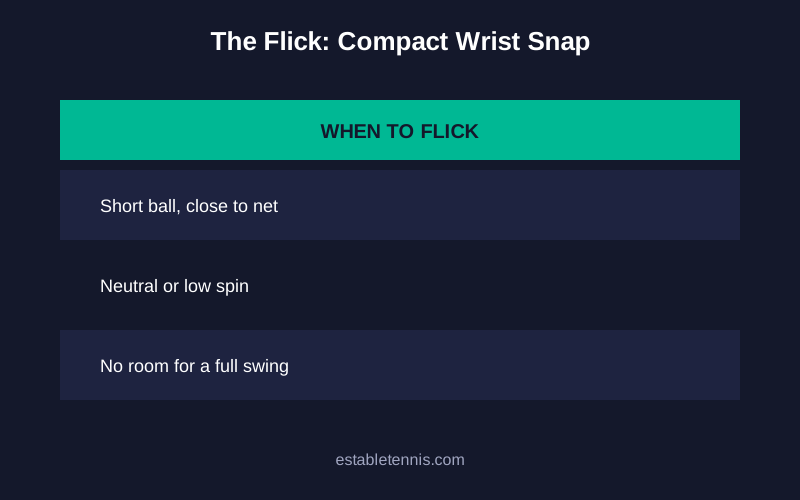
When is a flick actually the right shot to attempt?
Against a short ball landing close to the net, typically with limited spin, where a full swing isn’t physically possible due to the close proximity to the table’s edge. A flick against a heavily spun short ball, particularly heavy backspin, is considerably riskier and requires more precise technique than a flick against a relatively neutral, low-spin short serve or return.
How does a flick differ mechanically from a full loop or drive?
A flick relies almost entirely on wrist and forearm snap rather than the larger body rotation and weight transfer central to a full swing, since the ball’s proximity to the net and table edge leaves no room for a full backswing. This compact mechanism makes the flick simultaneously more accessible in tight spaces and more technically demanding to execute with consistent power and placement.
What’s the biggest risk in attempting a flick?
Misjudging the incoming ball’s spin, particularly backspin, which can cause a flick attempt to sail into the net if the wrist snap doesn’t adequately compensate for the ball’s downward-dragging rotation. This is why confident flick execution depends heavily on accurate spin reading, covered in our guide on how to read spin in table tennis, since a technically sound flick against misread spin still fails.
Why do so many players avoid using the flick even when they understand it?
Because the shot is attempted in a uniquely exposed moment (close to the table, with limited recovery time if it goes wrong), and that exposure creates genuine hesitation even among players with sound technical understanding of the mechanics.
This mirrors a broader pattern across the sport: understanding a shot intellectually and trusting it enough to commit under real pressure are two entirely different stages of development.
How does grip affect flick execution?
A slightly looser grip through the initial approach, tightening only at the moment of wrist snap, allows for the fast, whip-like acceleration a flick depends on. A grip held tightly throughout restricts the wrist’s range of motion and speed, producing a weaker, less controlled flick regardless of how sound the overall technique otherwise looks.
Does equipment affect how effectively a player can flick?
Yes, meaningfully. Rubber with good grip, covered in our guide on choosing rubber for beginners, is particularly important for a flick, since the shot’s compact, fast motion relies heavily on the rubber efficiently converting that motion into spin and control rather than the ball sliding across a low-grip surface.
What’s a good way to practice the flick specifically?
Multiball practice with a coach or partner feeding consistent short balls, covered in our guide on multiball training, lets a player repeat the specific wrist-snap motion and build confidence against a predictable feed before testing it against the unpredictability of live match serves and returns.
How does the flick connect to overall tactical aggression in a player’s game?
A player who has genuinely mastered the flick gains a real offensive option against short balls that would otherwise force a purely defensive push, which meaningfully expands their tactical range and makes them considerably harder to control through short serves alone. Opponents who rely heavily on short serves specifically to deny attacking opportunities lose much of that advantage against a player confident enough to flick aggressively.
How does the flick differ between forehand and backhand execution?
A forehand flick generally allows slightly more power through additional wrist and forearm range, while a backhand flick, often called a banana flick in modern competitive terminology, relies on an even more compact, precise wrist motion given the more restricted natural range of the backhand side.
Both variations share the same core principle (compact, wrist-driven acceleration against a short ball) adapted to each side’s specific mechanical constraints.
What’s the connection between flick confidence and overall serve-return strategy?
A player who can confidently flick short serves removes one of the most common defensive tactics opponents rely on: serving short specifically to deny an attacking response.
Once flick confidence develops, short serves become a genuine risk for the server rather than a safe, low-reward option, which shifts the entire tactical balance of serve-and-return exchanges covered in our guide on how to return serve.
How does mental pressure specifically affect flick execution?
The flick’s exposed, close-to-the-table nature makes it particularly vulnerable to pressure-induced hesitation, since a mistimed or under-committed flick attempt often produces a worse outcome than either a fully committed flick or a safer, more conservative push.
Players who’ve only practiced the flick in relaxed conditions frequently find their execution deteriorates specifically at key match moments, which is why deliberately practicing the shot under simulated pressure builds a different, more resilient kind of confidence than relaxed repetition alone provides.
Does the flick carry more risk against certain rubber types on the opponent’s side?
Yes. A flick attempted against a ball that’s already interacted with pimples-out or long pips rubber, covered in our guides on inverted vs pimples-out rubber and long pips table tennis, carries additional uncertainty, since the incoming ball’s actual spin behavior may not match what its trajectory and bounce initially suggest.
Players facing an opponent using disruptive rubber types should factor in extra caution before committing to an aggressive flick against an unfamiliar spin signature.
What’s a realistic developmental timeline for building genuine flick confidence?
Basic flick mechanics, executed against a predictable, fed short ball, typically develop within a few weeks to a couple months of dedicated practice. Genuine confidence to attempt the shot reliably in live, unpredictable match situations (the harder, more valuable milestone) usually takes considerably longer, often six months to a year of accumulated match experience, since it depends as much on overcoming the psychological exposure of the shot as on the underlying technical mechanics themselves.
How does footwork factor into an otherwise wrist-dominant shot?
Even though the flick’s power comes primarily from the wrist and forearm, getting the feet and body into a stable, close position near the table matters considerably: a flick attempted while lunging or off-balance loses much of the precision the shot depends on, since the wrist snap needs a stable base to actually transfer its energy accurately into the ball rather than into compensating for poor positioning.
Quick, small steps toward the ball, rather than a large lunging step, typically produce the more stable base a good flick requires.
What’s the difference between a flick and a short push, tactically speaking?
A push is a controlled, largely defensive shot that keeps the ball low and short, typically buying time or maintaining a neutral rally position without taking real risk. A flick actively converts the same short-ball opportunity into an attacking shot, accepting more risk in exchange for the chance to seize control of the point rather than simply continuing it.
Choosing between the two isn’t purely technical: it’s a tactical decision based on the specific match situation, score, and confidence level in that moment.
Does the flick require reading the opponent’s serve before or after the ball bounces?
Both, in sequence. Initial spin reading happens from the server’s toss and swing, covered in our guide on how to read spin in table tennis, giving a preliminary sense of what to expect. The ball’s actual bounce behavior on the receiving side then confirms or corrects that initial read, and a confident flick attempt depends on quickly synthesizing both pieces of information within a very short window before committing to the shot.
How does a player recover if a flick attempt goes wrong?
Quickly resetting footwork and positioning immediately after a missed or weak flick matters more than dwelling on the specific error, since the compact, exposed nature of the shot means a failed attempt often leaves a player in an awkward recovery position for whatever follows.
Treating each flick attempt as an independent decision, rather than letting one miss create hesitation on the next opportunity, is part of the same mental resilience that separates players who eventually trust the shot from those who quietly stop attempting it after a single bad experience.
Is the flick equally useful at every level of competitive play?
Its value generally increases with competitive level, since higher-level opponents serve shorter and more specifically to deny easy attacking opportunities, making a reliable flick increasingly valuable as a counter to that strategy.
At more casual or beginner levels, opponents may serve longer or less precisely, offering other attacking opportunities that reduce how often a flick specifically becomes necessary, though building the skill early still pays dividends as a player’s opponents improve.
How does the modern “banana flick” differ from a traditional backhand flick?
The banana flick, a specific backhand flick variation popularized in modern competitive play, uses an even more pronounced wrist rotation and a slightly different contact angle to generate exceptional sidespin combined with topspin, making the resulting shot considerably harder to read than a more traditional, simpler backhand flick.
This variation represents an evolution of the basic flick principle rather than a completely different shot, showing how a fundamental technique can continue developing new variations even after decades of competitive use.
What’s a good progression for a player learning to flick for the first time?
Start with flicks against a coach or partner’s gentle, predictable, low-spin short feeds, building basic wrist-snap mechanics and contact consistency before introducing any spin variation on the fed ball. Once contact and basic power feel reliable, gradually introduce backspin on the feeds to build the spin-reading and compensation skills a real match situation demands, rather than jumping straight into live match attempts before the underlying mechanics are solid.
How does a flick’s risk-reward calculation change based on the score in a match?
Many players adjust their willingness to attempt a flick based on match situation: more aggressive at a comfortable lead where a missed attempt carries less consequence, more conservative at a tight, pressure-filled score where a safer push might be the wiser tactical choice despite sacrificing offensive potential.
This situational judgment, weighing the shot’s real risk against the specific match context, is itself a skill that develops alongside the pure technical mechanics of the flick.
According to ITTF equipment regulations, rubber and blade specifications apply equally to every shot in the sport, meaning a flick’s effectiveness comes entirely from wrist mechanics and timing within those standardized limits, not from any equipment advantage a player might otherwise seek.
Three lost points and a full year of theoretical understanding sat between that player in Diego Martin and the moment he actually trusted his own wrist enough to commit. Most players carry that exact same gap for considerably longer than they need to, simply because nobody forced the issue the way running out of safe options finally did for him.
A shot understood in theory and a shot trusted under pressure occupy entirely different parts of a player’s game, and the flick sits closer to that gap than almost anything else in the sport: simple enough to explain in two sentences, difficult enough to actually commit to that most players quietly avoid it for years.
Practice doesn’t close that gap by itself. Only repeated exposure under something resembling real pressure eventually does, which is exactly why the flick rewards deliberate, uncomfortable practice more than almost any other shot covered on this site.
Wrist first, confidence second, and somewhere in between, an opponent stops finding your short-ball serve quite as safe as they thought it was.
Running out of safe options is a strange but reliable teacher. Most players never get pushed there voluntarily.
Push yourself there deliberately instead, in practice, where a miss costs nothing but a little pride.
A single committed attempt in a low-stakes rally teaches more about your own hesitation than a hundred hours of shadow practice ever could.
Simple as that.
Commit fully or don’t attempt it at all. The half-measure is the only version of this shot that reliably fails.
Somewhere in your own club, right now, an opponent is quietly counting on you never trying it.
Prove them wrong.
Next short serve you get, take the shot.
See what happens.
Worth it, win or lose that single point.
Quick Recap: Table Tennis Flick
A reliable table tennis flick turns a defensive short ball into a genuine offensive weapon, using compact wrist and forearm snap rather than a full swing that the close proximity to the table simply doesn’t allow. The player in Diego Martin had known the mechanics for over a year. What changed on the fourth point wasn’t his technique: it was finally trusting it enough to actually commit.
Frequently Asked Questions
When should you use a flick instead of a safe push?
What’s the biggest risk when attempting a flick?
Why do players avoid flicking even when they know the technique?
Does equipment affect flick execution?
How long does it take to build real confidence flicking in matches?
He won that point, and the next two after it, simply because his opponent had never once seen him flick before and had no answer prepared for a shot that had technically always been available.
Curious whether your current rubber setup supports the fast, compact motion a flick requires? PingPath gives you a fitted recommendation in under three minutes.
Leave a Reply