Every club has one. A player nobody wants to draw in the first round, not because they hit hard, not because their serve is unreadable, but because they barely hit the ball at all. Everyone in the draw knows exactly what to expect and loses to it anyway, year after year, because knowing the plan and actually executing it under real frustration turn out to be two very different things. They push it back, low and slow and heavy with backspin, and wait for you to beat yourself. A quiet game with a loud effect on the scoreline. Nobody enjoys drawing them. Everybody underestimates them anyway.
Losing to a pusher stings in a specific way losing to a hard hitter never does, because it feels like losing to someone doing less. That feeling is exactly the trap. That feeling has nothing to do with the actual difficulty of the match in front of you, and treating it as useful information is the first mistake. Losing to a strong attacker feels like meeting someone better. Losing to a pusher feels like losing an argument you were supposed to win.
To deal with a pusher in table tennis, wait for a shorter or higher push rather than forcing an attack on a deep, heavy one, vary your own serves and placement so they cannot settle into a rhythm, and manage your own patience, since the pusher’s real weapon is your frustration, not their backspin. A patience contest you can actually train for.
Why Is a Pusher So Much Harder to Beat Than Their Skill Level Suggests?
A pusher is harder to beat than their raw skill level suggests because they are not really playing a skill contest with you. They are playing a patience contest, and most attacking players have trained their skill far more than their patience.
Every push is a small, repeated invitation to force a shot before it is actually ready to be attacked, and every time you take that invitation early, you hand the pusher the exact unforced error they were waiting for. The mental trap is believing this should be easy because their shots look unimpressive. It is not easy, precisely because the entire style is engineered to make an impatient opponent beat themselves.
What Actually Is a Push, and Why Does It Create So Much Backspin?
A push is a short, controlled backspin shot made by brushing underneath the ball with a slightly open racket face, and the heavy backspin it produces comes from the same physics that make a topspin loop dip and curve, just running in the opposite direction.
Spin on a ball creates a pressure difference across its surface as it travels, the same Magnus effect responsible for a curveball in baseball or a bending free kick in football. Backspin generates lift that keeps the ball’s flight longer and lower, and when that same spin hits your racket, it wants to push your return down into the net unless you compensate for it.
This is why a rushed, flat return against a heavy push so often ends up in the net: the spin is doing exactly what the physics predicts, and the shot did not compensate for it.
What’s the Right Way to Attack a Push Instead of Just Rallying It Back?
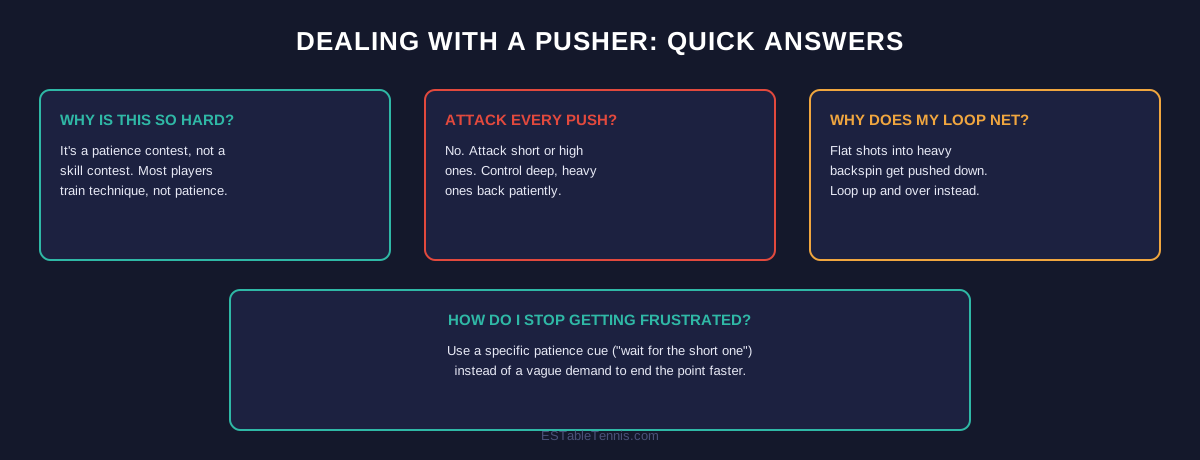
Wait for a push that sits up higher or shorter than the pusher intended, and attack that one specifically, rather than forcing an aggressive shot on every single push regardless of its quality.
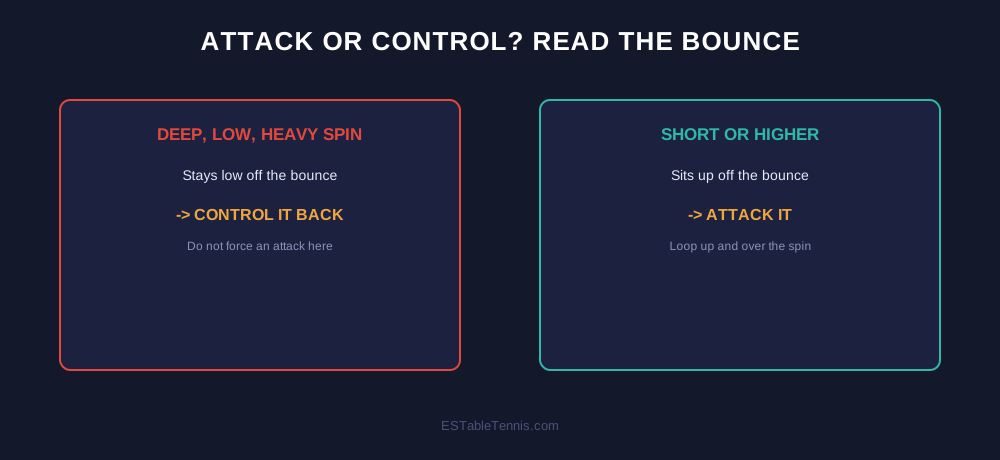
Good pushers rarely give you the same quality push twice in a row. A deep, low, heavily spun push is a shot to control back deep and low yourself, not a shot to attack. A shorter or slightly higher push is the actual opening, and recognizing the difference in the split second before you commit is the specific skill that separates players who beat pushers from players who lose to them repeatedly.
The specific tell most players miss: watch the ball’s bounce, not just the incoming trajectory. A push that bounces and stays low on your side of the table, barely rising above net height, is a genuine push to control back.
A push that bounces slightly higher off your own table, even by a small margin, is the one to attack, since that extra height is exactly what gives you room to brush up and over the backspin cleanly. Learning to read this specific difference, in the bounce rather than the flight, is a faster skill to build than it sounds, since it only requires watching one thing consistently rather than the whole shot.
When you do attack, loop up and over the backspin rather than driving flat through it, since a flat, hard shot straight into heavy backspin is the single most common way this rally ends in the net.
How Should You Serve Against a Pusher?
Serve short and low more often than you would against an attacking player, since a pusher’s whole game depends on receiving from a comfortable mid-distance, and a well-placed short serve denies them that starting position before the rally even begins.
A long, fast serve, which works well against players who struggle with pace, often plays directly into a pusher’s strength, since they are frequently very comfortable controlling exactly that kind of ball back into another patient push. Short serves force a decision at the table rather than a comfortable push from their preferred distance, and that decision, forced early in the point, is worth more than any single serve’s raw speed or spin.
How Do You Stop a Pusher From Settling Into a Rhythm?
Vary your own serves and shot placement deliberately, since a pusher’s game depends on predictable rally patterns, and disrupting that predictability is often more effective than trying to out-push them at their own specialty.
Mix your serve length and spin so they cannot settle into pushing back the same serve over and over. Bring them forward with a short, low serve occasionally, since some pushers are far less comfortable close to the table than they are in their preferred mid-distance rhythm. Change the pace of your own shots deliberately, a mix of patient control and sudden, well-chosen attack, rather than settling into the same predictable rally speed they are most comfortable countering.
What If the Pusher Also Blocks and Counter-Attacks Well?
Treat this hybrid style as a different problem, since a pusher who also blocks confidently can turn your attack back at you, which means the goal shifts from “win the point with one big attack” to “win the exchange that follows the attack.”
Against a pure pusher, one well-timed loop often ends the point outright. Against a pusher who blocks well, that same loop frequently comes back, sometimes with added spin or placement of its own, and the real contest becomes what happens two or three shots after your attack, not the attack itself.
Prepare for this specifically: if your first attack is likely to come back, plan your second and third shots as part of the same sequence rather than treating the loop as a single, point-ending action.
Doubles against a pusher-heavy pair changes the calculation again, since the third-ball attacker is not always the same player who just received the push, and communication about who is attacking which return becomes part of the plan itself, not just an individual shot decision.
Should Beginners Deal With a Pusher in Table Tennis Differently Than Advanced Players?
Yes. Beginners without a reliable loop yet should focus on consistency and patient rallying rather than forcing an attack their technique cannot yet support, while more advanced players should lean into the looping game plan described above.
If you cannot yet loop backspin consistently in practice, do not try to learn it live in a match that matters. A beginner’s more realistic path against a pusher is out-consistency rather than out-attacking, controlling the ball back reliably and waiting for the pusher to make the first unforced error, since even a specialist push game produces occasional mistakes over a long enough rally.
This is a less exciting plan than looping winners, and it is also the honest, correct plan for a player whose technique has not caught up to the more aggressive approach yet.
What’s the Mental Trap Most Players Fall Into Against a Pusher?
The trap is treating every single push as an insult that must be punished immediately, which produces exactly the impatient, forced attack the pusher is engineered to exploit.
This connects directly to the self-talk covered in table tennis self-talk between points. A player muttering “just hit it already” after every long push rally is talking themselves into exactly the rushed shot that loses the point. The useful internal cue here is patience-focused and specific: “wait for the short one,” not a vague, frustrated demand to end the point faster than the point is actually ready to end.
How Do You Practice Playing Against a Pusher When Your Club Doesn’t Have One?
Ask any training partner to deliberately push for an entire session, rather than waiting to encounter a real specialist only in tournament play, since the specific patience and decision-making this style requires does not develop from occasional, unplanned exposure.
Most clubs have at least one player capable of pushing consistently even if it is not their natural style, and asking them for a dedicated session, twenty minutes of nothing but push rallies where you practice waiting for the short ball, is worth more than months of hoping the skill develops naturally in matches you did not choose.
If nobody at your club can push reliably, a multiball routine with heavy backspin feeds is a reasonable substitute for grooving the stroke, though it will not replicate the decision-making of a real, varying opponent. Ask for it specifically. Most players are happy to help once they know what you are actually training.
Is It Ever Correct to Just Out-Push a Pusher?
Occasionally, particularly if your own push and placement are genuinely excellent and your looping game is not, but this is a narrower path than most players assume, since a dedicated pusher has usually spent far more time on this specific skill than you have.
Trying to beat a specialist at their own specialty is rarely the highest-percentage plan; the same principle applies to how to beat a higher-rated player. If you do choose this route, it should be a deliberate decision based on a real, honest read of your own push quality relative to theirs, not a default fallback because attacking backspin feels harder in the moment. Most players who “decide” to out-push a pusher are actually just avoiding the harder, more effective plan because it requires more nerve.
There is a specific version of this frustration worth naming directly: the player who plays a perfectly patient, well-controlled rally for eight or nine shots and then, out of nowhere, forces a wild attack on a deep, unattackable push purely because the rally has gone on “too long.”
The shot quality did not change. The patience did. If you notice this pattern in your own game, the fix is not more technical work on your loop. It is treating rally length as irrelevant information and judging every single push purely on its own merits, exactly as if it were the first ball of the point. Every single time, without exception, no matter how the rally started.
Does Your Rubber Choice Matter Against a Pusher?
Yes, significantly, since looping consistently off heavy backspin requires a rubber with enough grip and sponge response to generate real topspin from a low, spinny ball, and a rubber that is not suited to this produces exactly the mis-hit, net-bound returns that make pushers so frustrating to play. A hard, flat rubber can still control a push back competently.
It is the attacking half of this matchup, the loop, where the wrong sponge and surface actually cost you points, not the controlling half.
A hard, fast rubber built for flat hitting often struggles specifically against heavy backspin, since it does not grip and lift the ball the way a looping-oriented rubber does. If you find yourself netting looping attempts against pushers specifically, more than against any other style, that is worth checking against your actual equipment before assuming the problem is entirely technique.
PingPath’s fit quiz accounts for exactly this kind of style-specific mismatch when it recommends rubber.
Frequently Asked Questions
None of this is about learning to enjoy long, grinding rallies for their own sake. It is about removing the one variable, your own impatience, that the pusher across the table is actively counting on, so the match becomes a genuine contest of shot quality instead of a countdown to whoever cracks first.
What Should You Practice Before Your Next Match Against a Pusher?
Drill looping off backspin specifically, not just against a machine feeding identical balls, but with a partner varying push depth and height so you practice the actual decision: attack this one or control that one, not just the stroke in isolation.
The pusher across the table from you next weekend is not doing less work than a hard hitter. They are making you do the deciding, over and over, and betting you will decide badly under pressure. It only feels lazy. It is actually one of the most demanding disciplines in the entire sport, precisely because so little of it is visible from the sideline.
They have simply chosen to spend it differently than you have. Prove them wrong on the shot selection before you ever worry about the stroke. Not a stronger loop. A steadier head.
For a natural companion tactic, see how to beat a looper in table tennis, the opposite style problem. And if you suspect your rubber is part of why backspin gives you trouble, PingPath’s quiz matches your setup to your actual playing style in a couple of minutes.
Leave a Reply