
There is a player at a club in Tunapuna who narrates his own mistakes out loud. “Typical.” “Here we go again.” “Same thing every time.” He is not trying to be dramatic. He genuinely does not notice he is doing it. His opponents notice. So does his next shot, which usually arrives about as badly as the sentence he just said to himself. His self talk between points is not a quirk; it is the loudest voice in the match, and the one nobody ever coached him on.
He is a decent club player, good enough to make most opponents work, and the sentence coming out of his mouth after every unforced error has nothing to do with the actual shot he just missed. It is a verdict on his whole character, delivered out loud, in real time, several times a set.
What you say to yourself between points is not background noise. It is an instruction, and your body follows instructions whether you meant to give one or not. This applies whether you play in silence or narrate every point out loud, since the internal version runs the same script even when nobody else can hear it.
The self-talk that actually helps between points in table tennis is short, specific, and forward-looking: one instructional cue about the next shot (“watch the ball”), or one factual, non-catastrophic acknowledgment (“that was a tough point”) instead of a global judgment (“I always choke”). Catch the global judgment the moment it happens and replace it on purpose.
What Is Self Talk Between Points, and Does It Affect Performance?
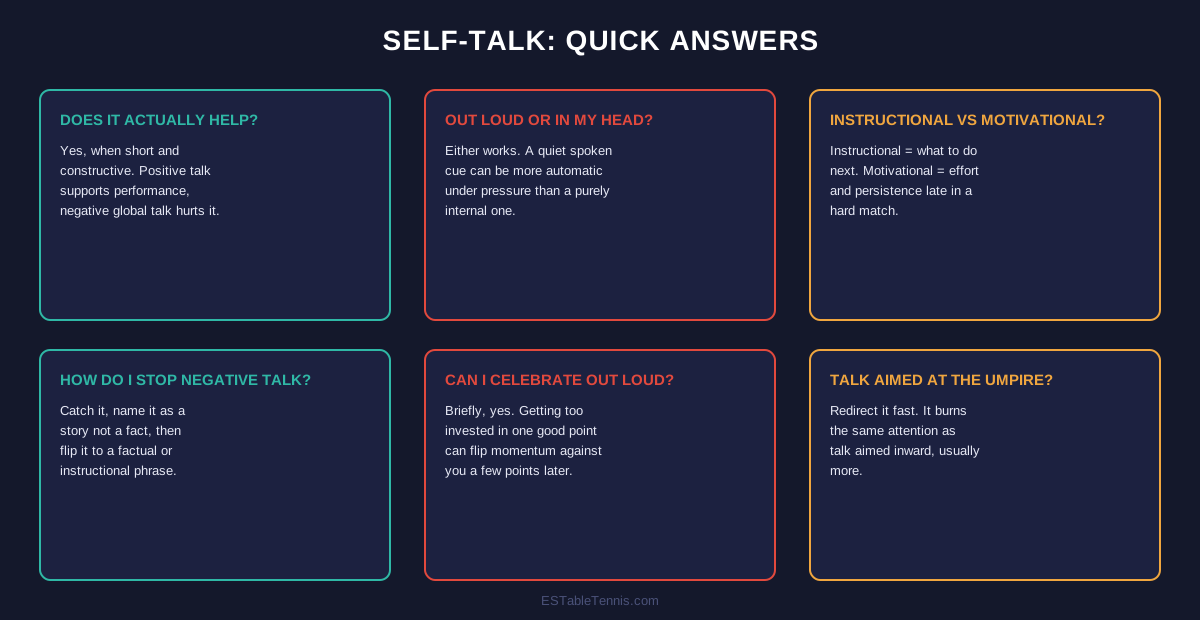
Self-talk is the internal or muttered commentary you run during a match, and research on self-talk in sport consistently finds that positive, constructive self-talk supports performance while negative self-talk actively hurts it. This is not a motivational slogan. It is a direct mechanical effect: the words you use shape where your attention goes next, and attention is the resource that decides whether your next shot executes cleanly or falls apart.
The player in Tunapuna is not unlucky. Every time he says “typical,” he is rehearsing the exact narrative he is trying to avoid, and priming his own attention toward failure rather than toward the next serve.
What’s the Difference Between Instructional and Motivational Self-Talk?
Instructional self-talk tells you what to do next (“watch the ball,” “soft hands”), while motivational self-talk is about effort and belief (“come on,” “stay in this”). Both have a place, but they are not interchangeable, and using the wrong one at the wrong moment wastes the tool.
Instructional talk works best for skill execution, exactly the moments covered in how to stop choking in table tennis, where a short external cue word redirects your attention away from over-supervising your own technique. Motivational talk works best for effort and persistence, the mental push needed after a long, physically demanding rally or deep into a fifth game when your legs are tired, and your focus is drifting toward the finish line instead of the point in front of you.
Mixing them up is common. Players often reach for motivational talk (“come on, focus”) when what they actually need is a specific instructional cue, and the vague encouragement does not tell their body anything concrete to do differently.
Does the Right Phrase Change Depending on the Stage of the Match?
Yes. Early in a match, when nerves are highest and your body has not settled, instructional cues do the most work, since your attention is the thing most likely to drift toward the crowd, the scoreline, or the size of the tournament rather than the ball. A simple “watch the ball” repeated on your own serve grounds you in the present task before your mind has the chance to wander somewhere less useful.
Mid-match, once you are physically warmed into the contest, self-talk shifts toward tactical reminders tied to your specific plan for that opponent, “middle, not wide” or “wait for the short one.” This is less about calming yourself and more about keeping your own game plan active in a match that is naturally pulling your attention toward whatever your opponent just did.
Late in a deciding game, when fatigue is real, and the stakes are at their highest, motivational talk earns its place back, short phrases about effort and presence (“one more,” “stay here”) that keep you fighting for the point in front of you rather than mentally negotiating with how tired you already are.
What Should You Actually Say to Yourself Between Points?
Build a short, specific phrase for each of the three situations that come up in every match: after a point you lost, after a point you won, and facing a pressure point.
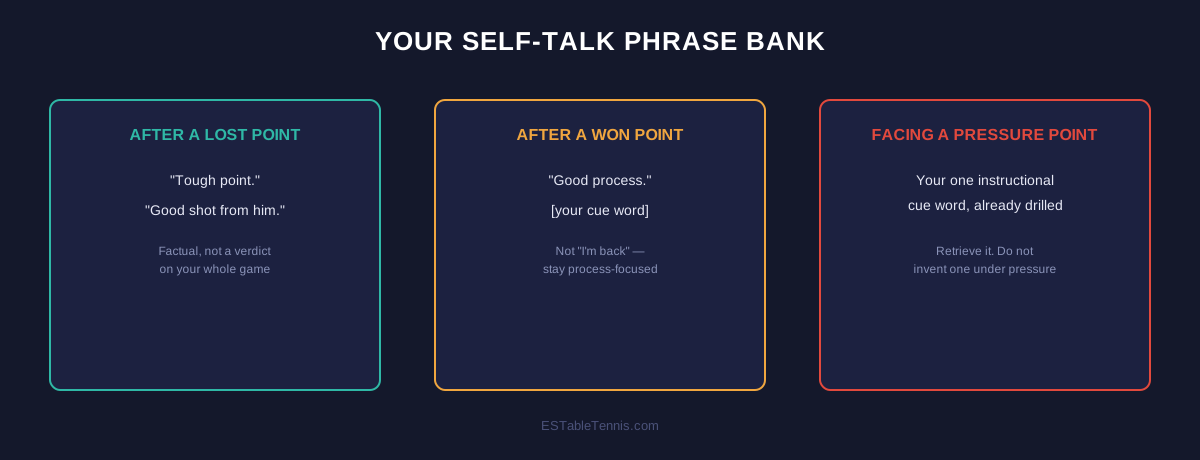
After a lost point, use a factual, non-catastrophic acknowledgment rather than a judgment: “tough point” or “good shot from him,” not “I always mess this up.” The first names what happened without attaching a permanent story to it. The second turns one point into a character flaw. One is a scoreline. The other is a diagnosis you gave yourself for free.
After a won point, keep it brief and process-focused rather than outcome-focused: “good process” or your specific cue word, not “I’m back.” Getting emotionally invested in a single good point is how a momentum shift starts working against you two points later, and it is one of the most common ways a genuinely strong player loses a game they were winning comfortably, a dynamic covered in full in how to stop a momentum shift in table tennis.
Facing a pressure point, use your one instructional cue word, the same one you have already drilled in practice. This is not the moment to invent a new phrase. It is the moment to retrieve the one you already trust. Under real pressure, your working memory narrows, and a phrase you are still deciding on competes for the same narrow bandwidth your shot needs. A retrieved phrase costs almost nothing. An invented one costs exactly the attention you cannot spare.
Building this bank is worth doing away from the table entirely, sitting down for ten minutes and actually writing three phrases: one for a lost point, one for a pressure point, one for the specific tactical reminder you need against your usual opponents. Players who try to invent the right words mid-match are doing the hardest version of this task at the worst possible time. Players who show up with the phrases already chosen are just retrieving something familiar.
This also explains why copying someone else’s exact words rarely works as well as building your own. A cue that feels natural in your own voice, drawn from how you actually think and talk, gets adopted faster than a phrase borrowed wholesale from a coach or a book, this one included. Use the categories here as a structure, not a script.
What If You Are Naturally Quiet and Do Not Talk to Yourself at All?
Silent self-talk works exactly the same way and does not need to become audible muttering to be effective. What matters is that the internal instruction still happens, deliberately, at the same specific moments, not that anyone can hear it.
Some players find the internal version alone drifts too easily, especially under real pressure, and a quiet, barely audible cue (a whisper only you would notice) anchors the thought more reliably than a purely mental one. This is worth testing in low-stakes practice rather than assuming one version suits you without trying both. Neither version is more advanced than the other. The only failure mode is skipping the deliberate cue entirely and letting whatever thought shows up run the show instead.
Quiet players sometimes worry that adding any form of self-talk will feel forced or fake, unlike their natural personality. It will, for the first few weeks. A cue word you have said two hundred times in practice stops feeling like a performance and starts feeling like your own voice, in the same way a stroke you have drilled two hundred times stops feeling like technique and starts feeling like instinct.
None of this requires you to become a different kind of competitor, loud, animated, visibly fired up. The quietest players in any club can run this exact system without anyone else in the room ever noticing it is happening. The only person who needs to hear it is you, and only at the moments you have already decided it matters.
What Do Elite Players Actually Say to Themselves?
Watch a high-level match closely, and you will see the self-talk even when you cannot hear it: a single word mouthed after a serve, a nod, a specific fixed phrase repeated at the same moment every single time. It is rarely dramatic. It is almost always short, and it almost always repeats identically point after point, which is the entire point.
The consistency matters more than the content. A cue that changes every match is not a cue; it is an improvisation, and improvisation under pressure is exactly what falls apart first. You would not walk into a match with a serve you invented that morning. Treat your cue word with the same respect. Elite players are not smarter about what to say.
They have simply said the same specific thing enough times that it fires on command instead of requiring thought. You can hear the difference in a coach who has watched enough matches: the mutter of a player narrating a verdict on themselves sounds completely different from the mutter of a player retrieving a rehearsed instruction, even when neither one is intelligible from three tables away.
How Do You Break a Habit of Negative Self-Talk?
Break the habit with a three-step catch, name, and flip sequence: notice the negative phrase the instant it happens, name it out loud as what it is (“that was a global judgment, not a fact”), then replace it with the factual or instructional version before you serve or receive the next point.
This will feel clunky and slow at first, and it should. You are interrupting a pattern that has probably been running on autopilot for years. The player in Tunapuna did not stop saying “typical” by deciding to feel more positive.
He stopped by noticing the exact moment the word left his mouth, calling it what it was, a story, not a fact, and substituting a specific instructional cue instead. It took him a full season of noticing before it became automatic. Ask him now, and he will tell you the hardest part was never finding the right words. It was noticing fast enough to use them.
Practice catching it in low-stakes situations first, casual games, not your most important match of the year. The skill of catching a negative phrase mid-sentence is trainable the same way a stroke is, through repetition in conditions where a miss costs nothing.
What If Your Self-Talk Is Really Aimed at Your Opponent or the Umpire?
Redirect it immediately, because talk aimed outward, at a bad call, a let, an opponent’s time-wasting, burns the same attention budget as talk aimed inward, and it usually burns more, since it comes with a grievance attached that tends to grow the longer you dwell on it.
A bad call is a fact you cannot change once the point is over. Muttering about it for the next thirty seconds does not correct the scoreboard. It does cost you the next point, which is the one thing still inside your control.
If you genuinely believe a call was wrong, address it through the actual process available to you, calling the umpire if the rules of your event allow it, and then run your normal between-points reset regardless of the outcome. The complaint and the reset are two separate actions. Do not let the first one eat into the time you need for the second. The reset is available to him whether the umpire got it right or not. That is the entire reason it works regardless of who is actually to blame for the point.
Does Your Equipment Affect What You Say to Yourself?
Yes, indirectly. Players who do not trust their rubber or blade tend to default to equipment-blaming self-talk (“this rubber is dead,” “I can’t control this bat”), which is its own form of the global judgment that derails focus, except aimed outward instead of inward. Rubber choice sits underneath more of your on-court vocabulary than most players realize, since a shot you genuinely trust rarely earns a complaint at all.
The fix is the same either direction: catch the global statement, and replace it with something specific and useful, either a technical adjustment if the equipment genuinely is the issue, or an instructional cue if it is not. Settling your equipment confidence before a tournament, not during it, removes one more source of the global, catastrophizing self-talk that has nothing to do with the actual point in front of you.
Frequently Asked Questions
What Should You Actually Try in Your Next Match?
Pick one phrase for losing a point and one for facing a pressure point. Write them down. Use them in your very next practice session, not your next important match, so they are already familiar by the time it matters.
The player in Tunapuna still mutters after a bad shot. The sentence changed, though. “Tough point” instead of “typical.” Nobody but him notices the difference. His next shot does. A small edit. A different match, most weeks.
For the full system this fits into, see how to stop choking in table tennis. And if you want a structured way to build your own mental game from the ground up, download the free ebook: How to Remain Calm When It’s Crunch Time.
Leave a Reply