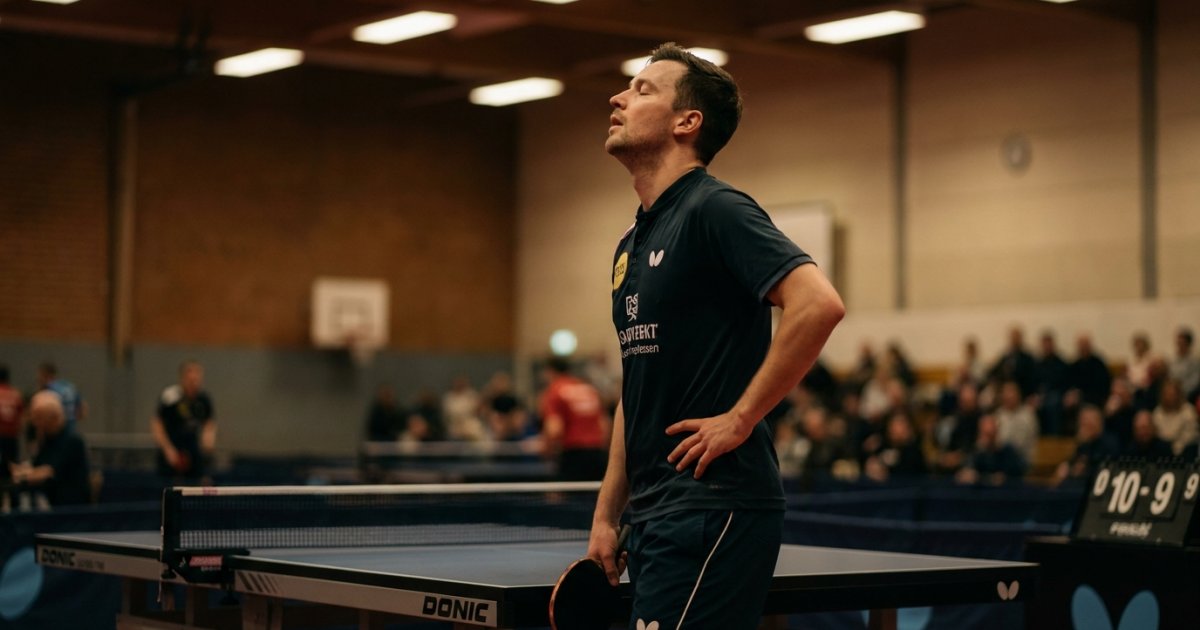
There is a version of losing that has nothing to do with skill. It happens at 8-3 in the fifth, when the match is basically decided, and somehow it isn’t.
I watched it happen to a player named Devon at a regional qualifier in Point Fortin two years ago. He had a shakehand forehand that opponents genuinely feared, and he was up 8-3 in the fifth against a man he had never lost to in four previous meetings. Four points later it was 8-7. Two points after that it was over, and Devon was packing his bag while the man he had dominated for four straight games shook his hand like nothing unusual had happened.
Nothing about Devon’s technique changed in those six points. His loop still had the same shape. His footwork was still fine. What changed was invisible, and it beat him just as thoroughly as a better opponent would have.
Sports psychologists call it psychological momentum, and here is the part that should annoy you a little: it is measurable, it is predictable, and it is stoppable. Devon did not lose to a mystery. He lost to a mechanism nobody had ever taught him to interrupt.
How do you stop a momentum shift in table tennis: call your time-out the moment you are on a losing run, not while you are winning. Run a fixed reset after every point (turn away, one breath, one forward-looking cue), and treat each new point as its own contest, disconnected from the score that came before it.
What Actually Causes a Momentum Shift in Table Tennis?
A momentum shift happens because your brain reads a run of points as a trend, not as a series of independent events, and that reading changes your arousal, your decision-making, and your shot execution before you are even aware anything has changed.
Den Hartigh and Gernigon’s 2018 study in the Journal of Sports Sciences tested this directly with 80 table tennis players. Each player was exposed to one of two audiovisual scenarios in a deciding game: either they came back from 1-7 to 7-7, or their opponent came back from 7-1 to 7-7. The score in both cases finished identical, 7-7. What was not identical was how players felt, thought, and expected to perform next. The direction of the run, not the number on the board, changed everything.
This matters because it means the momentum shift is not really in the score. It is in the story your nervous system is telling about the score. Two players can sit at 7-7 with completely different internal states depending on how they got there. One is composed. One is bracing. The scoreboard is doing nothing. The run is doing everything.
The same study found something even more useful: a time-out called during a negative run helped the player recover, and a time-out called during a player’s own positive run actually broke it, handing the advantage back to the opponent. That single finding is the basis for the next tactic.
How Do You Use Your Time-Out to Stop a Negative Run?
Call your time-out the moment your opponent goes on a run of four or more points against you. Never call it while you are the one on the run.
Most players save their time-out like a trophy, something to spend only in a genuine emergency, or worse, they burn it while they are winning, out of a nervous urge to lock in a lead. Both instincts run backwards. A time-out spent while you are winning interrupts your own rhythm and hands your opponent exactly the pause they need to regroup.
A time-out spent while you are losing does the opposite: it interrupts the psychological read that is building against you, before it compounds into something bigger.
| Situation | What to Do |
|---|---|
| Opponent on a 4+ point run against you | Call your time-out now |
| You are on a 4+ point run | Do not call your time-out |
| Opponent calls time-out during your run | Treat it as their concession; re-approach with the same process |
| Even score, but opponent’s body language improving | Adjust tactics proactively; do not wait for a run to start |
If Devon had called his time-out at 8-5, four points from the top of a lead he had built over four games, instead of playing through it and hoping the bleeding would stop on its own, that qualifier likely ends differently.
What Is the 3-Second Reset That Breaks a Losing Run?
The 3-second reset is a fixed physical sequence you run after every single point, win or lose, so your nervous system stops carrying the last point into the next one.
The sequence has five parts. First, turn away from the table. This breaks the visual loop of staring at where the last shot went wrong, or replaying the winner you just hit. Second, take one breath with a longer exhale than inhale. A 6-second inhale and a 7-second exhale activate the parasympathetic response, the physiological brake that pulls your heart rate back down.
Third, if the last point was lost to a technical error, spend two seconds imagining the correct version of the shot. This overwrites the motor memory of the miss instead of leaving the error as the freshest version in your head. Fourth, give yourself one forward-looking cue, a single tactical thought about the next point specifically.
Fifth, walk back to the table with your chest open and your shoulders back, regardless of how you actually feel. Body language is a tool you control, not just a symptom of your internal state.
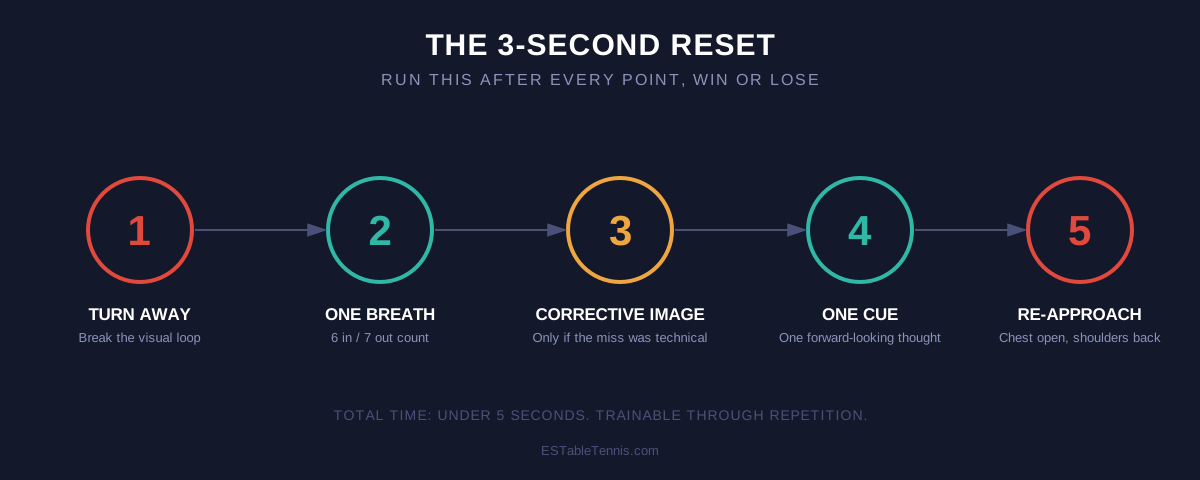
Most players only want to run this after bad points. That is the mistake. The sequence works because it is automatic and applied every time, not selectively. Run it after points you win too, until it fires without thinking. That consistency is what stops a three-point slip from becoming the seven-point collapse that ended Devon’s match.
How Do You Compete Each Point as an Island? (The Falck Principle)
You compete each point as an island by mentally resetting the score to 0-0 before every serve or receive, so the number on the board stops functioning as a constraint on what you are capable of doing with the next ball.
The clearest public example of this is Mattias Falck’s comeback from 2-9 down in a deciding game, a deficit that looks finished by any normal reading of a scoreline, won by taking nine consecutive points. The principle behind that run is not “believe you can come back,” which is motivational but empty. It is that the point at 2-9 and the point at 10-9 are structurally identical: serve or receive, rally, win or lose the point. The score is context. It is not a constraint on what the next ball can do.
Practically, this means pairing the 0-0 mentality with the reset routine above. The reset clears the last point. The 0-0 mentality stops the running total from leaking into how you play the next one. A comeback, or a stopped momentum shift, is not one decision to try harder. It is a sequence of 0-0 points, applied one at a time, that happens to add up to a comeback in hindsight.
How Do You Tell a Tactical Momentum Problem From a Mental One?
If your opponent has changed something specific- their serve placement, their pace, the side they are targeting- you have a tactical problem and need a tactical fix. If nothing has changed except how the last few points felt, you have a mental problem, and the reset routine above is the fix. Most losing runs are actually a blend of both, which is why strong players use both tools instead of picking one and hoping.
| Problem-Focused (Change the Situation) | Emotion-Focused (Change Your Response) |
|---|---|
| Adjust tactics if your serve is being read | Breathing and centering (parasympathetic reset) |
| Call a time-out to break a negative run | Reappraisal: “this is still manageable, I’ve been here before” |
| Change your service pattern | Body-language discipline regardless of internal state |
| Force a different rally tempo | 0-0 mentality to remove the weight of the deficit |
The trap is defaulting entirely to one column. Trying to breathe your way out of a problem that actually needs a tactical adjustment wastes the time-out you should have called. Changing your serve pattern when the real issue is that your hands are shaking solves nothing, because the tactics were never the problem.
A practical example: if you are losing points because your opponent suddenly started serving short to your backhand every time, that is tactical, and no amount of breathing fixes it. Adjust your receive position and the run usually stops within a point or two. If your opponent’s serve has not changed at all and you are still missing the same return you made cleanly ten minutes earlier, that is not a tactics problem. That is tension, and it needs the reset, not a scouting report.
What About Bad Luck? Net Cords and Edge Balls?
Table tennis has built-in variance, net cords and edge balls that decide points on nothing but geometry, and the players who stay composed through them are not lucky. They have simply decided in advance that variance is part of the game, so no single unlucky moment gets treated as a threat.
This is one of the rare mental fixes that works better decided in advance than handled in the moment. Reactive anger management after a bad edge ball is slow and unreliable. A pre-decided stance, edges and nets happen to everyone, including your opponent, over the course of a season, is already in place before the ball clips the white line, so there is nothing left to manage when it happens.
How Do These Tactics Work Together Mid-Match?
Before the match, decide your stance on variance so a bad edge cannot ambush you later. During the match, run the reset sequence after every point, not just the ones that go wrong. The instant you are down four points or more, call your time-out rather than hoping the run stops on its own. On every serve and every receive, treat the score as 0-0, so the number stays out of your hands and feet.
There is an equipment layer to this too, and it is worth naming directly, because it rarely gets mentioned in momentum advice. A racket you do not fully trust adds a background doubt that makes a losing run feel more threatening than it needs to, because part of your attention is spent wondering whether the last miss was you or your gear.
That uncertainty is one more thing your brain can spiral on mid-run. Removing it in advance, by knowing your equipment cold before you ever reach a tournament, is one less variable working against you when a run starts.
How Do You Practice This Before You Ever Need It in a Match?
None of this works if the first time you try it is at 8-3 in a deciding game. These are trained responses, and trained responses need repetition before they hold up under real pressure.
In week one, drill the reset sequence on its own, in every practice game, after every single point, regardless of whether you won or lost it. It will feel slow and a little artificial at first. That is what a new habit feels like before it becomes automatic, not a sign it is not working.
In week two, add scored practice games with a real consequence for the loser, then deliberately create a four-point run for one player partway through (your training partner can simply agree to push pace for a stretch) and practice calling the time-out the moment that run starts, rather than waiting to see if it fixes itself.
In week three, add the 0-0 mentality on top of the reset. After a bad run in practice, notice the pull to think about the score, and deliberately redirect to the single point in front of you. By week four, most players report the sequence starting to fire without conscious effort, which is exactly when it becomes useful in a match that actually matters.
Frequently Asked Questions
Is psychological momentum real, or just a way of explaining a loss afterward?
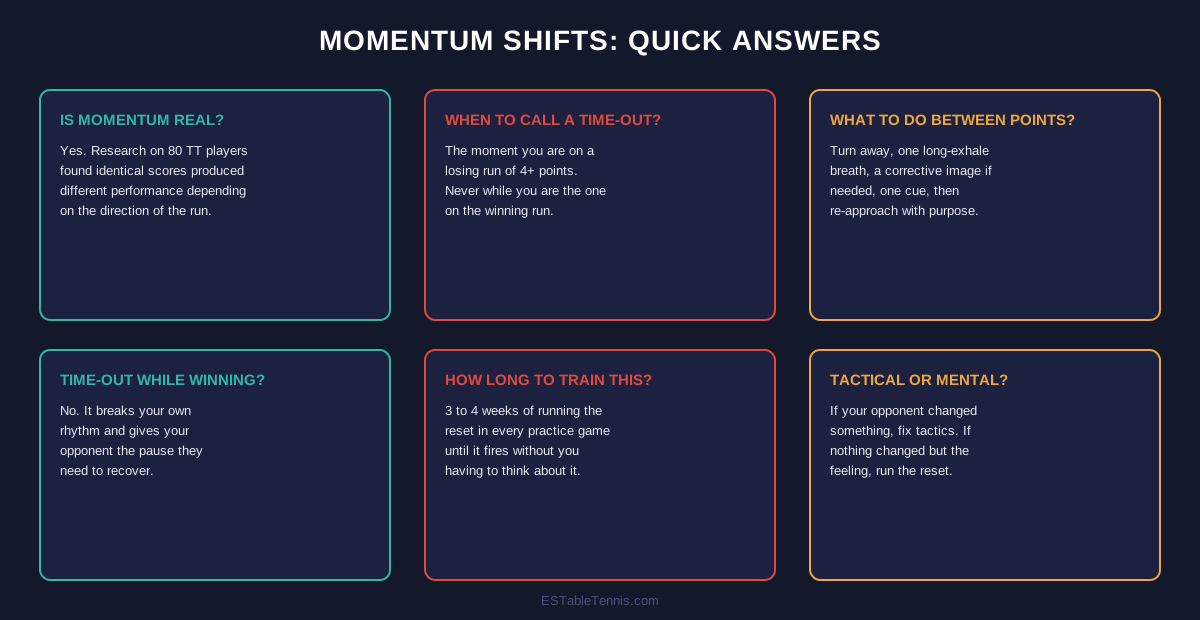
It is real and measurable. Den Hartigh and Gernigon’s 2018 study found that table tennis players performed differently at an identical score depending on whether they had just come back into it or just let a lead slip, which means the run itself, not the number, changes performance.
When should I call a time-out to stop a momentum shift?
The moment you are on a losing run of four points or more. Never call it while you are the one winning, since research shows a time-out during your own positive run tends to break it and hand the advantage to your opponent.
What do I do between points to stop a run from growing?
Run a fixed reset: turn away from the table, take one breath with a longer exhale than inhale, briefly image the correct shot if the last point was a technical error, give yourself one forward-looking cue, then re-approach with purposeful body language.
Should I ever call a time-out while I am winning?
No. The same research shows a time-out called during your own positive run interrupts your rhythm and gives your opponent the pause they need to recover. Save it for when the run is against you.
How long does it take before these habits work automatically under pressure?
Most players notice the reset routine starting to feel automatic after three to four weeks of running it in every practice game, not just matches. It has to be a habit before you need it, not a plan you remember mid-crisis.
What Should You Do With This the Next Time You Are Up 8-3?
Devon played the following season again. Same qualifier, similar situation, up big in a deciding game against a dangerous opponent. This time, the moment the run started, he called his time-out at the fourth point instead of the seventh. He does not talk about that match the way he talks about the first one. He barely remembers it, which is exactly the point.
He still calls it the best time-out of his career, mostly because nobody watching the match even noticed he had taken it. The version of the story where nothing goes wrong is the version nobody tells afterward.
A momentum shift is not a verdict on your game. It is a nervous system reading a trend that is not actually fixed yet. Interrupt the read, and the trend stops being a trend.
If you want the full system behind this- the reset routines, the confidence banking, and the exact momentum tactics laid out step by step, the techniques that stop choking under pressure are the natural next read, and the MentalEdge Course builds all of it into a structured program with video demonstrations, including the full module on swinging momentum back in your favor mid-match.
For a deeper look at what happens once a run has already put you a long way behind, see how to come back from losing a big lead in table tennis.
Leave a Reply