
Akil was ranked something like sixty places below the man across the table from him at a closed tournament in Princes Town. Everyone in the room, including Akil, expected the match to take maybe fifteen minutes.
It took fifty. Akil won in five games, and afterward, when someone asked him how he did it, he said something that stuck with me: “I stopped trying to play like him and started playing like me, just more of it.” A better story, if you ask him, than the fifteen-minute blowout everyone in the room expected instead. What Akil understood, and most players never do, is that to beat a higher rated player you stop borrowing their game and commit harder to your own.
That sentence is most of what beating a higher-rated player actually requires. Not a miracle. Not a personality transplant. A specific, learnable shift in how you plan the match and how you carry yourself once it starts going your way.
How do you beat a higher rated player in table tennis: build your game plan around forcing the match into conditions that favor your strengths, not theirs, keep rallies short where your best shot decides the point, and treat the rating gap as history, not a verdict on what is about to happen in this specific match.
What’s the Real Difference Between You and a Higher-Rated Player?
A rating is a record of consistency across many matches over time, not a hard ceiling on what either of you can do in the next fifteen minutes. A higher-rated opponent is, on average, better than you across a large sample of matches. On any single day, in any single match, that average does not get to vote.
This matters because most players quietly treat the rating gap as a spoiler for the result before the first point is played. That belief does real damage. It changes what shots you attempt, how much risk you are willing to take, and how you react to your own mistakes. If you have already decided the outcome, every early miss confirms a story you wrote before you picked up your bat.
The gap is real. It is just not the only fact in the room. Your specific game, on this specific day, against this specific opponent’s specific patterns, is a separate question from the rating list.
This is also why best-of-five and best-of-seven formats give the underdog more of a chance than a single-game race would. A better player’s edge shows up reliably over a large sample, which is exactly what a long tournament season or a head-to-head rivalry represents. A single match, even a long one, is a small sample, and small samples have room in them for the version of the match where your best day meets their slightly-off one.
How Do You Build a Game Plan Against a Player Better Than You?
Build your game plan around forcing the match into the specific conditions where your best shot decides the point, rather than trying to out-play a stronger player at their own strongest patterns.
A higher-rated player is usually better than you in the broad, general sense: better footwork, more consistent loop, sharper serve-receive. Trying to beat that version of them head-on, playing a long, neutral rally and hoping to outlast them, is betting against the exact skill gap that made them higher rated in the first place.
Instead, identify the one or two things you do better than almost anyone you play, your short serve, your forehand from the middle, your ability to read a specific spin, and build the entire point structure around getting to that shot as early as possible. Akil’s forehand loop off a short push was, by his own admission, better than his opponent’s. His plan was not to survive long enough for a miracle. It was to manufacture that exact shot as many times as he could in fifty minutes.
How Do You Stay Confident When You’re Supposed to Lose?
Stay confident by using the fact that you are supposed to lose as freedom rather than pressure. Nobody expects you to win, which means there is genuinely nothing to protect and nothing to lose by playing your most aggressive, highest-ceiling game from the first point.
This is the single biggest structural advantage the underdog has and rarely uses. The favorite is carrying the weight of an expected result. You are not. Every player who has pulled off a genuine upset describes some version of the same internal shift: at some point they stopped playing not to embarrass themselves and started playing to actually win, because they realized nobody in the room, including their opponent, expected that outcome anyway.
This lines up with Bandura’s research on self-efficacy, the belief in your own ability to execute a specific task, which sports psychology research consistently links to effort and persistence under pressure. Confidence here is not manufactured self-belief you have to talk yourself into.
It is a specific, factual account: your own recent evidence of what you can do, banked deliberately in the weeks before the match so you are not walking in on hope alone. If you already keep a nightly record of what you did well in training, effort, small successes, visible progress, you are drawing on a real ledger, not empty encouragement.
A specific version of confidence banking worth running in the week before you know you are facing a stronger player: each night, write one line naming something real from that day’s training, effort, a shot that landed, a drill you pushed through when it got hard. By match day, you are drawing on a week of dated, factual evidence rather than trying to manufacture belief out of nothing in the changing room twenty minutes beforehand.
What Tactical Adjustments Actually Work Against Stronger Players?
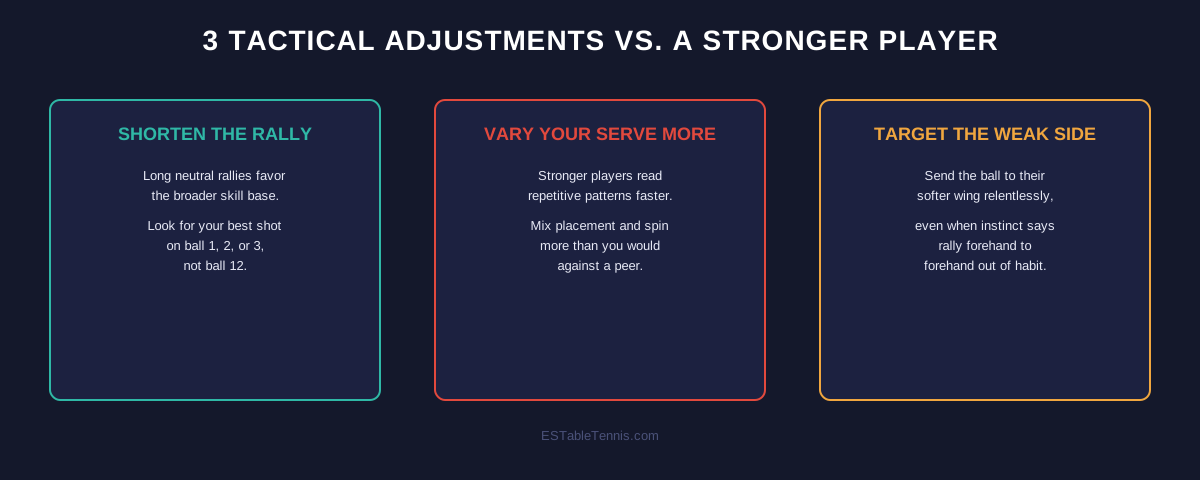
Three tactical adjustments consistently help against a stronger opponent: shorten the rally whenever you can, vary your serve more than you normally would, and attack the side of the table your opponent defends worst rather than their strongest wing.
Shortening the rally matters because the longer a point runs, the more it favors the player with the broader skill base, which is usually the higher-rated one. If your best weapon is your third-ball attack off a short serve, look for that shot on point one, two, and three of the rally, not point twelve.
Serve variation matters more than usual here because a stronger player has typically seen more serves than you have, and reads a repetitive pattern faster than a weaker player would. Mix your placement and spin more aggressively than you would against someone closer to your own level, even at the cost of a slightly less polished-looking serve.
Targeting the weaker side sounds obvious and gets ignored constantly, usually because players get drawn into rallying with whatever shot feels comfortable rather than whatever shot is actually working. If their backhand is visibly the softer wing, send the ball there relentlessly, even on shots where your instinct says go forehand-to-forehand out of habit.
A second, quieter adjustment: change the pace of the match itself, not just your shots. Slow down slightly between points, take your full allotted time, towel off if the rules of the event allow it. A stronger player often plays best at a rhythm they control. Disrupting that rhythm, within the rules and without gamesmanship, is a legitimate tactical tool, not a trick, and it is one underdogs use far less often than they should.
How Should You Prepare in the Days Before, Not Just During the Match?
Prepare by scouting the specific opponent in the days before, not by generically training harder, since a game plan built on real information about this player beats a vague plan built on general improvement.
Watch them play if you get the chance, even a few points in an earlier round. Note their go-to serve when they need a safe point, which wing they protect under pressure, and whether they rush or slow down when a game gets close.
Akil had watched his opponent play twice that same tournament before their match and noticed he consistently served short to the middle on big points, a small, specific detail that shaped exactly where Akil positioned himself at 8-8 in the fourth.
If you cannot watch them directly, ask around. Club players talk, and someone who has played this opponent before usually has one specific, useful detail: a serve they lean on, a shot they avoid, a tell in their body language before a risky play. One real detail is worth more than an hour of generic drilling the week of the match.
A practical version of this: fourth game, 8-8, Akil’s opponent served short and fast to the middle exactly as expected. Akil had already decided, before the point started, that he would step around and load his forehand the instant he saw that specific serve.
The decision was made in preparation, not improvised under pressure, which is the entire value of scouting in the first place. Reacting well in the moment is hard. Executing a decision you already made two days earlier is much easier, even at 8-8 in a game that decides the match.
What Happens Mentally Once You Start Actually Winning Points?
Once the scoreline starts reflecting an upset in progress, a new kind of pressure appears: the pressure of protecting a lead you were never supposed to have, and this is the exact moment most near-upsets fall apart.
The freedom that got you the early lead quietly evaporates the moment you start thinking about the result instead of the next point. Akil said the hardest game of the match was the fourth, up 2-1 in games, because that was the first moment it occurred to him he might actually win, and the thought nearly cost him the set.
The specific fix is the same one that stops any momentum shift: treat the point in front of you as its own contest, disconnected from the growing scoreline, and run your between-points reset after every single point, especially the ones that are going well.
The players who complete upsets are not the ones who never feel that shift in stakes. They are the ones who recognize it the moment it arrives and have a specific, trained response ready instead of discovering the pressure for the first time in the middle of the game that matters most.
What If the Skill Gap Is Genuinely Too Big to Close?
Sometimes the gap is real enough that no game plan closes it in a single match, and pretending otherwise is not confidence; it is denial, which tends to collapse the moment the score confirms what you already suspected.
If you are two hundred rating points below your opponent rather than fifty, the honest goal for that match might not be winning outright. It might be winning a game you were not expected to win, executing your game plan cleanly regardless of the scoreline, or simply testing a new tactic against a genuinely strong player who will show you exactly where it breaks down.
All three are real, useful outcomes, and none of them require you to lie to yourself about the size of the gap beforehand.
The players who compete well against much stronger opponents over a whole career are not the ones who convince themselves every match is winnable. They are the ones who set an honest, specific goal for what they can actually take from a hard match, and then compete fully toward that goal instead of an outcome that was never realistic to begin with.
Does Equipment Play a Role in Beating a Better Player?
Equipment matters here specifically because a mismatched setup narrows the one advantage an underdog has: a game plan built around a specific strength. If your rubber does not actually support the short-serve, third-ball-attack style your plan depends on, you are asking your equipment to produce a shot it was never suited to help you play, at the exact moment you need it most.
This is worth settling long before you ever draw a higher-rated opponent, not the week of the tournament. Know what your gear does well, and build your underdog game plan around that reality rather than around a version of your game your equipment cannot actually deliver. Know it. Do not guess at it under pressure for the first time in a match that already has enough working against you.
Frequently Asked Questions
Is it realistic to beat a higher rated player?
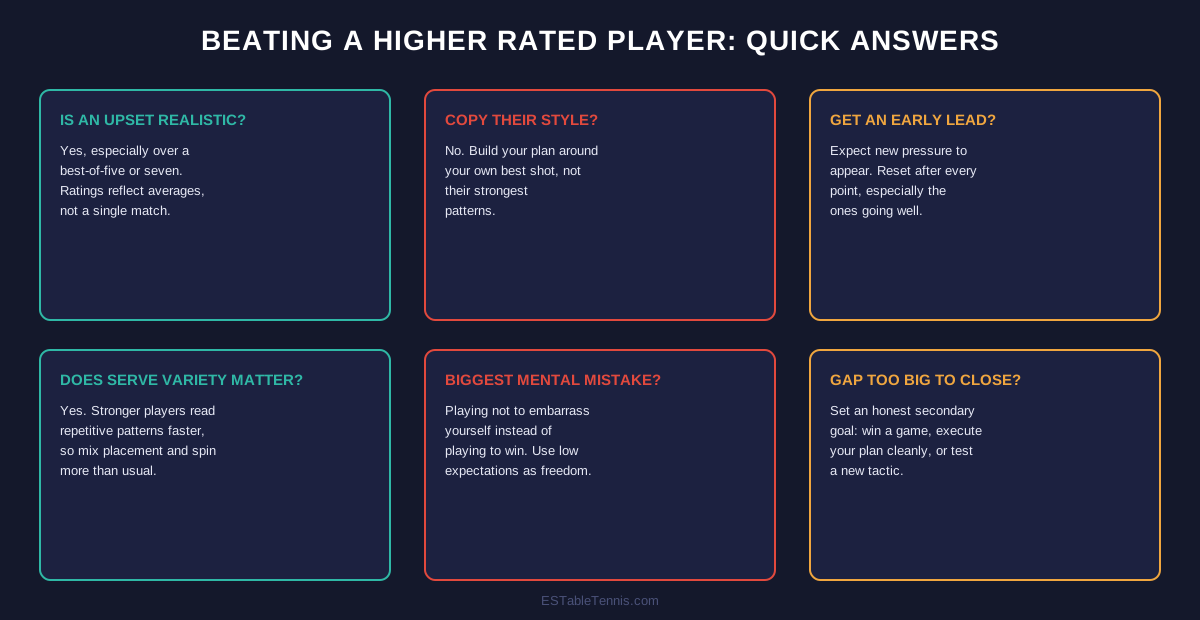
Yes, on a given day, especially in a best-of-five or best-of-seven format where variance has room to play out. Ratings reflect average performance across many matches, not a guaranteed outcome in any single one.
Should I copy a higher-rated player’s style to compete with them?
No. Trying to out-play a stronger player at their own strongest patterns usually loses. Build your plan around forcing the match toward your own best shot instead.
How do I stay calm if I get an early lead against a favorite?
Expect a new kind of pressure to appear the moment the lead becomes real, and run your between-points reset after every point, especially the ones going well, rather than starting to think about the final result.
Does serve variation really matter more against stronger players?
Yes. Stronger players have generally seen and read more serves than weaker ones, so a repetitive pattern gets picked apart faster. Mix placement and spin more aggressively than you would against a similarly rated opponent.
What is the biggest mental mistake underdogs make?
Playing not to embarrass themselves instead of playing to actually win. Since nobody expects the underdog to win anyway, there is nothing to protect, which should be used as freedom, not carried as extra pressure.
What Should You Actually Do Before Your Next Match Against a Favorite?
Write down the one shot you would bet on against anyone in the club. Then write down the specific sequence of serves and placements that gets you to that shot fastest. That is your game plan. Not “play well.” Not “see what happens.” A specific route to your own best weapon, repeated on purpose, point after point.
None of this requires you to feel fearless walking in. Akil has said, more than once, that his stomach still turns over before that particular match every season. The difference is what he does in the ten minutes after that feeling shows up, not whether it shows up at all. Not because he stopped respecting the gap. Because the gap stopped being the only thing in the room.
Akil still plays that opponent every season. He does not win every time. Nobody’s underdog run is a permanent state, and that is fine. What changed permanently is that neither of them treats the rating gap as the whole story anymore. He also does not lose to him the way he used to, quietly, before the match even started in his own head.
For the full system behind staying composed once the match starts turning your way, see how to stop choking in table tennis and table tennis competition mindset. The MentalEdge Course builds the full confidence and tactical framework behind this into a structured program you can train before your next tournament, not the night before it.
Leave a Reply