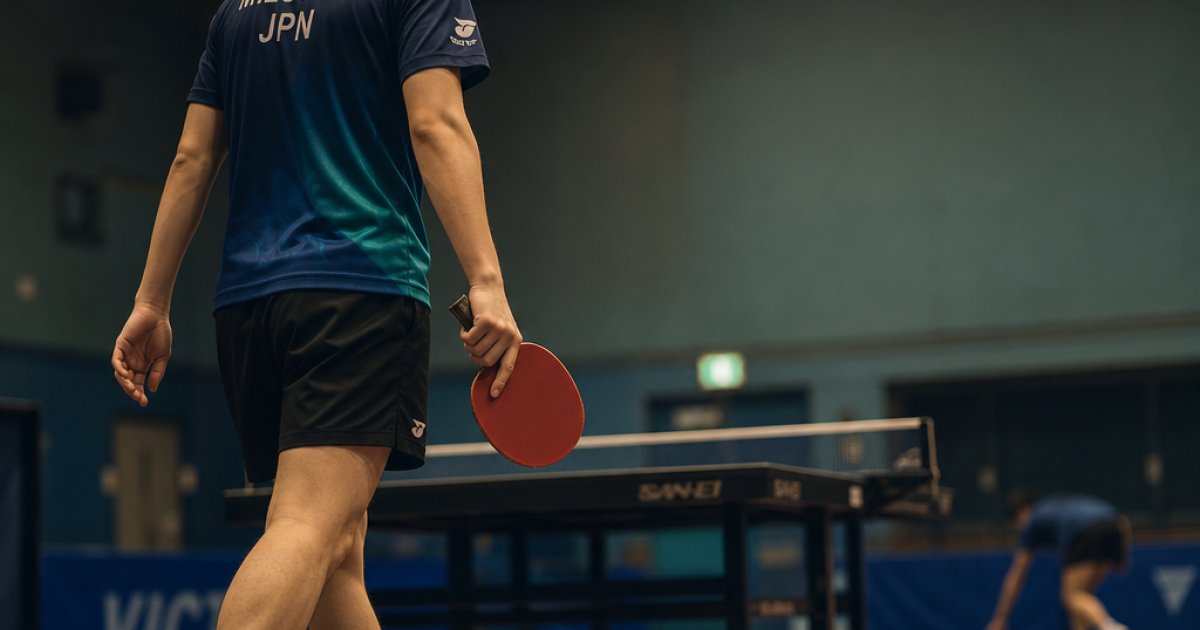
Odette played chopper defense at a club in Barataria, three tables squeezed into what used to be a church hall with ceiling fans too slow to do much against the heat, and for two years she had exactly one bad habit nobody could talk her out of. The moment she won a point, she’d bounce straight back to the ready position, quick, eager, already thinking about the next ball, while the player across the table was still walking back from retrieving it. She thought the hustle looked sharp, the kind of visible effort a coach is supposed to like.
Her own coach finally told her what it actually was: a chopper, a defensive player whose whole game depends on reading spin calmly and patiently, sprinting past the only few seconds of the point where she was supposed to be slowing everything down, not speeding it up.
She wasn’t skipping her pre-serve routine at all, and that was the confusing part for a while. She had one of those, a bounce and a breath before every serve, same as most players who’ve read anything about the mental side of the sport. What she was skipping was everything in between, the several seconds after a point ends that most players either waste on adrenaline or don’t structure at all.
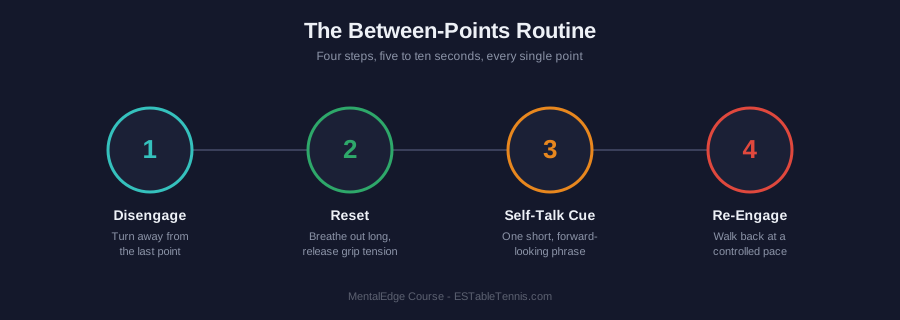
A table tennis routine between points is a fixed four-step sequence run after every single point, win or lose: disengage from the last point, physically reset your breathing and grip, run one short self-talk cue, then re-engage and walk back to the ready position.
It is not the same as a pre-serve routine, which covers only the few seconds right before you serve, and it is not the same as self-talk, which is just one step inside it. Run all four steps every time, and the routine does the regulating for you instead of leaving it to whatever mood the last point left you in.
Why Do You Need a Routine for the Time Between Points, Not Just Before the Serve?
Because the moment right after a point ends, win or lose, is when your emotional state is at its loudest and least examined, and almost nobody builds a deliberate practice around a moment that short. A missed easy shot leaves frustration running. A great winner leaves adrenaline running.
Either way, if you walk straight into the next point without processing that state, it comes along for the ride, and it shows up as a rushed serve, a tight grip, or a decision made from irritation instead of tactics. A pre-serve routine only covers the last two or three seconds before contact. By the time you’re there, whatever happened after the previous point has already been decided. The between-point routine is what happens before the pre-serve routine even starts.
How Much Time Do You Actually Have Between Points?
Less than most players assume, and the rules of the sport don’t give you any real room to stall your way into more of it. The ITTF’s laws of table tennis require play to resume without unnecessary delay, and umpires are entitled to penalize a player who deliberately stalls between points. In practice, that leaves you somewhere around five to ten seconds, the time it takes to retrieve the ball and walk back to position, which is exactly why the routine has to be short and automatic rather than a long ritual.
You are not trying to buy extra time. You’re trying to use the time you’re already going to spend walking back to the table for something other than nothing.
What Are the Four Steps of a Complete Between-Point Routine?
Disengage first. Turn slightly away from the table, even half a step, which is a small physical signal to your own brain that the last point is over and being filed away, not still being played. Second, reset physically: one breath with a longer exhale than inhale, and a genuine, deliberate release of grip tension, since most players squeeze harder than they need to after either a miss or a big point without noticing.
Third, run one short self-talk cue, a single phrase, forward-looking rather than a replay of what just happened; the full range of options for this step is covered in table tennis self-talk between points, since the phrase itself is a separate skill from the sequence it sits inside. Fourth, re-engage: walk back to the ready position at a controlled pace, not a sprint and not a delay, and let your focus land on the next point rather than the last one.
Step 1: Disengage
This step takes under a second, and most players skip it entirely without realizing it’s even available to them. A half-turn away from the table, a glance down at your paddle, anything that breaks the direct visual and mental line to the spot where the last point just happened. The point is not to forget what happened. It’s to mark, physically, that the point is closed, the same way closing a laptop lid signals the end of a task even though the work inside it still exists.
Step 2: Reset
One breath, exhale longer than the inhale, is the single most well-supported piece of this sequence, since a longer exhale is one of the few voluntary actions that reliably nudges your nervous system out of a heightened state. Pair it with a deliberate check of your grip pressure. Most players don’t notice they’re gripping the handle like they’re trying to strangle it until someone points it out, and a tight grip mid-rally costs you feel and reaction speed exactly when you need both.
Step 3: Self-Talk Cue
One short phrase, said internally, not out loud, aimed at the next point rather than the last one. This is the step most players think the whole routine consists of, when it’s really just the third of four, which is exactly why a good phrase still fails players who skip the disengage and reset steps that are supposed to come before it.
Step 4: Re-Engage
Walk back at a pace you’d be comfortable repeating on the very last point of a deciding game, since that consistency is the actual goal. Let your eyes land on the ball, the table, or your opponent’s position rather than the scoreboard, and consider the previous point genuinely closed the moment your feet reach the ready position.
Does the Routine Change After You Win a Point Versus Lose One?
The four steps stay the same regardless of the outcome. What changes is how tempting it becomes to skip them, and the temptation pulls in two opposite directions depending on which way the point went. After a loss, players tend to rush the routine because they want to erase the discomfort of the miss as fast as possible, which is exactly Odette’s old habit, just triggered by frustration instead of excitement.
After a win, players tend to skip it because the adrenaline feels good and slowing down feels like giving that feeling up. Both instincts are wrong for the same reason: the routine isn’t there to manage only bad feelings; it’s there to make sure neither a bad feeling nor a good one gets to make the next decision for you unchecked. A big winner running into the next point on pure adrenaline produces the same kind of rushed, undisciplined shot as a bad miss run into the next point on frustration.
What Mistakes Do Players Make With Their Between-Point Routine?
The first mistake is copying someone else’s routine wholesale, down to the exact gestures and timing, without ever checking whether it actually fits their own temperament and pace. A routine borrowed from a highlight reel of a professional match looks impressive but does nothing for you if the pace or the specific action doesn’t match how your own nervous system actually calms down.
The second mistake is changing the routine depending on the score, adding extra steps when things get tense and skipping steps when the match feels comfortable, which defeats the entire purpose. A routine that only shows up under pressure hasn’t been practiced enough to be reliable under pressure, which is precisely when you need it to run without having to think about it.
The third mistake, and the most common one, is treating the routine as something to perform for the opponent rather than something to actually use. Players sometimes turn the between-point sequence into a show of composure, a deliberate slow walk meant to signal confidence, while the actual internal reset never happens underneath the performance.
An opponent who’s paying attention can usually tell the difference between someone who is regulated and someone who is just acting regulated, and more importantly, so can your own body a few points later when the accumulated, unprocessed frustration or adrenaline finally catches up with you.
Does This Change During Longer Breaks Like a Timeout or Changing Ends?
The four steps stay identical. What changes is how much room you have to run them properly. A one-minute timeout or a break at the change of ends gives you far more time than the five to ten seconds of a normal between-point gap, which is an opportunity most players waste by using the extra time to think about the score instead of actually completing the sequence.
Use the extra time the same way, just slower and more deliberately: a longer, more complete physical reset, a clearer self-talk cue, and a genuine re-engagement rather than more time spent replaying the last few points. The players who get real value out of a timeout are rarely the ones getting tactical advice shouted at them. They’re the ones who used the extra seconds to actually finish resetting, something a rushed ten-second gap rarely allows all the way through.
What Happens If You Skip the Routine and Just Rush?
You get exactly what Odette got for two years: a technically solid player whose composure never quite matched her hands: a player whose technique was solid but whose composure reset itself randomly, point to point, depending on whatever the previous rally happened to leave behind.
Rushing back to the table doesn’t just look eager. It means the next point starts on borrowed emotional material, whatever was left over from the last one, rather than on a clean slate you actually chose. Over a long match, this compounds. A player with a real routine plays roughly the same version of themselves in the third game as the first. A player without one is at the mercy of a string of small emotional accidents they never noticed accumulating.
This is also part of why momentum shifts feel so sudden from the outside, covered in more depth in how to stop a momentum shift in table tennis. A run of points rarely turns on one big mistake. It turns on several rushed, unexamined between-point moments stacking up until the pattern becomes visible on the scoreboard.
Does This Routine Work Differently in Doubles?
Yes, in one specific way worth planning for. In doubles, you’re not always the one walking back into position after a point; your partner might be the one serving or receiving next, which means part of your between-point routine now includes handing off cleanly rather than resetting for yourself alone.
The four steps still apply, but step four, re-engage, sometimes means positioning yourself to support your partner’s next shot rather than preparing to hit the ball yourself. Doubles players who never adapt their routine for this tend to look a half-step slow covering the table, not because their reflexes are worse, but because their routine was built assuming they’re always next to hit, and doubles doesn’t work that way.
The self-talk cue changes shape in doubles too, and it’s worth planning deliberately rather than assuming your solo-play habits transfer over unchanged. A cue built for solo play, something like “trust the swing,” doesn’t always translate to a doubles context where the next shot might belong to your partner. Many strong doubles pairs use a shared cue instead, a short word one partner says to the other between points, which does the same regulating job as an internal cue but reinforces the partnership at the same time.
Should Newer or Younger Players Use a Shorter Version?
Yes, and trying to force a full four-step sequence onto a player who’s only been at the table for a few months usually backfires. A newer player, especially a younger one, often does better starting with just the first two steps, disengage and reset, run consistently, before adding a specific self-talk cue on top.
Trying to install all four steps at once tends to produce a routine that feels like homework rather than a habit, which defeats the purpose entirely. Build the physical half first. Once turning away and taking one settling breath after every point feels automatic, layering in a specific phrase is a much smaller lift than trying to learn everything simultaneously.
Coaches working with juniors often get better results reinforcing just the disengage step for the first few weeks, since it’s the most visible from the sideline and the easiest to correct in the moment with a quiet reminder between points, before asking a ten-year-old to also manage grip tension and a self-talk phrase they’re still learning to trust.
How Do You Actually Practice This Routine Before a Match?
Run the full sequence in practice matches first, out loud at first if that helps you notice when you skip a step, on every single point, including the ones that feel too routine or too low-stakes to bother with. The mistake most players make is saving the routine for moments that feel like they matter- a close game, a big point- which guarantees the routine is unfamiliar and clunky exactly when you need it most fluent.
Treat it the way you’d treat a serve you’re grooving: repetition in low-stakes moments is what makes it available without thinking in high-stakes ones. By the time Odette had run the four steps a few hundred times in practice, she stopped needing to remind herself to do it. It just ran, the same way her footwork did.
Frequently Asked Questions
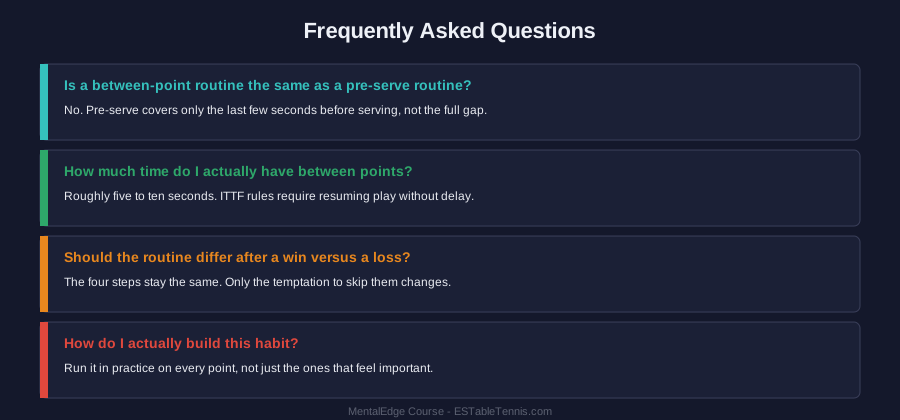
Is a between-point routine the same as a pre-serve routine?
No. A pre-serve routine covers only the last few seconds before you serve. A between-point routine covers the full gap after a point ends, including disengaging, physically resetting, and a self-talk cue, before the pre-serve routine even starts.
How much time do I actually have between points?
Roughly five to ten seconds in practice, the time it takes to retrieve the ball and walk back. The ITTF’s rules require resuming play without unnecessary delay, so the routine has to be short and automatic.
Should my routine be different after I win a point versus lose one?
The four steps stay the same either way. What changes is the temptation to skip them, rushing out of frustration after a loss or skipping them out of adrenaline after a win.
How do I actually build this habit?
Run the full routine in practice matches, on every point, not just the ones that feel important. Repetition in low-stakes moments is what makes it automatic when a match actually matters.
Odette still chops the same way she always did, low, patient, reading spin off a ball most players don’t even see rotating. What changed is the several seconds before she gets there. She turns away, breathes once, says one thing to herself, and walks back at exactly the pace the last point deserves, not the pace her nerves, or her old idea of what looked impressive, wanted to set for her.
Her coach still watches from the same folding chair by the wall. He doesn’t say anything about her pace between points anymore. There’s nothing left to correct.
A routine between points is the cheapest upgrade in table tennis: no new gear, no extra training hours, just the same few seconds spent on purpose instead of on autopilot.If building a routine like this from scratch is the piece you’re missing, the MentalEdge Course walks through the full sequence step by step, along with the self-talk and breathing work that fits inside it.
Leave a Reply