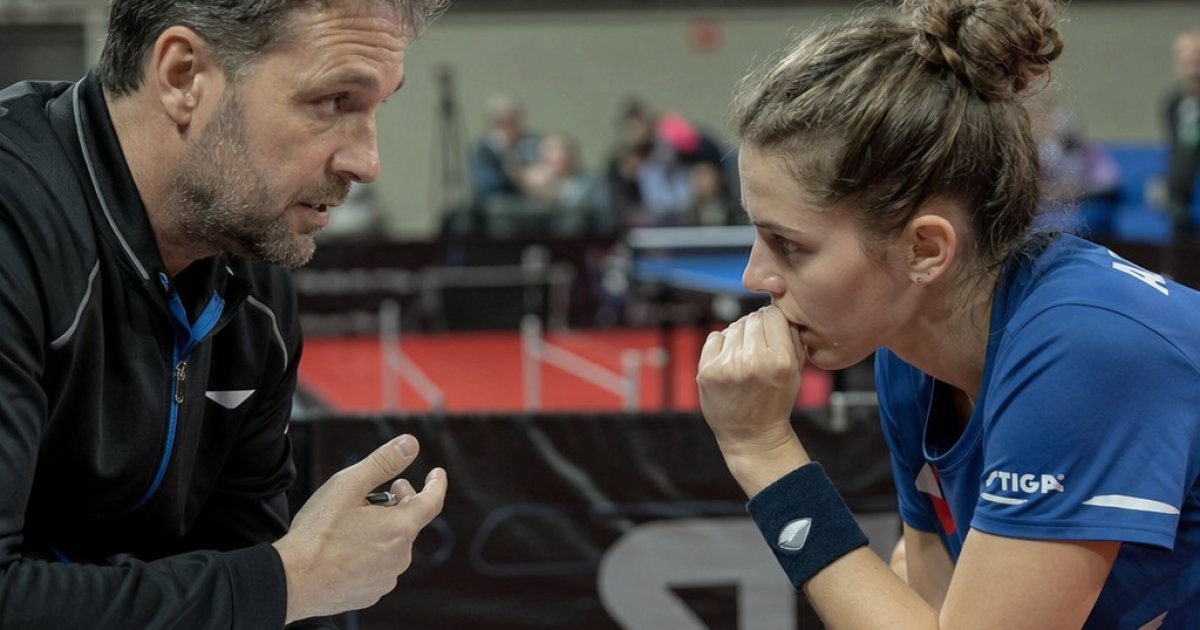
There was a player I coached in San Fernando, a compact right-hander with a forehand loop that looked borrowed from a training video, who could not explain why he kept losing to players he had beaten easily in practice. He assumed it was a gap in his game he simply had not found yet. It was not. It was a gap in the field of study nobody had ever pointed him toward.
He had every reason to assume it was technical. His coaches before me had focused entirely on stroke mechanics, footwork patterns, serve variation, because that is what most table tennis coaching still is. Nobody had ever sat him down and asked what was actually happening in his head at 8-6 in the third, because nobody had been trained to ask that question in the first place.
Sports psychology is not a motivational add-on to real training. It is a real, peer-reviewed field with a real evidence base, and most of what actually works in competitive table tennis traces back to specific, named research rather than folk wisdom passed down from one coach to the next.
The field is broad enough that no single article covers all of it, and this one does not try to. What it does is map the specific sub-areas of sport psychology research that apply most directly to table tennis, name the actual studies behind each one, and point to where you can go deeper on each mechanism individually.
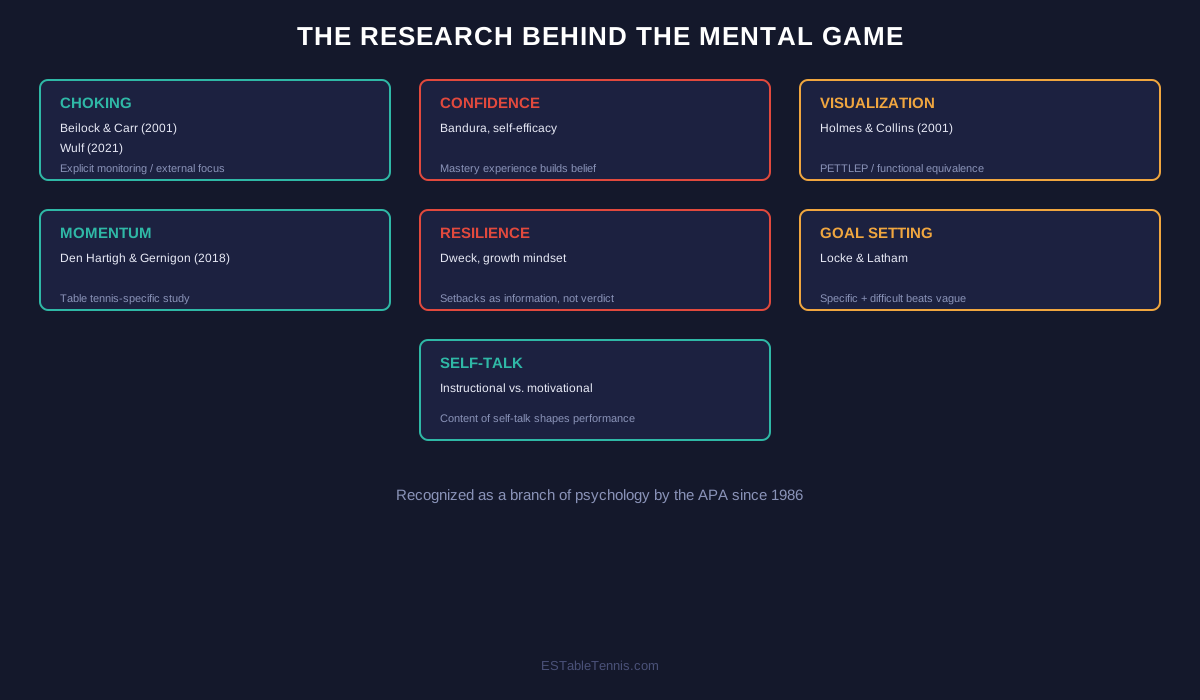
Sports psychology for table tennis is the applied study of what actually happens in a player’s mind under pressure, backed by research on choking (explicit monitoring), attention (external focus), confidence (self-efficacy), imagery (PETTLEP), momentum, goal setting, and mindset, and it has been a recognized branch of psychology since the American Psychological Association formally acknowledged it in 1986.
What Is Sports Psychology, and Why Does Table Tennis Need Its Own Version of It?
Sport psychology is the study of the psychological basis, processes, and effects of sport, formally recognized as a branch of psychology by the American Psychological Association in 1986. It is not a soft or unproven discipline. It sits inside mainstream psychology with the same research standards as any other applied field.
Table tennis needs its own reading of this research because the sport’s specific demands are unusual even within racket sports. The ball travels fast enough that conscious, deliberate thought during a rally is often too slow to help. The serve is self-paced and closed-skill, unlike almost anything else in the rally, which makes it uniquely suited to certain interventions and useless for others.
And the sport’s rapid point-to-point structure, dozens of discrete pressure moments in a single match rather than a handful, makes momentum and recovery mechanisms matter more here than in sports with fewer, longer-spaced pivotal moments.
What follows is not a list of tips. It is a map of the actual research areas, and what each one has been shown to do.
What Does the Research Say About Why Players Choke?
Choking is caused by explicit monitoring, a well-documented mechanism where pressure makes a skilled performer consciously attend to movements that normally run on autopilot, and that conscious attention breaks the automated execution.
Sian Beilock and Thomas Carr’s foundational 2001 study on the fragility of skilled performance established this mechanism directly: high-level skills degrade under pressure not because performers try less hard, but because pressure prompts step-by-step self-monitoring of a movement that was never meant to be consciously supervised.
The fix that follows directly from this research is external focus, attention on the intended effect of a movement (the ball’s spin, its target) rather than the movement itself. A 2021 systematic review by Gabriele Wulf confirmed this across dozens of studies: external focus produces superior performance and learning compared to internal focus, especially in skilled performers under pressure. The full practical breakdown of both findings is in how to stop choking in table tennis.
This matters specifically for table tennis because the serve and the third-ball attack, the two shots most players practice thousands of times until they are automatic, are exactly the movements explicit monitoring targets first.
A shot you have drilled so many times it runs without conscious input is precisely the shot most vulnerable to being dragged back under conscious control the moment a point matters. The more automatic the skill, the more damage explicit monitoring can do to it, which is a genuinely counterintuitive finding: your most trained shots are not immune to choking. In some ways they are the most exposed.
What Does the Research Say About Confidence?
Confidence functions as self-efficacy, the specific belief in your ability to execute a specific task, and research on self-efficacy consistently links higher self-efficacy to greater effort, longer persistence, and better performance under pressure.
The practical implication is that confidence is buildable through evidence, not through positive thinking alone. Self-efficacy research identifies mastery experience, your own accumulated record of specific successes, as the strongest source of genuine confidence, stronger than encouragement from others or watching someone else succeed.
This is why deliberate confidence banking, keeping a factual record of specific training successes, outperforms generic self-encouragement, and it is covered in practical depth in how to beat a higher-rated player.
Bandura’s original framework identifies four sources of self-efficacy, ranked by strength: your own mastery experience (what you have actually done), vicarious experience (watching someone similar succeed), verbal persuasion (encouragement from others), and your physiological state (how your body’s arousal gets interpreted).
Most amateur players lean almost entirely on the third and weakest source, hoping a coach’s pep talk before a big match will manufacture belief that thirty seconds of encouragement was never going to build. The first source, your own accumulated, specific evidence, does the actual work, which is the entire logic behind a nightly practice of recording concrete wins.
What Does the Research Say About Visualization?
Mental imagery works through functional equivalence, meaning vividly imagined movement activates many of the same neural pathways as physically performing it, and the closer the imagery matches the real conditions, the stronger the transfer.
Paul Holmes and David Collins formalized this into the PETTLEP model in a 2001 paper, one of the most cited papers the Journal of Applied Sport Psychology has published, identifying seven elements (physical posture, environment, task detail, timing, learning, emotion, and perspective) that determine how well imagery actually transfers to real performance. The full protocol, including the weekly structure and the most common mistake players make with it, is in table tennis visualization techniques.
The emotion element of the seven is the one most self-directed players skip, and it is the one the underlying functional-equivalence research treats as essential rather than optional. Imagery rehearsed in a calm, detached state trains a calm version of the skill, which is not necessarily the version you need at 9-9 with real arousal running through your system.
Including the genuine nervous energy of competition inside the imagery, not just the technical execution, is what makes the rehearsal transfer to the actual state you will be in when it counts.
What Does the Research Say About Momentum?
Psychological momentum is measurable in table tennis specifically, not just a narrative players tell themselves after a match, and it responds directly to specific in-match interventions like the timing of a time-out.
Ruud Den Hartigh and Christophe Gernigon’s 2018 study exposed 80 table tennis players to scenarios that reached an identical score (7-7) via opposite paths, a comeback or a collapse, and found the direction of the run changed how players felt and performed next, despite the number on the board being the same. The same research found a time-out called during a losing run helped recovery, while one called during a player’s own winning run tended to break it. The tactical breakdown of this finding is in how to stop a momentum shift in table tennis.
What makes this finding unusual in sport science is how specific and actionable it is. Most psychological research describes a general tendency; this one produces a direct tactical rule a player can apply the next time they are on a table: use your time-out the moment you are on a losing run, never while you are the one winning. Few findings in the field translate this cleanly from a laboratory scenario into a single, memorable in-match decision.
What Does the Research Say About Resilience After a Setback?
How a player interprets failure predicts how well they recover from it, and this is best explained by Carol Dweck’s research on mindset: players who treat setbacks as fixed judgments on their ability protect themselves by avoiding risk, while players who treat the same setbacks as fixable information keep taking the shot.
This distinction explains why two players can experience an identical losing streak and emerge from it completely differently, one quietly recalibrating their whole identity around losing, the other auditing what actually went wrong and fixing one specific thing. A first-hand account of exactly this is in how to handle a losing streak in table tennis.
This research also has a direct coaching implication that most clubs get backwards without realizing it. Praising a young player as “talented” or “a natural” reinforces a fixed mindset, since it locates the success in an inherent trait rather than an effort the player controls. Praising the specific work, the extra reps, the deliberate fix to a weak shot, reinforces the growth mindset that produces better long-term resilience after the setbacks every competitive career eventually includes.
What Does the Research Say About Goal Setting?
Specific, difficult goals produce significantly better performance than vague or easy ones, a finding that goes back to Locke and Latham’s decades of goal-setting research and holds up consistently across sport and non-sport performance domains alike.
Applied to table tennis, this means “get better this year” carries almost none of the performance benefit that a specific, measurable target does, such as a defined win rate on a specific shot by a specific date. The full hierarchy for building this properly- outcome, performance, and process goals layered on top of each other- is in table tennis goal setting for players.
The research is also specific about why difficulty matters, not just specificity. A goal that is too easy produces almost no additional effort, since there is nothing to stretch toward. A genuinely unreachable goal produces disengagement, since effort feels pointless against an impossible target. The performance benefit lives specifically at the difficult-but-believable edge, which is a narrower target than most players’ New Year resolutions ever land on.
What Does the Research Say About Self-Talk?
The content of your self-talk directly affects performance, with research on self-talk consistently finding that positive, instructional self-talk supports performance while negative, global self-talk actively hurts it.
This research also distinguishes instructional self-talk (what to do next) from motivational self-talk (effort and persistence), a distinction most players never learn and so apply the wrong type at the wrong moment.
This distinction matters more under match conditions than it sounds. Instructional cues (“watch the ball,” “soft hands”) work best on skill execution moments. Motivational cues (“stay in this,” “one more”) work best late in physically demanding matches, when the issue is not technique but sustained effort.
Reaching for the wrong category- motivational encouragement when what is actually needed is a concrete instruction- is one of the more common and least discussed reasons a player’s self-talk fails to help despite being entirely well-intentioned.
The full phrase bank and situational breakdown are in Table Tennis Self-Talk Between Points.
Is Sports Psychology Just Common Sense Dressed Up in Research Language?
No, and the clearest evidence against that idea is how often the actual research contradicts what common sense would predict. Common sense says calm yourself down before a big point. The research on reappraisal says the opposite works better, labeling the same arousal as excitement rather than trying to suppress it. Common sense says a time-out is for when things are going badly. The momentum research says the opposite call, using it while you are winning actively hurts you.
A field that only confirmed what everyone already believed would not be worth citing. This one keeps overturning it, which is exactly why it is worth taking seriously instead of dismissing as common sense with footnotes. A field this alive is not settled trivia. It is still finding out things that surprise the people who study it for a living, which is a fairly reliable sign it is describing something real.
How Reliable Is This Research, Actually?
Some of these findings are more thoroughly replicated than others, and being honest about that difference is part of taking the research seriously rather than cherry-picking whatever supports a claim.
Explicit monitoring and external focus sit among the most replicated findings in the entire field, tested across many sports, skill levels, and decades, by multiple independent research groups. The table tennis-specific momentum study is a single, well-designed study rather than a large replicated body of work, which does not make it wrong, but does mean it should be read as strong initial evidence rather than settled consensus the way explicit monitoring is.
Goal-setting theory has been tested and replicated across sport and non-sport domains for decades and is about as close to settled as psychology research gets. Self-efficacy theory is broad and well-supported in general, though its exact effect size varies considerably by task and context.
None of this is a reason to dismiss the newer or narrower findings. It is a reason to weight your confidence in each one honestly, and to keep watching for follow-up research rather than treating any single study as the final word, which is exactly how the field itself operates.
Where Does Equipment Fit Into the Psychology?
Equipment sits underneath almost every mechanism described above, since uncertainty about your gear adds a background cognitive load that competes with the exact attentional resources this research says you need for execution, confidence, and focus.
A player who has not settled their equipment fit is running a second, unresolved process during every point: wondering whether a miss was technique or gear. That process draws on the same limited attention that external focus, confidence, and concentration all depend on. Settling equipment fit is not a separate problem from the psychology. It removes one of the biggest sources of unmanaged cognitive load sitting underneath it.
Frequently Asked Questions
Is sports psychology backed by real research, or is it mostly motivational advice?
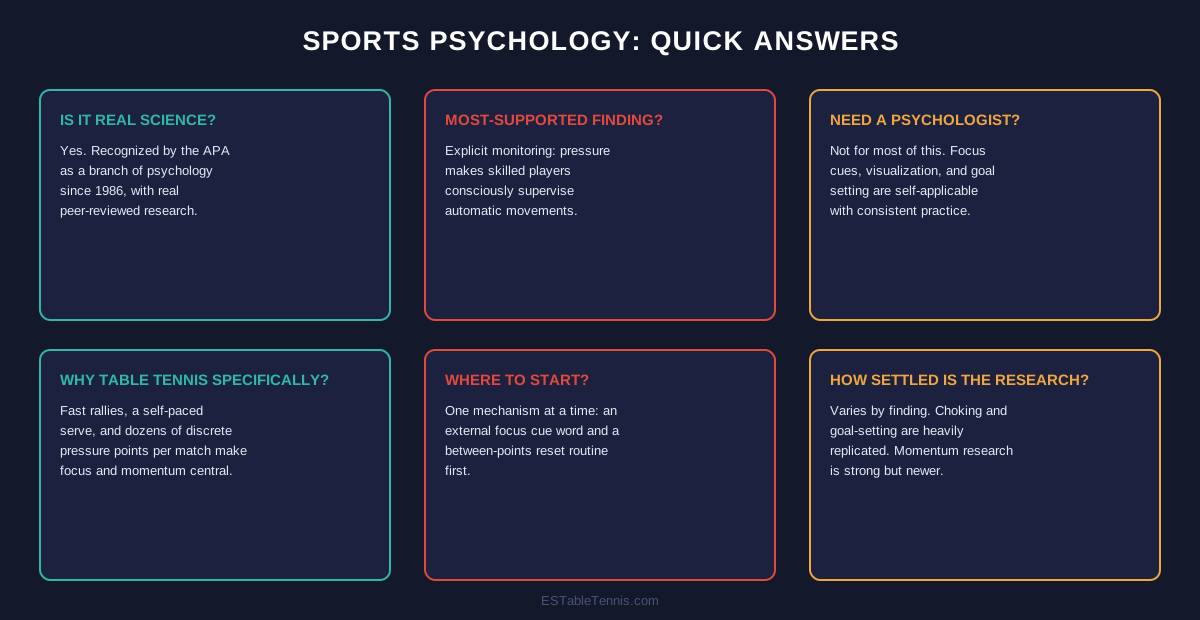
It is a formally recognized branch of psychology, acknowledged by the American Psychological Association since 1986, with a substantial peer-reviewed research base behind specific mechanisms like choking, confidence, and momentum.
What is the single most well-supported finding in sports psychology for table tennis?
The explicit monitoring theory of choking, that pressure causes skilled performers to consciously supervise automatic movements, is one of the most replicated findings, along with the related benefit of external attentional focus.
Do I need a sports psychologist to use this research, or can I apply it myself?
Most of the core techniques (external focus cues, structured visualization, specific goal setting, confidence banking) can be self-applied with consistent practice. A sports psychologist becomes more valuable for persistent, severe performance anxiety that self-directed training does not resolve.
How is table tennis psychology different from psychology in other sports?
Table tennis’s fast rally speed, self-paced serve, and high number of discrete pressure points per match make attentional focus and momentum management particularly central, compared to sports with fewer, more spaced-out pivotal moments.
Where should I start if I want to apply sports psychology to my own game?
Start with one mechanism at a time rather than all of them at once: an external focus cue word and a between-points reset routine are the highest-leverage starting point for most players.
What Should You Actually Do With All of This?
The player in San Fernando did not need a new stroke. He needed to know that explicit monitoring had a name, that his brain’s habit of narrating the score instead of the ball was a documented, well-studied mechanism, not a personal weakness unique to him.
That is the actual value of this field. Not motivation. Diagnosis. Once a problem has a name and a mechanism, it has a fix, and the fixes above are not guesses. They are the same interventions the underlying studies tested and found effective.
The MentalEdge Course builds every mechanism covered here- choking, confidence, imagery, momentum, resilience, goals, and self-talk- into one structured program with video demonstrations, so you are not piecing the research together one article at a time.
Leave a Reply