A regional tournament in Trinidad once switched its official table supplier, and the change generated more heated conversation among competing players than any rule adjustment that same season, purely because of what brand name now appeared on the equipment they’d be competing on. That is the strange gravity of Joola table tennis: the name on the table changes how players feel about the match.
Joola’s presence in that conversation wasn’t accidental: the brand has built specific credibility around tables and playing surfaces that runs alongside its blade and rubber reputation in a way not every competitor manages equally well.
Joola is a German manufacturer recognized for both playing equipment and tournament-grade tables, having served as an official table supplier for major international competitions.
This dual reputation across tables and blades/rubber distinguishes it from brands focused primarily on one equipment category.
Few brands manage credibility across both playing equipment and tables simultaneously, and understanding why Joola has achieved that balance reveals something useful about evaluating equipment brands more broadly.
What’s Joola’s specific reputation in the tournament table category?
The brand has served as an official supplier for major international competitions, covered in principle in our guide on best ping pong table, which requires meeting exacting bounce consistency and construction standards that casual consumer tables don’t need to satisfy.
This tournament-level credibility carries real weight among serious competitive players evaluating table options.
Does Joola’s blade and rubber lineup carry comparable credibility to its table reputation?
Yes, spanning a genuine range from beginner-friendly to tournament-grade equipment, covered across our guides on choosing rubber for beginners and carbon fiber table tennis blade, though the brand’s table reputation arguably carries even more specific weight given how visibly tied it is to major sanctioned competition.
How does a brand build simultaneous credibility across such different product categories?
Through sustained, demonstrated quality in each category independently, rather than one reputation simply transferring automatically to the other.
A table manufacturer earning trust through consistent tournament performance doesn’t automatically guarantee blade and rubber quality: Joola has had to build and maintain credibility in both categories through separate, sustained product performance over time.
Should a buyer weigh Joola’s table reputation when evaluating its playing equipment, or treat them independently?
Largely independently, covered in principle throughout this site’s equipment guides: the same fit-first evaluation process should apply to Joola’s blades and rubber as to any other brand’s, rather than assuming the table reputation automatically extends to playing equipment quality. Both happen to be strong, but for genuinely separate reasons.
How does Joola compare to Butterfly and Stiga in terms of overall brand identity?
Each brand, covered together across our guides on Butterfly and Stiga, carries a distinct identity: Joola’s dual strength across tables and playing equipment sets it apart from competitors whose reputation concentrates more narrowly in one category, giving buyers a genuinely different consideration when evaluating a complete setup rather than individual components.
Does Joola’s tournament table supply history actually affect consumer-level table quality?
Meaningfully, since design and engineering knowledge developed for tournament-grade requirements often informs the broader consumer product line, even when consumer tables don’t need to meet the same exacting bounce-consistency standards as officially sanctioned tournament equipment.
What should a buyer prioritize when choosing between Joola and other established brands for a home table purchase?
The same practical considerations covered throughout our table-buying guide (actual usage patterns, available space, and indoor versus outdoor placement) rather than defaulting purely to tournament-supplier prestige, which matters more for competitive players than for a household prioritizing casual, recreational use.
How does being an official tournament table supplier actually work, and what does it require of a manufacturer?
Tournament organizers select official suppliers through a combination of demonstrated equipment quality, reliability, and often direct sponsorship relationships, requiring the manufacturer to meet strict, independently verified bounce consistency and construction standards across every unit deployed at a major event.
This is a considerably higher bar than consumer product quality control typically demands.
Does Joola’s German manufacturing heritage carry any specific significance beyond general brand story?
Primarily reflected in consistent engineering and quality control standards associated with the broader manufacturing reputation, rather than any inherent technical advantage tied to geography alone: the practical significance lies in sustained consistency rather than any specific property unique to where the equipment happens to be produced.
How should a club deciding on tournament tables weigh Joola against other tournament-grade suppliers?
Actual specifications (tabletop thickness, frame stability, net quality, covered throughout our guide on best ping pong table) should guide the decision alongside supplier reputation, since even a well-regarded tournament supplier’s specific model needs to match a club’s actual usage patterns and budget rather than being chosen on brand prestige alone.
Does Joola’s blade and rubber lineup serve any particular playing style especially well, the way some competitors specialize?
The brand’s playing equipment catalog spans a genuinely broad range across offensive and control-oriented options, covered in our guide on offensive vs defensive style, without the same degree of specialized identity some competitors have built around one particular tactical approach, making it a reasonably versatile option across different playing styles.
What’s a practical way for a buyer to evaluate whether Joola’s specific product actually fits their needs?
The same fit-assessment process covered throughout every equipment guide on this site: matching actual specs to skill level, style, and physical characteristics, rather than assuming the brand’s tournament credibility automatically extends to every product in its catalog being the right choice for any given buyer’s specific situation.
How does official tournament sponsorship actually get negotiated between a manufacturer and a competitive organization?
Typically through multi-year agreements involving equipment supply, financial sponsorship, and sometimes co-branding of the event itself, reflecting a substantial mutual investment: the manufacturer gains prestige and visibility, while the tournament organization gains reliable, high-quality equipment and often financial support for running the event.
These relationships tend to be long-term rather than single-event arrangements, reflecting the substantial trust and logistics involved in supplying equipment for major competition.
Does Joola’s brand identity differ meaningfully between its presence in different regional markets?
Some variation exists in product availability and market emphasis across different countries, reflecting the practical realities of distribution and regional competitive infrastructure, though the core brand reputation for quality and reliability tends to remain fairly consistent across markets where the brand maintains an active, sustained presence.
What’s the relationship between a brand’s tournament visibility and its actual consumer sales, beyond simple prestige?
Tournament visibility functions as a powerful, if indirect, form of product validation: consumers reasonably infer that equipment trusted for major sanctioned competition has met a demonstrated quality bar, even if the specific consumer product they’re purchasing isn’t the exact tournament-grade configuration used at that highest level.
This validation effect is a genuine, rational factor in purchasing decisions, not purely emotional brand appeal.
How should a developing player think about Joola’s playing equipment relative to its more famous table reputation?
Evaluate the playing equipment on its own specific merits (actual rubber and blade specs matched to personal skill level and style, covered throughout this site’s equipment guides) rather than assuming the table reputation, however well-earned, automatically implies equally exceptional playing equipment without independent verification.
Does Joola face specific competitive pressure in the table category from other tournament-grade suppliers?
Yes, several manufacturers compete for prestigious tournament supplier relationships, meaning Joola’s position reflects sustained, demonstrated quality maintained against genuine ongoing competition rather than an uncontested market position.
This competitive pressure, if anything, reinforces the credibility of maintaining that supplier relationship over an extended period.
What’s a practical takeaway for a club or organization considering Joola tables specifically for their own facility?
Request actual specifications and, where possible, a demo or trial period before committing to a purchase, treating the brand’s tournament reputation as a reasonable starting point for research rather than a substitute for verifying the specific model actually meets the club’s own practical needs and budget constraints.
How does Joola’s dual reputation across categories affect how the brand approaches new product development?
Likely benefits from cross-category engineering knowledge: insights from tournament table development around surface consistency and bounce behavior potentially informing playing equipment refinement, and vice versa, though the specific mechanisms of this cross-pollination aren’t always publicly detailed by manufacturers protecting proprietary development processes.
Does a brand’s dual-category strength like Joola’s actually matter to the average recreational buyer, or mainly to serious competitive players and clubs?
Primarily relevant to serious competitive players and clubs making tournament-adjacent purchasing decisions: a casual recreational buyer choosing a home table or a beginner paddle benefits less directly from the tournament-table prestige specifically, and should still prioritize the same practical fit considerations covered throughout this site regardless of which brand’s broader reputation initially draws their attention.
According to the ITTF equipment regulations, official tournament tables must meet precise dimension, height, and bounce-consistency standards independently verified before sanctioned use, which is exactly the bar Joola and its competing tournament suppliers have to clear repeatedly to maintain those prestigious supplier relationships: prestige here reflects a genuinely measurable, ongoing quality standard, not just marketing.
That heated debate in Trinidad eventually resolved itself the way most equipment debates do: not through argument, but through actual matches played on the new tables, which either performed as promised or didn’t.
They did, and the conversation moved on to whatever the next season’s controversy happened to be.
Equipment debates like that one tend to burn hot and fade fast precisely because the actual test is unavoidable and immediate, unlike a marketing claim that can linger unverified for years, a tournament table gets tested by dozens of real matches within days of its installation, and any genuine quality gap surfaces almost immediately rather than staying hidden behind confident branding.
That immediacy is part of what makes tournament-supplier relationships such a meaningful signal in the first place.
A brand can’t hide behind clever positioning when hundreds of competitive players are physically testing the product in real time, under real pressure, with real consequences attached to the outcome of every match played on it.
That’s a considerably higher-stakes test than most consumer products ever face, and it’s worth remembering the next time a tournament supplier switch generates the kind of heated pre-season conversation that always seems, in the moment, like it might actually matter forever. It rarely does, once the actual results start coming in.
Every brand covered across this series earns its place the same way: not through a single dramatic announcement, but through sustained performance verified across genuine competitive conditions, match after match, tournament after tournament, until the reputation simply becomes an accepted, uncontroversial fact rather than an open question anyone still feels the need to argue about.
Dual reputations, spanning genuinely different product categories, are considerably harder to fake than a single narrow area of strength.
Joola’s position across both tables and playing equipment reflects twice the sustained scrutiny most single-category brands only ever have to satisfy once.
Buyers evaluating that kind of dual-category credibility should still separate the two decisions cleanly, though.
A brand’s tournament table prestige earns real respect on its own terms; it shouldn’t automatically substitute for the same specific fit assessment a buyer would apply to any blade or rubber purchase from any manufacturer.
Every equipment category on this site rewards that same discipline: separate the earned reputation from the specific product fit question, and evaluate each on its own actual merits rather than letting one carry the other automatically across an entire catalog spanning multiple distinct product lines.
Most buyers skip this step entirely, letting one strong impression of a brand quietly stand in for research they never actually did on the specific product they ended up purchasing.
It rarely causes a disaster. It does mean a meaningful number of purchases land somewhere short of the genuinely best fit that a few extra minutes of comparison would have revealed instead.
Do that extra research next time. Whether the answer leads to Joola, one of its competitors, or something entirely unexpected, the process itself matters more than which specific brand name ends up winning your particular decision.
A tournament’s heated pre-season debate over table suppliers might feel enormous in the moment.
By the following season, nobody remembers it happened at all, which is exactly the fate every equipment controversy eventually meets once the actual matches settle the question everyone was arguing about beforehand.
Simple as that.
Equipment debates always resolve themselves the same unglamorous way, whether the brand in question is Joola or any competitor covered on this site: real matches, played on real equipment, under real conditions, until the results simply speak for themselves.
Trust that process more than any pre-match argument, however heated it happens to feel at the time.
Whatever brand’s name ends up on the equipment in front of you, let the actual games decide whether it belongs there.
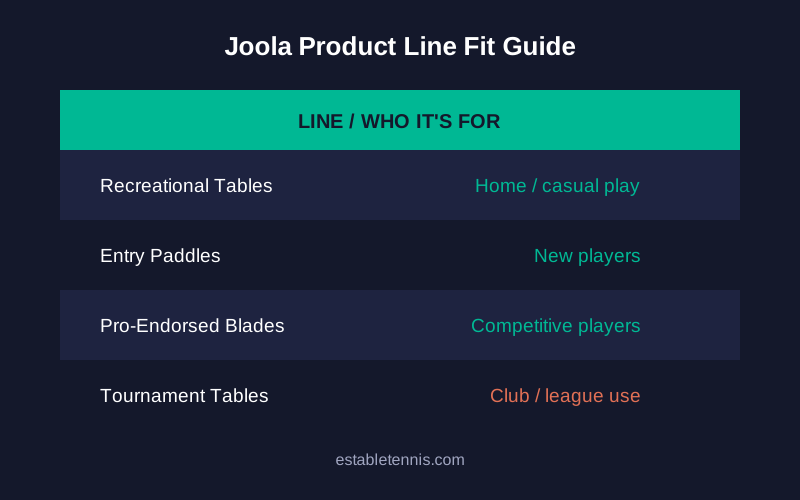
Joola built its name on tables and paddles for club players who wanted German engineering without the flagship price tag, and that positioning hasn’t really changed even as the brand’s sponsorship roster has grown.
What has changed is how much choice sits inside that positioning. A shopper walking into a decision about Joola now has to sort through recreational tables, tournament-grade tables, entry paddles, and pro-endorsed blades, all wearing the same three letters on the box.
The letters tell you almost nothing about which one you should buy. The spec sheet tells you everything.
None of that is a criticism of the brand. It’s just a reminder that brand loyalty and product fit are two separate questions, and only one of them should decide your purchase.
Quick Recap: Joola Table Tennis
Joola’s distinctive strength lies in credibility across both tournament-grade tables and playing equipment, a dual reputation few competitors match equally well.
That heated conversation over a tournament’s table supplier switch in Trinidad reflected genuine, earned stakes: the brand’s name on that equipment meant something specific to the players about to compete on it.
Frequently Asked Questions
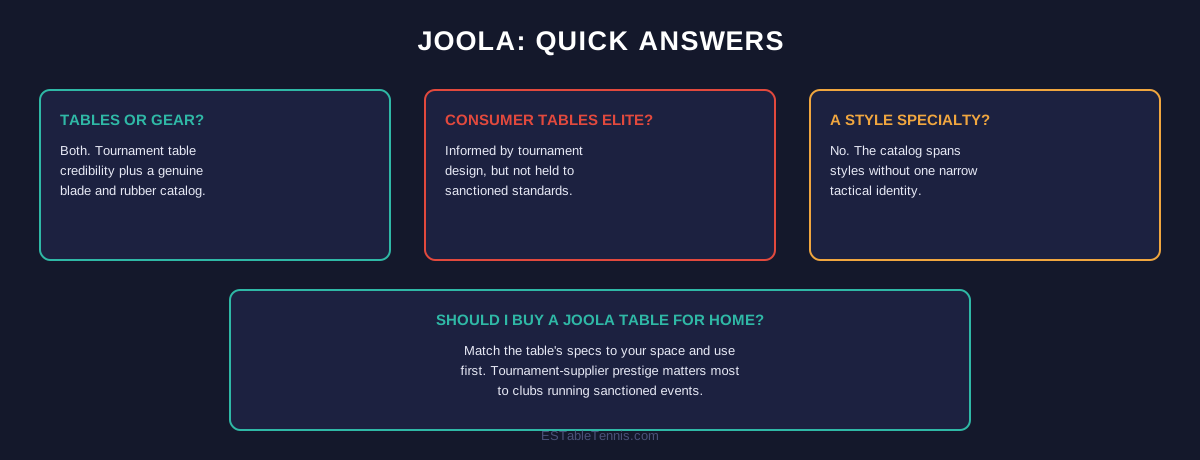
Is Joola primarily known for tables or playing equipment?
Both, which distinguishes it from brands focused primarily on one category. Its tournament table supply history runs alongside a genuine blade and rubber catalog.
Does Joola’s tournament table reputation mean its consumer tables are equally exceptional?
Design knowledge from tournament requirements often informs consumer products, though consumer tables don’t need to meet the same exacting standards as sanctioned tournament equipment.
How does Joola compare to Butterfly and Stiga?
Each carries a distinct identity. Joola’s dual strength across tables and playing equipment sets it apart from brands with more narrowly concentrated reputations.
Should I choose Joola specifically for a home table purchase?
Match actual usage patterns and space to any table’s specs first, rather than defaulting purely to tournament-supplier prestige, which matters more for competitive clubs.
Does Joola serve a specific playing style especially well?
Its playing equipment catalog spans a broad range without the specialized identity some competitors have built around one particular tactical approach.
That club eventually settled on the new supplier, and within a season, nobody remembered the debate had ever happened at all.
The equipment simply did its job, match after match, the same quiet way good equipment always does once the initial noise settles.
Curious whether Joola or another brand actually fits your specific game and setup? PingPath gives you a fitted recommendation in under three minutes.
Leave a Reply