There’s a particular argument that breaks out in equipment shops every few months, usually between a longtime club veteran and a teenager holding a blade box with a photo of a professional player on it, over whether carbon fiber table tennis blade construction is a genuine performance category or a marketing invention layered onto ordinary wood.
Both of them are half right, which is exactly the kind of answer neither one wants to hear mid-argument.
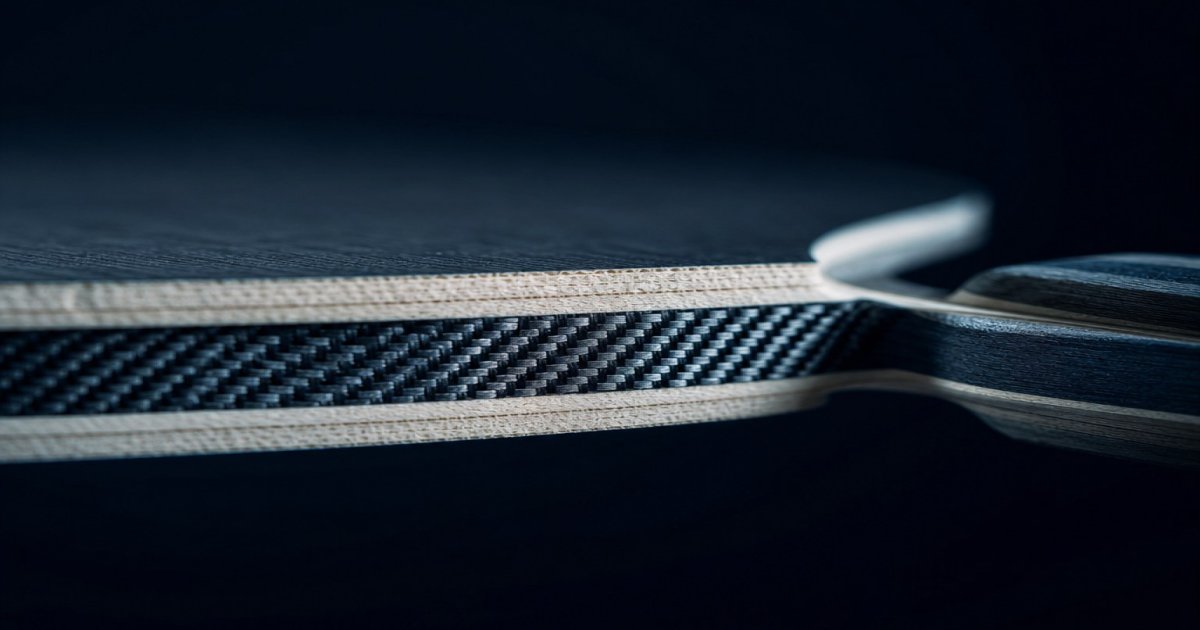
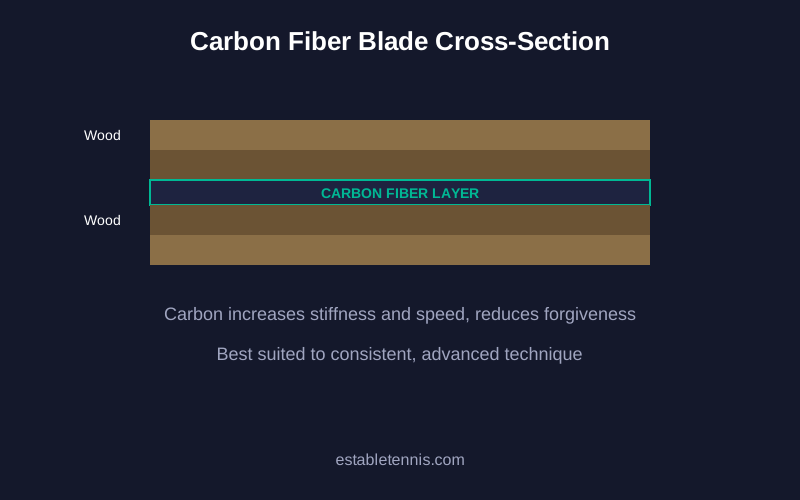
A carbon fiber table tennis blade is a wood blade with one or more layers of carbon-fiber composite material embedded within its wood plies, increasing stiffness and speed.
It’s a genuine, measurable construction difference, not just marketing, but the added stiffness suits advanced, technically consistent players far more than beginners or intermediates.
The confusion around carbon blades comes from treating them as a single category, when in practice carbon content, placement, and ratio vary enormously between models sold under the same broad label.
How is a carbon fiber blade actually built?
Manufacturers press thin sheets of woven carbon fiber between layers of wood veneer during the blade’s lamination process, most commonly placing the carbon layer close to the core rather than at the outer hitting surface, which nearly always remains wood.
This construction increases the blade’s overall stiffness and reduces energy loss on contact, since carbon fiber barely compresses compared to wood, returning a higher proportion of the player’s swing energy directly into the ball.
What’s the actual performance difference versus an all-wood blade?
Carbon blades transfer energy more efficiently and produce noticeably more speed for the same swing effort, particularly on shots where the player is already generating good racket-head acceleration.
The tradeoff, covered extensively in our companion guide on is a carbon blade good for beginners, is reduced forgiveness: mishits and imperfect contact get amplified rather than absorbed, which is precisely why carbon blades reward consistent technique rather than building it.
Are all carbon fiber blades built the same way?
No, and this is the single biggest source of confusion in the category. Some blades use a thin, minimal carbon layer specifically to add stability and a slightly crisper feel without dramatically increasing speed, closer in practice to a fast all-wood blade than a true offensive carbon build.
Others use thick, dense carbon layers explicitly engineered for maximum stiffness and speed, aimed at advanced looping specialists who need every bit of efficient energy transfer they can get. Reading past the word “carbon” on a product label to the actual construction details matters more than the label itself.
What’s the difference between carbon and arylate carbon (ALC)?
Arylate carbon, often abbreviated ALC, uses a different composite material that behaves somewhat softer and more controlled than pure carbon fiber, offering a middle ground between an all-wood blade’s forgiveness and a full carbon blade’s stiffness and speed.
ALC blades are a common choice for intermediate players making their first move away from all-wood construction, since the stiffness increase is real but more moderate than a full carbon build.
Does carbon placement within the blade change how it plays?
Significantly. Carbon layered deep in the core, sandwiched between multiple wood plies, produces a more even, moderated stiffness increase than carbon placed close to the outer hitting surface, which transmits that stiffness far more directly and immediately into every shot.
Two blades with an identical percentage of carbon content by weight can feel meaningfully different in hand purely based on where that carbon sits within the construction.
How does a carbon blade affect vibration and feedback feel?
Carbon fiber dampens certain vibration frequencies differently than wood, which changes the tactile feedback a player feels on contact: many players describe carbon blades as feeling “sharper” or more “solid” on clean contact, with less of the softer, more diffuse feel typical of all-wood construction.
This isn’t purely subjective; it reflects a real physical difference in how the two materials transmit and absorb the shock of ball contact.
What skill level should a player be at before considering a carbon blade?
Contact consistency is the real gatekeeper, not time played or ambition. A player whose mishits are rare and whose technique is consistent enough that the current all-wood blade’s speed ceiling is genuinely limiting well-executed shots has a legitimate case for moving to carbon.
A player still working through inconsistent contact and timing will find a carbon blade amplifies exactly the errors they’re trying to eliminate, extending rather than shortening the path to consistency.
Do carbon blades require different rubber pairing than all-wood blades?
Often, yes. Since carbon blades already add speed and stiffness, pairing one with an equally fast, hard rubber can push total setup speed beyond what’s controllable for all but the most advanced players.
Many experienced players deliberately pair a carbon blade with a slightly more control-oriented rubber, letting the blade provide the speed increase while the rubber moderates it back toward a manageable, controllable overall setup, the same balancing principle covered in our guide on choosing rubber for beginners.
Is a carbon blade a worthwhile investment for a serious intermediate player?
For a player who has genuinely outgrown their beginner all-wood blade’s speed ceiling, yes, but the emphasis belongs on “genuinely outgrown,” verified through consistent play over months, not a hunch based on watching professional matches.
A carbon blade purchased before that ceiling is actually reached tends to recreate the same forgiveness problems beginners face, just at a slightly later stage of development.
How does carbon fiber compare to titanium and other exotic blade materials?
Titanium and other metal-composite layers, sometimes marketed alongside or instead of carbon, generally aim for a similar goal (increasing stiffness and speed beyond what pure wood construction can offer), but through a slightly different feel profile.
Titanium layers often produce a springier, more elastic sensation compared to carbon’s stiffer, more direct energy transfer. Neither material is objectively superior; they represent different flavors of the same underlying tradeoff between speed and forgiveness.
What’s the price difference between carbon and all-wood blades, and is it justified?
Carbon blades typically command a meaningful price premium over comparable all-wood blades, reflecting both the additional material cost and the more complex manufacturing process required to properly bond carbon layers within the wood lamination.
For a player who has genuinely reached the skill level where carbon’s benefits apply, the premium is a reasonable investment.
For a player buying carbon primarily because of the price tag’s implied prestige, the extra cost buys a mismatch rather than an upgrade.
Does humidity or climate affect how carbon fiber blades perform?
Less than wood does, which is one of carbon fiber’s genuine practical advantages. Wood is naturally sensitive to humidity, subtly swelling or contracting with moisture changes in ways that can slightly affect a blade’s feel over time.
Carbon fiber is far more dimensionally stable across humidity swings, meaning a carbon blade tends to feel more consistent across different playing environments and seasons than a comparable all-wood blade might.
How long does a carbon fiber blade typically last compared to all-wood?
Carbon fiber itself is highly durable and resistant to the kind of gradual fatigue that can affect wood over years of heavy use, meaning the carbon layer itself rarely becomes the limiting factor in a blade’s lifespan.
In practice, most blades of either construction are retired due to changing player preference or accumulated minor damage to the outer wood veneer and handle, rather than the core material itself failing.
What’s a sensible first carbon blade for a player ready to make the transition?
A moderate carbon or ALC blade, rather than the most aggressive full-carbon offensive option on the market, is the sensible entry point, offering a genuine step up in speed and stiffness from all-wood without jumping straight to equipment built for advanced looping specialists.
This mirrors the same gradual-progression logic that applies to rubber hardness and thickness: move one step at a time, and let real match feedback guide the next step rather than jumping straight to the most extreme option available.
How does carbon fiber affect a blade’s balance point?
Since carbon layers are typically thinner and lighter than the wood they partially replace, carbon blades can sometimes achieve a similar or even lower total weight than an equivalent all-wood blade while still delivering more speed, a genuine engineering advantage rather than a pure tradeoff.
This means a carbon blade doesn’t automatically feel heavier in hand despite its added stiffness, which surprises some players expecting the added material to translate directly into added mass.
What’s the relationship between carbon content percentage and price?
Generally, blades with higher carbon content, thicker layers, or carbon placed in multiple positions within the lamination command higher prices, reflecting both material cost and manufacturing complexity.
This isn’t a perfectly linear relationship, though: some mid-priced blades use carbon efficiently and effectively, while some expensive options rely partly on brand reputation rather than dramatically superior construction.
Reading actual construction specifications matters more than trusting price as a pure proxy for quality.
How do carbon blades perform specifically for defensive and all-round styles?
Less favorably than for offensive looping styles, generally speaking. Defensive and all-round players who rely more on placement, touch, and controlled blocking than on raw looping power often find a full carbon blade’s reduced forgiveness works against their style rather than for it.
Carbon technology was developed primarily to serve offensive, spin-heavy play, and players outside that style spectrum should weigh the tradeoff more carefully before assuming carbon is automatically an upgrade.
Does switching to a carbon blade require adjusting technique?
Some adjustment is normal and expected. Players moving to a carbon blade for the first time often need several sessions to recalibrate their sense of timing and contact, since the blade’s faster energy return changes how quickly the ball leaves the racket relative to what their body has learned to expect from a slower all-wood blade.
Treating the first few sessions on a new carbon blade as a deliberate recalibration period, rather than expecting instant comfort, avoids the frustration of judging the blade before the adjustment period has actually run its course.
What’s the environmental and durability case for carbon versus wood?
Carbon fiber production has a different environmental footprint than wood harvesting, and this is a genuine consideration for players who weigh sustainability in their purchasing decisions, though it rarely factors into typical equipment discussions focused purely on performance.
From a pure durability standpoint, both materials are generally long-lasting under normal play conditions, with actual blade retirement more often driven by player preference changes than material failure of either type.
How does carbon fiber content interact with a player’s serve game specifically?
Serves benefit less dramatically from a carbon blade’s added speed than looping shots do, since serve power is less central to serve effectiveness than spin variation and placement.
A player primarily focused on serve development may find the speed increase from a carbon blade largely irrelevant to that specific skill, while a player focused on aggressive third-ball attacks off the serve benefits considerably more from the added pace a carbon blade provides.
Is there a risk of over-relying on equipment speed rather than developing technique?
Yes, and this is worth naming directly. A carbon blade’s free speed can mask underlying technical gaps for a while, letting a player win points through equipment-assisted power rather than genuinely sound mechanics.
This tends to surface as a ceiling later: opponents who develop real technique eventually catch up and surpass a player who leaned too heavily on equipment speed instead of building the underlying skill the equipment was meant to complement, not replace.
What should a player do if they’re unsure whether they’re ready for carbon?
Default to waiting. The cost of moving to carbon too early (lost consistency, compensating habits, frustration that sometimes leads players to quit) outweighs the cost of waiting slightly too long, which is simply a few more months on a perfectly functional all-wood blade.
When in doubt, the all-wood control blade a player already owns is rarely the actual limiting factor in their game; more focused practice on the current setup usually reveals whether the equipment or the technique is the real bottleneck.
Quick Recap: Carbon Fiber Table Tennis Blade
A carbon fiber table tennis blade is a genuine construction category, not a marketing label slapped onto ordinary wood, but genuine doesn’t mean universally better.
It rewards a specific stage of development and a specific style, and the same construction that turns a consistent looper’s game up a level can just as easily turn a developing player’s inconsistency into a louder, more frustrating problem.
Match the material to where your technique actually stands today, not where the box photo suggests you should already be.
According to ITTF equipment regulations, blade composition materials including carbon composites are permitted provided the overall racket meets approved thickness and construction standards: carbon fiber itself was never the controversial part of the equipment conversation, its fit to the player holding it always was.
Both men in that shop were arguing about the wrong thing entirely: not whether carbon works, but whether it worked for the specific hands holding it that day.
Neither of them was fully wrong, which is usually how the best equipment arguments end.
Simple as that.
End of story.
Ready or not, the box photo doesn’t get a vote.
Frequently Asked Questions
Is a carbon fiber table tennis blade better than an all-wood blade?
What’s the difference between carbon and ALC (arylate carbon)?
Do professional players all use carbon fiber blades?
How much does carbon placement in the blade matter?
Should an intermediate player upgrade to a full carbon blade or start with ALC?
The teenager in that equipment shop bought the carbon blade anyway, professional’s photo and all.
Six months later he was back at the same counter, quietly asking about all-wood control blades instead, and the veteran who’d argued with him didn’t say a single word about it. He didn’t have to.
Not sure whether your current game actually calls for carbon, or whether you’re buying the photo on the box? PingPath gives you a fitted blade and rubber recommendation in under three minutes.
Leave a Reply