
A retired club champion in Arima still plays with a Stiga blade he bought before some of his current opponents were born, resurfaced twice, handle worn smooth from decades of the exact same grip, and refuses every suggestion to finally upgrade. Stiga table tennis gear inspires exactly that kind of stubbornness. The blade itself has long since been replaced by newer models in the brand’s own catalog. His loyalty was never really to a specific product. It was to a name that had earned his trust once, thoroughly, and never given him a reason to look elsewhere.
Stiga has built its reputation on a long competitive history, strong Scandinavian manufacturing heritage, and consistent blade quality particularly favored by all-round and control-oriented players, offering a distinct product philosophy compared to some competitors’ more offense-focused catalogs.
Every established brand in this sport carries a slightly different identity, and understanding what actually distinguishes Stiga’s specifically helps buyers make a more informed choice than brand recognition alone ever could.
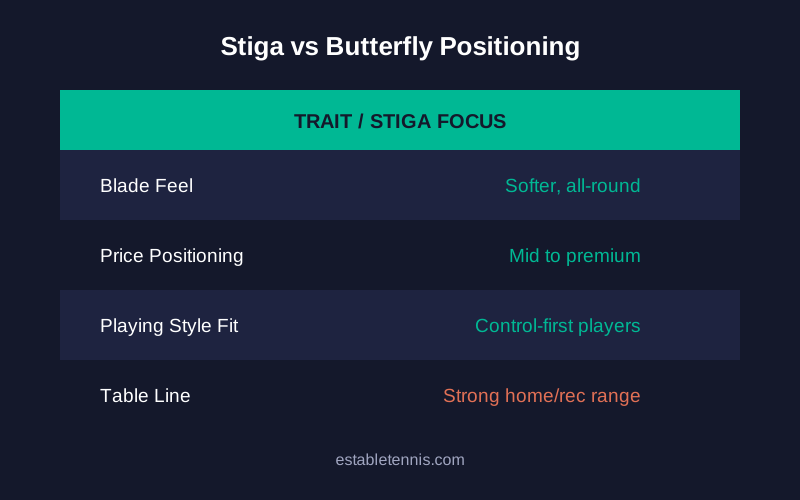
What’s Stiga’s historical background in the sport?
A long-standing Scandinavian manufacturer with decades of competitive history, having sponsored numerous elite players across different eras of the sport’s development. This sustained presence across multiple competitive generations has built a reputation for consistency that, like other established brands, compounds meaningfully over time as each generation reinforces trust for the next.
How does Stiga’s product philosophy differ from more offense-focused competitors?
The brand has historically built strong reputation around all-round and control-oriented blade construction, appealing particularly to players whose style, covered in our guide on offensive vs defensive style, favors placement and consistency over the most extreme offensive speed ratings. This isn’t a limitation: it’s a distinct product identity that serves a genuinely different segment of the competitive player base particularly well.
Does Stiga offer equipment across the full skill-level spectrum, or does it specialize narrowly?
The brand’s catalog spans genuine beginner-friendly options through to advanced, tournament-grade equipment, though its particular strength and reputation concentrate most heavily in the control and all-round categories rather than the most extreme offensive speed segment some competitors emphasize more heavily.
How does blade construction quality factor into Stiga’s specific reputation?
Wood selection and lamination consistency, covered in principle in our guide on table tennis blade weight, represents one of the brand’s most consistently praised attributes, with players frequently citing reliable weight consistency and predictable flex characteristics across production runs as a key reason for sustained brand loyalty.
Should a player specifically seeking a more control-oriented setup prioritize Stiga over other brands?
Worth strong consideration given the brand’s particular strength in that category, though genuine fit assessment, covered throughout our equipment guides, should still guide any final decision rather than brand reputation alone. A player whose actual style leans toward patient, all-round play may find Stiga’s product philosophy particularly well-aligned with their specific needs.
How does Stiga compare directly to Butterfly and Joola in terms of overall market position?
All three brands, covered together across our guides on Butterfly and Joola, hold respected positions in the competitive equipment market, each with distinct product philosophies and areas of particular strength, serving an overlapping but not identical segment of the overall player base.
Does long-term product consistency actually matter for a buyer’s practical purchasing decision?
Genuinely, yes: a brand with a demonstrated history of consistent quality across years or decades reduces the risk that a specific product will disappoint relative to its stated specifications, which is a real, practical benefit distinct from any purely emotional brand loyalty a longtime customer might also feel.
How does Stiga’s rubber lineup fit alongside its blade reputation?
While blades represent the brand’s most historically celebrated category, Stiga’s rubber offerings, covered in principle across our guides on rubber hardness and choosing rubber for beginners, span a comparably wide range of speed and control options, letting buyers build a complete setup within the brand rather than needing to mix and match with other manufacturers.
What’s the actual experience of a control-style player switching to Stiga from a more offense-focused brand?
Often described as an immediate, noticeable increase in touch and placement feel, sometimes at a modest cost to outright speed compared to more aggressive offensive equipment. Players making this switch specifically because their natural style favors control, covered in our guide on offensive vs defensive style, frequently report the tradeoff feels like a genuine upgrade rather than a compromise.
Does Stiga’s Scandinavian manufacturing heritage carry any practical significance beyond brand story?
Primarily reflected in consistent quality control standards and material sourcing practices that have remained stable across the brand’s long operating history, rather than any specific technical advantage tied to geography itself. The practical significance lies in that sustained consistency, not in any inherent property of where the equipment happens to be manufactured.
How should a buyer weigh Stiga’s reputation for control-oriented equipment if their own style is genuinely offensive?
Stiga’s catalog does include offense-oriented options, but a genuinely aggressive, power-focused player might find equally strong or stronger offensive-specific options from brands whose core reputation centers more heavily on that category. Matching actual style to a brand’s particular strength, rather than defaulting to any single brand regardless of fit, remains the more reliable approach.
What’s a realistic way for a new buyer to test whether Stiga’s product philosophy actually suits them?
Demoing equipment at a club where available, or starting with a moderately specified Stiga blade paired with control-oriented rubber to genuinely experience the brand’s characteristic feel before committing to a more expensive, specialized setup within their catalog specifically.
How has Stiga’s product line evolved as offensive, loop-based play has grown more dominant across the sport?
The brand has expanded its offensive-oriented offerings over recent decades to remain competitive as the overall game has shifted, while still maintaining its historical strength in control and all-round categories as a core identity rather than abandoning it entirely to chase the broader market shift. This balance reflects a genuine effort to serve evolving player demand without diluting the brand’s established reputation.
What’s the relationship between Stiga’s sponsored competitive players and its consumer product development?
Similar to other major manufacturers, feedback from sponsored elite players informs product refinement, though Stiga’s competitive sponsorship history has historically emphasized players whose style aligns with the brand’s broader control-and-placement identity, reinforcing a consistent product philosophy across both the professional and consumer sides of the business.
Does Stiga’s pricing structure reflect a different value proposition than more offense-focused competitors?
Generally comparable across similar product tiers, with pricing driven more by materials and construction complexity than by any systematic premium or discount tied to the brand’s specific stylistic identity. A control-oriented Stiga blade and a comparably specified offense-oriented blade from a different brand typically land in similar price ranges for equivalent quality tiers.
How should a coach evaluate recommending Stiga specifically to a developing player with an emerging all-round style?
As a genuinely strong option worth serious consideration once a player’s natural tendencies toward patient, placement-focused play become clear, covered in our guide on offensive vs defensive style, rather than as a default recommendation applied regardless of a player’s actual emerging style. The brand’s particular strength genuinely rewards a good style match.
Does Stiga’s long operating history create any risk of outdated technology compared to newer manufacturers?
Not meaningfully: established brands with sustained competitive relevance, including Stiga, continuously update materials and construction techniques to remain competitive, meaning decades of operating history reflects sustained adaptation rather than technological stagnation. A brand that failed to keep pace with genuine technical advancement simply wouldn’t maintain the competitive relevance Stiga has sustained across its long history.
What’s a common mistake buyers make when evaluating a control-oriented brand like Stiga against more offense-focused competitors?
Assuming control-oriented automatically means lower performance ceiling, when in reality it reflects a different tactical philosophy rather than an inferior one: elite competitive players using control-oriented equipment achieve results entirely comparable to those using more aggressive offensive setups, simply through a different style of play that the equipment specifically supports.
How does a player know if they’ve actually found the right Stiga product within the brand’s own broad catalog?
The same fit-assessment process covered throughout this site: does the specific blade and rubber combination genuinely support the shots and tactical approach the player actually wants to execute, tested across real match conditions rather than judged purely from a single practice session or the brand’s own marketing description of a given product line.
According to the ITTF equipment regulations, every legally approved Stiga product meets the same baseline construction standards as any other manufacturer, meaning the brand’s control-oriented reputation was built entirely through product design philosophy and consistent execution, not through any special regulatory allowance unavailable to competitors emphasizing a different tactical approach.
That champion in Arima has watched newer players walk in with the latest offensive-rated equipment from half a dozen different brands over the years, and he’s never once felt tempted to match them. His blade does exactly what he needs it to do, every single time, which turned out to matter considerably more than whatever speed rating a newer model might have offered instead.
Consistency over decades is a genuinely rare thing for any manufacturer to sustain, in any product category, and it’s worth taking seriously as a real signal rather than dismissing it as simple nostalgia from a player unwilling to change. A blade that performs identically well after twenty years of use, resurfaced or not, has already passed a durability test most modern products never get the chance to face, since so few buyers keep any single piece of equipment long enough to find out.
That’s the quiet, practical case for a brand like this one, separate from any emotional attachment a longtime player might feel toward it: sustained, demonstrated reliability across a genuinely long time horizon, verified not by a marketing claim but by actual use, session after session, decade after decade.
Younger players at his club sometimes ask, half-joking, whether he’s simply too stubborn to try anything newer. He usually just hands them the blade and lets them hit a few balls with it themselves, which tends to settle the question faster and more convincingly than any argument he could make with words. Most walk away understanding exactly why he’s never felt the need to change.
Brand loyalty built this way, tested repeatedly against real alternatives rather than simply assumed out of habit, carries a legitimacy that a first-time buyer’s untested brand preference simply can’t yet claim. His loyalty has survived decades of genuine opportunity to switch. That survival is itself a form of evidence worth taking seriously.
None of this means every player should chase a decades-old blade over a modern, well-fitted setup: equipment does genuinely improve over time, and a beginner starting fresh today has access to options that simply didn’t exist when that champion first bought his own blade. The lesson isn’t nostalgia for its own sake. It’s that genuine, sustained quality, once found, rarely needs replacing purely for the sake of novelty.
A player who’s found a setup that genuinely works, whatever brand it happens to carry, has already solved the hardest part of the equipment equation that so many buyers spend years and considerable money still chasing. Recognizing when you’ve actually found that fit, rather than continuously second-guessing it in favor of whatever’s newest, is its own underrated skill.
If your own current setup already does everything you actually need it to do, resist the pressure to upgrade purely because a newer model exists somewhere on a shelf. Genuine fit, once found, is worth more than whatever marginal improvement a fresh release might promise on paper.
That resurfaced blade has outlasted three separate ‘next big thing’ product cycles at his own club, quietly, without ever needing to compete for attention against any of them.
Every brand featured across this site earns its coverage the same way, through sustained, verifiable performance rather than a single flashy launch. Stiga’s story simply happens to include a resurfaced blade and a stubborn champion in Arima as its most vivid proof.
Ask around your own club for the equivalent story, and you’ll probably find one. Most established brands have at least one player somewhere still trusting the same setup, decades after everyone else moved on.
That story, wherever you find it, is worth more than any brand’s own marketing copy, precisely because nobody’s paying the player telling it.
Simple as that.
Loyalty this durable rarely announces itself. It just quietly keeps showing up, tournament after tournament, decade after decade, until someone finally bothers to ask why.
Now someone finally has. The answer, it turns out, was never complicated.
Trust that’s earned this thoroughly rarely needs a second explanation.
Look for your own version at your own club. It’s probably closer than you think.
Every club has one, once you know to look for it.
Somewhere in your own club, someone’s holding onto exactly this same story right now.
Go ask them about it.
Worth every minute of the conversation.
End of story.
Every genuine brand loyalty story eventually leads back to a version of that same worn, resurfaced blade.
Yours might too.
Give it time to find out.
Decades, if you’re lucky.
Some players never need to look for anything else again.
That’s the entire point.
Good luck finding yours.
It’s out there, waiting patiently.
Find it.
Then keep it.
For as long as it works.
Which, with the right fit, could be a very long time indeed.
Quick Recap: Stiga Table Tennis
Stiga’s reputation rests on decades of consistent quality and a distinct, control-oriented product philosophy that serves all-round and placement-focused players particularly well. That worn, resurfaced blade in Arima was never really about one specific product: it was about a brand that earned complete trust once and never gave a reason to look elsewhere since.
Frequently Asked Questions
Is Stiga a good brand for control-oriented players specifically?
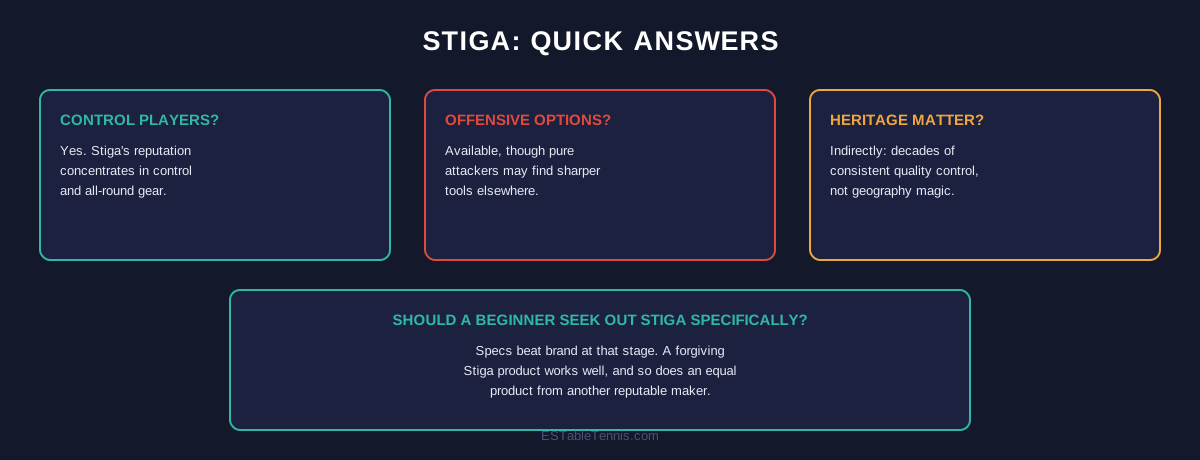
Yes, the brand’s particular strength and reputation concentrate heavily in control and all-round categories, making it a strong fit for patient, placement-focused playing styles.
Does Stiga make equipment for offensive, aggressive players too?
Yes, though its core reputation centers more on control-oriented products, and genuinely aggressive players might find stronger dedicated options from more offense-focused brands.
How does Stiga compare to Butterfly and Joola?
All three are respected, established brands with distinct product philosophies, each serving overlapping but not identical segments of the competitive player base.
Does Stiga’s Scandinavian heritage actually affect product quality?
Indirectly, through consistent quality control and manufacturing standards sustained over decades, rather than any specific advantage tied to geography itself.
Should a beginner specifically seek out Stiga equipment?
Brand matters less than actual specs at the beginner stage. A forgiving Stiga product works well, but so does a comparably specified product from another reputable brand.
He’ll probably never upgrade that blade, and honestly, nobody at his club expects him to anymore. Some loyalties, earned decades ago, simply stop needing to prove themselves twice.
Curious whether a control-oriented Stiga setup or another brand actually fits your game? PingPath gives you a fitted recommendation in under three minutes.
Leave a Reply