A player in Sangre Grande spent three months convinced his footwork had collapsed, arriving a half-step late on every counter-drive he used to make without thinking. Table tennis blade weight, does it matter? His next three months were one long yes. His coach didn’t touch his footwork drills at all. He picked up the racket, weighed it in his palm for two seconds, and asked one question: “When did you switch blades?”
The new blade was eleven grams heavier than the one it replaced. Eleven grams, spread across a swing repeated thousands of times a week, had quietly rewritten his timing before he ever noticed the racket itself had changed.
Yes, significantly. Blade weight affects swing speed, recovery time between shots, and how much natural power a stroke generates. A heavier blade adds power but slows recovery; a lighter blade recovers faster but requires more active stroke generation. Most players perform best within a narrow, personal weight range rather than at either extreme.
Weight is one of the least discussed specs on a blade’s product page, buried under speed rating and ply count, and yet it’s often the variable that decides whether a technically sound stroke actually arrives on time.
What’s the typical weight range for a table tennis blade?
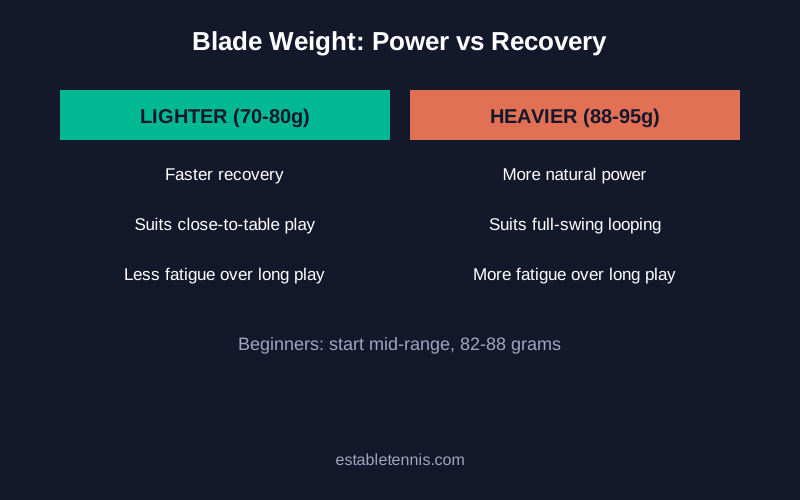
Most blades fall between 70 and 95 grams, excluding rubber and handle variations, with the bulk of all-round and control blades clustering in the 80 to 87-gram range. Offensive blades built for looping specialists often run lighter, in the 75 to 85 gram range, prioritizing racket-head speed over raw mass. Defensive and all-wood control blades can run heavier, since the added mass itself contributes to a more stable, forgiving contact feel at slower swing speeds.
How does a heavier blade actually change a shot?
Mass carries momentum. A heavier blade, once in motion, transfers more energy into the ball on contact without requiring additional swing speed from the player, which is why heavier blades are often associated with more “natural” power.
The tradeoff is recovery time: more mass takes more effort to decelerate and redirect, which matters enormously in fast exchanges where a player needs to reset position and swing direction within a fraction of a second between consecutive shots.
What does a lighter blade trade away, and what does it gain?
A lighter blade sacrifices some of that free, momentum-driven power, asking the player to generate more of the shot’s pace through active racket-head acceleration rather than relying on mass alone. In exchange, it recovers faster between shots, which is a genuine advantage in fast, close-to-the-table exchanges and doubles play, where the time between contacts is often too short for a heavier blade to reset fully.
How does blade weight interact with rubber choice?
Total racket weight is the blade plus both rubber sheets, and heavier rubber (thicker sponge, denser topsheet) compounds whatever weight tendency the blade already has.
A heavy blade paired with thick, heavy rubber can push the total racket weight well past what a player’s wrist and forearm comfortably manage over a long match, while a light blade paired with thin rubber can leave a setup feeling under-powered even for an otherwise well-timed stroke. Balancing blade and rubber weight together, rather than choosing each in isolation, is covered alongside the broader rubber selection question in our guide on choosing rubber for beginners.
Does playing style determine the right blade weight?
Yes, more than almost any other factor. A close-to-the-table blocker or counter-driver, who needs to reset quickly between rapid exchanges, generally benefits from a lighter setup that prioritizes recovery speed over raw power.
A player who takes their time, sets up loops from further off the table, and relies on generating spin and power through a full, committed swing often performs better with a slightly heavier blade that rewards that fuller motion with more free power on contact.
How does blade weight affect fatigue over a long match or tournament day?
This is one of the most overlooked practical effects of weight. A blade that feels perfectly manageable for the first game of a match can start to feel noticeably heavier by the third or fourth game of a long, physical contest, as forearm and wrist fatigue accumulate.
Players competing across full tournament days, sometimes playing five or more matches, often report that a blade a few grams lighter than what felt ideal in a single practice session actually holds up better across a demanding day of repeated play.
Can weight be adjusted after a blade is purchased?
To a limited degree. Small lead tape strips applied to the blade’s edge or handle can add a few grams and shift the balance point without requiring a full blade replacement, a common tuning trick among players fine-tuning an otherwise well-liked blade.
This only works in the direction of adding weight, though: there’s no reliable way to meaningfully reduce a blade’s weight after manufacturing, which makes the initial purchase decision more consequential than it might first appear.
How does weight distribution, not just total weight, affect feel?
Two blades of identical total weight can feel completely different depending on where that weight is concentrated. A head-heavy blade, with more mass toward the tip, generates more natural power on contact but feels sluggish to redirect quickly.
A handle-heavy or evenly balanced blade feels more maneuverable and responsive but sacrifices some of that free power. This distribution, often described as the blade’s “balance point,” is arguably as important as the raw gram figure printed on the spec sheet, yet it’s rarely mentioned in basic product listings.
What weight should a beginner actually start with?
A mid-range weight, typically 82 to 88 grams for the bare blade, gives a new player enough natural power to feel encouraging without demanding the fast recovery skills a lighter blade requires or the fatigue management a heavier one demands over a long session.
This mirrors the same beginner-forgiveness logic covered in our guide on is a carbon blade good for beginners: start in the safe middle, and let real playing feedback over months, not a spec sheet, guide any move toward a lighter or heavier setup.
Does blade weight change how spin feels to generate?
Indirectly, yes. A heavier blade’s added momentum can make loops feel more powerful with less conscious effort, but that same momentum makes it harder to make the fine adjustments needed for delicate touch shots: short pushes, drop shots, and fine placement near the net.
A lighter blade sacrifices some raw loop power but rewards a player with quicker, more precise touch on exactly those finesse shots, since there’s simply less mass to control and redirect at slow speeds.
How does junior or youth play factor into blade weight selection?
Younger, still-developing players generally benefit from lighter blades, both because their forearm strength hasn’t fully matured and because a too-heavy blade can encourage compensating swing patterns (shortened strokes, awkward grip adjustments) that become difficult habits to break later.
Coaches working with junior players often start noticeably lighter than they would with an adult beginner of similar skill level, prioritizing clean technique development over any early power gains a heavier blade might offer.
What role does grip strength play in tolerating a heavier blade?
Real, measurable grip and forearm strength differences between players mean the same blade weight that feels comfortable and controllable to one player can feel genuinely fatiguing to another within a single practice session.
This is one of the few equipment variables that’s meaningfully tied to a player’s physical conditioning rather than purely their technique or style, which is why generic weight recommendations always come with the caveat that individual testing matters more than following a number on a spec sheet.
Is there a connection between blade weight and injury risk?
A real, if often overlooked, one. A blade that’s too heavy for a player’s current forearm and wrist strength can contribute to repetitive strain patterns over months of regular play, since the joint and tendon structures are working harder on every single stroke to control and decelerate that extra mass.
Players experiencing unexplained wrist or forearm discomfort that developed alongside a blade change are often overlooking a simple, fixable equipment cause rather than a training load issue.
How should a player actually test whether a blade’s weight is right for them?
Beyond a single session’s first impression, the real test spans multiple sessions across at least a couple of weeks, paying specific attention to two things: whether recovery between fast exchanges feels natural rather than labored, and whether the blade still feels manageable in the final game of a long session rather than noticeably heavier than it did at the start.
A blade that passes both tests across several sessions, not just the first enthusiastic hit, is genuinely a good weight match.
Does total racket weight matter more than blade weight alone?
Ultimately, yes: the blade is only one component of what actually swings through the air. Two players holding blades of identical weight can end up with meaningfully different total racket weights once their chosen rubber thickness and density are added, which is why serious equipment decisions should always be made holistically rather than blade-first.
A player fixated purely on blade weight while ignoring how their rubber choice compounds it is optimizing only half the equation.
What’s a sensible way to think about weight changes as a player’s game evolves?
Treat weight the same way this entire equipment series treats every other spec: a starting point matched to where you are now, not a permanent identity. A player who begins on a mid-weight blade and later develops a stronger, more committed swing may find real benefit in stepping up several grams for the added natural power; a player whose game evolves toward fast, close-to-the-table blocking may find real benefit in stepping down for recovery speed.
Neither move is required, and neither is a sign the original choice was wrong: it’s simply the equipment following the game, which is the standing principle behind every piece of gear advice on this site.
How does blade weight interact with handle shape and grip comfort?
A blade’s felt weight isn’t purely a function of the gram figure: handle shape and thickness change how securely and comfortably a player can control that weight through the full swing.
A slightly heavier blade with a well-matched, comfortable handle can feel more manageable than a lighter blade with an awkward grip that forces a player to compensate with extra tension in the hand and forearm. This is worth testing in person where possible, since handle feel is one of the few equipment variables that resists being captured in a spec sheet at all.
Do professional players all gravitate toward one end of the weight spectrum?
No, and this is a useful reminder that weight preference is genuinely personal rather than a solved, one-size-fits-all question. Professional offensive loopers often favor lighter blades that maximize racket-head speed for their fast, whip-like strokes, while some all-round and defensive professionals favor noticeably heavier setups that support a more controlled, block-based game.
Watching professional equipment choices confirms that weight should follow individual style, not the other way around.
What’s a practical way to compare two blades of different weights before committing to a purchase?
Where possible, borrowing or demoing blades at a club before buying is the single most reliable method: no spec sheet substitutes for the actual felt experience of swinging a specific weight through real rallies.
Where demoing isn’t practical, reading detailed player reviews that describe recovery feel and fatigue over a session, rather than reviews that only mention raw power, gives a more useful proxy for how a blade will actually perform in your hands.
Is my blade too heavy for my level?
Level does not tell you what weight to buy. It tells you how much room you have to be wrong about the weight you already picked. A player with ten years of clean technique can carry a blade that is a few grams over their natural range and barely notice, because an efficient stroke absorbs the extra mass before it becomes a problem. A developing player carries the same blade like a debt: every stroke pays a little interest, and the bill comes due late in the match rather than at the start of it.
That is the part nobody warns you about. The first game with a too-heavy blade feels fine, sometimes even good, because your arm is fresh and your timing hasn’t been tested yet. It’s the fifth game where the truth comes out: the same shot you made cleanly an hour ago now lands long, your transitions get lazy, and your decisions start arriving half a second slow. Players read that pattern as nerves. They go looking for a mental fix, more focus, a better routine, when the actual fault line is a spec sheet.
It’s worth asking whether the version of you that plays worse in matches is really a mental collapse or a blade that only reveals its weight in the fifth game, not the first. The equipment can pre-load the mental game to fail long before either one gets blamed correctly, which is exactly the trap covered in more depth here.
Quick Recap: Table Tennis Blade Weight Does It Matter
Table tennis blade weight: does it matter comes down to one honest answer: yes, but not in a way any single number on a spec sheet can settle for you. Weight shapes power, recovery speed, fatigue, and touch simultaneously, and the right figure is the one that holds up across a full session, not just the first enthusiastic swing in a store aisle.
Revisit your own blade weight whenever your game changes enough (a shift toward more aggressive looping, a shift toward faster blocking, or simply a season of building forearm strength) that the setup which once felt exactly right quietly stops matching the player holding it.
According to ITTF equipment regulations, blade construction and dimensions must meet approved standards, though weight itself is left to manufacturer variation rather than being fixed by rule, which is exactly why the range across the market is as wide as it is.
Eleven grams doesn’t sound like much until it’s asked to arrive on time, thousands of times a week, in a swing built around a different number entirely.
No wonder his coach reached for the racket before the drill sheet: the simplest explanation is usually checked first for a reason.
Weight is quiet in a way most equipment specs aren’t: it never announces itself with a dramatic miss; it just nudges timing a fraction of a second off, week after week, until the miss finally looks like a pattern worth blaming on something else entirely.
Weigh it. Feel it. Trust the answer your own hand gives you over any number printed on a box.
Simple as that.
Frequently Asked Questions
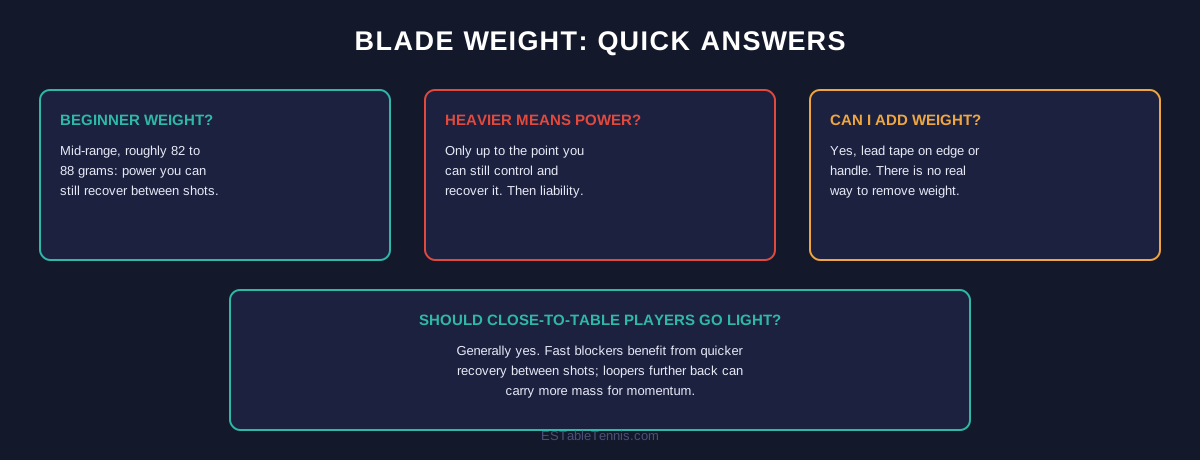
What’s the ideal table tennis blade weight for a beginner?
Does a heavier blade always mean more power?
Can I add weight to a blade I already own?
Does blade weight affect fatigue during a match?
Should close-to-the-table players use lighter blades?
The player in Sangre Grande switched back to a blade closer to his old weight the following week. His footwork, it turned out, had never been the problem at all: it just took a coach who knew to check the racket first, and a player humble enough to believe him.
Not sure whether your current blade weight is helping or working against your game? PingPath gives you a fitted setup recommendation in under three minutes.
Leave a Reply