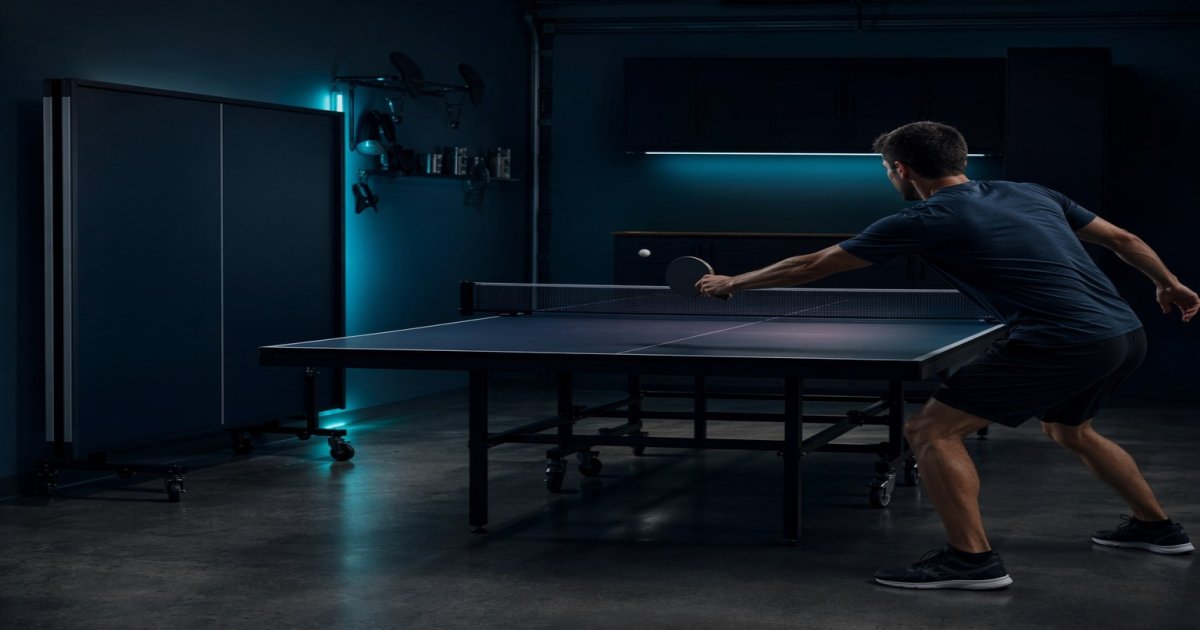
A family in Chaguanas bought a ping pong table on a Black Friday impulse, unfolded it exactly four times over eighteen months, and eventually sold it at half price to a neighbor who’s had it out permanently in his garage for three years running.
The table itself never changed. What changed was whether anyone actually built a habit around it, and no purchase decision, however well researched, guarantees that part on its own.
The best table depends on where it’ll live, how often it’ll actually get used, and by whom. A thicker tabletop (25mm+) and sturdy frame matter more for serious, regular play, while a lighter, more portable folding table suits casual, occasional use or limited storage space.
This purchase gets treated as a simple spec comparison when it’s really a question about actual usage patterns first, and table quality second.
What tabletop thickness actually matters, and why?
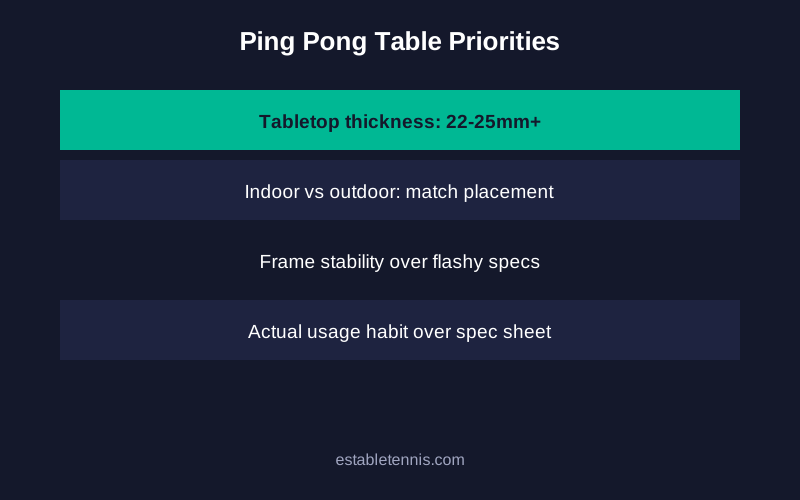
Thicker tabletops, generally 22 to 25mm or more, produce a more consistent, truer bounce that matters increasingly as play gets more serious and competitive.
Thinner tabletops, common in budget and portable models, are perfectly serviceable for casual, recreational play but can produce a slightly less consistent bounce that becomes noticeable once a player’s technique, covered across our guides on how to play table tennis, develops enough to actually feel the difference.
Indoor or outdoor: does that choice actually change what table to buy?
Significantly. Outdoor tables use weather-resistant materials specifically engineered to resist warping and moisture damage, while indoor tables prioritize playing surface quality over weather resistance, since they’re never exposed to rain or humidity swings.
Buying an indoor table for outdoor use, or vice versa, typically produces disappointing results regardless of how good the specs otherwise look on paper.
How much does frame and leg sturdiness actually matter?
Considerably more than most casual buyers expect. A wobbly, unstable frame undermines even a good playing surface, since inconsistent table movement during play affects bounce and rally consistency in ways that are difficult to compensate for through technique alone.
Testing stability in person, where possible, reveals more about long-term satisfaction than any spec sheet comparison.
Does a folding table sacrifice meaningful playing quality compared to a fixed table?
Not necessarily, though it depends on the specific model: many quality folding tables use the same tabletop materials and thickness as fixed alternatives, with the folding mechanism affecting storage convenience rather than playing surface quality itself.
For most households without a dedicated permanent space, a quality folding table offers genuine playing quality without demanding the space commitment a fixed table requires.
What’s the actual role of net and post quality in overall table satisfaction?
More important than most buyers initially consider, since a poorly tensioned or unstable net creates constant minor annoyances during play: net height inconsistencies affect legal serve requirements and rally fairness in ways that compound across every single point.
Quality net and post systems, even on an otherwise modest table, meaningfully improve the actual playing experience.
How should a buyer weigh price against actual long-term usage likelihood?
Honestly assess actual usage intentions before comparing prices: a family planning genuinely regular use benefits from investing in a sturdier, higher-quality table that will hold up to that use, while a household anticipating occasional, casual play may reasonably prioritize a more affordable, space-efficient option instead.
Matching the purchase to realistic usage patterns, rather than aspirational ones, produces considerably better long-term satisfaction.
Does the space where a table will actually live change which table makes sense?
Yes, fundamentally. A dedicated, permanent playing space justifies a fixed or heavier table that never needs storing away, while a shared, multi-purpose space essentially requires a folding table regardless of other spec preferences, since storage practicality overrides almost every other consideration when floor space is genuinely limited.
What’s the difference in assembly and setup between different table types?
Fixed tables often require more involved initial assembly but rarely need reassembly afterward, while folding tables trade a simpler initial setup for the repeated folding and unfolding cycle that becomes part of regular use.
This tradeoff matters more than it initially seems: a folding table that’s genuinely quick and easy to fold gets used considerably more often than one with a stiff, awkward mechanism that turns every session into a minor chore.
Does wheel and caster quality on a folding table actually matter?
Yes, more than most buyers expect at the point of purchase. Sturdy, smooth-rolling casters make the difference between a table that gets moved and used regularly versus one that becomes increasingly annoying to reposition, quietly discouraging use over time simply because the physical friction of moving it outweighs the motivation to play.
This is exactly the kind of small, easy-to-overlook detail that determines whether a table becomes a permanent household fixture or an eventual half-price sale to a neighbor.
How does color and surface finish affect actual playability, beyond aesthetics?
Surface color affects ball visibility during play, with darker blue and green surfaces generally offering better contrast against a white or orange ball than lighter alternatives.
This is a genuine functional consideration, not purely cosmetic, and worth factoring in alongside thickness and frame quality when comparing otherwise similar table options.
What’s a reasonable way to think about warranty and long-term durability?
Manufacturer warranty length often correlates reasonably well with a company’s own confidence in build quality, making it a useful, if imperfect, proxy when comparing tables with similar specs on paper.
A notably shorter warranty on an otherwise comparable table is worth treating as a mild red flag rather than dismissing outright.
Does a table’s net system need to be replaced or upgraded separately from the table itself?
Sometimes, particularly on budget tables where the included net and post system is a genuine weak point compared to the tabletop and frame quality.
Upgrading just the net system, a relatively inexpensive fix, can meaningfully improve the playing experience on an otherwise solid table without requiring a full table replacement.
How should a buyer think about table size relative to available space, beyond just the table’s own footprint?
Regulation tables require meaningful clearance space around all sides for actual gameplay, not just the table’s own dimensions: a table that technically fits in a room can still feel cramped and impede footwork if there’s insufficient clearance for players to move naturally during play.
Measuring actual available clearance, not just floor space for the table itself, avoids a common and frustrating post-purchase surprise.
How does household composition affect which table actually makes sense?
A household with young children benefits from a table with rounded edges, stable low-center-of-gravity legs, and a folding mechanism simple enough for supervised kids to help set up, while a household of dedicated adult players might prioritize tabletop thickness and net quality over child-safety features that aren’t relevant to their actual use case.
Matching the table to who will actually use it, not a generic household profile, produces a considerably better long-term fit.
Does climate control in the intended space affect table choice, even for an “indoor” table?
Yes, somewhat. A garage or basement without climate control experiences more humidity and temperature swings than a fully conditioned indoor living space, even though both technically count as “indoor” placements.
A table destined for an unconditioned garage benefits from somewhat more moisture-resistant construction than the specification sheet for a purely indoor table might assume, even if it’s not marketed as a dedicated outdoor model.
What’s a sensible way to think about table height and accessibility for players of different heights?
Standard regulation height is fixed and doesn’t vary between tables, which means height accommodation for younger or shorter players comes down to technique and positioning adjustments rather than table selection itself.
This is worth knowing upfront so a buyer doesn’t spend time searching for a nonexistent height-adjustable regulation table when the actual solution lies in coaching and technique rather than equipment.
How does table maintenance factor into the actual long-term cost of ownership?
Regular cleaning and proper storage, particularly protecting the surface from direct sunlight and moisture even for indoor tables, meaningfully extends a table’s usable lifespan beyond what the base build quality alone determines.
A moderately priced table maintained carefully often outlasts an expensive table left exposed to poor storage conditions, mirroring the same maintenance-matters principle covered throughout our rubber care guides on this site.
Does a table’s playing surface color need to match any particular competitive standard?
For casual and recreational play, no: any reasonably contrasting surface color works fine.
For players planning to eventually compete in sanctioned events, familiarizing themselves with standard blue or green tournament surface colors builds useful familiarity, though this consideration matters far less for a home purchase than genuine usage and space fit.
What’s the actual role of a table’s playing surface texture, beyond just color?
Surface texture affects how consistently the ball bounces and how much subtle grip the tabletop itself provides on contact, with higher-quality tables generally offering a more consistent, uniform texture across the entire surface.
Budget tables sometimes show more surface inconsistency, which becomes noticeable primarily to more advanced players whose technique is precise enough to feel small variations in bounce behavior across different areas of the table.
How should a buyer weigh a well-known brand name against a lesser-known manufacturer offering similar specs at a lower price?
Established brands often carry more reliable quality control and customer support history, which is worth a modest premium particularly for a first table purchase where a buyer has less personal experience evaluating quality independently.
Lesser-known manufacturers can still offer genuinely good value, but verifying actual user reviews and specific build quality becomes more important when the brand name alone doesn’t carry the same track record.
Does the choice between a table sold as a complete set versus purchasing components separately matter?
Complete sets, including net, posts, and sometimes paddles and balls, offer convenience and often better overall value than assembling components separately, though the included accessories in a bundled set are sometimes lower quality than what a buyer might choose independently.
For most buyers, particularly those newer to the sport, a complete set remains the more practical starting point, with individual component upgrades, like a better net system, reserved for later once actual usage patterns are clear.
According to the ITTF equipment regulations, regulation tables must meet specific dimension, height, and bounce-consistency standards, which is worth knowing when comparing a genuinely regulation-compliant table against a smaller or non-standard recreational alternative that might not translate identically to standard competitive play.
That family in Chaguanas didn’t buy the wrong table. They bought a perfectly reasonable one, on a perfectly reasonable impulse, and simply never built the small daily or weekly habit that would have made any table worth the space it occupied. The table was never the actual variable that mattered most.
A table left folded in a corner has never once taught anyone a forehand. A table left out, imperfect specs and all, has taught thousands of families their first real rally, simply by being present and accessible on an ordinary Tuesday evening when nobody had specifically planned to play at all.
That accessibility, more than tabletop thickness or brand reputation, is usually the actual variable separating a table that gets used from one that eventually gets sold at half price to whichever neighbor finally asks.
Before comparing another single spec sheet, ask the more honest question first: where will this table actually live, who will actually walk past it most days, and will it be genuinely easy enough to use that a casual, unplanned Tuesday evening rally actually happens.
Every other decision on this list matters considerably less than that one.
Buy the table that’s actually easy to leave out, easy to fold when it must be folded, and easy to walk past without a second thought before deciding to play.
That table, more than the one with the most impressive spec sheet, is the one that survives past the first eighteen months.
Every table on every showroom floor is capable of a good rally. Only some of them ever actually get one, and the difference has surprisingly little to do with which one cost more.
Buy for the life you’ll actually live around that table, not the ambitious version of it you’re imagining at the point of purchase.
The neighbor with three years and counting never planned any of it. He just left the table out, and the rest happened on its own.
That’s the whole secret, really, hiding behind every spec comparison anyone’s ever agonized over before checkout.
Simple as that.
Buy accordingly, and leave the table out this time.
End of story.
The habit was always the whole point. The table just needed to get out of its own way long enough to let it form.
Nobody sells a habit at half price to a neighbor. Only the table gets sold. The habit either formed or it didn’t, well before that transaction ever happened.
Worth remembering before the next Black Friday impulse.
Choose well, this time, with the habit in mind rather than just the spec sheet.
Simple as that, truly.
Good luck with the next eighteen months.
Make them count.
Then some more, after that.
Three years and counting, if you’re lucky.
More, hopefully.
Enjoy the table.
Quick Recap: Best Ping Pong Table
The best ping pong table for any given household depends on actual usage patterns, available space, and indoor versus outdoor placement far more than any single spec comparison can capture.
That table in Chaguanas was never a bad purchase on paper. It just never got the habit built around it that would have made any table worth keeping.
Frequently Asked Questions
What tabletop thickness should I look for?
Should I buy an indoor or outdoor table?
Does a folding table sacrifice playing quality?
How much clearance space do I actually need around the table?
Does net and post quality really matter?
His neighbor never planned to build a three-year habit either. He just left the table out permanently instead of folding it away, and the habit built itself from there, one casual evening at a time.
Not sure which table setup actually fits your space and how you’ll really use it? RallyRei gives you a fitted recommendation in under three minutes.
Leave a Reply